






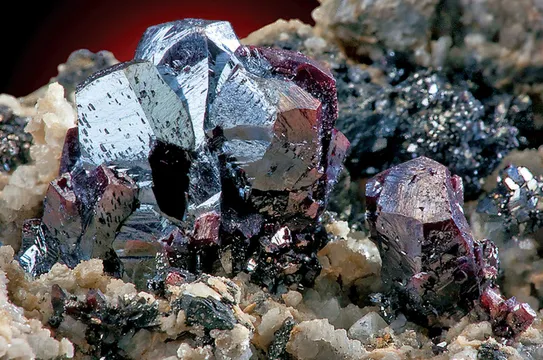
St Andreasberg, Germany - historic Harz locality yielding ruby pyrargyrite, native silver, arsenic and calcite varieties; prized by collectors for classic Euro…
Key facts
St Andreasberg is one of the classic silver-mineral districts of Europe: a compact but mineralogically extravagant vein camp in the Harz Mountains of Lower Saxony, famous far beyond the tonnage it produced. Its veins cut Middle Devonian slates, marly shales, sandstones and spilitic volcanic rocks within the contact aureole of the Brocken granite, in a fault-bounded block where steep, narrow hydrothermal veins were repeatedly opened, sealed and reopened. That structural history made mining awkward, but it made specimens superb. The collector’s St Andreasberg is a cabinet of dark ruby pyrargyrite, metallic dyscrasite, stephanite, native arsenic, native silver, argentiferous galena, endlessly varied calcite and late zeolites, especially harmotome, stilbite and pale pink apophyllite.
Regional View
Country View
The best specimens have a distinctly “old European” look: white to grey calcite plates or vein fragments carrying black-red ruby silver crystals; silver-white dyscrasite in and on calcite; mammillary grey native arsenic with metallic silver minerals; or drusy calcite crusts sprinkled with glassy zeolite twins. St Andreasberg calcite alone would make the locality important, because the district is historically celebrated for an exceptional number of crystal forms and combinations, including the old German habit names Papierspat, Blätterspat, Kanonenspat, Würfelspat and Compositenspat. But the real magic is the contrast: soft, pale carbonate against black metallic sulfosalts that flash red only at thin edges or under transmitted light.

Photo: Wikimedia Commons

Photo: Wikimedia Commons
Historically, the district is anchored by the Samson Mine, opened in the early sixteenth century and worked until 1910. The mine is now a preserved technical monument and museum, with its water wheels, shaft house, man engine and mineral displays giving the locality an unusually tangible link between specimens and the underground world that produced them. For collectors, St Andreasberg is a locality where provenance matters: many of the finest examples are nineteenth-century or early twentieth-century pieces from old European collections, and even small, well-labeled specimens can be more desirable than larger but locality-vague examples.
Search for specimens: View all specimens from St Andreasberg, Germany
St Andreasberg is a polymetallic silver vein district in the Middle Harz, now within Braunlage, Goslar District, Lower Saxony. The former mining town sits at roughly 600 m elevation in a landscape where mining, water management and later tourism are inseparable. The mineralization occupies a horst-like wedge bounded by major fault systems, with a suite of relatively narrow veins that differ from the broader Upper Harz veins in thickness, dip direction and structural behavior. Many veins average less than a metre in thickness, dip steeply to the north or northeast, and were mineralized to depths exceeding 800 m.
The vein assemblage is best understood as a repeated hydrothermal system rather than a single simple ore event. Early low-grade oxide-carbonate mineralization was followed by a main sulfide stage dominated by galena, sphalerite, chalcopyrite and tetrahedrite-tennantite minerals. Later reopening of fractures produced the silver-rich ore shoots, nickel-cobalt arsenides, native arsenic, native antimony and the famous “noble calcite” generation. A final phase remobilized calcite and deposited still richer silver minerals. This overprinting explains why a single specimen may combine calcite, galena, dyscrasite, pyrargyrite, native arsenic, native silver, lollingite and zeolite minerals in relationships that are visually dramatic but paragenetically complex.
Ore shoots were especially important where veins intersected cataclastic zones such as the Silberburger Ruschel. These crushed, impermeable or semi-impermeable structural zones helped focus hydrothermal fluids and produced localized “rich ore falls,” the concentrated silver pockets for which the district became famous. Mining records and modern geological summaries repeatedly emphasize how variable the veins were: rich silver could occur abruptly, but the veins changed rapidly with host rock and fault behavior, making steady production difficult.
Mining around St Andreasberg is documented from the late fifteenth century, with rich silver discoveries around 1520 triggering the development of the mining town and a remarkable proliferation of workings. At its peak, more than a hundred mines or prospects operated in the broader district. The Samson-Andreaskreuz vein train and Dorotheer-Jacobsglück vein train were among the principal productive systems, while the Beerberg area to the east preserves numerous old workings of the Auswendiger Zug. The Samson Mine became the emblem of the district: it reached great depth by nineteenth-century standards, worked into the early twentieth century, and ultimately closed when declining grade, falling silver prices, difficult hoisting and pumping costs could no longer be justified.
The district’s total metal output was modest compared with the great Upper Harz producers, but still significant: approximately hundreds of tonnes of silver, along with lead, copper and associated metals. Its scientific output was much larger. More than 180, and in broader district lists more than 200, mineral species have been reported from St Andreasberg and its sublocalities. The Samson Mine, Catharina Neufang, Abendröthe, Bergmannstrost, Gnade Gottes, Alter Theuerdank and Roter Bär names all matter to collectors, because they can imply different parageneses, ages of collecting and mineral associations.
Collecting access today is not a matter of casual underground entry. Samson is a museum and technical monument, not a collecting mine. Roter Bär is operated as a teaching and visitor mine by the local historical association and mining working group, with access tied to guided visits, preservation work and formal permissions. Old dumps, portals and mining relics around St Andreasberg are part of a historic and often protected mining landscape; serious collectors should treat them as cultural sites first and collecting opportunities only where permission is explicit. Most desirable specimens on the market come from old collections, historic mine runs, museum deaccessions or long-established dealer inventories rather than new collecting.
The most important specimen-producing environment was the drusy calcite-rich vein material of the silver stages. Cavities and reopened fractures furnished calcite crystals in an astonishing range of forms, while rich ore shoots supplied pyrargyrite, dyscrasite, stephanite, acanthite, native silver and native arsenic in or on calcite and quartz. Later zeolite-bearing pockets gave harmotome, stilbite, apophyllite and related species. The most famous single modern mineralogical event was the discovery of samsonite at the Samson Mine in 1908, on the 29 Drift, roughly 550 m below surface; the species remains one of the great type-locality prizes of St Andreasberg.
Calcite is the visual matrix and, in many specimens, the principal show mineral of St Andreasberg. It occurs in white, grey, colourless, translucent and locally lustrous crystals in the silver-bearing veins, with habits ranging from thin lamellar Papierspat and Blätterspat to elongated Kanonenspat, blockier rhombohedral or “cube spar” forms, scalenohedra, composite forms and complex modified crystals. The Samson Mine is particularly celebrated for calcite diversity, with historical literature recording an extraordinary number of crystallographic forms and combinations. Good St Andreasberg calcite is not just “white calcite”: it has sharp form, old-surface luster, undamaged terminations, and ideally a meaningful association with pyrargyrite, dyscrasite, galena, native arsenic, native silver, lollingite, breithauptite, harmotome, stilbite or apophyllite. Plain calcite fragments are common by reputation; specimens that combine elegant form, fresh luster and classic silver-mineral association are the ones collectors pursue.
Pyrargyrite is the signature red silver of St Andreasberg and one of the reasons the locality stands with Freiberg, Příbram and Guanajuato in classic silver-mineral collecting. It occurs as dark red to nearly black trigonal crystals, short prisms and clusters, usually on or in calcite and commonly with galena, quartz, dyscrasite, native arsenic, native silver, lollingite, argentopyrite and, rarely, samsonite. The finest pieces show sharp, lustrous crystals that look black by reflected light but transmit a deep wine-red glow at thin edges or under strong backlighting. Millimetric crystals are collectible when isolated and sharp; larger miniature and cabinet pieces are much scarcer, especially if unrepaired, well crystallized and on attractive pale calcite rather than buried in massive ore. Good St Andreasberg pyrargyrite has both aesthetics and age: an old label, a recognized sublocality such as Samson or Catharina Neufang, and visible ruby translucency greatly improve desirability.
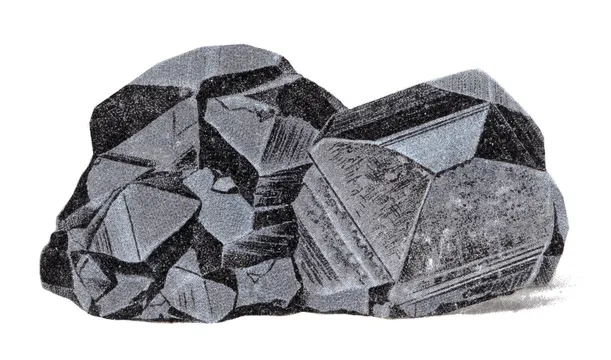
Dyscrasite from St Andreasberg is a classic metallic silver-antimony mineral of the rich silver stages, typically appearing as silver-white to grey, tarnishing metallic grains, blades, striated crystals, aggregates or pseudohexagonal forms in calcite-rich vein material. It is especially associated with calcite, galena, pyrargyrite, proustite, quartz, native arsenic, stibarsen and native silver, and documented specimens include crystals in the centimetre range. The most appealing pieces show distinct dyscrasite rather than anonymous grey ore: bright metallic crystals or coherent patches standing out against white calcite, preferably with red silver or galena for context. Because dyscrasite tarnishes and can be visually confused with other silver-rich metallic minerals, confirmed old labels, analytical provenance or association with well-characterized St Andreasberg assemblages make a major difference.
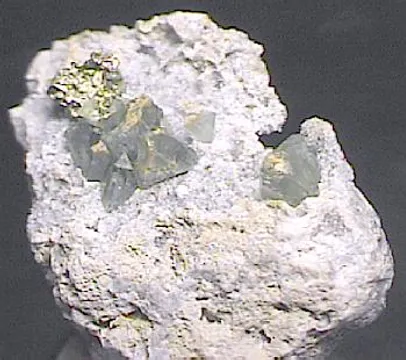
Harmotome is one of St Andreasberg’s great type-locality minerals, historically known by names such as Kreuzstein and Andreasbergolith before modern nomenclature settled on harmotome. In the St Andreasberg veins it is a late zeolite-stage mineral, found as colourless, white, greyish or glassy translucent twins and aggregates on calcite, and locally in association with pyrargyrite and other late-stage species. The collector habit to look for is the crisp, cross-twinned or blocky zeolite crystal on pale carbonate, not an indistinct crust. Most St Andreasberg harmotome is small, but sharp, lustrous, undamaged crystals on a clean calcite plate are highly prized because they combine type-locality importance with classic Harz aesthetics; pieces with clear old provenance to Samson, Abendröthe or Bergmannstrost have added weight.
Galena was one of the important main-stage ore minerals at St Andreasberg and is common in the district’s specimen associations, though rarely the star unless the crystals are sharp or the association is exceptional. It occurs as lead-grey metallic masses, cleavages and crystals in calcite- and quartz-bearing vein material, commonly with calcite, quartz, lollingite, jamesonite, breithauptite, dyscrasite, native arsenic, native silver, chalcopyrite, ullmannite and pyrargyrite. Fine collector pieces show bright galena set off by white calcite or accompanied by red silver, dyscrasite or native silver; ordinary massive galena is far less compelling. Because St Andreasberg galena is often part of complex silver-rich ore, the best examples are valued as assemblage specimens rather than as simple galena crystals.
Proustite, the arsenic analogue of pyrargyrite, is much less frequently seen from St Andreasberg but belongs to the same red-silver collecting tradition. It occurs in silver-rich vein material as scarlet to dark red crystals or grains, documented with dyscrasite, galena and quartz, and expected in calcite-rich assemblages of the late silver stages. Compared with pyrargyrite it is typically a brighter, more scarlet red and is more vulnerable to darkening under prolonged light exposure. Good St Andreasberg proustite is sharply crystallized, visibly red at an edge or in transmitted light, and accompanied by a credible old label or sublocality attribution; small but well-defined crystals are far more desirable than vague reddish-black specks in ore.
Native arsenic, historically known to miners under names such as Scherbenkobalt in related Harz usage, is a characteristic mineral of the arsenic-rich silver stages at St Andreasberg. It occurs as grey to blackish, metallic to dull, mammillary, botryoidal, crusty or massive aggregates in calcite and quartz, commonly accompanied by dyscrasite, pyrargyrite, native silver, stibarsen, lollingite, galena and other arsenides or sulfosalts. Fine specimens have sculptural rounded arsenic surfaces, clear contrast with pale calcite, and ideally a sprinkling or overgrowth of silver minerals; dull massive lumps are mainly reference material. Collectors should recognize that native arsenic surfaces can alter, tarnish or be overgrown, and that old “arsenic silver” labels may hide mixtures of arsenic, stibarsen and dyscrasite rather than a single modern species.
Apophyllite from St Andreasberg, generally treated in modern listings as fluorapophyllite-(K) where specified, is a late-stage vein mineral and one of the district’s attractive non-silver classics. The prized material is pale pink to colourless or whitish, occurring as glassy tabular, blocky or prismatic crystals on calcite, often in the broader zeolite association with harmotome and stilbite. It is not abundant on the market compared with Indian basalt-cavity apophyllite; its value lies in locality, old provenance and association with the silver-vein paragenesis. A good St Andreasberg apophyllite should show discrete, lustrous crystals with recognizable form, preferably on an old calcite matrix and not merely as indistinct pale coatings.
Stephanite is one of the important but scarcer dark silver sulfosalts from St Andreasberg, reported from the Samson Mine and Catharina Neufang among other district records. It occurs as black to iron-black metallic crystals, aggregates or ore patches in silver-rich material, typically with calcite, galena, pyrargyrite and other Ag-Sb-S minerals. Because stephanite can look like several other black silver sulfosalts, locality-specific association and documentation matter: a sharp black crystal on calcite from an old Andreasberg collection is very different from an unverified dark speck in mixed ore. The best pieces show identifiable crystal faces, strong metallic luster and an undisturbed relationship with calcite or galena.
Acanthite is a minor but significant silver sulfide in St Andreasberg assemblages, historically liable to be labeled “silver glance” or argentite on old specimens. It occurs as black to lead-grey metallic grains, coatings or small crystals in the rich silver ore, associated in district records with calcite and with the broader suite of pyrargyrite, proustite, stephanite, dyscrasite, galena, native silver and quartz. The challenge for collectors is confidence: acanthite is rarely the most visually obvious mineral on an Andreasberg specimen, and old labels may not distinguish it from other dark Ag-Sb sulfosalts. Good examples are those where acanthite is visibly isolated, well crystallized or analytically credible, preferably with a label preserving an old Samson, Gnade Gottes or Catharina Neufang attribution.
Quartz is a common gangue and cavity mineral at St Andreasberg, but it is usually valued for what it carries rather than as a standalone show species. It occurs as milky to colourless vein quartz, small drusy crystals and cavity linings with calcite, galena, pyrargyrite, proustite, dyscrasite and other silver minerals. In the best pieces, quartz provides a sparkling open framework for red silver or metallic dyscrasite, or records a clean late-stage pocket relationship with calcite and zeolites. Ordinary massive quartz is low-value, but crisp drusy quartz with well-placed silver minerals can be very attractive because it preserves the open-space character of the Andreasberg veins.
Native silver occurs at St Andreasberg as part of the late, rich silver mineralization, in calcite- and quartz-bearing veins with galena, native arsenic, dyscrasite, pyrargyrite, acanthite and related Ag-Sb-As minerals. Unlike the great wire-silver fame of Kongsberg, Andreasberg silver is typically collected as small metallic blebs, leaves, wiry patches or inclusions in classic assemblage pieces rather than as large sculptural wires. The most desirable specimens show visible native silver in a recognizable paragenetic setting, especially with red silver or arsenic on pale calcite. Because silver tarnishes and may be confused with dyscrasite or allargentum, analytical confirmation or reliable historic labels are especially valuable here.
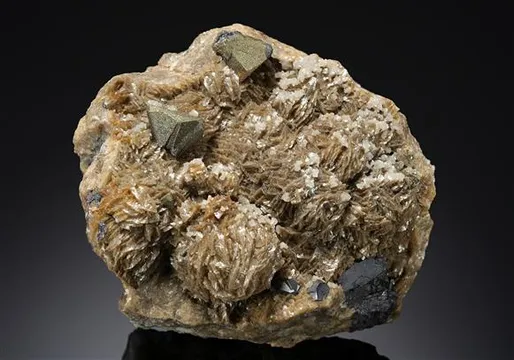
Stilbite is part of the late zeolite suite of St Andreasberg and is prized as a locality specimen rather than for the giant crystals familiar from basalt zeolite fields. It occurs as white, cream, pale tan or pinkish sheaves, sprays and radiating aggregates on calcite, locally with harmotome, apophyllite and other zeolite-group minerals. Old specimens with stilbite “garben” on calcite are known from the district, and even modest pieces can be desirable because St Andreasberg zeolites are much less available than the silver ores and calcites. Fine examples show intact sheaves with silky to pearly luster, good separation from the calcite matrix, and credible provenance to the historic mining district.
Beyond these collector staples, St Andreasberg has a remarkable roster of rarities and type-locality minerals. The district is associated with arsenolite, breithauptite, harmotome, gysinite-(Ce), theuerdankite, roterbärite and samsonite as type-locality species in modern locality records, with samsonite from the Samson Mine remaining the great prize: a black metallic silver-manganese-antimony sulfosalt found in 1908 and described in 1910. Roterbärite, PdCuBiSe3, is a modern micro-mineral discovery from the Roter Bär Mine, occurring as tiny inclusions in clausthalite with gold and other selenide assemblage minerals. Theuerdankite, Ag3AsO4, described from the Alter Theuerdank Mine, shows that St Andreasberg is still scientifically alive long after commercial mining ended. Other notable species include breithauptite, nickeline, lollingite, gersdorffite, stibarsen, allargentum, pyrostilpnite, miargyrite, polybasite, chlorargyrite, realgar, fluorite, chabazite, heulandite, natrolite, pyromorphite, mimetite, cerussite and a broad suite of arsenates, selenides and oxidation products.
The main authenticity issue with St Andreasberg is not a flood of modern fabricated fakes, but the subtler problem of old-label drift, obsolete names and look-alike silver minerals. Historic labels may use terms such as “ruby silver,” “dark red silver ore,” “silver glance,” “arsenic silver,” “antimonial silver,” “Andreasbergolith,” “Kreuzstein,” “Papierspat” or “Kanonenspat.” These are valuable historical clues, but they are not modern identifications. “Ruby silver” may be pyrargyrite or proustite; “silver glance” may mean acanthite or an argentite-era label; “arsenic silver” may hide a mixture involving native arsenic, stibarsen, dyscrasite or related phases.
Condition is critical. Pyrargyrite and proustite are soft and light-sensitive; old specimens often look black on the surface, with red only at thin edges, fractures or under transmitted light. Avoid strong display lights, direct sun and prolonged photographic lighting. Proustite is especially vulnerable. Calcite cleaves easily and the thin Papierspat or Blätterspat habits can be extremely fragile. Harmotome, stilbite and apophyllite are also prone to edge bruising; inspect zeolite specimens carefully for broken terminations and repaired plates.
Handling requires common sense. Native arsenic, arsenides, arsenates and many Ag-Sb-As minerals should be kept away from food preparation areas, washed hands after handling, and never cut, ground, brushed aggressively or cleaned with acids without expert knowledge. Old calcite matrices may react vigorously to acid, and attempts to “improve” a specimen can destroy the very associations that make St Andreasberg pieces valuable.
Rarity varies widely. Calcite from St Andreasberg is available, but top-form calcite with old provenance and silver-mineral association is not common. Pyrargyrite is the most market-visible red silver, yet fine matrix specimens are increasingly expensive. Dyscrasite, proustite, stephanite, samsonite, good harmotome, attractive apophyllite and well-displayed native silver are all significantly harder to buy than locality reputation might suggest. Many pieces circulating today are thumbnails and small miniatures from old collections; a clean, well-documented cabinet specimen with multiple classic species is a serious acquisition.
For labels, favor specificity. “St Andreasberg, Harz” is acceptable on older material, but “Samson Mine,” “Catharina Neufang,” “Gnade Gottes,” “Abendröthe,” “Bergmannstrost,” “Alter Theuerdank” or “Roter Bär” adds interpretive value when credible. Be cautious of vague “Harz, Germany” labels on red silver or dyscrasite; the Harz contains multiple historic districts, and specimen style alone is not enough to prove St Andreasberg.
The St Andreasberg story begins with a paradox familiar to many great mineral localities: the district was not the Harz’s largest silver producer, yet it became one of its most famous mineral localities. The veins were narrow, broken and unpredictable, but that very instability created pockets rich enough to become legendary. Around 1520, rich silver ore was discovered where a vein cropped out near the Beerberg, setting off the mining boom that shaped the town. In a landscape of forests, steep valleys and severe winters, the veins drew miners, investors, smelters, water engineers and, eventually, mineral collectors.
The Samson Mine became the great machine at the center of the story. Opened in the early sixteenth century, it descended to extraordinary depth for its time, with dozens of levels and a shaft system ultimately approaching the 800 m range. Its survival as a museum is part of its importance: the visitor does not merely see display cases of red silver and calcite, but the machinery that made deep mining possible. The 9 m reversible waterwheel handled hoisting; the 12 m waterwheel drove the man engine installed in 1837. Instead of climbing hundreds of metres on ladders, miners rode moving platforms in the shaft, stepping in rhythm between fixed and moving stages. The machine was later electrified for practical use, but the preserved installation remains one of the great physical links between mineral specimens and the labor that extracted them.
Water was both enemy and power source. St Andreasberg mining suffered repeatedly from drainage problems, yet the Upper Harz water-management system also supplied the energy that drove pumps, hoists and man engines. When mining became uneconomic and the pumps were switched off in 1910, the deep workings flooded up to the drainage level. Two years later, the same water system entered a new life: underground hydroelectric plants were installed in the Samson shaft system, and the old man engine continued to provide access for maintenance. Few classic mineral localities have such a direct afterlife, where the infrastructure of a closed silver mine still participates in producing energy.
The most famous mineral discovery came almost at the end. In the summer of 1908, Royal Mining Inspector H. Werner encountered an unknown black metallic mineral in the Samson Mine, in the 29 Drift at a depth of about 550 m. The new species was described in 1910 as samsonite, named for the mine itself. It was not a showy mineral in the popular sense—black, metallic, slender, rare—but scientifically it became one of the defining species of St Andreasberg. Modern summaries still emphasize how few true samsonite specimens exist and how strongly they are tied to the type locality.
St Andreasberg’s mining culture had an unexpected second export: canaries. Tyrolean miners helped bring canary breeding into the Harz in the eighteenth century, and the Harzer Roller became an economic lifeline when mining declined. By the late nineteenth century, hundreds of families in St Andreasberg were breeding birds, and enormous numbers were exported abroad. It is a startling image: the same town known to collectors for black ruby silver and arsenic-grey ore was also sending songbirds across oceans to North America, South America and Australia.
Roter Bär tells a different chapter. Unlike Samson, it was primarily an iron mine, worked in the nineteenth century by a tiny crew of private miners producing modest tonnages of brown ironstone. Its ore was prized because of its manganese content, useful in making good steel for mining tools. Later, in the 1920s, renewed exploration drove kilometres of workings in search of iron and polymetallic ores, but no economic reserves followed. The mine became a visitor mine in 1931, closed during the Second World War, and was used as an air-raid shelter in 1945. In 1988, mining enthusiasts and students began reopening and securing the workings, turning Roter Bär into a living teaching mine rather than a polished tourist stage set. Its later scientific reward was roterbärite, a palladium-copper-bismuth selenide recognized from microscopic material in the Roter Bär assemblage.

_im_Calcit_-_St_Andreasberg,_Harz.jpg)