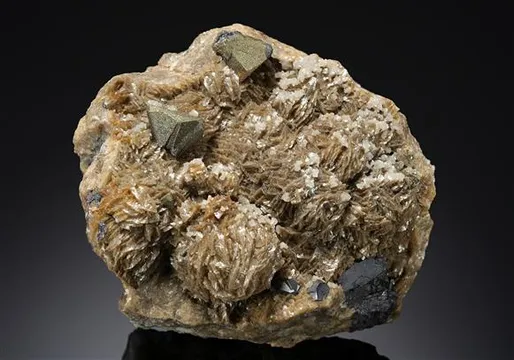
Lower Saxony, Germany - a premier mineral province led by Rammelsberg and St Andreasberg, home to silver-base-metal ore and unique type-locality minerals.
Key facts
Lower Saxony is not a single mine locality in the collector’s sense; it is a state-sized mineral province whose serious specimen reputation rests on a few extraordinary districts. The two great poles are the Harz Mountains in the south—especially Rammelsberg at Goslar and the silver veins of St Andreasberg—and the evaporite and salt-dome occurrences farther north, above all Lüneburg. Together they give Lower Saxony an unusual collecting personality: ancient sediment-hosted base-metal ores, narrow silver-cobalt-nickel-arsenic veins, salt-dome borates, zeolites, arsenates, sulphosalts, native elements, and several classic type-locality minerals.
Rammelsberg is the historic giant: a Middle Devonian sediment-hosted Cu-Zn-Pb-Ba massive sulphide deposit on the northern margin of the Harz, worked for centuries for silver, lead, copper and zinc and now preserved as part of a UNESCO World Heritage landscape. Its best specimen material is less about showy crystals than about ore textures—banded sphalerite-galena-chalcopyrite-pyrite-barite ore, massive sulphide lenses, vitriols, and alteration products that made Goslar a name in mineralogy. The mineral goslarite, ZnSO4 · 7H2O, carries that connection in its name.
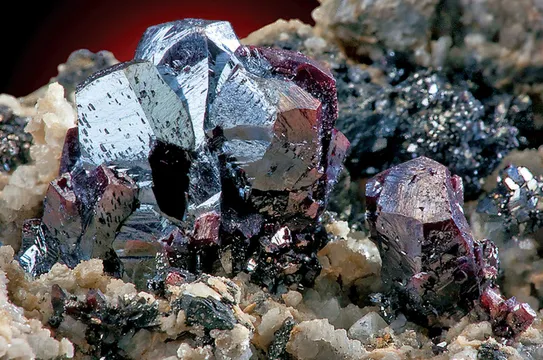
St Andreasberg is the connoisseur’s district. Its mines cut thin but remarkably mineralized calcite-quartz veins in the western Harz, producing some of Germany’s most celebrated old-time silver specimens: dark red pyrargyrite crystals that flash ruby in transmitted light, dyscrasite, stephanite, native silver, native arsenic, native antimony, breithauptite, nickeline, cobalt-nickel arsenides, harmotome, pink fluorapophyllite-(K), and a remarkable range of calcite habits. The Samson Mine alone links mining history, specimen history and species history: it is the type locality of samsonite, Ag4MnSb2S6, and its old specimens still define the species in the collector market.
Regional View
Country View
The northern evaporite occurrences add a very different signature. At the Lüneburger Kalkberg, the gypsum cap rock of a salt dome yielded boracite, Mg3(B7O13)Cl, the type-locality borate long known from old collections as sharply formed pseudocubic, tetrahedral or dodecahedral crystals in anhydrite or gypsum. Nearby Volgershall is the type locality of lüneburgite, Mg3B2(OH)62 · 6H2O. These salt-dome minerals are not visually related to the Harz silver ores, but together they make Lower Saxony one of the more varied classic collecting regions in Germany.

Photo: Ra'ike / Wikimedia Commons

Search for specimens: View all specimens from Lower Saxony, Germany
For collectors, “Lower Saxony” should be read as a regional heading covering several distinct geological environments rather than one mine. The dominant specimen-producing terrain is the Harz, where Variscan deformation, Devonian sedimentary successions, intrusive activity and later hydrothermal circulation produced both stratiform ore deposits and crosscutting vein systems. South of Goslar, the Rammelsberg deposit formed in a Devonian marine basin as metal-bearing fluids discharged into or onto the sea floor, creating large polymetallic sulphide-barite bodies later folded and overturned during the Variscan orogeny. The principal ore minerals are sphalerite, galena, chalcopyrite, pyrite and barite, with numerous subordinate sulphides, sulphates, carbonates and secondary minerals.
Rammelsberg’s historical ore bodies are classically divided into the Altes Lager and Neues Lager, with additional ore types recognized by miners and geologists according to texture and metal content. Collectors encounter these names most often on old ore specimens: massive or banded sulphide ore, melierterz with contrasting copper-rich and zinc-lead-rich layers, barite-bearing lagererz, banderz passing into shale, and oxidized or vitriol-rich material. The best Rammelsberg specimens are typically educational rather than sculptural—dense, heavy ore slices or lumps showing lamination, folding, barite blebs, galena-sphalerite-chalcopyrite assemblages, and the mineralogical fingerprints of a deposit mined almost to exhaustion before its closure in 1988.
Mining at Rammelsberg shaped the town of Goslar and the surrounding Harz economy for roughly a millennium. The mine, the historic town of Goslar, and the Upper Harz Water Management System together form a World Heritage landscape. The mine is now a museum and visitor mine rather than a collecting site. Specimens on the market come from old mine collections, Preussag-era material, museum deaccessions, historic collections, or occasional legacy ore pieces that left the mine before modern heritage protection. Active collecting underground is not a normal option for visitors.
St Andreasberg, now part of Braunlage, is a smaller but more specimen-rich name in classic mineral collecting. Its silver mines worked steep veins, many less than a metre thick, cutting Devonian host rocks. The district differs from Rammelsberg: instead of stratiform massive sulphide lenses, St Andreasberg is known for hydrothermal vein mineralization in which calcite and quartz gangue hosted silver-rich shoots, cobalt-nickel arsenides, native arsenic, native antimony and late zeolite minerals. The veins were repeatedly opened, displaced and reactivated, producing complex pockets and sharply changing mineral assemblages over short distances.
The Samson Mine is the most famous St Andreasberg mine. It worked primarily silver ores from the early 16th century until 1910 and reached a depth of more than 800 m. It is now a preserved mining monument and visitor mine, with water-powered machinery, a working historic man engine and museum displays rather than free collecting access. In specimen terms, Samson is best remembered for pyrargyrite on calcite, dyscrasite, native silver, breithauptite, harmotome, native arsenic and samsonite. The exact specimen-producing zones were not broad, modern “pockets” in the commercial sense; they were localized shoots and druses encountered during mining, many recorded in old mine terminology by level, drift and vein.
Other St Andreasberg mines are equally important to specialists. Catharina Neufang, Gnade Gottes, Bergmannstrost, Claus-Friedrich, Alter Theuerdank, Abendröthe and Roter Bär appear repeatedly in labels, publications and micro-mineral records. The district’s modern mineralogical importance has been renewed by new species from old workings and dumps, including roterbärite from Roter Bär, gysinite-(Ce) from Abendröthe, and theuerdankite from Alter Theuerdank. These are not cabinet-specimen minerals; they are analytical species from tiny grains, polished sections or micromount-scale material, but they demonstrate how much complexity remains hidden in a famous “old” district.
The Roter Bär Mine, east of Sankt Andreasberg, is historically an iron mine rather than one of the great silver producers, but it has become important because of arsenide nickel-cobalt ores and unusual selenide mineralization. It functions today as an educational and research mine run by a mining-history association. Access is organized, not casual; collectors should regard the site as a protected historical and research locality unless they have explicit permission.
Lüneburg represents a second Lower Saxon mineral world. The Lüneburger Kalkberg is the cap rock of a salt dome, formerly quarried for gypsum and now a nature reserve within the city. Boracite occurred there in gypsum and anhydrite, commonly as small idiomorphic crystals—often greenish, white, bluish or sea-foam colored, and famously deceptive in their pseudocubic appearance. Lüneburg-area collecting today is essentially historical: the old quarries are gone, protected, built over or inaccessible, and the best boracites circulate from old collections. Volgershall, another Lüneburg occurrence, is historically important as the type locality of lüneburgite, but it is not a practical collecting locality today.
Lower Saxony also includes potash and salt mines with borates and evaporite minerals, iron-ore mines such as those around Peine, and numerous smaller Harz and foreland localities. For the specimen market, however, the main labels to recognize are Rammelsberg/Goslar, St Andreasberg/Samson/Catharina Neufang/Beerberg/Roter Bär, and Lüneburg/Kalkberg/Volgershall.
The signature mineral of Lower Saxony for many collectors is pyrargyrite from St Andreasberg, especially from the Samson Mine. The finest examples are black to metallic gray by reflected light but reveal deep red internal color in thin edges or with strong transmitted light. Old Samson pyrargyrites occur as isolated crystals, clusters and crystal groups on white to pale calcite, sometimes with quartz, galena, native silver, dyscrasite or arsenic-group minerals. St Andreasberg belongs in the same conversation as Freiberg and Guanajuato when collectors discuss the great classic pyrargyrite localities.
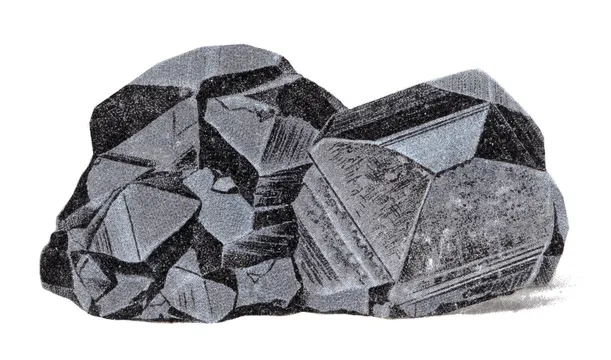
Samsonite is the most famous St Andreasberg type-locality rarity. It is a silver-manganese-antimony sulfosalt, Ag4MnSb2S6, named for the Samson vein. The original 1908 discovery in the Samson Mine produced only a small number of specimens, and samsonite remains one of the classic “label minerals” of the district: steel-gray to black, metallic, commonly slender prismatic or somewhat tabular, with reddish brown translucency in thin splinters. Because of its rarity and visual similarity to other dark silver sulfosalts, serious samsonite specimens deserve analytical confirmation or unusually strong provenance.
Breithauptite, NiSb, is another important St Andreasberg species, historically tied to the district. It occurs in the cobalt-nickel-silver-arsenic association and is admired for its copper-red to violet metallic appearance, often with calcite and other ore minerals. Native arsenic, locally abundant enough to have old mining and smelting importance, is a defining mineral of the district as well. Collectors should expect it as gray to dark, often botryoidal, massive, crusty or “shell-like” material rather than bright metallic crystals; it is frequently associated with löllingite, stibarsen, dyscrasite, pyrargyrite, galena and native antimony.
Dyscrasite and stephanite are among the most desirable St Andreasberg silver minerals. Dyscrasite, Ag3Sb, may occur as metallic masses or crystal aggregates associated with calcite, arsenic and ruby silver minerals. Stephanite, Ag5SbS4, is less commonly encountered but is part of the classic dark sulfosalt suite. Argentopyrite, miargyrite, polybasite-group minerals and acanthite add to the silver mineral list, especially in micromount and old-collection material.
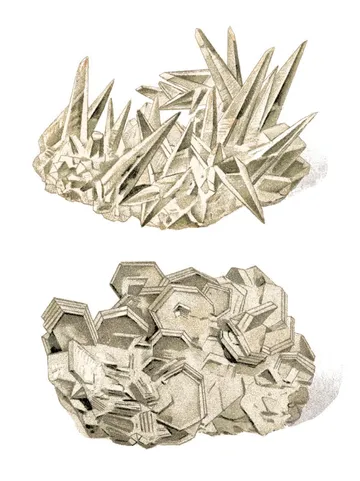
Calcite from St Andreasberg deserves separate attention. The district is famous not merely for calcite accompanying ore, but for the diversity of its crystal habits. Collectors encounter old German habit names such as Papierspat, Blätterspat, Kanonenspat and Würfelspat, reflecting platy, leafy, stout, complex or pseudo-cubic forms. The best calcites may be white, colorless, pale gray, pinkish or included, and they serve as the stage on which pyrargyrite, breithauptite, native antimony, galena, löllingite and other ore species sit. Fluorapophyllite-(K), including pink apophyllite historically prized from the district, harmotome, stilbite-subgroup minerals and other zeolites give St Andreasberg an additional post-ore aesthetic distinct from most silver districts.
Harmotome is one of the district’s classic zeolite names and has been historically linked to St Andreasberg as a type locality. It appears as glassy, pale, twinned crystals, commonly on calcite or in late cavities. Arsenolite, As2O3, is another type-locality mineral historically connected with St Andreasberg; it is a secondary arsenic oxide and should be treated as toxic material. More recent type-locality species from the district—roterbärite, gysinite-(Ce) and theuerdankite—are scientifically important but generally microscopic or analytical rather than display-specimen species.
Rammelsberg’s mineral identity is very different. Its great assemblage is sphalerite, galena, chalcopyrite, pyrite and barite, with ore textures reflecting sediment-hosted massive sulphide deposition and later deformation. Goslarite, ZnSO4 · 7H2O, is the name-bearing classic sulphate from the Goslar-Rammelsberg setting and belongs to the vitriol tradition of the mine. Rammelsberg specimens may also include calcite, smithsonite, hemimorphite, hydrozincite, azurite, cassiterite, strontianite and tourmaline-group minerals, but the locality’s strongest collector value is often historical, textural and educational rather than gem-crystal aesthetics.
Lüneburg’s collector mineral is boracite. From the Lüneburger Kalkberg, boracite occurs in evaporite cap-rock material, typically in gypsum or anhydrite, as small but sharply formed crystals. Good crystals may be pale gray, white, greenish or bluish, with a glassy to adamantine lustre and pseudocubic habit despite the species’ orthorhombic symmetry at room temperature. Larger, well-formed crystals in matrix are prized because the classic material is old and finite. Lüneburgite from Volgershall is far rarer in the market and usually unattractive visually—more a systematic and historical mineral than a display species.
Lower Saxony specimens demand locality discipline. “Harz, Germany” is too broad for serious cataloguing, and “Saxony” is not the same place as Lower Saxony. Old English labels may say “Andreasberg, Hartz,” “St. Andreasberg,” “Samson,” “Goslar,” “Rammelsberg,” “Luneburg,” “Lüneburg,” or “Hanover.” Specimens from the Kingdom of Hanover period can be correctly historical yet confusing to modern collectors. Conversely, a label reading simply “Saxony” may refer to Freiberg, Schneeberg or another locality in the modern Free State of Saxony, not Lower Saxony. Ruby silver minerals, dyscrasite, native silver and zeolites from German collections are especially prone to over-broad or archaic labels.
For St Andreasberg pyrargyrite, the main authenticity issue is not usually modern fabrication but overconfident attribution. Fine pyrargyrite occurs at several classic European localities, and old collection labels can migrate. The most persuasive St Andreasberg pyrargyrites combine the right association—white calcite, local silver-antimony-arsenic minerals, sometimes native arsenic or dyscrasite—with old provenance, habit and matrix. Very bright, isolated ruby-silver crystals without matrix or documentation should be catalogued cautiously. Strong backlighting that shows red translucency is a useful field character for pyrargyrite, but it does not prove the locality.
Samsonite is a higher-risk identification because it resembles other dark silver sulfosalts. A specimen sold as samsonite should ideally have analytical support, a credible old Samson provenance, or both. True samsonite is rare enough that casual labels deserve skepticism. The same caution applies to modern micro-species from St Andreasberg such as roterbärite, gysinite-(Ce) and theuerdankite: these names should not be used on hand specimens unless the exact analyzed grain or mount is documented.
Condition issues vary by suite. Pyrargyrite can darken and is light-sensitive over long exposure; keep the best specimens out of prolonged strong light and avoid unnecessary cleaning. Silver minerals and native silver can tarnish; aggressive chemical brightening damages both specimen integrity and historical value. Native arsenic and arsenolite require special care: do not abrade, lick, heat, acid-clean or store them where powder can contaminate other specimens. Handle arsenic-bearing specimens with clean hands or gloves, keep dust contained, and label toxicity clearly.
Calcite from St Andreasberg is easily bruised, cleaved or etched. Many old calcites have small contact marks or mining damage; perfect damage-free examples with ore minerals are scarce and command premiums. Zeolites such as harmotome and apophyllite are also vulnerable to breakage. Pink fluorapophyllite-(K) and delicate zeolite coatings should not be washed harshly.
Rammelsberg specimens are often dense ore pieces rather than open-vug crystals. Collectors should value texture, old labels, mine-level data and ore-type names. Massive sulphide ore may oxidize slowly in poor storage; keep specimens dry and watch for sulphate efflorescence. Goslarite and other vitriol-type sulphates are water-soluble or humidity-sensitive and should be treated as unstable display materials unless preserved carefully.
Lüneburg boracite has its own market pattern. Small loose crystals and crystals in anhydrite are obtainable from old collections, but large, sharp matrix pieces from the Kalkberg type locality are much scarcer. Boracite’s pseudocubic habit can invite casual misidentification as fluorite, quartz or “cube-shaped” material; the correct evaporite matrix, old Lüneburg provenance and crystal form matter. Lüneburgite is far rarer still, and many historical mentions of “Lüneburgite from Kalkberg” should be checked because the type locality is Volgershall, not the Kalkberg.
Modern collecting access is limited. Rammelsberg and Samson are museum and World Heritage contexts; Lüneburger Kalkberg is a protected nature reserve; Roter Bär is an educational and research mine. Serious collectors should rely on old collections, reputable dealers, documented exchanges, museum duplicates where legally released, and specimens with precise labels.
The most repeated Rammelsberg origin story begins not with a geologist but with a horse. In the legend, Emperor Otto’s knight Ramm tied up his mount while hunting on the wooded Harz slope; the restless animal pawed at the ground and uncovered ore. Whether taken as folklore rather than geology, the tale captures the way Goslar imagined the mountain: a place where metal lay so close to the surface that even a horse could reveal it. A more sober explanation links the name to old words for copper ore, but the horse remains the story collectors remember.
Rammelsberg’s documented history is no less dramatic. The mountain became one of Europe’s longest-lived non-ferrous mining centres, and the wealth of its ores helped make Goslar a political and economic power. The old town’s medieval fabric and the mine’s industrial remains are now inseparable; it is difficult to look at a banded Rammelsberg ore specimen without also seeing the timber-framed city it financed.
At St Andreasberg, the great underground story is the Samson Mine. Mining in the area was active before the end of the 15th century, and Samson itself became one of the deepest mines in the world during its working life. It ultimately descended through dozens of levels to more than 800 m. The technological heart of the preserved mine is its water-powered machinery: great wheels, hoists and the man engine that once moved miners through the shaft. The survival of that machinery gives Samson specimens a particular atmosphere; these are not anonymous “Harz” pieces, but products of a mine where engineering, water management and mineral collecting all intersect.
Johann Wolfgang von Goethe visited the Samson Mine on 12 December 1777 during his first Harz journey. His diary note is short and memorable: “Entered Samson in the evening, came out by God’s grace.” For a collector holding an old St Andreasberg pyrargyrite, that line matters. The mine was already a place of wonder and unease in the 18th century—deep, cold, mechanically ingenious, and rich in minerals whose names were still being sorted out by European science.
The samsonite discovery is one of the finest mineralogical episodes in Lower Saxony. In the summer of 1908, near the end of active mining, royal mining inspector Heinrich Werner was shown an unusual part of the Samson vein in the roof of the 29th level, about 550 m deep and a little over 300 m from the shaft. The ore zone had been tectonically squeezed and thinned over roughly 40 m. In the calcite, quartz, anhydrite and gypsum gangue, miners found antimony-rich material and then opened a druse with about sixty steel-gray to black prismatic crystals, some reaching 3 cm, projecting from hacked quartz into open space. A second, smaller druse about five metres higher yielded around twenty more crystals. Werner first thought the blackish red-translucent prisms were miargyrite. Professors Bergeat and Kolbeck urged that the material might be new, and chemical work by Dr. Fraatz in Clausthal found not only silver, antimony and sulphur but significant manganese. In 1910 the new mineral was named samsonite, after the mine that had produced it just as the old silver district was fading.
Lüneburg has a very different story, almost playful by comparison. Boracite crystals from the Kalkberg looked so deceptively cubic that the mineral was once associated with names such as “cubic quartz” and “Lüneburg diamond.” A mineralogical anecdote repeated in modern literature says that children in Lüneburg liked to play dice with the cube-shaped boracite crystals. That image—children handling what would now be prized type-locality borate crystals—says much about the age of the locality and the way common familiarity can precede scientific recognition. Later, boracite became important far beyond collecting because it played a role in early crystal-physics studies of piezoelectricity.
Guenter Grundmann, Thomas P. Moore and Wendell E. Wilson, “The St. Andreasberg Mining District, Western Harz Mountains, Niedersachsen, Germany,” The Mineralogical Record, 48(3), 301–410, 2017 — The major modern collector-oriented treatment of St Andreasberg, covering history, geology, mineralogy and classic specimens.
Paul Pohwat, “Connoisseur’s Choice: Samsonite, Samson Lode, 29 Drift, Samson Mine, St. Andreasberg, Harz, Lower Saxony, Germany,” Rocks & Minerals, 2024 — A specimen-focused discussion of samsonite from the type locality.
TU Clausthal Geomuseum, “Samsonit” — Detailed German-language account of the 1908 Samson Mine discovery, associated minerals, pocket details and early samsonite literature.
W. Bruhns, “Kristallformen des Samsonits von St. Andreasberg,” Jahresbericht der Niedersächsischen Geologischen Vereinigung, IV, 103–104, 1911 — Early crystallographic note on samsonite, cited in the TU Clausthal Geomuseum bibliography.
F. Kolbeck and V. Goldschmidt, “Über Samsonit von Andreasberg,” Zeitschrift für Kristallographie, 50, 455–458, 1912 — Early formal crystallographic work on the new Samson Mine sulfosalt.
F. Slavik, “Morphologie des Samsonits,” Bulletin International de l’Académie des Sciences de Bohême, XVI, 1–10, 1911 — Early morphological study of samsonite.
A. Wilke, “Die Erzgänge von St. Andreasberg im Rahmen des Mittelharz-Ganggebietes,” Beihefte zum Geologischen Jahrbuch, 7, Hannover, 1952 — Foundational geological work on the St Andreasberg vein system.
Jakub Plášil et al., “Theuerdankite, Ag3AsO4, a new mineral from the Alter Theuerdank Mine, St. Andreasberg, Germany,” Mineralogical Magazine, 88(5), 557–564, 2024 — Open-access new-mineral description for the St Andreasberg silver arsenate.
Anna Vymazalová et al., “Roterbärite, PdCuBiSe3, a new mineral species from the Roter Bär mine, Harz Mountains, Germany,” 2020 — New-mineral record tying the Roter Bär educational mine to a rare Pd-Cu-Bi selenide.
Mindat Type Locality Report for St Andreasberg, Braunlage, Goslar District, Lower Saxony, Germany — Compact list of type-locality species recorded from the St Andreasberg district and its sublocalities.
D. Large and E. Walcher, “The Rammelsberg massive sulphide Cu-Zn-Pb-Ba deposit, Germany: an example of sediment-hosted, massive sulphide mineralisation,” Mineralium Deposita, 34, 1999 — Key modern deposit-scale reference for Rammelsberg geology.
C. Moreno, F. González and R. Sáez, “Basin Evolution and Massive Sulfide Deposition at Rammelsberg (Germany): Updating the Subsidence Analysis,” 2019 — Modern basin-analysis work cited in Rammelsberg locality records.
C. A. S. Hoffmann, Mineralsystem des Herrn Inspektor Werners, Bergmännisches Journal, 2(1), 369–398, 1789 — Historical source tied to the description of boracite from Lüneburger Kalkberg.
C. Nöllner, “Über den Lüneburgit,” Sitzungsberichte der königlich bayerischen Akademie der Wissenschaften zu München, Band I, 291–293, 1870 — Original publication for lüneburgite from Volgershall.
Typmineral-Katalog Deutschland, Boracite type specimens, TU Bergakademie Freiberg collection — Catalogue entry documenting presumed type material and historical boracite specimens from Lüneburg Kalkberg.
“Roterbärit – neues Mineral im Oberharz,” TU Clausthal — Short university media piece on the identification of roterbärite from the Roter Bär Mine near St Andreasberg.
“Mines of Rammelsberg, Historic Town of Goslar and Upper Harz Water Management System,” UNESCO / NHK World Heritage media — UNESCO World Heritage page with official media and context for the Rammelsberg-Goslar-Upper Harz heritage landscape.
Mindat: Lower Saxony, Germany — Regional mineral-locality index for the state.
Mindat: Rammelsberg Mine, Goslar District, Lower Saxony — Mineral list, references and locality data for the classic Rammelsberg deposit.
UNESCO World Heritage Centre: Mines of Rammelsberg, Historic Town of Goslar and Upper Harz Water Management System — Authoritative overview of the protected mining landscape and its historical significance.
World Heritage Rammelsberg: Ore Dressing Plant — Museum page explaining the preserved processing plant and Rammelsberg visitor context.
World Heritage Rammelsberg: Mineralien — German-language museum page on the Rammelsberg mineral collection and Preussag legacy material.
Dr. Thomas Krassmann: Ore Types of the Rammelsberg Deposit — Illustrated guide to Rammelsberg ore textures, ore types and historic mine material.
Mindat: St Andreasberg Mining District — Broad mineral list and locality framework for the St Andreasberg silver district.
Mindat: Samson Mine, St Andreasberg — Locality page for the most famous St Andreasberg mine and samsonite type locality.
Grube Samson official visitor page — Current access, guided-tour and museum information for the preserved Samson Mine.
World Heritage in the Harz: Samson Mine — Heritage overview of Samson Mine, its water-powered machinery and mining monument status.
Lehrbergwerk Roter Bär: Andreasberger Erzgänge — German-language explanation of the St Andreasberg vein mineralization and mineral assemblage.
Geopark Harz: Pit Red Bear — Visitor and heritage context for the Roter Bär Mine.
Mindat: Lüneburger Kalkberg, Lüneburg — Locality record for the boracite type locality and associated evaporite minerals.
Mindat: Boracite from Lüneburger Kalkberg — Occurrence record documenting boracite as a valid type-locality species from Lüneburg.
Mindat: Volgershall, Lüneburg — Type-locality record for lüneburgite.
Handbook of Mineralogy: Lüneburgite — Concise mineralogical data sheet for lüneburgite, including distribution and type-material notes.
Mineralienzimmer: Die Gipsbrüche von Lüneburg — Collector discussion with practical historical notes on Lüneburg gypsum-quarry minerals and market availability.
JGR Apolda Forum: Die Mineralien der alten Gipsbrüche bei Lüneburg — Detailed German collector field-note style discussion of old Lüneburg gypsum quarry minerals, boracite and lüneburgite context.