Samson Mine, Germany - a classic European silver locality known for ruby silver and samsonite; prized for provenance, rarity, and historic specimens.
Key facts
Samson Mine, at Sankt Andreasberg in the Upper Harz of Lower Saxony, is one of the classic European silver localities by every standard that matters to collectors: age, geology, rarity, crystallography, and provenance. It worked a compact but extraordinarily varied hydrothermal vein system in Devonian slates, shales, sandstones, and spilitic rocks close to the contact aureole of the Brocken granite. The productive veins were narrow, steep, structurally restless fissures whose ore shoots were localized by intersections, shear zones, and impermeable cataclastic “Ruschel” zones. From that difficult ground came a mineral suite that seems almost disproportionate to the size of the district: ruby silver minerals, silver-antimony alloys and sulfosalts, nickel-cobalt arsenides, native arsenic and antimony, galena, sphalerite, chalcopyrite, quartz, calcite in famously varied habits, zeolites, pink apophyllite, and the type-locality mineral samsonite.
For the collector, Samson is above all a name attached to old, cabinet-born silver specimens: deep red to red-black pyrargyrite on pale calcite; silvery dyscrasite in distorted, striated crystals; dark miargyrite and samsonite that may require real scrutiny; and calcite plates whose forms were so distinctive that miners and collectors gave them folk names such as Papierspat, Blätterspat, Kanonenspat, Würfelspat, and Compositenspat. The best specimens have an unmistakable old-European look—subtle colour, hard metallic lustre, pale calcite contrast, and, very often, labels that tell as much history as the crystals.
Regional View
Country View
The mine also stands apart as a monument of mining technology. Worked for silver from the early sixteenth century until 1910, it reached depths of roughly 810 to 840 m and was long counted among the deepest mines in the world. Its preserved shaft complex, waterwheels, ore-hoisting machinery, and 1837 wire-rope man engine make Samson much more than a specimen label: it is a still-readable machine for understanding how difficult, expensive, and ingenious deep Harz silver mining became.

Photo: Ra'ike / Wikimedia Commons

Photo: Llez / Wikimedia Commons
Search for specimens: View all specimens from Samson Mine, Germany
Samson Mine lies just northwest of Sankt Andreasberg, now part of Braunlage in the Goslar District of Lower Saxony. It belongs to the Sankt Andreasberg silver-mining district of the Middle Harz, a small but mineralogically famous vein field developed in a horst-like block bounded by major fault systems. Within that block, the veins are typically less than a metre thick, steeply dipping, and structurally complex. Their country rocks include Middle Devonian slate, marly shale, sandstone, and spilitic volcanic rocks affected by the contact aureole of the Brocken pluton.
The ore was not a simple lead-zinc-silver vein but a multi-stage hydrothermal system. Geological work on the district distinguishes an early low-grade oxide-carbonate stage; a main sulfide stage dominated by galena, sphalerite, chalcopyrite, and tetrahedrite-group minerals; a later reactivation stage that produced the celebrated silver-rich shoots, nickel-cobalt arsenides, native arsenic and native antimony in the so-called “noble calcite” generation; and a final remobilization stage in which calcite and rich silver minerals were deposited along young fractures. The best specimen pockets belong to this complicated late history: drusy calcite openings carrying ruby silvers, dyscrasite, stephanite, polybasite, argentopyrite, native silver, arsenides, and related rarities.
The Samsoner Gang, or Samson lode, was the principal structure of the mine and part of the larger Samson-Andreaskreuzer vein trend. Rich ore shoots were particularly associated with structural intersections and crushed zones such as the Silberburger Ruschel, where hydrothermal solutions appear to have been ponded or focused. Even at very great depth, rich silver ore was still encountered; sources on the district record silver-rich ore shoots on the Samson main vein as deep as about 800 m. The veins were famously irregular, and this made them costly to mine: ore grades and vein behaviour changed rapidly with depth, host rock, faulting, and the reopening of older fissures.
Mining in the Sankt Andreasberg district is documented by 1487, and the Samson Mine is traditionally dated to 1521, the year associated with the granting of mining freedoms that helped draw skilled miners to the district. The first boom came in the sixteenth century, when Sankt Andreasberg grew rapidly and numerous small mines worked the steep silver veins. Water soon became the limiting problem. Drainage adits were driven from the valleys, but deep working required a sustained water-management system, and the later Rehberger Graben and Oderteich water supply became essential to the mine’s power and drainage.
After disruption during the Thirty Years’ War, the district revived slowly, then reached a second great period from the late seventeenth into the early eighteenth century. Around 1700 to 1730, annual silver output in the Sankt Andreasberg district commonly reached roughly 1,000 to 2,000 kg, and in 1724 the district produced nearly 2,000 kg of silver. The Sieberstollen, begun in 1716 and reaching Samson and Catharina Neufang in 1755 after a drive of about 4 km, was a major improvement in drainage and enabled deeper work.
The nineteenth century brought another short but intense technical and productive phase. Annual silver production in the district reached about 3 metric tons in 1822–1824, and the Samson shaft was deepened to extraordinary levels. The 1824 reversible waterwheel served ore hoisting, and the 1837 Fahrkunst man engine reduced the brutal ladder climb that miners had endured on their way to and from deep workings. After the annexation of Hanover by Prussia in 1866, the remaining Sankt Andreasberg mines were reorganized; the state retained the “Inwendiger Zug” with Samson, Catharina Neufang, Gnade Gottes, and Bergmannstrost as a fiscal mining field. Later investments included mechanical drilling, introduced in the late 1880s, and a new central ore dressing plant intended to make lower-grade lead-silver ores payable.
Those measures could not overcome declining grades, deep hoisting costs, falling silver prices, water shortages, and the increasingly erratic search for rich ore. Active ore mining ended at Samson on 31 March 1910, when the last shift—reported as 80 men—left the mine. Below the Sieberstollen level the workings flooded after pumping stopped, while the upper old workings, supported by competent rock, preserved much of the underground labyrinth. Samson later became a museum and technical monument; it is now part of the UNESCO World Heritage Site associated with the Rammelsberg Mine, the Old Town of Goslar, and the Upper Harz Water Management System.
Collecting access today is not comparable to nineteenth-century mining-era collecting. Samson is a protected historic mine and museum, visited only by guided tour; specimen collecting in the mine is not part of normal visitor access. The old dumps and the broader Sankt Andreasberg district have yielded some modern finds and re-examined pieces, but serious Samson specimens on the market overwhelmingly come from old collections, old dealer stock, museum deaccessions, and historic labels. For practical collecting purposes, “Samson Mine” is now primarily an antique-specimen locality.
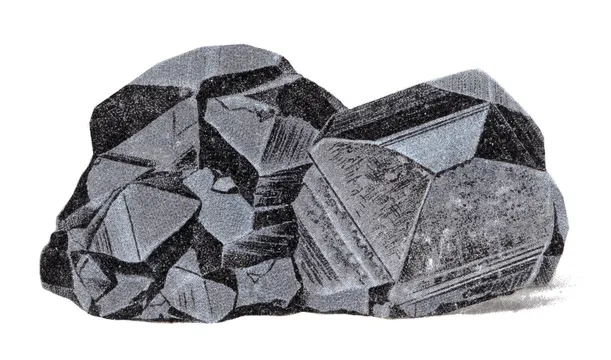
The most important documented pocket story is the 1908 samsonite discovery on the 29th level of the Samsoner Gang, about 550 m below surface and more than 300 m from the shaft. There, in an unusual tectonically thinned part of the ore zone, quartz, calcite, anhydrite, and gypsum carried galena flakes and silver minerals. One opened druse produced about 60 steel-grey to steel-black monoclinic prismatic crystals to 3 cm on broken quartz, associated with pyrargyrite, galena, löllingite, chalcopyrite, native silver, apophyllite, quartz, and other ore minerals. A second smaller druse about five metres above yielded roughly 20 more crystals. Only about 80 small samsonite specimens are recorded from the original find, making it one of the most storied late discoveries of the mine.
Pyrargyrite is the signature collector mineral of Samson Mine: the dark “ruby silver” that turns an otherwise restrained Harz calcite specimen into a classic. Samson pieces show short-prismatic to blocky, striated trigonal crystals, commonly red-black to submetallic on the surface but cherry-red to deep ruby where light catches edges or fractures; documented specimens include crystals from a few millimetres to about 2 cm, with exceptional loose or matrix crystals reaching around 2.2 cm. The normal associations are pale to white calcite, galena, quartz, native arsenic, löllingite, argentopyrite, dyscrasite, native silver, and related sulfosalts. The finest examples have sharp, lustrous, well-separated crystals sitting visibly on calcite rather than lost in massive ore, and old pieces with intact terminations, translucent red edges, and credible nineteenth-century provenance command a premium over dull, chipped, or indistinct black masses.
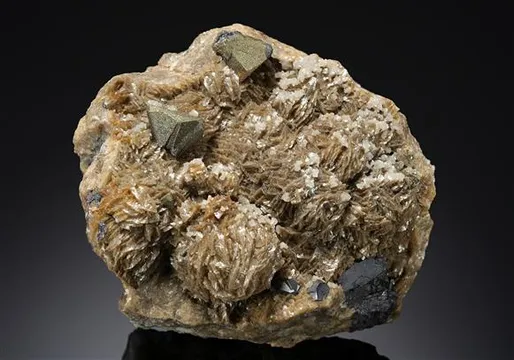
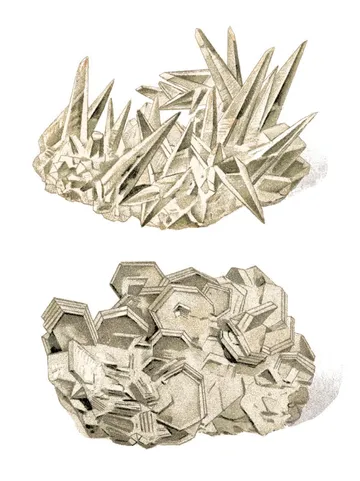
Calcite from Samson Mine is not just gangue; it is one of the great historic calcite suites of Europe. The district became famous for an extraordinary range of forms—thin, platy, bladed, cannon-like, cuboid, composite, scalenohedral, rhombohedral, and poker-chip habits—so distinctive that the old Harz names Papierspat, Blätterspat, Kanonenspat, Würfelspat, and Compositenspat still carry meaning for collectors. Samson calcite is commonly white, greyish, colourless, or translucent, and many specimens are miniatures to small cabinets, though individual crystals may range from small drusy faces to centimetric, well-formed tablets and rhombs. Associations with galena, pyrargyrite, dyscrasite, löllingite, breithauptite, native antimony, native arsenic, safflorite, and pink fluorapophyllite-(K) are especially desirable. Good Samson calcite is judged by form first, then by condition and contrast: crisp, undamaged habit, visible ore-mineral inclusions or accents, and an old label separate a real classic from a pale calcite plate of merely local interest.
Dyscrasite at Samson is one of the locality’s elite silver-antimony minerals, historically sought alongside pyrargyrite and pyrostilpnite. It occurs as silver-white to pale grey metallic crystals and aggregates, often tarnishing darker, with distorted, striated, and sometimes penetration-twinned or triplet forms; published and photographed examples include sharp miniature groups, crystals to about 1.5 cm, and specimens etched or exposed from calcite. It is closely tied to the calcite-rich silver stages and is found with calcite, galena, pyrargyrite, stibarsen, native arsenic, native silver, and other silver minerals. Top Samson dyscrasite is not merely “present”: the collector wants a clearly recognizable, bright or only lightly tarnished crystal, visibly freed from the calcite, ideally with galena or ruby silver in the same specimen. Massive grey ore with microscopic dyscrasite belongs to the study tray; sharp, striated metallic crystals belong in the cabinet.
Galena was part of Samson’s principal ore assemblage and is often the structural host that makes the showier silver minerals intelligible. In specimens it appears as lead-grey metallic masses, flakes, granular aggregates, and cubed crystals, commonly embedded in or supporting calcite and locally associated with pyrargyrite, dyscrasite, samsonite, tetrahedrite-group minerals, chalcopyrite, sphalerite, and native silver. The Samson collector should not expect the large freestanding cubes of a classic lead mine; the best galena specimens here are locality combinations—galena matrix with tabular or hexagonal calcite, pyrargyrite perched above, or dyscrasite exposed beside it. Attractive galena shows clean metallic faces, partial beveling or cubic form, and strong contrast with white to translucent calcite; dull massive galena is historically relevant ore but much less desirable unless it carries a rare silver species or a fine old label.
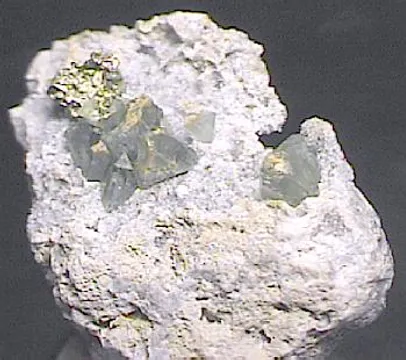
Miargyrite from Samson Mine is a collector’s mineral in the strict sense: uncommon, dark, easily overlooked, and best appreciated under magnification. It is documented with pyrargyrite and calcite, and some Samson examples are described as tiny crystals on or with massive pyrargyrite, rather than as large display crystals. The relevant habit is dark grey to black metallic tabular or prismatic crystals, sometimes with striation, in the same silver-sulfosalt environment that produced pyrargyrite, samsonite, dyscrasite, galena, quartz, and calcite. The great caution at Samson is identification: the original samsonite find was first mistaken for miargyrite because both can appear as blackish silver-antimony sulfosalt crystals with red to brown transmitted light in thin fragments. A good Samson miargyrite specimen therefore needs not only visible crystals but believable determination and provenance; analytical confirmation or a reliable expert label adds real value.
The apophyllite of Samson Mine, now treated mineralogically as fluorapophyllite-(K) where specified, is famous for its old-time pink crystals, a colour long prized from Sankt Andreasberg. Samson examples occur as glassy, translucent to transparent, pale rose crystals on drusy matrix, commonly calcite-rich and sometimes with glittering safflorite or other ore minerals in the vugs; documented specimens show crystals from a few millimetres to about 1.2–1.6 cm, with nineteenth-century and early twentieth-century provenance especially valued. The colour is typically gentle rather than lurid, and the charm lies in its association with a silver-vein environment, not in size competition with basalt-apophyllite localities. Fine Samson apophyllite should have intact lustrous crystals, visible pink colour in daylight, and a credible old label; bruised, colourless, or attribution-only material is much less satisfying.
Beyond these headline species, Samson Mine is important for samsonite, Ag4MnSb2S6, the mine’s own type-locality mineral, named from the Samson vein after the 1908 discovery. The broader Sankt Andreasberg district is also famous for arsenolite, breithauptite, harmotome, pyrostilpnite, stephanite, polybasite, argentopyrite, allargentum, native silver, native arsenic, native antimony, stibarsen, safflorite, löllingite, rammelsbergite, nickeline, ullmannite, gersdorffite, chalcopyrite, sphalerite, fluorite, quartz, stilbite, analcime, and secondary arsenates such as picropharmacolite and guérinite. Many of these species are not common as display specimens from Samson, but they explain why old Harz labels still attract systematic collectors long after the mine closed.
Samson Mine specimens are a provenance-driven market. The mine closed in 1910, and the best material was collected during active mining or preserved in old European collections, so original labels, dealer tickets, museum inventory numbers, and collection histories matter. Labels reading “Andreasberg,” “St. Andreasberg,” “Samson,” “Sampson,” “Grube Samson,” or “Samsoner Gang” may all occur, but the wording should be interpreted carefully: older labels often used the district name loosely, and neighbouring mines such as Catharina Neufang, Gnade Gottes, Bergmannstrost, St. Andreaskreuz, and Claus-Friedrich can produce similar associations.
The most important authenticity issue is not a widely documented fake industry but misidentification and over-attribution. Dark silver sulfosalts from Samson—especially pyrargyrite, miargyrite, argentopyrite, stephanite, and samsonite—can be visually treacherous. Samsonite in particular was originally mistaken for miargyrite, and because only about 80 small specimens came from the classic discovery, any offered samsonite should be treated as a high-scrutiny purchase. Serious buyers should expect analytical confirmation, a strong expert provenance, or both. Similarly, “dyscrasite” in dark massive ore should be supported by visible habit or analysis if the specimen is priced as a species piece.
Condition is often the difference between a cabinet classic and a study specimen. Pyrargyrite is soft and photosensitive enough that old crystals may show edge wear, dulling, bruised terminations, or surface darkening; the best pieces retain lustre and some red internal glow. Dyscrasite tarnishes and is commonly distorted or etched from calcite, so distinguish natural irregularity from breakage. Calcite is easily cleaved and chipped, particularly in thin Papierspat and bladed habits. Pink apophyllite crystals can be delicate and are often small; edge damage is common and should be priced accordingly. Native arsenic, arsenides, antimony minerals, and secondary arsenates should be handled conservatively: avoid dust, wash hands after handling, and never trim or grind suspect ore without proper controls.
Fluorescence is not the main reason to buy Samson specimens, but it can add interest. At least some Samson calcite has been reported with attractive pink fluorescence, and collectors should test gently rather than assume all calcite from the mine behaves the same way. For display, keep pyrargyrite and other ruby silvers out of strong light, avoid high heat, and store old labels separately but with the specimen.
Market availability is uneven. Small calcite, galena-calcite, and pyrargyrite-calcite pieces appear periodically, especially from old European collections. Good pyrargyrite crystals on calcite remain desirable and competitive. Dyscrasite is much scarcer, and attractive apophyllite is scarcer still. Confirmed samsonite from the Samson Mine is a true rarity; when available, it is more often a thumbnail or analytical specimen than a flamboyant display piece.
On 12 December 1777, Johann Wolfgang von Goethe entered the Samson Mine during his first Harz journey. The visit was not a polite surface inspection. He went underground in the evening and later recorded the experience in a short, memorable line: “Entered Samson in the evening, came out by God’s grace.” It was a famous mine even then, and the note has survived because it catches something no production table can show—the psychological weight of descending into a deep, wet, cold, narrow silver mine by eighteenth-century means.
By the nineteenth century, the depth of Samson had become a daily ordeal as much as an engineering achievement. Before the man engine, miners climbing hundreds of metres of ladders spent hours each day simply getting to and from work, an effort not counted as productive labour. The 1837 Fahrkunst changed that. Two moving systems with small platforms rose and fell in alternation; at the moment they came level, a miner stepped from one to the other, descending or ascending by rhythm rather than by ladder. The mechanism shortened the journey and spared strength, but it also demanded nerve and timing. Today the preserved Samson man engine is valued as an international mechanical monument precisely because it makes that old routine visible.
The mine’s most collector-famous episode came very late, almost at the end of its working life. In the summer of 1908, Royal Mining Inspector Heinrich Werner was shown an unusual part of the ore zone in the roof of the 29th level of the Samsoner Gang, about 550 m underground and more than 300 m from the shaft. The lode had been squeezed and thinned tectonically over a length of about 40 m, and the gangue was a strange mixture of quartz, calcite, anhydrite, and gypsum with galena flakes. Nearby lay a stibnite lens only about 20 by 1 cm, enclosed in massive calcite.
A few metres east, a druse had opened. In it were roughly 60 steel-grey to steel-black prismatic crystals, some reaching 3 cm, standing on broken quartz and projecting into open space. Werner thought they were miargyrite, an understandable mistake; in thin splinters they showed deep red to brown transparency. The association was exactly the sort to fool the eye: pyrargyrite, unidentified silver pyrites, tetrahedrite-group minerals, galena, löllingite, chalcopyrite, native silver, apophyllite, quartz, and probably cubanite. Five metres above, a smaller second druse yielded about 20 more of the same black crystals. Some were even perched on a pea-sized bit of pyrolusite.
Professors Bergeat and Kolbeck, at Clausthal and Freiberg, recognized that Werner’s material might be new. A half gram went to Dr. Fraatz in Clausthal for chemical analysis. The result was decisive: along with silver, antimony, and sulfur, the material contained measurable manganese. Werner and Fraatz published the new mineral in 1910 as samsonite, named for the mine. The larger druse had produced crystals that were seldom perfectly terminated; the smaller upper druse yielded better-ended crystals. Most surviving pieces are small, and the whole find numbered only about 80 specimens.
There is another, less mineralogical story attached to Samson: canaries. The Harzer Roller canary, brought into the Harz tradition by miners and developed as a singing breed, became an important sideline when mining fortunes declined. By 1883, about 350 Sankt Andreasberg families were breeding canaries, and annual exports reportedly reached as many as 150,000 birds to distant markets including the Americas and Australia. That unlikely detail—ruby silver below ground, singing birds above it—belongs inseparably to the social history of the mine.
The modern mine has its own chapter. Samson’s water system did not simply become a museum relic after silver mining ended. Hydroelectric plants installed after closure still use the historic water supply, with turbines at depths of about 130 m and 190 m. The Fahrkunst remains part of the operating infrastructure, used by personnel maintaining the underground power installations. In 2016 the shaft of the great wooden wheel broke, forcing a major renewal. After extensive carpentry and more than half a million euros in support, the renewed Kunstrad was inaugurated in September 2023, returning motion to one of the most evocative machines in European mining history.