A collector's guide to Clausthal-Zellerfeld, Germany: its geology, mining history and notable minerals, illustrated with the 39 specimens documented from this locality on EarthWonders.
Key facts
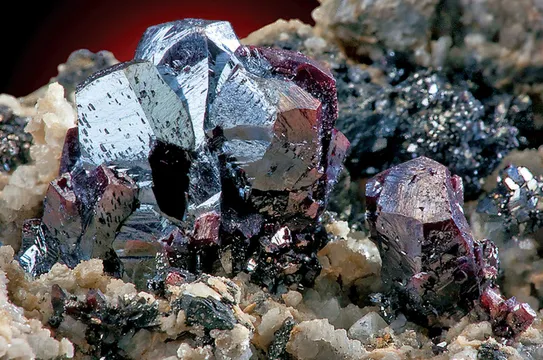
Clausthal-Zellerfeld is one of the classic names in European vein mineralogy: a mining town built over the Upper Harz Pb-Zn-Ag vein district, where steep, WNW-ESE fault systems cut Carboniferous greywacke and slate and carried repeated pulses of quartz, calcite, siderite, barite, galena, sphalerite, chalcopyrite, pyrite, tetrahedrite-group minerals, silver minerals, and rare selenides. To collectors the locality is not merely “old German lead-zinc ore”; it is the source of cabinet pieces with a distinctly Harz personality—milky quartz points, sugary calcite, toffee-brown siderite rhombs, black-brown sphalerite, bright galena, and the famous iridescent chalcopyrite films on tetrahedrite.
Regional View
Country View
The best specimens usually have the measured architecture of old vein pieces rather than the flamboyance of modern pocket bonanzas: sharp sulfides sitting exactly where the paragenesis placed them, carbonate crusts draping earlier crystals, and quartz or calcite providing pale contrast to metallic faces. Many surviving pieces are old collection specimens, often small-cabinet to cabinet size, with labels that matter almost as much as the crystals. Clausthal also has a scientific distinction few mining districts can match: clausthalite, PbSe, is named for Clausthal, and the nineteenth-century Clausthal selenide assemblage remains important enough that modern researchers have re-examined historical specimens from the Königin Charlotte mine.

Photo: Wikimedia Commons

Photo: Wikimedia Commons
Search for specimens: View all specimens from Clausthal-Zellerfeld, Germany
The Clausthal-Zellerfeld mines belong to the Upper Harz vein district of Lower Saxony, a historically decisive Pb-Zn-Ag district developed on steep fault zones in the northwestern Harz Mountains. The host rocks are chiefly Lower Carboniferous greywackes and slates, and the productive structures are not simple single fissures but broad fault and vein zones in which mineralized veins, breccias, altered wall rock, and clayey fault material can occupy widths from only a few metres to far larger zones. Modern descriptions emphasize that the richest ore shoots commonly formed where faults split into horsetail structures, creating networks of ore veins and veinlets rather than a single planar lode.
The principal ore and gangue suite is a low- to medium-temperature hydrothermal assemblage dominated by galena and sphalerite with chalcopyrite, pyrite, and lesser tetrahedrite-group minerals, set in quartz and calcite with local siderite and barite. Banded and breccia textures are typical: fragments of country rock and earlier vein material were repeatedly broken, rimmed by sulfides, and cemented by carbonate and quartz. The Burgstätter vein system is especially important in the scientific literature. In the Burgstätter Fault, banded and breccia veins reached several metres thick, and the ore was developed to very considerable depth; the main sulfide stage contained sphalerite, galena, accessory chalcopyrite, quartz, and calcite, while siderite and barite were much less prominent there than in some other Upper Harz stage-3 assemblages.
The district’s named vein systems and mining fields—Burgstätter, Rosenhöfer, Zellerfelder, Silbernaaler and associated workings—are central to old labels. The Burgstätter system alone accounted for a major share of Clausthal-Zellerfeld’s ore production, with ore bodies connected to shafts such as St. Lorenz, Caroline, Dorothea, Kaiser Wilhelm II, Königin Marie, and others. The Rosenhöfer and Zellerfelder systems are equally important to specimen provenance, especially because nineteenth-century and early twentieth-century centralization moved ore handling toward the Ottiliae Shaft, the great hoisting complex west of the town.
Mining here reaches back into the medieval Harz economy, but the great systematic phase began with the revival of Upper Harz mining in the early sixteenth century. The seven Upper Harz mining towns were founded in that period, and the Clausthal-Zellerfeld area became part of one of Europe’s most sophisticated early industrial landscapes. Ore mining was inseparable from water engineering: ponds, ditches, adits, watercourses, underground drainage levels, and water-powered machinery made deep mining possible on the high plateau. That water-management landscape is now part of the UNESCO World Heritage ensemble of Rammelsberg, Goslar, and the Upper Harz Water Management System.
By the nineteenth century, the district was both a mining centre and a centre of mining technology. The deep adit systems, underground boat transport, and central hoisting arrangements were industrial solutions to a practical collecting fact: the ore came from deep, wet, complex lodes, not from casual surface digging. The Ottiliae Shaft, begun in the later nineteenth century, became the central hoisting shaft for ore from the Rosenhöfer, Burgstätter, and Zellerfelder vein systems. Ore was brought through deep workings, including water-level transport, then raised and processed near the shaft. Mining around Clausthal-Zellerfeld was stopped in 1930, after metal prices and economics no longer justified continued production; later some shafts and water systems were repurposed for hydropower or preserved as monuments.
For collectors today, access is essentially historical, not active. The old mines are not open collecting localities in the modern sense, and the most important underground exposures are exhausted, flooded, sealed, protected, or part of museum and heritage landscapes. The TU Clausthal GeoSammlung, the Upper Harz Mining Museum, and older European collections are therefore crucial repositories of genuine material. Specimens now reaching the market usually come from long-held private collections, dealer inventories, estate dispersals, or museum-quality duplicates rather than fresh finds.
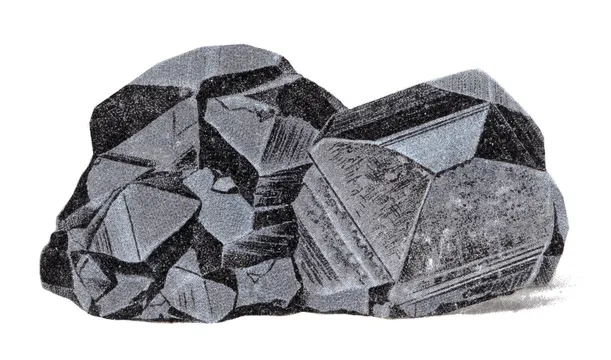
Notable finds include classic chalcopyrite-coated tetrahedrite-group specimens from the Clausthal-Zellerfeld area, especially pieces associated with siderite and dolomite; quartz-calcite-sphalerite-galena combinations from the main sulfide veins; and rare selenide material from the Clausthal mines. The Königin Charlotte mine material is particularly important for clausthalite and tiemannite, where modern work has documented selenide salbands along quartz-carbonate veinlets, patches of clausthalite within tiemannite, and massive to semi-massive selenide pockets in historical samples. These are not showy quartz-pocket minerals in the usual sense; they are dense, dark, metallic, scientifically important pieces whose value depends heavily on provenance and analytical confidence.
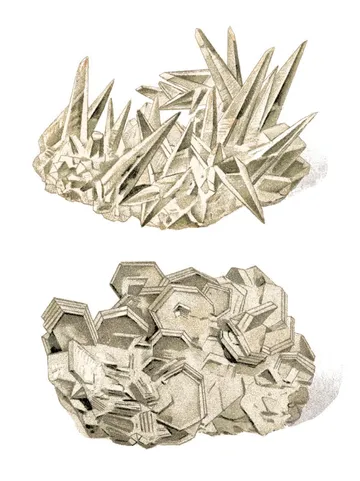
Clausthal-Zellerfeld siderite is most familiar to collectors as warm brown to toffee-brown rhombohedral or lenticular carbonate crusts and druses on sulfide-rich vein matrix, commonly associated with quartz, calcite, galena, sphalerite, chalcopyrite, dolomite, barite, and tetrahedrite-group minerals. It is not usually the huge bladed siderite of Alpine iron deposits; its strength here is paragenetic elegance—fine rhombs coating matrix, framing metallic sulfides, or forming a contrasting brown carpet beneath galena and chalcopyrite. Good pieces show bright, discrete siderite crystals rather than dull oxidized carbonate, strong contrast with metallic species, and minimal edge bruising, because old Harz siderite crusts commonly suffered from trimming, mine wear, or long cabinet life.
Quartz from Clausthal-Zellerfeld is a primary gangue and display mineral in the Pb-Zn-Ag veins, most often milky white to grey-white and occurring as stout points, drusy linings, comb-textured vein fill, and banded quartz intergrown with calcite and sulfides. In classic specimens it carries sharp dark sphalerite, galena, calcite, or small chalcopyrite and pyrite, and in the rarer selenide assemblage it appears with tiemannite and clausthalite in quartz-carbonate veinlets from historical Clausthal material. The best quartz pieces are not judged by water-clear perfection but by structure: undamaged milky points, sparkling drusy surfaces, visible banding or breccia texture, and clean placement of sulfides that records the Upper Harz vein sequence.
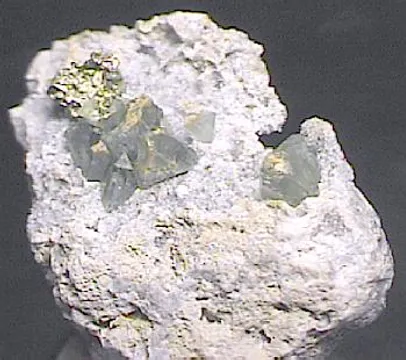
Chalcopyrite at Clausthal-Zellerfeld is important both as an ore mineral in the main sulfide assemblage and as a collector’s accent, particularly where it forms bright golden to iridescent coatings on tetrahedrite-group crystals or small metallic crystals with siderite, dolomite, calcite, quartz, galena, and sphalerite. The most desirable pieces are not massive chalcopyrite ore but old-time combinations in which chalcopyrite sharpens the visual effect of tetrahedral fahlerz crystals, adds brassy colour to brown siderite or pale carbonate, and remains naturally lustrous rather than artificially “rainbowed.” Because chalcopyrite may be a thin surface coating here, careful inspection is needed to distinguish a legitimate chalcopyrite skin on tetrahedrite from later tarnish, abrasion, or ambiguous metallic film.
Other minerals documented from Clausthal-Zellerfeld and its named mines include galena, sphalerite, pyrite, calcite, dolomite, barite, tetrahedrite-group minerals, bournonite, acanthite, pyromorphite, cerussite, malachite, linarite, leadhillite, susannite, hydrocerussite, and a suite of rare selenides. Clausthalite, PbSe, is the signature type-locality species and was named for Clausthal; tiemannite, HgSe, is also treated in modern work as a Clausthal type-locality mineral. Historical specimens from the Königin Charlotte mine have yielded clausthalite and tiemannite as the main selenide components, with naumannite locally subordinate and klockmannite and eskebornite accessory.
Clausthal-Zellerfeld specimens should be bought as old European classics, which means provenance matters. A specimen with an old label naming a mine, shaft, or vein system—Burgstätter Gangzug, Rosenhöfer Gangzug, Zellerfelder Gangzug, St. Lorenz, Königin Charlotte, Caroline, Dorothea, Alter Segen, Zilla, Thurm Rosenhof, Ottiliae-related material—has a collecting value beyond a generic “Harz” label. Conversely, “Harz, Germany” is too broad for serious work unless the mineral association is unmistakable or the piece carries a trustworthy chain of labels.
I found no well-documented class of systematic fakes specific to Clausthal-Zellerfeld comparable to the well-known treated or manufactured problems at some modern localities. The more realistic risks are mislabelling, over-broad locality attribution, and optimistic species lists on complex sulfide specimens. Chalcopyrite may be present only as a coating or as minute crystals; sphalerite and galena can be intergrown; tetrahedrite-group identifications may be historically labelled without modern analysis; and dark selenide specimens require analytical support if they are being sold as clausthalite, tiemannite, or rarer Se species.
Condition is a major issue. Much of the material was mined before modern specimen-preparation standards, and many pieces passed through a century or more of collection storage. Look for bruised quartz terminations, chipped galena corners, rubbed tetrahedrite tips, crushed carbonate druse, and oxidized or loosened siderite crusts. Dealer descriptions of fine Clausthal pieces often point out small fractures, incomplete corners, or wear because damage-free specimens are genuinely scarcer than the mineral names alone suggest.
For handling, treat sulfide-rich pieces as cabinet specimens: keep them dry, avoid repeated washing, and do not soak complex carbonate-sulfide pieces in cleaning agents. Galena and sphalerite are stable under normal indoor conditions, but old pyrite- or marcasite-bearing material from any European sulfide district deserves monitoring for incipient oxidation. Lead-bearing species such as galena, cerussite, pyromorphite, leadhillite, and clausthalite should be handled with ordinary mineral-collection hygiene—wash hands after handling, avoid dust, and keep friable pieces away from children.
Market availability is limited but not vanishing. Modest quartz-calcite-sulfide specimens appear periodically, while fine old tetrahedrite-chalcopyrite-siderite combinations, attractive galena on siderite, and well-provenanced selenides are much scarcer. The top end of the market rewards three things: a precise old label, an attractive multi-species paragenesis, and unusually good preservation for a nineteenth- or early twentieth-century Harz specimen.
Clausthal-Zellerfeld’s mineral specimens come out of a landscape that had to be engineered before it could be mined. The Upper Harz plateau does not hand the miner easy drainage; water was the enemy, the power source, and the organizing principle. Over centuries the miners built a connected machine out of the mountains: ponds to store water, ditches to move it, underground channels to drain it, and waterwheels to convert it into hoisting and pumping power. The result was not a mine with a few support works, but an industrial watershed. That is why the surviving mining landscape around Clausthal-Zellerfeld feels different from many classic localities: the specimen label is often only the mineralogical surface of a far larger system.
One of the most vivid episodes is the underground boat transport of ore. At the Ottiliae Shaft, ore from the Rosenhöfer, Burgstätter, and Zellerfelder vein systems was not simply hoisted at the nearest working. It was transported underground on the Tiefe Wasserstrecke, part of the Ernst-August-Stollen system, from workings as much as 6 km away. At roughly 341 m below the surface, boats carrying ore reached the underground harbour at the Ottiliae Shaft. There the steel transport boxes were fastened to wire ropes, lifted out of the boats, and hoisted to daylight. It is worth pausing on that image: Harz ore specimens—galena, sphalerite, quartz, siderite, chalcopyrite—beginning their journey to the surface not in a mine cart on a visible track, but in a boat moving through a dark engineered waterway beneath Clausthal.
The headframe at the Ottiliae Shaft is itself a surviving object with a collector’s precision of detail. It is a 19.86 m steel truss headframe, made in 1876 in the Clausthal mining forge, and it is described as the oldest steel headframe in the Upper Harz. The shaft was not an independent ore body but a central hoisting point, the logistical heart for several vein systems. Early in the twentieth century the shaft was deepened to 594 m, linking it with deeper workings as the district chased ore downward and eastward. Today the headframe stands as a monument, but for collectors it also helps explain why so many Clausthal-Zellerfeld specimens have mixed labels and central-processing histories: ore and specimens moved through networks, not tidy isolated mines.
Clausthal also belongs to the history of modern wire rope. Wilhelm August Julius Albert, the Harz mining official, developed a serviceable iron wire rope for mine hoisting after the dangers and limitations of hemp ropes and chains became unavoidable in deep shafts. In July 1834 the new rope was put into service at the Caroline mine near Clausthal. The first Albert rope was built from strands of iron wire and became the ancestor of the modern wire rope used in mining, bridges, lifts, and cableways. For a mineral collector, that story is not a technological footnote. It belongs directly to the specimens: deeper hoisting, safer transport, and more reliable mine operation changed what parts of the vein system could be exploited and preserved.
Another Clausthal invention was the man-engine, associated with Georg Ludwig Dörell of Zellerfeld. In 1833, he developed a system that used moving rods and steps to carry miners through deep workings, reducing the brutal time and exertion of ladder climbing. The Harz was a place where deep mining forced inventions, and those inventions travelled. A specimen from Clausthal-Zellerfeld therefore carries a double identity: it is a mineral object and a witness to a mining culture that helped define European underground engineering.
The selenide story is quieter but more mineralogically intimate. In the nineteenth century, Clausthal material gave the world clausthalite and tiemannite, but for a long time the actual type-locality assemblage remained thinly documented. Modern researchers had to return not to an accessible mine, but to historical material stored at the Technische Universität Clausthal. In those specimens from the Königin Charlotte mine, they found tiny but telling relationships: selenide salbands along the contact between fine-grained quartz and reddened greywacke, tiemannite with subordinate clausthalite, patches of clausthalite along microfissures and margins, and massive to semi-massive selenide pockets. It is a reminder that the most important Clausthal specimens are not always the prettiest. Some are dark, dense, and almost secretive until polished, sectioned, or analyzed.