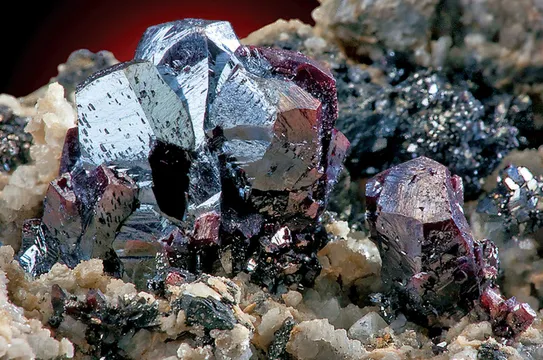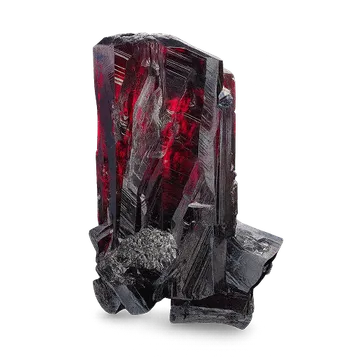
St Andreasberg pyrargyrite, Harz Mountains, Germany; famed for dark ruby-silver crystals, sharp forms, and historic cabinet pieces prized by collectors.
Key facts
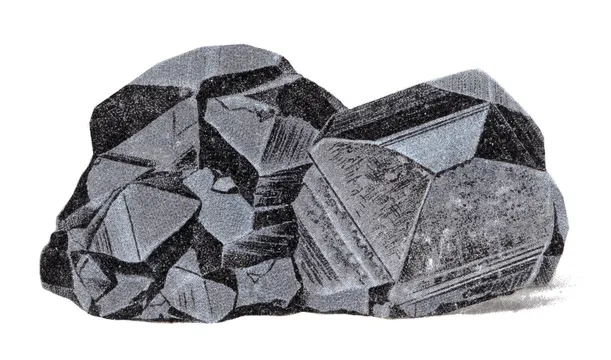
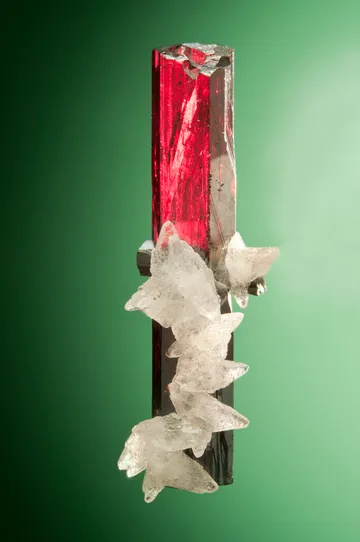
St Andreasberg pyrargyrite is one of the classic signatures of European silver mineral collecting: dark “ruby silver” that often looks almost black in ordinary room light, then suddenly glows cherry- to wine-red when a strong light catches an edge or penetrates a thinner crystal. The best pieces combine razor-sharp trigonal crystals, adamantine-to-metallic luster, steeply striated faces, and the old German silver-mining provenance that serious collectors recognize immediately.

Photo: Wikimedia Commons
The locality is not a single pocket or one isolated vein, but a compact and unusually complex silver-mining district in the Harz Mountains of Lower Saxony. The mines worked narrow hydrothermal veins in a fault-bounded block of Devonian slates, marly shales, sandstones, and spilitic rocks near the Brocken pluton. Those veins were never broad lodes by modern mining standards; many averaged less than a meter thick. What made them extraordinary was their repeated reopening, shifting chemistry, and late silver-rich stages. In that setting, pyrargyrite formed with a distinctly St Andreasberg suite: calcite, galena, native silver, native arsenic, dyscrasite, löllingite, argentopyrite, stibarsen, stephanite, miargyrite, quartz, and rare silver species that have made the district famous far beyond its small geographic footprint.

Photo: Wikimedia Commons
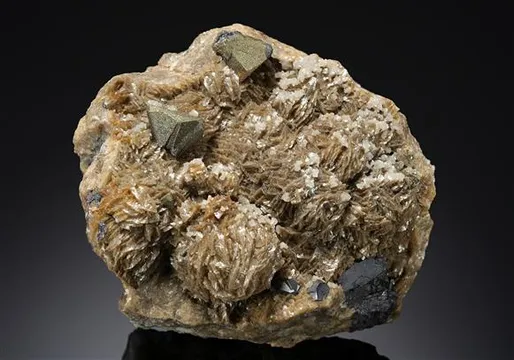
For collectors, the St Andreasberg look is unmistakable when it is at its best: lustrous black-red crystals rising from pale calcite, lead-gray sulfide matrix, or heavy native arsenic; small but commanding clusters with bright faces; and old labels that may trace through 19th- or early 20th-century European collections. Large single crystals are scarce, but the district produced highly aesthetic miniatures and small cabinet specimens, and a few historic cabinet pieces have dendritic or stacked crystal aggregates several centimeters long. Many fine examples are old-time specimens mined before the Samson Mine closed in 1910, so provenance, labels, and documented collection history can be nearly as important as crystal quality.

Photo: Wikimedia Commons
Search for specimens: View all pyrargyrite specimens from St Andreasberg Mining District, Germany
St Andreasberg lies in the middle Harz Mountains, today within Braunlage, Goslar District, Lower Saxony. Historically it was a Bergstadt, a mining town, whose identity was built around silver. Documented mining activity in the area reaches back to 1487, and rich silver discoveries around 1520 led to the founding and growth of Sankt Andreasberg. At its height the district included scores of mines, with the Samson Mine becoming the emblematic operation and later the best-known source attached to classic pyrargyrite specimens.
The deposit is a hydrothermal silver vein district. Its veins occupy a horst-like wedge bounded by the Neufanger and Edelleuter fault systems. Around twenty principal veins of differing strike are recognized, most of modest width, and the productive mineralization persisted to more than 800 m depth. The ore shoots were controlled by intersections of veins with cataclastic zones, where barriers to hydrothermal flow helped localize high-grade silver mineralization. This structural complexity explains both the difficulty of mining and the remarkable mineral diversity.
The paragenesis is especially important for understanding St Andreasberg pyrargyrite. Early low-grade oxide-carbonate mineralization was followed by a main base-metal stage dominated by galena, sphalerite, chalcopyrite, and tetrahedrite. Later reactivation produced silver-rich ore shoots with nickel-cobalt arsenides, native arsenic, native antimony, and the famous “noble calcite” generation. A still later stage remobilized calcite and deposited rich silver ores. Pyrargyrite belongs to this celebrated silver-rich environment, often appearing with calcite and other silver-antimony or silver-arsenic minerals.
The Samson Mine was opened in the early 16th century and worked until 1910. It ultimately reached roughly 840 m total depth and had 42 levels. In the 19th century it ranked among the deepest mines in the world, and its preserved surface and underground engineering are now part of the wider UNESCO-listed Rammelsberg Mine, Old Town of Goslar, and Upper Harz Water Management System. The surviving mine complex, with its waterwheels, shaft house, and man-engine, gives St Andreasberg specimens a unusually tangible historical setting: these are not anonymous old German silvers, but minerals from a precisely documented mining landscape.
Collecting access today is not a matter of entering old workings casually. The Samson Mine is a museum and technical monument, while the Roter Bär educational mine preserves and investigates historic workings under organized control. Some documented modern finds from mine dumps and reopened historical workings exist, especially in the broader Beerberg area, but serious collectors should treat St Andreasberg material as primarily historic. Pieces with reliable old labels from Samson, Catharina Neufang, Gnade Gottes, Claus-Friedrich, Alter Theuerdank, Felicitas, or the district generally are far more meaningful than unsupported locality claims.
Pyrargyrite from St Andreasberg is prized for the tension between darkness and fire. In hand, many crystals appear black, steel-gray, or dark red-black with bright metallic to adamantine reflections. Under intense illumination, thin edges, broken contacts, and gemmy zones reveal the red that gave the “ruby silver” ores their fame. On the best specimens, this internal color is not a surface tint but a deep transmitted glow.
The characteristic habits are trigonal prisms, short to stout crystals, steep rhombohedral terminations, complex stacked groups, and sharply striated faces. Individual crystals of a few millimeters are common on good miniatures; crystals around 1 cm are already significant, and crystals exceeding that size command attention. Historic cabinet specimens may show dendritic, bladed-looking, or branching aggregates rather than isolated equant crystals. One famous large cabinet specimen from the Ferguson Collection, described as circa 1800, carries lustrous black dendritic pyrargyrite crystals to about 5 cm across a flat gray matrix.

Photo: Wikimedia Commons
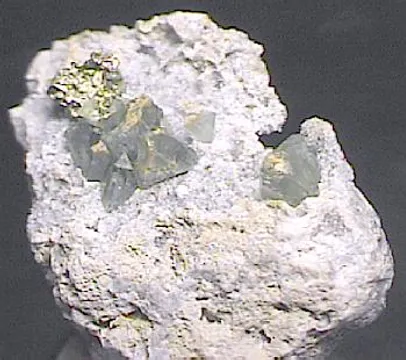
Associations are a major part of locality recognition. The most desirable contrast pieces show pyrargyrite on white to translucent calcite. Other classic matrices include galena-rich sulfide, massive pyrargyrite, quartz, and heavy native arsenic. Native arsenic associations are especially evocative of St Andreasberg: rounded arsenic masses, dull gray to brownish-gray surfaces, and small bright black-red pyrargyrite crystals perched in protected recesses. Löllingite, native silver, dyscrasite, stibarsen, argentopyrite, harmotome, and stephanite also appear in the documented assemblage.

Photo: Wikimedia Commons
Quality is judged by sharpness, luster, transmitted red color, aesthetics, condition, and provenance. A thumbnail with a few flawless, highly lustrous, backlit red crystals on calcite may be more desirable than a larger but dull mass. Collectors favor well-terminated crystals, visible striations, three-dimensional grouping, and a matrix that explains the district rather than obscuring it. Historic labels can elevate the specimen considerably, especially when they connect the piece to old European collections or to well-known collectors and dealers.
St Andreasberg pyrargyrite is a closed-locality classic in practical collecting terms. The Samson Mine ended ore production in 1910, and the best crystallized specimens entered collections generations ago. Good pieces do appear on the market, but they usually come from estate collections, old dealer stock, or historic European suites rather than from new production.
The first authenticity concern is not artificial treatment but identity and provenance. Pyrargyrite, proustite, pyrostilpnite, and other dark ruby-silver minerals can be visually confusing, and St Andreasberg produced several related silver sulfosalts. Pyrargyrite is Ag3SbS3, the antimony member; proustite is the arsenic analogue and tends to be lighter scarlet, but visual separation is not always secure. On valuable specimens, especially those lacking an old label, analytical confirmation or a highly documented chain of ownership is worth seeking.
Provenance is especially important because “St Andreasberg” has been a prestigious name for more than two centuries. A convincing specimen should fit the district mineralogically: dark red-black trigonal crystals, calcite or galena or arsenic matrix, and a classic silver-sulfosalt habit. A vague “Harz” label is not the same as Samson Mine or St Andreasberg District; it may still be correct, but the value should reflect the uncertainty.
Condition is a major issue. Pyrargyrite is relatively soft, and old specimens often show bruised terminations, rubbed high points, chipped prism edges, or missing crystals in clusters. Many St Andreasberg crystals are small and bright, so even minor damage can be visually significant under magnification. Dense black-red clusters can hide repaired contacts or losses; examine under a loupe and with raking light.
Pyrargyrite is less notorious than proustite for rapid light damage, but it can darken with prolonged exposure. Fine old specimens should be displayed conservatively: avoid direct sunlight, intense hot lamps, and long-term high-UV exposure. For photography, use brief, controlled lighting. Do not attempt aggressive cleaning; calcite associations can be sensitive to acids, arsenic-rich matrices require sensible handling, and old labels are part of the specimen’s value.
Market availability ranges from small dark crystals on matrix to significant old-time miniatures and cabinet specimens. Recent dealer offerings show typical miniatures in the few-hundred to low-thousand-dollar range, while cabinet specimens with strong display quality, historic labels, or exceptional provenance can move much higher. The most desirable examples combine visible red translucency, undamaged sharp crystals, a classic matrix, and pre-1910 or 19th-century documentation.
In the winter of 1777, Johann Wolfgang von Goethe came to the Harz not as a casual tourist but as a man intensely curious about mining, geology, and the machinery of the underground world. At St Andreasberg he entered the Samson workings and came out by way of the neighboring Neufang and Gottes Gnade mines. The line that survived in his diary has the clipped force of a man who had felt the mine in his bones: “Ward mir sehr sauer diesmal.” It was hard on him this time.
The physical reality behind that sentence is easy to underestimate from a modern museum doorway. Before mechanical conveyance, miners and visitors descended by ladders, one wet, dark section after another. Accounts of Goethe’s mining excursions emphasize the extremity of these descents: narrow workings, dangerous wet shafts, falling rock in nearby mines, and, at Samson, more than 800 m of depth and thousands of rungs. In that world, the silver minerals were not abstract cabinet objects. They were won from a deep, cold, structurally complicated mine where the path down and back could itself become an ordeal.
The Samson Mine later became famous not only for its minerals but for the machine that changed the rhythm of that ordeal. The man-engine installed in 1837 used paired moving rods with small platforms. A miner stepped from one platform to the other at the change of stroke, gradually being carried down or up instead of climbing the entire shaft by ladder. The working depth was already more than 600 m when the system was introduced and later extended toward 800 m. The machine reduced the punishing ladder journey, and the St Andreasberg installation became a landmark of mining engineering.
By the end, the great mine had the melancholy profile of many classic European ore districts: immense depth, famous minerals, superb engineering, and worsening economics. Compressed-air drilling introduced in 1890 raised output, but falling silver values, low-grade ore, and high hoisting costs undermined the operation. In 1905 the Samson Mine produced 364 kg of silver; in 1909 only 90 kg. On 31 March 1910, the last shift of 80 miners left the pit. Pumps were stopped, and water rose through the workings to the main drainage level. For collectors, that date matters. It marks the end of the mining life that supplied the old pyrargyrites now passing from collection to collection.
One of the most vivid specimen stories belongs not to a mine crew but to a cabinet specimen that survived generations. A large St Andreasberg pyrargyrite from the Ferguson Collection, described as circa 1800, resurfaced in London after having remained in a family estate largely untouched. It is not a dainty thumbnail: it measures 17.3 x 13.1 x 2.3 cm, with dendritic lustrous black pyrargyrite crystals to 5 cm running across a flat gray limestone matrix and spongy dark silver-rich ore on the reverse. Its importance lies in the double survival—first from the mine, then through two centuries of collecting history.