South Orebody, USA - premier Missouri locality for amber calcite, galena, chalcopyrite, and dolomite specimens; famed for paragenesis and galena study.
Key facts
South Orebody is the collector’s name for a specimen-producing part of the Sweetwater Mine, the southernmost of the great Viburnum Trend lead-zinc-copper mines of Reynolds County, southeastern Missouri. In specimen terms it is not a casual roadcut or a dump locality, but a deep, working Mississippi Valley-type orebody in the Cambrian Bonneterre Formation, where hot saline basinal brines moved through the Lamotte Sandstone and into reactive dolostone around buried Precambrian highs. The same process that made the Viburnum Trend one of the premier lead-producing districts on Earth also lined open spaces with some of the most distinctive American mine specimens of the late twentieth and early twenty-first centuries: waxy amber calcite, bright golden to iridescent chalcopyrite, heavy galena, pearly dolomite, and, in rare cases, Co-Ni-Cu sulfides such as siegenite.
Regional View
Country View
The best South Orebody pieces have a look that is immediately Missouri: pale honey to yellow calcite crystals, commonly scalenohedral, doubly terminated, prismatic, or “nailhead”-terminated, perched on a dark metallic galena-and-chalcopyrite ore matrix or on small sparkling dolomite rhombs. Many specimens are not just single-species display pieces but compact paragenetic narratives, with earlier sulfides acting as a heavy armature for later carbonate growth. Good examples balance sharpness, translucency, undamaged calcite terminations, lively chalcopyrite color, and enough galena mass to anchor the specimen visually and literally.
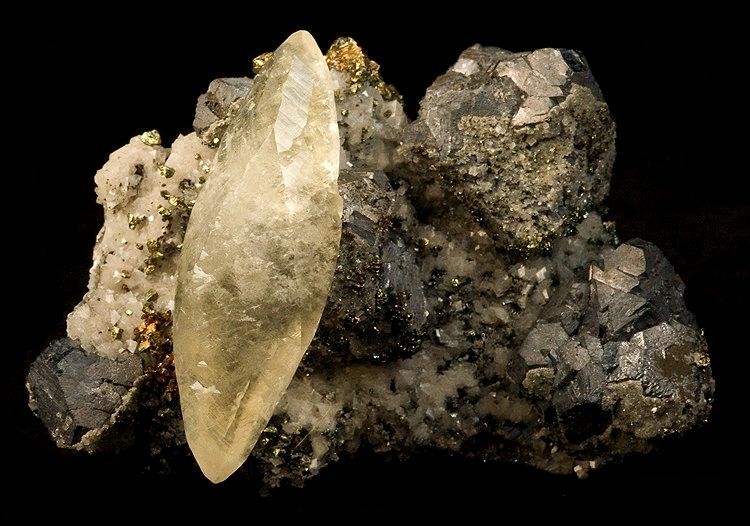
Photo: Rob Lavinsky, iRocks.com via Wikimedia Commons
South Orebody is especially important because it is tied to a formal mineralogical study of Sweetwater galena morphology. More than 400 well-crystallized galena specimens were collected from the South Orebody for measurement of crystal form and distribution, showing a full gradation from nearly pure octahedra to strongly cubic cuboctahedra. For collectors, that means South Orebody galena is not merely attractive; it is a documented example of how ore-fluid pathways and crystal morphology can be read specimen by specimen.

Search for specimens: View all specimens from South Orebody, USA
South Orebody is part of the Sweetwater Mine near Ellington in Reynolds County, Missouri, within the Viburnum Trend of the Southeast Missouri Lead District. Sweetwater has also appeared in older labels and literature as the Milliken Mine, Frank R. Milliken Mine, Ozark Lead Company Mine, Blair Creek, Adair Creek, and Logan Creek. The mine lies roughly northwest of Ellington and represents the southern end of the productive Viburnum Trend belt.
Geologically, the deposit is a classic carbonate-hosted Mississippi Valley-type system, but it is a particularly metal-rich and mineralogically complex member of that family. Ore is mainly hosted by the Upper Cambrian Bonneterre Formation, a dolostone unit deposited around Precambrian basement knobs and paleotopographic highs, with the underlying Lamotte Sandstone serving as a major fluid pathway. Mineralizing brines rose into permeable and reactive carbonate facies, replacing dolomite and lining open spaces. The principal ore minerals are galena, sphalerite, and chalcopyrite, with dolomite, calcite, quartz, pyrite, and marcasite among the most important gangue or associated minerals.
The Viburnum Trend ores are tabular to sinuous, stratabound bodies rather than simple vertical veins. They are controlled by sedimentary facies, permeability contrasts, brecciation, and the geometry of buried Precambrian topography. At Sweetwater the orebody was reported at about 1,400 feet depth, matching the collector’s experience of Sweetwater material as mine-run underground production rather than surface-collected field material. Room-and-pillar mining, drill-and-blast methods, underground crushing, and shaft hoisting are documented for the operation.
The history of Sweetwater began with exploration by Bear Creek Mining Company, Kennecott’s exploration subsidiary. The discovery hole was drilled in 1962, and production began in 1968 under the Ozark Lead Company. Low lead prices forced the mine onto standby in 1983. ASARCO purchased the operation in 1986, renamed it Sweetwater Mine, and restarted production in December 1987. Doe Run acquired the Sweetwater operation in the late 1990s and continues to list Sweetwater among its Viburnum Trend mining assets. Collector labels therefore vary meaningfully by era: Ozark Lead/Milliken labels point to early mine history, ASARCO labels to the late 1980s and 1990s, and Doe Run-associated material to later production.
The mineralization is paragenetically layered in the way that makes Viburnum Trend specimens so rewarding. Regional studies describe early copper and Co-Ni events, repeated sphalerite and galena deposition, several generations of dolomite cement, and late quartz and calcite. Open-space pockets and vug linings are the source of the display specimens: cuboctahedral and cubic galena, chalcopyrite sprinkled or encrusting earlier sulfides, white to pinkish dolomite rhombs, and later calcite crystals ranging from small translucent scalenohedra to large amber prisms and double terminations. South Orebody galena, in particular, is known from a systematic study of more than 400 specimens selected for crystal quality and known position in the orebody.
Access today is not comparable to a public collecting locality. Sweetwater is an active private underground mine, and ordinary collecting on the property should be considered closed unless arranged through the operator under formal permission and mine-safety requirements. Collector material reaches the market through mine-related recovery, old collections, dealer stocks, and specimen lots dispersed from miners and regional collectors. The best older South Orebody pieces therefore carry significant locality and provenance value, especially when accompanied by ASARCO, Ozark Lead, Milliken, or collection labels that preserve the specific orebody attribution.
South Orebody calcite is the visual signature mineral on many specimens: pale amber, honey-yellow, colorless, grayish, or waxy cream crystals sitting on galena-chalcopyrite-dolomite ore matrix. Habits include steep scalenohedra, doubly terminated crystals, elongated prisms with rhombohedral caps, and flattened “nailhead” or beveled terminations; documented Sweetwater examples range from thumbnail crystals to cabinet specimens over 20 cm overall, with individual display crystals exceeding 5 cm on fine pieces. The most desirable examples combine translucency, complete terminations, strong contrast against dark galena or brassy chalcopyrite, and minimal bruising along the easy calcite cleavage directions; lesser pieces are often cloudy, heavily contacted, or have chipped apices. Some Sweetwater calcite also shows notable midwave UV fluorescence, including pink-magenta responses on amber calcite over galena, making clean, fluorescent pieces especially attractive to collectors who build both daylight and UV suites.
Chalcopyrite from South Orebody occurs as bright brassy crystals, small sparkling druses, coatings, and richly colored iridescent accents on galena, dolomite, quartz, and calcite-bearing matrix. Individual crystals on association specimens are commonly millimetric to about 1 cm, though the species can dominate cabinet-size plates from Sweetwater; the finest pieces show sharp, lustrous, golden crystals or natural blue-purple-gold tarnish that contrasts with pastel dolomite and amber calcite. Because Viburnum Trend paragenesis places chalcopyrite early among important ore minerals and also within later complex sulfide assemblages, it may appear as scattered crystals, coatings on galena faces, or part of copper-rich replacements. The collector’s challenge is separating naturally iridescent Sweetwater chalcopyrite from acid-brightened “peacock” material: sharp crystal form, believable color distribution, old labels, and undamaged associated calcite all matter.
Galena is the scientific backbone of South Orebody collecting. A formal study of more than 400 South Orebody specimens showed that main-stage Sweetwater galena is dominated by octahedral forms variably modified by cubic faces, producing a full spectrum of cuboctahedral habits from almost entirely octahedral to nearly cubic. On specimens, the galena appears as metallic lead-gray to gunmetal crystals and crystal groups, commonly associated with chalcopyrite, dolomite, and later calcite; crystals may be modest millimeter-size accents or substantial centimeter-scale forms, with documented Sweetwater specimens showing compound octahedra over 3 cm and cabinet pieces with heavy galena matrices. Good South Orebody galena has crisp faces, bright luster, attractive modification, and enough contrast from calcite or chalcopyrite to avoid looking like massive ore; ordinary pieces tend toward dull, cleaved, or visually crowded galena where form is obscured.
Dolomite at South Orebody is usually the quiet but essential matrix mineral: pale white, cream, pinkish, or sparkling rhombic crystals that line cavities and provide a bright granular stage for galena, chalcopyrite, and calcite. In the Viburnum Trend, dolomite cement is not a single event; cathodoluminescence studies of the district document multiple regionally correlative dolomite generations overlapping sulfide deposition, which helps explain why dolomite can appear below, between, or beside ore minerals rather than simply as late decoration. Collectible South Orebody dolomite is seldom valued as isolated crystals; instead, the best examples are clean association pieces where fine rhombs sharpen the contrast between dark galena, golden chalcopyrite, and amber calcite. Drusy, undamaged, evenly distributed dolomite on a stable matrix is preferable to chalky, bruised, or massive carbonate surfaces.
Other minerals documented from the Sweetwater system broaden South Orebody interest well beyond the four common display species. Sphalerite, pyrite, marcasite, quartz, and dickite occur in the general assemblage, and the mine is also notable for copper and Co-Ni sulfides including bornite, chalcocite, digenite, covellite, anilite, polydymite, millerite, fletcherite, and siegenite. Siegenite is the standout rarity for collectors: South Orebody material includes reported specimens of sharp metallic crystals with chalcopyrite and dolomite, including a June 1997 example with a main crystal about 0.9 x 0.8 cm, and later Sweetwater material with tiny siegenite crystals perched on chalcopyrite. No new species is treated here as a South Orebody type-locality mineral, but the orebody belongs to the same Viburnum Trend mineralogical province that made Co-Ni-Cu sulfides a Missouri specialty.
South Orebody specimens should be judged first by locality confidence. Labels may read South Orebody, Sweetwater Mine, Milliken Mine, Ozark Lead Company Mine, ASARCO Sweetwater, or simply Reynolds County, Missouri. The most valuable labels are those that preserve the orebody-level attribution, because “Sweetwater Mine” alone covers a broader collecting and mining history. Since similar calcite-chalcopyrite-galena-dolomite associations also come from other Viburnum Trend mines such as Brushy Creek, Buick, Fletcher, West Fork, and Casteel, vague “Missouri lead mine” labels should not be upgraded to South Orebody without supporting provenance.
The most common condition issue is calcite damage. Sweetwater calcite may look robust, but sharp scalenohedra and double terminations chip easily, and cleavage bruises can appear as dull flat scars on otherwise lustrous faces. Large amber calcites are often contacted at their base or along one side where they grew against the pocket wall; this is acceptable when natural and not visually disruptive. Galena is heavy and cleaves perfectly, so broken corners, dull cleavage flashes, and rubbed edges are common. Chalcopyrite can lose luster through handling, cleaning, or oxidation, while marcasite-bearing matrix should be watched for instability in humid storage.
Treatments and misrepresentation deserve special attention. Brilliant “peacock” chalcopyrite is sometimes produced or enhanced by acid treatment, and this is especially relevant for Viburnum Trend material because natural iridescent chalcopyrite also occurs. Acid-brightened pieces may show unnaturally uniform electric color, etched carbonate, or a lack of old surface patina. Natural iridescence tends to be more localized and consistent with crystal growth, coatings, or bornite-related tarnish. When buying high-color chalcopyrite, ask whether the dealer considers the color natural, treated, or uncertain.
Fluorescence adds a second collecting dimension. Some Sweetwater calcite fluoresces strongly enough under midwave UV to be desirable as a UV specimen, with reported pink-magenta calcite over galena and pale blue-white fluorescence from coatings on the matrix. Not every South Orebody calcite is a fluorescent specimen, and longwave response may be much weaker than midwave in some documented examples. If fluorescence is part of the price, request wavelength-specific photographs and visible-light images of the same faces.
Market availability is better than for many classic closed localities because Sweetwater has remained a working operation into the modern period, yet true South Orebody-attributed specimens with excellent aesthetics are still selective pieces. Small calcite-chalcopyrite-dolomite associations are obtainable; crisp galena study-quality pieces, old Ozark/ASARCO-era specimens, large undamaged calcites, and examples with siegenite or unusual Co-Ni-Cu sulfides are much scarcer. The best specimens combine three things at once: unmistakable Viburnum Trend mineralogy, specific Sweetwater/South Orebody provenance, and specimen quality that rises above attractive ore.
One of the best South Orebody stories is not a single pocket blast but a scientific collecting campaign. More than 400 well-crystallized galena specimens were taken from the South Orebody at Sweetwater so their crystal shapes could be measured, sorted, and mapped. The study did not simply say “cubes and octahedra occur here.” It measured the relative areas of cube and octahedron faces and separated the crystals into nine morphological groups, ranging from crystals with more than 90 percent octahedral development to much more cubic forms. Six of those types followed the length of two ore runs, and another was restricted to a circular area at the end of one ore run. That is the sort of detail collectors rarely get: a pocket’s galena not only as display material, but as a directional trace of ore-fluid movement through the mine.
Another story belongs to the small, glittering world of siegenite. A 1997 South Orebody specimen from the former Silvane Collection was described as siegenite with chalcopyrite and dolomite, mined in June of that year, with a main crystal measuring 0.9 x 0.8 cm. For most Viburnum Trend collectors, a centimeter-class siegenite crystal is already a serious object; from Sweetwater’s South Orebody, the association and date make it even more desirable.
A later Sweetwater siegenite specimen adds a modern collector’s twist. Acquired at the 2022 Detroit mineral show from Everett Harrington and Darcie Smith of Minerals Plus, the cabinet-size specimen carried tiny siegenite crystals on earlier chalcopyrite with calcite and quartz. The crystals were only about 0.05 to 0.2 cm, but the collector recorded a memorable detail: Everett said it was the only specimen with siegenite among roughly 6,000 specimens. Whether one treats that number as a dealer’s field recollection or a hard inventory count, it captures the reality of Sweetwater rarity. Thousands of calcite-chalcopyrite combinations may pass through collections, but a single Co-Ni sulfide-bearing piece can be the one everyone remembers.
Sweetwater calcite has also become a favorite among collectors who like unusual crystal surfaces. So-called “dragon scale” calcite, described by collectors from the mine, consists of overlapping calcite growths with dark internal coloration attributed to chalcopyrite inclusions and phantoms. These pieces are not the standard clean amber scalenohedra of Sweetwater; they are odd, textured, and immediately recognizable. The better examples have enough translucency to show their internal glitter and zoning, yet enough surface relief to earn the nickname.
Sun, Yan; Hagni, Richard D.; and Walker, W. T. “Classification and Spatial Distribution of Galena Crystals at the Sweetwater Mine, Viburnum Trend, Southeast Missouri, U.S.A.” In Carbonate-Hosted Lead-Zinc Deposits: 75th Anniversary Volume, Society of Economic Geologists Special Publication 4, 1996, pp. 587–596. The key South Orebody paper, based on more than 400 galena specimens collected from the South Orebody and used to classify cuboctahedral galena morphology and spatial distribution.
Voss, Robert L.; Hagni, Richard D.; and Gregg, Jay M. “Sequential Deposition of Zoned Dolomite and Its Relationship to Sulfide Mineral Paragenetic Sequence in the Viburnum Trend, Southeast Missouri.” Carbonates and Evaporites, vol. 4, no. 2, 1989, pp. 195–209. Important for understanding the multiple dolomite cement generations that form much of the matrix and paragenetic framework for Sweetwater specimens.
Niewendorp, C. A.; and Clendenin, C. W. “Paragenetic Link Between Organic Matter and Late-Stage Ore Deposition in the Sweetwater Mine, Viburnum Trend, Southeast Missouri.” Economic Geology, vol. 88, 1993, pp. 957–960. A Sweetwater-specific paper useful for late-stage ore and organic-matter relationships.
Hagni, Richard D. “Mineralogy and Significance of Bornite Ores in the Viburnum Trend, Southeast Missouri Lead District.” In Carbonate-Hosted Lead-Zinc Deposits, Society of Economic Geologists Special Publication 4, 1996. Places Sweetwater’s rarer copper and Co-Ni-Cu sulfide assemblages in the broader Viburnum Trend context.
Hagni, Richard D.; and colleagues, Viburnum Trend references summarized in “Platy Galena from the Viburnum Trend, Southeast Missouri: Character, Mine Distribution, Paragenetic Position, Trace Element Content, Nature of Twinning, and Conditions of Formation,” Minerals, 2018. Open-access synthesis of Viburnum Trend galena, geology, paragenesis, temperature, brine salinity, and rare platy galena occurrence.
Missouri Department of Natural Resources / Missouri Geological Survey, Field Guide to the Upper Cambrian of Southeastern Missouri: Stratigraphy, Sedimentology, and Economic Geology. Useful regional guide for Bonneterre Formation stratigraphy, Viburnum Trend paragenesis, and district-scale ore controls.
U.S. Geological Survey, Hydrologic Investigations Concerning Lead Mining Issues in Southeastern Missouri, Scientific Investigations Report 2008–5140. Provides concise Sweetwater Mine history, discovery, production start, ownership sequence, mine depth, and operational context.
Calvin Harris, “Luminosity of a Calcite Specimen from the Sweetwater Mine, Ellington, Reynolds County, Missouri,” Friends of Mineralogy Midwest Chapter Newsletter, vol. 39, issue 5, September–October 2024. A specimen-based study of Sweetwater calcite fluorescence and phosphorescence under multiple UV wavelengths.
“Galena with Calcite, Chalcopyrite and Dolomite from Sweetwater Mine, Ellington, USA” — Fabre Minerals. Short specimen video showing sharp cubic galena with polycrystalline face growths on dolomite and chalcopyrite, with translucent calcite; specimen size 11.2 x 7.6 x 8.8 cm.
“JHG5050 Galena on Marcasite, Sweetwater Mine USA” — Jordi Fabre / Fabre Minerals. Specimen video documenting a Sweetwater galena-marcasite association.
Mindat: Sweetwater Mine, Ellington, Reynolds County, Missouri, USA — Core locality page for the parent mine, including historical names, geology, mineral list, and references.
Mindat minID 0K5-REY: Siegenite, Calcite, Chalcopyrite, Quartz — A useful modern documented Sweetwater siegenite specimen record, with collector notes on rarity and South Orebody occurrence.
Wikimedia Commons: Category Sweetwater Mine — Large image set of Sweetwater specimens, useful for comparing calcite, galena, chalcopyrite, dolomite, pyrite, marcasite, and siegenite habits.
Wikimedia Commons: Calcite-Galena-Chalcopyrite-235256 — Photograph and provenance notes for a classic calcite-galena-chalcopyrite-dolomite Sweetwater specimen from the Dr. Gary Hansen Collection.
Wikimedia Commons: Chalcopyrite and Calcite, Sweetwater Mine — Clear visual reference for iridescent chalcopyrite and calcite from the mine.
Doe Run Company: Mining Jobs / Viburnum Trend — Current operator context showing Sweetwater as part of Doe Run’s Viburnum Trend mining assets.
Doe Run Company: History — Company timeline useful for placing Sweetwater within the post-Old Lead Belt Viburnum Trend operating history.
Virtual Museum of Geology: Missouri Minerals — Photographic comparisons of Sweetwater calcite and covellite, plus broader Viburnum Trend mineral specimens.
FMF Mineral Forum: A Mineralogical Trip Through the States of USA — Missouri — Collector-oriented thread including a documented South Orebody siegenite specimen mined in June 1997.
USGS: Hydrologic Investigations Concerning Lead Mining Issues in Southeastern Missouri — Best concise public source for Sweetwater discovery, ownership, production, and environmental-mining context.