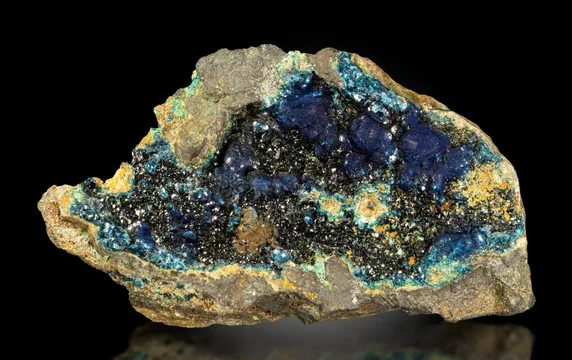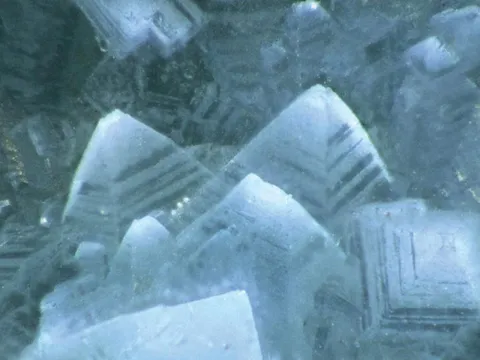
Clay Canyon Mine, USA: Utah locality famed for variscite nodules (Little Green Monster) and as type locality for wardite, millisite, montgomeryite—historic pho…
Key facts
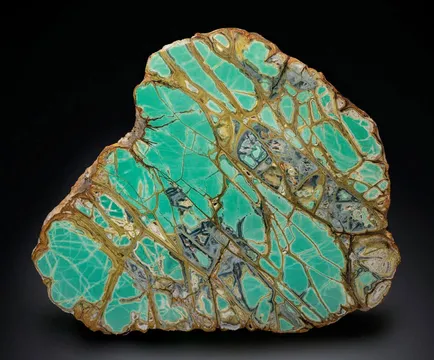
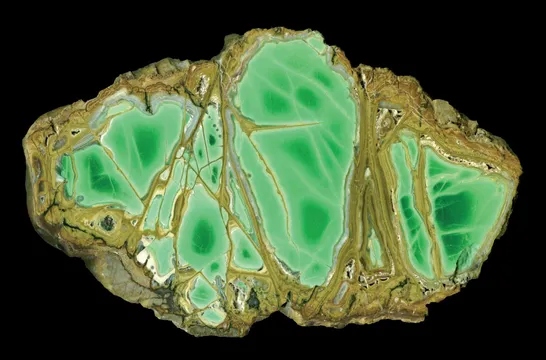
Clay Canyon is the classic American locality for variscite nodules: the “Little Green Monster” material from near Fairfield, Utah, whose best polished halves and slabs show dense apple- to emerald-green variscite cut and rimmed by yellow crandallite, grey-green to blue-green wardite, pale millisite, and a suite of rare hydrous aluminum phosphates. The mine lies in Clay Canyon on the south end of the Oquirrh Mountains, in the Sunshine Mining District of Utah County, roughly west of Fairfield and southwest of Salt Lake City. Its specimens are not simply attractive lapidary objects; they are historic mineralogical documents. Clay Canyon is the type locality for wardite, englishite, gordonite, millisite, montgomeryite, and overite, and the locality was central to the early 20th-century study of phosphate alteration in variscite nodules.
Geologically, the deposit is a shallow, structurally controlled phosphate replacement and fissure-filling occurrence in brecciated Mississippian Great Blue Limestone, with dark limestone and black shale above the Long Trail Shale Member providing the host setting described in Utah Geological and Mineral Survey work. Variscite formed first as nodules and replacements, then later waters altered and partly dissolved it to produce concentric shells, seams, cavities, and crystal-lined pockets of crandallite, wardite, millisite, gordonite, englishite, montgomeryite, overite, apatite-group minerals, and other phases. To the collector’s eye, the important thing is that the mineralization records its own sequence in cross-section: green cores broken by pale healed seams, yellow replacement rinds, grey-blue “eyes,” and occasional tiny crystals in solution cavities.
Regional View
Country View
Clay Canyon specimens occupy a special place between gem rough and systematic mineral specimen. The most familiar pieces are sawn and polished nodules, because the beauty of the locality is chiefly internal: color zoning, fortification-like crandallite bands, turquoise-green variscite islands, and wardite-millisite spherules that would be invisible or unimpressive on an uncut lump. The finest examples have strong color contrast, unbroken nodular structure, a clear rind, and enough polish to show the paragenesis as a miniature geologic map.

Photo: Wikimedia Commons

Photo: Wikimedia Commons
Search for specimens: View all specimens from Clay Canyon Mine, USA
Clay Canyon Mine, in collector usage, usually refers to the Little Green Monster Variscite Mine in Clay Canyon near Fairfield, Utah, though older labels may say Clay Canyon Variscite Mine, Utahlite Mine, Chlorutahlite Mine, Fairfield, or simply “Utah variscite.” Utah Geological and Mineral Survey work describes three variscite occurrences in Clay Canyon: the Little Green Monster deposit and two unnamed deposits. The principal collector locality is the Little Green Monster, a former underground phosphate and gemstone mine in altered limestone.
The host rocks are dark limestone and black shale of the Upper Mississippian Great Blue Limestone, stratigraphically above the Long Trail Shale Member. At the Little Green Monster, the phosphate mineralization follows a north-trending, nearly vertical fracture zone, with nodules occurring in pipe-like bodies plunging northward. Variscite and crandallite occur as nodule aggregates in highly altered matrix, as elongate replacements along fractures, and as fissure fillings. The surrounding brecciated and fractured limestone is altered to limonitic clay with alunite, chalcedonic quartz, and calcite. The broader Clay Canyon area also sits near epithermal alteration and precious-metal mineralization of the southern Oquirrh region, but the precise genetic relationship between the scandium-bearing aluminum phosphate deposits and nearby hydrothermal systems has remained debated.
The classic nodule structure is the key to understanding both the geology and the specimens. Early work by Esper S. Larsen, 3rd, showed that variscite was the first phosphate phase to be deposited, forming nodules in shattered limestone. Later solutions replaced and veined the variscite, first producing the yellow calcium aluminum phosphate material historically called pseudowavellite and now treated in the Clay Canyon collector context chiefly as crandallite, then alternating wardite and millisite bands, then later yellow and white crandallite-like layers. A later, more open-cavity stage produced the crystallized rarities: gordonite, englishite, montgomeryite, overite, and associated apatite-group minerals.
Historically, Clay Canyon variscite entered science and commerce in the 1890s. F. T. Millis of Lehi sent material to George P. Merrill of the U.S. National Museum in 1893, and R. L. Packard published on the Utah variscite in 1894. George F. Kunz later promoted the gem name “utahlite,” while “chlorutahlite” was used commercially for the green ornamental material. Don Maguire mined and marketed the material for the jewelry trade from the 1890s into the early 20th century. Production peaked in the 1909–1911 period, when thousands of pounds of variscite were reportedly produced for gem and ornamental use.
The specimen-mining era most important to modern collections began in 1936–1937, when Arthur Montgomery and Edwin J. Over took an interest in the deposit. They were not simply mining green stone; they were searching for phosphate specimens. Their underground work in 1937 and again in 1939 produced large quantities of nodules and, more importantly, better examples of wardite, gordonite, montgomeryite, overite, englishite, and related rarities. Material from those workings entered Harvard, the Smithsonian, the American Museum of Natural History orbit, and many old private collections. Much of the finest classic material on the market today traces, directly or indirectly, to those early campaigns or to old lapidary stock derived from the mine.
The mine was later examined as a scandium-bearing phosphate occurrence. Beginning in 1959, the Kawecki Chemical Company investigated the deposits as a possible scandium source, and two small crandallite-ore shipments were made in 1959 and 1960, weighing 330 pounds and 4,000 pounds. Analyses of Clay Canyon phosphates showed notable scandium enrichment: crandallite and variscite from Fairfield contain significant scandium, and wardite, deltaite, and goyazite were also reported with measurable scandium oxide. For collectors, that scandium chapter explains why otherwise quiet-looking pale phosphate rinds from Clay Canyon matter scientifically.
Collecting access today should be treated conservatively. The Little Green Monster claim is patented private property, and published locality accounts state that permission from the owner is required. Mindat also notes that very little of the old locality remains visible today, with mine entrances and dumps bulldozed to conform to the surrounding hills. In practical terms, modern collectors should not expect a public collecting locality or productive dump digging. The supply is overwhelmingly old-stock nodules, older sawn slabs, vintage museum or dealer material, and specimens circulating from established collections.
Clay Canyon variscite occurs as dense, fine-grained to microcrystalline green nodules and residual green masses within replaced nodules, not as freestanding crystals; Larsen described the best color range from vivid emerald green to lighter pea green, commonly mottled and locally marked by darker green healed fracture lines. The nodules range from small pieces under an inch to exceptional masses measured in feet, though the common old collecting size is roughly one to three inches, and the desirable cabinet specimens are usually sawn and polished halves or slabs that reveal bright variscite cores rimmed by yellow crandallite and cut by grey-green to blue-green wardite, pale millisite, white crandallite-like layers, quartz, calcite, or limonitic matrix. Good Clay Canyon pieces are judged less by raw size than by color saturation, completeness of the nodule architecture, sharp contrast between green variscite and yellow crandallite, clean polish, attractive “eyes” or fortification bands, and minimal fracturing or crumbly rind; ordinary pieces are paler, patchier, overly altered, or lack the diagnostic green-yellow-grey association that makes the locality unmistakable.
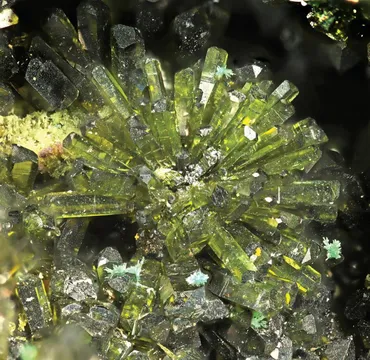
Wardite is one of Clay Canyon’s signature scientific minerals and the locality’s great rarity in association with variscite: it forms blue-green, grey-green, bluish grey, pale yellow, or nearly colorless tetragonal crystals, crusts, coarse fibrous aggregates, spherules, and alternating wardite-millisite shells within the altered nodules. In polished variscite nodules, wardite commonly appears as grey-green to blue-green “eyes,” seams, and concentric bands with white millisite immediately inside or around yellow crandallite rinds; in more open altered nodules, individual wardite crystals may project into small solution cavities, sometimes more than a millimeter across, and can be coated by millisite or overgrown by later apatite-group minerals. The best Clay Canyon wardites show clear identity rather than mere grey phosphate: recognizable blue-green crystalline or spherulitic wardite in sharp association with green variscite and yellow crandallite, preferably with visible banding, cavities, or polished cross-section geometry that proves its place in the nodule sequence.
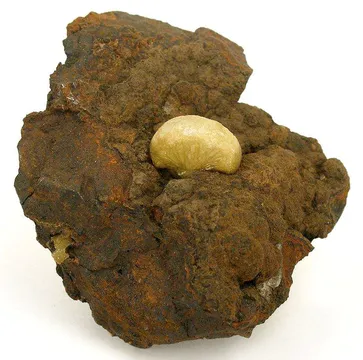
Beyond variscite and wardite, Clay Canyon’s reputation rests on a rare-phosphate assemblage that has repeatedly revised mineralogical nomenclature. Confirmed type-locality minerals include englishite, gordonite, millisite, montgomeryite, overite, and wardite. Millisite is typically white to light grey and closely interlayered with wardite in spherules and crusts. Gordonite occurs as colorless, smoky white, pale violet, pale green, or faintly tinted prismatic triclinic crystals in cavities near variscite. Englishite appears as pearly, flexible, plate-like aggregates and is strongly cleavable. Montgomeryite is especially prized when present as bright blue-green bladed crystals or dark circular zones in polished nodules. Overite is among the rarest Clay Canyon phosphates, occurring as tiny pale yellow to colorless crystal clusters or thin platy shells. Crandallite is the dominant yellow to cream replacement rind in most display pieces. Kolbeckite is also important historically, because Clay Canyon material once described as sterrettite was later shown to be the scandium phosphate kolbeckite; clear crystals are usually tiny, though exceptional larger examples have been reported. Older names such as deltaite, lehiite, davisonite, dehrnite, and lewistonite appear in the early literature and on some old labels, but several were later discredited or reassigned, so old Clay Canyon labels should be read with mineralogical caution.
The main authenticity issue with Clay Canyon material is not usually treatment, but locality attribution and nomenclature. “Utah variscite” is too broad for a serious label: Lucin, Amatrice Hill, Clay Canyon, and other western occurrences can all produce green variscite-like material. Clay Canyon’s strongest visual signature is a polished nodule or slab with dense green variscite, yellow to cream crandallite rinds or veins, grey-green to blue-green wardite, and commonly pale millisite or white crandallite-like seams. Pieces lacking that association may still be Utah variscite, but they should not be upgraded to Clay Canyon without provenance.
Turquoise confusion is another recurring problem. Historically, variscite was marketed under trade names such as utahlite and chlorutahlite, and green nodular material may be miscalled “Utah turquoise” in lapidary contexts. True Clay Canyon variscite is aluminum phosphate, not copper phosphate, and the locality’s typical green color is associated with trace chromophores such as vanadium and chromium rather than the copper chemistry of turquoise. For high-value pieces, especially cabochons or polished nodules sold as “Clay Canyon,” old labels, collection history, or analytical confirmation are worth far more than color alone.
Condition issues are locality-specific. Clay Canyon nodules are often naturally fractured, healed, replaced, and rimmed by softer, porous phosphate and limonitic material. A polished face may be excellent while the outer rind is friable or undercut. Yellow crandallite and pale alteration bands can be chalkier than the green variscite and may take a weaker polish. Thin slabs can warp, chip at the edges, or cleave along old seams if mishandled. Avoid soaking specimens, ultrasonic cleaning, acids, or aggressive detergents; a soft dry brush or barely damp cloth is safer for polished faces.
Specimens with identifiable rare phosphates should not be recut casually. A plain green variscite cabbing slab and a scientifically valuable Clay Canyon nodule can look similar to a lapidary buyer, but a grey-green wardite spherule, a tiny gordonite cavity, a montgomeryite patch, or an old label noting englishite, millisite, or overite can transform the specimen’s significance. Micromount-scale cavities in altered nodules deserve careful inspection before any polishing or trimming.
Market availability is uneven. Attractive polished variscite-crandallite-wardite slabs appear periodically because old stock was cut for lapidary and display use, but fine, large, sharply patterned cabinet pieces from the Little Green Monster are classic and bring strong prices. Unpolished nodules with intact scientific context, old Montgomery-Over era provenance, or visible rare phosphate crystals are scarcer. Good wardite specimens from the locality are much less common than attractive variscite slabs, and matrix pieces with recognizable gordonite, montgomeryite, englishite, overite, or kolbeckite should be treated as specialist material rather than decorative variscite.
The Clay Canyon story begins with a green stone that did not yet have its modern collector’s mythology. In December 1893, F. T. Millis of Lehi sent a specimen to George P. Merrill, curator of geology at the U.S. National Museum. The original locality information was imprecise by modern standards: material said to occur as “nuggets” in a quartz vein near Lewiston, now Mercur, about twenty miles west of Lehi. Packard’s 1894 examination recognized the material as variscite rather than the older and poorly constrained “peganite,” and the Utah locality quickly entered the literature. The specimen described from Merrill’s material was no mere chip: it was a large nodular mass nearly seven inches long, with green variscite divided by yellow crandallite bands and a powdery white coating between the two.
Commercial names followed almost immediately. George F. Kunz suggested “utahlite,” and the jewelry trade soon saw “chlor-utahlite,” a name tailored to the stone’s green color and marketability. Don Maguire of Ogden acquired the deposit and worked it for years as ornamental gem material. Those early miners and dealers were looking primarily for polishable green stone, not for the intricate phosphate paragenesis that later made the locality famous to systematic collectors.
Wardite entered the story through the commercial stream. John M. Davison examined variscite nodules received by Ward’s Natural Science Establishment in Rochester, New York, and found cavities left by decomposition of variscite. Those cavities were lined with light green to bluish green crystals of a new phosphate mineral, which he named wardite for Henry A. Ward. In hindsight, the discovery was a remarkable example of commerce delivering science: gem nodules shipped for sale carried inside them a new mineral species.
Then came the long pause. After the 1890s descriptions, the locality sat mineralogically quiet for decades. Esper S. Larsen and Earl V. Shannon revived serious study in the 1920s using museum material, a large collection from George L. English at Ward’s Natural Science Establishment, and specimens Larsen collected from the dump during a 1927 visit. Larsen found the deposit developed by a short tunnel and drift. Their 1930 paper described a remarkable suite of phosphates, including several names that would later be revised, discredited, or reinterpreted. Clay Canyon was already proving to be both a treasure chest and a taxonomic trap.
The most vivid collecting chapter arrived in the fall of 1936. Arthur Montgomery and Edwin J. Over came to Clay Canyon after collecting epidote at the Jumbo mine and Green Monster Mountain on Prince of Wales Island, Alaska. Their Utah claim would become the “Little Green Monster,” a name that nicely compresses the whole episode: an echo of the Alaskan Green Monster and a wink at the little green variscite nodules hiding in the limestone. In 1937 and again in 1939 they did what the earlier gem miners had not done systematically: they mined for mineral specimens as well as variscite. The result was thousands of pounds of nodules and far better crystals of several rare phosphates, distributed to major museums, dealers, and collectors.
Those Montgomery-Over workings reshaped the scientific record. Frederick H. Pough studied better wardite and gordonite crystals. Duncan McConnell worked out that dehrnite and lewistonite belonged to the apatite group. Esper S. Larsen, 3rd, used the material in a series of papers tied to his doctoral research, describing overite and montgomeryite in 1940 and publishing his three-part paragenetic study in 1942. The polished nodules that collectors admire for color were, under Larsen’s microscope, a sequence of groundwater chemistry written in rings: variscite first, then replacement, dissolution, wardite-millisite banding, renewed crandallite-like alteration, tiny cavity crystals, and final apatite-group deposition.
Clay Canyon also produced one of the quieter dramas of mineral nomenclature. The deposit’s early papers named a crowd of supposed new phosphates: dehrnite, deltaite, davisonite, englishite, gordonite, lehiite, lewistonite, millisite, overite, montgomeryite, and sterrettite among them. Later work dismantled part of that list. Some names fell into crandallite, apatite, or mixtures; sterrettite ultimately gave way to kolbeckite for ScPO4 · 2H2O. What remains is still extraordinary: six accepted type-locality minerals tied to Clay Canyon, plus a deep historical paper trail showing how difficult fine-grained hydrous phosphates can be when chemistry, optics, and crystal structure all have to agree.