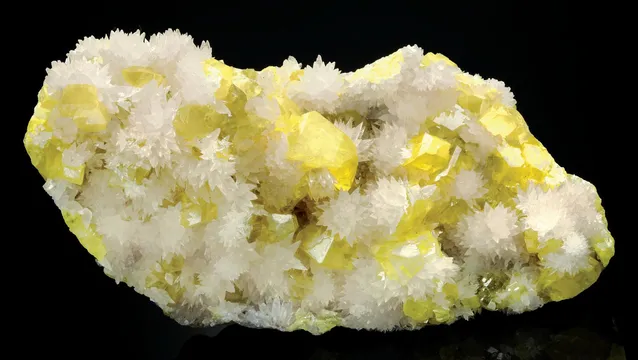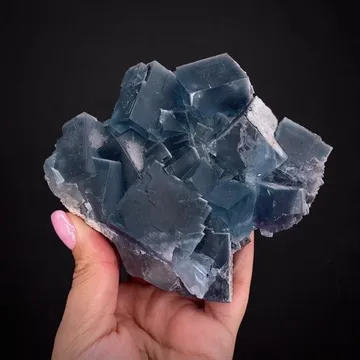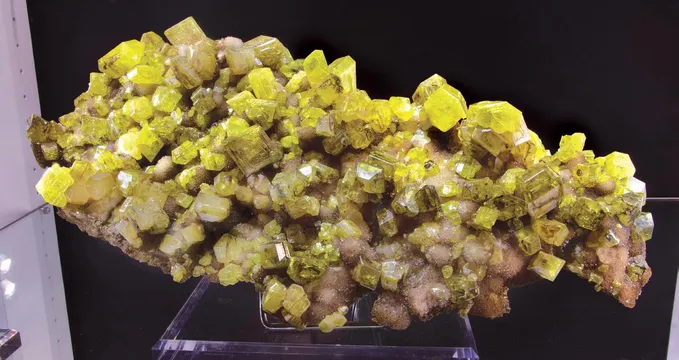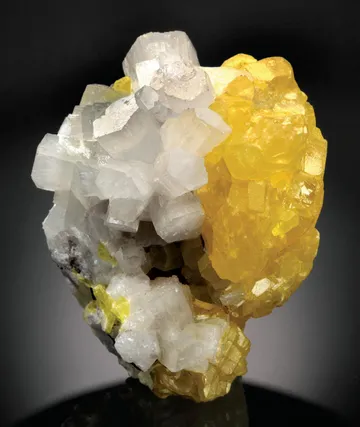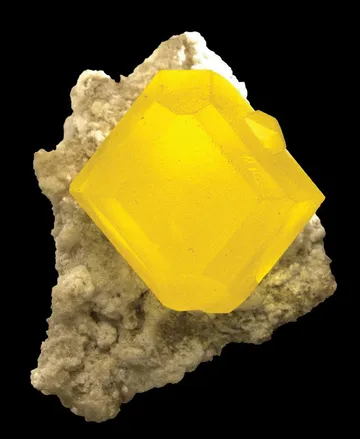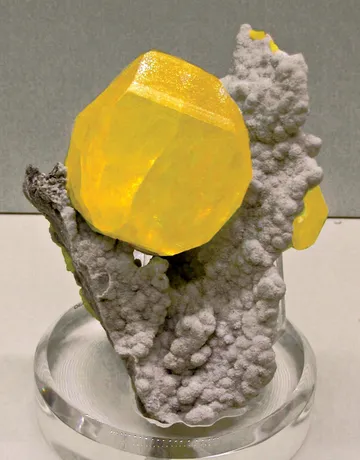
Sicily, Italy — renowned sulfur locality with sharp, lemon-yellow native sulfur on aragonite, calcite, or gypsum; famed old zolfare and collectible cavities.
Key facts
Sicily is one of the few mineral localities whose specimens can be recognized across a room: lemon-yellow native sulfur crystals, often sharp and translucent, perched on white aragonite, calcite, gypsum, or pale celestine from the old zolfare of the island’s central belt. For collectors, “Sicily” usually means the Messinian evaporite sulfur province of Agrigento, Caltanissetta, and Enna, where the late Miocene Mediterranean salinity crisis left thick gypsum, anhydrite, halite, limestone, and marl successions that later became the host for native sulfur, secondary carbonates, strontium sulfate, bitumen, and the classic cavities known to miners and collectors alike.
The mineralogical personality of Sicily is not merely sulfur in isolation, but a whole evaporite assemblage: sulfur with aragonite, calcite, gypsum, celestine, bitumen, and rare silica phases such as melanophlogite. The best cabinet pieces show sulfur as complete orthorhombic crystals with glassy to resinous luster, saturated yellow color, and enough transparency to glow from within. Matrix examples are especially desirable when the white carbonate or sulfate makes a clean architectural stage for the sulfur rather than burying it. On the finest old pieces from mines such as Cozzo Disi, Racalmuto, Cianciana, Floristella, La Grasta, Gessolungo, and Trabonella, the contrast is as important as the mineral species: yellow sulfur against snow-white aragonite, bluish celestine, or granular calcite, sometimes with dark bituminous staining that gives the specimen an unmistakably Sicilian edge.
Historically, the island matters far beyond specimen cabinets. Sicilian sulfur supplied industry for generations, feeding the European appetite for sulfuric acid, gunpowder, and chemical production during the 18th, 19th, and early 20th centuries. The same mines that produced world-class crystals also became a central chapter in labor history, remembered for the carusi, the boys who carried ore up from the galleries, and for the disasters that scarred mining towns around Caltanissetta and Agrigento. Modern collecting is therefore inseparable from provenance: an old Sicilian sulfur is a mineral specimen, a mining artifact, and often the surviving physical record of a vanished underground industry.
Regional View
Country View
Sicily’s collector story also has a volcanic counterpoint. The Aeolian Islands, especially Vulcano and its La Fossa crater, have produced a suite of extremely rare fumarolic minerals, while the Cyclopean Islands off Aci Trezza are historically tied to analcime. These are not the large display specimens that made Sicily famous in the mineral trade, but they make the island one of Italy’s more varied mineralogical regions: sedimentary sulfur deposits in the center and south, active volcanic sublimates to the north, zeolitized basalts in the east, and isolated rare sulfide occurrences such as the celebrated hauerite of Raddusa.

Photo: Fabre Minerals
Search for specimens: View all specimens from Sicily, Italy
The classic Sicilian sulfur specimens come from sediment-hosted native sulfur deposits within the Messinian evaporite succession, especially the “gessoso-solfifera” terrain of central and south-central Sicily. During the Messinian salinity crisis, roughly 5.96 to 5.33 million years ago, restricted Mediterranean basins accumulated vast evaporites: gypsum, anhydrite, halite, limestones, marls, and associated salts. Later diagenetic reactions involving sulfate minerals, organic matter, hydrocarbons, methane, and sulfate-reducing microbial systems generated native sulfur and secondary carbonate bodies. In hand specimen this history appears as sulfur growing with calcite and aragonite, celestine in vugs and crusts, gypsum crystals and plates, limestone or marl matrix, and local bitumen or petroleum staining.
The main collecting belt follows the old sulfur-mining districts of Agrigento, Caltanissetta, and Enna. Agrigento Province gives many of the most familiar locality names on old labels: Racalmuto, Cozzo Disi at Casteltermini, Cianciana, Cattolica Eraclea, Favara, Aragona-Comitini, and related mine groups. Caltanissetta Province contributes Gessolungo, Trabonella, La Grasta, Muculufa, Canicassè, and numerous smaller solfare. Enna Province includes Floristella, Grottacalda, Giumentaro, and other workings in the great mining landscape between Valguarnera Caropepe, Piazza Armerina, Aidone, and Enna. Older labels may use Girgenti for Agrigento, “Sicilien” or “Sicilia” for the island, and mine spellings that vary between Italian, local usage, and collector tradition.
The ore bodies were not simple veins in the classic hard-rock sense. They were bedded and replacement-style sulfur concentrations in sedimentary evaporite and carbonate rocks, with cavities, geodes, and irregular mineralized spaces. Miners used the word garbere for cavities that could produce loose or attached crystals. These openings are central to specimen quality: sulfur needed open space to form sharp orthorhombic crystals rather than massive ore, while aragonite, celestine, calcite, and gypsum crystallized as coatings, sprays, druses, pseudomorphs, and lining material. Cozzo Disi is especially important for sulfur on aragonite and calcite, with celestine, gypsum, and bitumen also documented; calcite replacing or coating aragonite is a characteristic feature of some specimens from that mine.
Mining intensified in the late 18th and 19th centuries as European chemical industries consumed enormous quantities of sulfur. Early extraction and refining were primitive and wasteful, including open burning methods such as calcarelle and later calcaroni; improved Gill furnaces appeared in some districts, but Sicilian production was eventually undercut by cheaper sulfur from the Frasch process in the United States and later by sulfur recovered from petroleum and gas. The island still produced into the 20th century, with major workings active through the postwar years, but the old industry declined sharply after the 1950s. Floristella and Grottacalda are now interpreted as an industrial-heritage landscape; Trabia-Tallarita is preserved in part as a museum; and Cozzo Disi, often described as the last of the Sicilian sulfur mines, belongs to the final phase of commercial activity that ended in the late 1980s.
Operators and ownership changed through the centuries. In the 19th century, Sicilian sulfur was tied to landowners, concessionaires, contractors, and export interests; the 1838 monopoly granted by Ferdinand II to the French company Taix & Aycard became a political and commercial flashpoint. Floristella is associated historically with the Pennisi family, whose Palazzo Pennisi still stands as part of the mining landscape. In the 20th century, state and regional involvement became more prominent, including the Ente Minerario Siciliano during the attempted rescue and rationalization of a failing industry. By the time the last mines closed, the specimen-producing galleries that supplied the classic market were no longer a living source in any practical collecting sense.
Collecting access today should be treated as essentially historical rather than recreational. Many old workings are collapsed, fenced, private, contaminated, or protected as cultural and environmental heritage sites; underground entry is dangerous and not a collector activity. Floristella-Grottacalda and Trabia-Tallarita are best approached as museums or industrial-archeology sites, not collecting grounds. Modern specimens on the market are overwhelmingly old-stock pieces, specimens recovered during earlier mining, material from long-dispersed Italian and European collections, or pieces that passed through dealers after the closure of the mines. A precise old label, mine name, collection history, or publication reference adds real value, because “Sicily” alone may hide a wide range of possible sources and quality levels.
The notable finds were pocket finds rather than a single modern “discovery.” Cianciana produced admired sulfur crystals, aragonite twins, gypsum groups, celestine, and calcite associations. Cozzo Disi yielded some of the classic sulfur-on-carbonate display pieces, including sulfur on aragonite, sulfur with calcite, and calcite-after-aragonite textures. Racalmuto is represented by old-time sharp sulfur crystals, some on white aragonite or calcite, and by material with the dark bituminous notes collectors expect from Sicilian evaporites. La Grasta, Muculufa, and Canicassè are especially remembered for blue to pale bluish celestine, sometimes in stout crystal aggregates. Giumentaro is valued for aragonite specimens, including UV-reactive material, and is still cited in recent Italian mineralogical collecting literature as one of the localities where attractive non-sulfur specimens remain more obtainable than top sulfur crystals.
Sicilian sulfur is the island’s signature species: native sulfur, S8, in bright yellow to orange-yellow orthorhombic crystals, commonly sharp, lustrous, and translucent, with the finest examples forming complete single crystals or well-balanced clusters on white aragonite, calcite, gypsum, or celestine. Agrigento localities such as Racalmuto, Cozzo Disi, and Cianciana are especially important for display pieces, while Caltanissetta and Enna mines add classic associations from Gessolungo, Trabonella, La Grasta, Floristella, Grottacalda, and related workings. Ordinary Sicilian sulfur may be granular, massive, contacted, or dull from handling and abrasion; good pieces show undamaged faces, clean terminations, saturated color, and an attractive carbonate or sulfate matrix. The best old specimens have a visual tension that collectors prize: fragile, glassy sulfur crystals emerging from pale evaporite matrix, often with bitumen stains that confirm the sedimentary, hydrocarbon-rich setting rather than detract from it.
Aragonite from Sicily is inseparable from the sulfur mines, where it occurs as white to grayish, cream, and locally stained sprays, pseudohexagonal twins, crusts, and jackstraw-like aggregates that commonly serve as the matrix for native sulfur. Cozzo Disi, Racalmuto, Cianciana, Giumentaro, and other central Sicilian zolfare have produced aragonite with sulfur, calcite, celestine, gypsum, and bitumen; some specimens show later calcite coating or partly replacing the aragonite, creating bold pseudohexagonal forms with a softer, granular surface. Collectors value aragonite here less as isolated CaCO3 than as a sculptural matrix mineral: sharp white sprays framing sulfur crystals, twinned clusters with good relief, or aragonite groups from Giumentaro with strong red to orange fluorescence under ultraviolet light. Damage is common because the sprays and tips are brittle, so a Sicilian aragonite specimen rises above ordinary examples when it has fresh terminations, a balanced architecture, and an undisturbed relationship to its sulfur or celestine association.
Sicilian celestine, SrSO4, is a classic accessory to the sulfur deposits and can be far more than a minor association: the old mines around Caltanissetta, including La Grasta, Muculufa, and Canicassè, are noted for pale blue to bluish-white celestine, sometimes in stout crystalline aggregates, while Floristella, Grottacalda, Cozzo Disi, Racalmuto, and other zolfare produced celestine with sulfur, aragonite, calcite, gypsum, and marl or limestone matrix. The crystals range from colorless or white crusts and sparkling druses to more collectible blue tabular or blocky groups; on sulfur specimens, celestine may appear as a delicate pale coating or contrasting crystalline carpet. Good Sicilian celestine is judged by color, crystal definition, freedom from bruising, and association: blue or bluish crystals in aesthetic relationship with yellow sulfur are much stronger than dull white crusts with no form. The best pieces retain the evaporite character of the mine while offering a cooler palette than the usual sulfur-on-aragonite classics.
Calcite from Sicily’s sulfur mines occurs as granular white matrix, drusy coatings, clear to milky crystals, stalactitic or crustiform growths in limestone cavities, and most distinctively as calcite coating or replacing aragonite in large pseudohexagonal forms, especially reported from Cozzo Disi and other central Sicilian workings. It is part of the same diagenetic carbonate story that produced native sulfur: calcium released from sulfate minerals and carbonate precipitation in reducing, organic-rich evaporite settings. On specimens, calcite may support sulfur crystals, encrust aragonite, form sparkling white bases, or appear as later pale coatings that soften crystal edges. Good collector pieces depend on contrast and clarity of relationships: bright sulfur perched on snowy calcite, calcite after aragonite with recognizable original habit, or clean drusy calcite that enhances rather than obscures the yellow sulfur. Routine calcite matrix is common; well-composed calcite-sulfur associations with undamaged sulfur and recognizable mine provenance are much scarcer.
Other documented Sicilian minerals add depth to the locality beyond the four marketplace staples. Gypsum is important in the sulfur mines, including clear selenite crystals, swallowtail twins, and specimens with sulfur inclusions or associations, though it is fragile and fresh aesthetic examples are less common than the geology would suggest. Melanophlogite, a low-temperature silica clathrate associated with sulfur deposits, has a historically important Sicilian story tied to the Giona mine and other old sulfur localities, with yellow to brown or reddish material colored by organic matter and bituminous films. Hauerite from the Destricella mine near Raddusa is one of the island’s great rarities: sharp black to brownish octahedral MnS2 crystals from clay below sulfur-gypsum mineralization, long regarded among the finest hauerite specimens known. Sicily also has type-locality significance outside the sulfur belt: analcime is historically tied to the Cyclopean Islands at Aci Trezza, while the fumaroles of La Fossa crater on Vulcano have produced rare ammonium, thallium, bismuth, lead, sulfate, chloride, and fluoride-bearing minerals including barberiite, hephaistosite, steropesite, aiolosite, adranosite, and related micro-mineral species.
The chief authenticity issue is artificial “Sicilian” sulfur. In the 1970s, manufactured specimens entered the market: laboratory-grown sulfur crystals crystallized on natural Sicilian matrix, visually convincing enough that crystal habit, association, and ordinary chemistry may not be sufficient to separate them from natural pieces. Later sulfur-isotope work showed that some manufactured examples used non-Sicilian salt-dome sulfur grown onto Sicilian matrix. This is not a theoretical risk; it is one of the classic fraud cases in modern mineral collecting. Large, perfect, intensely yellow sulfur crystals on white matrix with weak provenance should be treated carefully, especially if the piece lacks an old label, collection chain, or credible dealer history.
Current Chinese lab-grown sulfur specimens, sometimes bright yellow and spectacular, add a second layer of confusion. Many are honestly sold as lab-grown, but some have been marketed online as natural or even as Sicilian. These may be grown on artificial, altered, or unrelated matrix and can be far too “fresh,” glassy, or flamboyant for a classic old Sicilian specimen. Natural Sicilian sulfur can certainly be brilliant, so appearance alone is not proof of fraud; the safest approach is provenance, comparison with documented old material, and caution with bargain-priced cabinet pieces that would be very costly if genuine.
Condition matters enormously. Sulfur is soft, brittle, heat-sensitive, and easily bruised; it should be kept away from sunlight, hot display lights, heaters, and rapid temperature changes. Even hand warmth is not ideal for prolonged handling of fine crystals. Chipping along sulfur crystal edges is common, and contacted backs are normal on many old specimens, but front-facing damage, broken tips, greasy handling, dull surfaces, and glued repairs reduce desirability. Aragonite and celestine sprays are also fragile, and many matrix specimens have edge rubs or lost needles. A little bitumen staining is normal and often attractive; oiliness, artificial yellow residue, or a strong chemical odor should prompt closer examination.
Fluorescence can add interest but should not be overvalued unless the specimen is otherwise strong. Sicilian aragonite from sulfur mines may show red to orange fluorescence under UV, and some calcite or celestine associations can be visually pleasing under ultraviolet light. Sulfur itself is usually not the fluorescent attraction. For display, use LED lighting with low heat output and avoid intense direct light. For storage, keep sulfur away from reactive metal labels or mounts, and avoid sealed hot cases; good old boxes with stable temperature and low physical contact are safer than dramatic but warm display environments.
Market availability is uneven. Small sulfur-on-matrix pieces and older sulfur fragments are still seen with some regularity, but top Sicilian sulfur—large, sharp, undamaged, aesthetic, and well-provenanced—is genuinely scarce and increasingly tied up in established collections. Celestine and aragonite from the sulfur mines remain more obtainable, especially as old-stock or mid-grade specimens, though fine blue celestine associations and crisp aragonite-sulfur combinations are much less common than generic “Sicily sulfur” labels suggest. Precise mine attribution, old Italian labels, museum or collection provenance, publication history, and intact condition all carry a premium.
In the old sulfur districts, mineral beauty and human cost occupied the same ground. The display specimen in a collector’s cabinet began as ore in a working world of pirriaturi, the pickmen who broke sulfur-bearing rock underground, and carusi, boys who carried loads up from the galleries. Historical accounts describe children beginning at seven or eight years old, while medical and social histories give a range as young as six to fourteen. The smallest boys carried roughly 25 to 30 kilograms; older boys could be loaded with 30 to 80 kilograms of ore. They climbed narrow inclines and stairways from galleries where ventilation was poor, lamps were open, and explosions, fires, collapses, and flooding were never abstract risks.
The most haunting date in Sicilian sulfur history is November 12, 1881. At the Gessolungo mine near Caltanissetta, a firedamp explosion, ignited by a lamp, killed 65 miners and injured dozens more. Among the dead were 19 carusi; nine of those boys were never identified by name. The Cimitero dei carusi near the mine remains one of the starkest memorials in the sulfur country, a place where the collector’s phrase “classic Sicilian sulfur” suddenly acquires weight beyond mineral aesthetics. When a Gessolungo label appears with sulfur on aragonite or “strawberry” sulfur, it carries not only locality data but the memory of one of Italy’s most painful mining disasters.
Trabia-Tallarita tells the story at industrial scale. In its great period around 1920, the mine produced a reported 12 percent of the world’s sulfur and employed about 3,000 miners underground. The site was not just a mine but a working settlement, with a carabinieri station, chapel, post office, employee housing, workshops, and the Palladio power station. Today the restored museum in the former power station turns machinery into interpretation: a simulated descent into the mine, animated Tosi engines, scientific exhibits on electricity, a timeline of Sicilian sulfur, and a permanent photographic exhibition on miners and mining life. It is one of the best places to understand the industrial world from which the old specimens came.
Floristella-Grottacalda offers a different kind of survival. Across roughly 400 hectares, the park preserves two major abandoned sulfur mines in the landscape between Enna, Piazza Armerina, Valguarnera Caropepe, and Aidone. Floristella was active from the late 18th century into the modern closure period, while Grottacalda has documented early 19th-century activity and probably earlier prospecting. Palazzo Pennisi still stands there, a striking reminder that sulfur wealth created palaces as well as tunnels. The visitor sees headframes, furnace remains, galleries, service buildings, and the scars of extraction in open country—an open-air museum of a vanished mineral economy.
Cozzo Disi remains a name collectors say with special respect. Its specimens are among the most recognizable Sicilian classics: sulfur crystals on aragonite, sulfur with calcite, calcite after aragonite, celestine, gypsum, and bitumen. It also belongs to the end of the story, because Cozzo Disi is widely cited as the last Sicilian sulfur mine, closing in the final phase of the 1980s after a history that linked premodern hand labor to late industrial decline. The mine’s best specimens preserve the whole paragenesis in miniature: yellow native sulfur, white carbonate, occasional bluish celestine, and the dark hydrocarbon signature of the evaporite basin.
The strangest mineralogical story may be Raddusa. At the Destricella mine near Raddusa, black octahedral crystals were collected from a clay layer below the sulfur-gypsum mineralization. In 1890 Eugenio Scacchi, then a leading Italian mineralogist, reported on crystals sent to him by Santi Rindone Lo Re through a student. They resembled magnetite at first glance, but Scacchi’s tests showed sulfur and manganese, establishing them as hauerite, MnS2. The species had been known from Hungary, but the Sicilian crystals became legendary because they were sharper, larger, and more abundant than almost any others. Destricella hauerite is now an old-collection classic: black octahedra from a small sulfur mine that left little else behind.
Wilson, Wendell E., and Renato Pagano. “Famous mineral localities: The sulfur mines of Sicily.” The Mineralogical Record 43, no. 2 (2012): 161–206. The essential modern collector reference on Sicilian sulfur mines, specimens, history, and major localities.
Pagano, Renato. “Artificial ‘Sicilian’ Sulfurs.” The Mineralogical Record 33, no. 2 (2002): 149–154. The key published account of manufactured sulfur specimens sold as natural Sicilian material.
Peterson, R. C., K. Kyser, Renato Pagano, and K. Klassen. “Sulfur isotope analysis for the identification of sulfur sources.” The Mineralogical Record 34, no. 2 (2003): 171–175. Follow-up isotope study showing how non-Sicilian sulfur could be distinguished in artificial “Sicilian” specimens.
Passarino, Giuseppe, Marco Pellecchia, and Antonio Miglioli. “Hauerite from the Destricella mine near Raddusa, Catania, Sicily, Italy.” The Mineralogical Record 54, no. 4 (2023): 537–553. Detailed modern treatment of Sicily’s finest hauerite occurrence.
Haüy, René Just. “Analcime.” Journal des Mines 5 (1797): 278–279. Historical type-locality record for analcime from the Cyclopean Islands off Aci Trezza.
Garavelli, Anna, and Filippo Vurro. “Barberiite, NH4BF4, a new mineral from Vulcano, Aeolian Islands, Italy.” American Mineralogist 79 (1994): 381–384. Description of barberiite from Vulcano fumaroles.
Campostrini, Italo, Francesco Demartin, and Paolo Orlandi. “Hephaistosite, TlPb2Cl5, a new thallium mineral species from La Fossa crater, Vulcano, Aeolian Islands, Italy.” The Canadian Mineralogist 46 (2008): 701–708. Description of the rare thallium-lead chloride hephaistosite from high-temperature fumaroles.
Campostrini, Italo, Francesco Demartin, and Paolo Orlandi. “Steropesite, Tl3BiCl6, a new thallium bismuth chloride from La Fossa crater, Vulcano, Aeolian Islands, Sicily, Italy.” The Canadian Mineralogist 47 (2009): 373–380. Type description of steropesite from Vulcano.
Machel, Hans G. “Bacterial and thermochemical sulfate reduction in diagenetic settings — old and new insights.” Sedimentary Geology 140 (2001): 143–175. Broader geochemical framework relevant to sulfur formation in evaporitic and hydrocarbon-bearing settings.
Pierre, Catherine, and Jean-Marie Rouchy-related studies on Sicilian Messinian sulfur and secondary carbonates, summarized in “Formation of secondary carbonates and native sulphur in sulphate-rich Messinian strata, Sicily.” Sedimentary Geology 227 (2010): 37–50. Important modern sedimentological treatment of native sulfur and carbonate formation in Sicilian Messinian strata.
Smithsonian National Museum of Natural History — Sulfur, catalog number R16918, Agrigento, Sicily, Italy. Open-access museum record for a Sicilian sulfur specimen in the National Mineral Collection.
“Museo delle Solfare” — Animado Film A museum-media presentation for the Trabia-Tallarita sulfur mine museum, focused on the former mine, its industrial setting, and interpretive installations.
“Parco Minerario Floristella Grottacalda” — Valguarnera / dellaria.org A local video feature showing the Floristella-Grottacalda mining park landscape and preserved industrial remains.
Mindat — Sicily, Italy Regional mineral locality record listing the island’s documented species, sublocalities, and type-locality minerals.
Mindat — Cozzo Disi Mine, Casteltermini, Agrigento Province Core locality page for one of the most important Sicilian sulfur specimen mines.
Mindat — Aragonite from Sicily, Italy Useful occurrence record summarizing aragonite localities and associated Sicilian sulfur-mine minerals.
Comune di Caltanissetta — Museo Mineralogico, Paleontologico e della Zolfara “Sebastiano Mottura” Official museum page with detailed notes on sulfur, aragonite, calcite, celestine, gypsum, hauerite, and the mining-school collection.
Comune di Caltanissetta — Museo mineralogico e paleontologico della Zolfara Official civic page for the Caltanissetta museum and its role in documenting the old zolfare.
Parco Archeologico di Gela — Complesso Minerario di Trabia Tallarita Official heritage page for the Trabia-Tallarita sulfur mine museum, including production history and visitor interpretation.
Ente Parco Floristella — History of Floristella-Grottacalda Official park history for one of Sicily’s most important preserved sulfur-mining landscapes.
Italia.it — Floristella Grottacalda Mining Park Tourism and heritage overview of the mining park as an open-air museum of sulfur mining.
ISPRA — New insight on geo-heritage sulphur itineraries in Central Sicily Recent geoheritage paper on central Sicilian sulfur itineraries, mines, museums, and industrial heritage.
Gruppo Mineralogico Lombardo — Abstract 2023, aragonite from the Giumentaro Mine Collector-focused Italian mineralogical abstract on Giumentaro aragonite, fluorescence, and the Sicilian sulfur-mine assemblage.
Mindat — Destricella Mine, Raddusa, Catania Locality record for the famous Sicilian hauerite occurrence.
Treccani — Hauerite Historical encyclopedia entry noting Raddusa as a classic hauerite locality.
Mindat — La Fossa crater, Vulcano Island Locality page for the rare fumarolic minerals of Vulcano’s La Fossa crater.
Smithsonian NMNH — Sulfur from Agrigento, Sicily Museum specimen record with open-access media and provenance to Agrigento.
Wikimedia Commons — Sulphur from Racalmuto Mine Freely licensed photograph of a classic Racalmuto sulfur crystal.
Fabre Minerals — Sulphur with Calcite, Agrigento Province, Sicily Dealer archive entry documenting an old Agrigento sulfur-with-calcite specimen and Messinian evaporite context.
Mindat forum — Sicilian sulfur fakes Collector discussion summarizing the artificial Sicilian sulfur problem and isotope-testing background.