Racalmuto, Italy — famed Sicilian sulfur locality in evaporite beds; bright yellow sulfur on aragonite and calcite, with rare melanophlogite and provenance.
Key facts
Racalmuto is one of the classic names of the Sicilian sulfur province: a locality where collectors encounter not a volcanic sulfur suite, but the sedimentary-evaporite world of the Messinian salinity crisis. The specimens come from the zolfare and related evaporite workings around the town in Agrigento Province, especially the Racalmuto sulfur-mining group and the celebrated Gibellini mine. Their geologic home is the Sicilian Gessoso-Solfifera succession—gypsum, anhydrite, halite, clay, carbonate and sulfur-bearing beds laid down and later altered in one of the Mediterranean’s great evaporitic basins. In specimen terms, Racalmuto means bright lemon to golden-yellow sulfur on white aragonite, calcite, gypsum, celestine and bituminous carbonate matrix; in mineralogical history, it also means melanophlogite, the rare silica clathrate first recognized from the sulfur deposits near Racalmuto and Lercara Friddi in the nineteenth century.
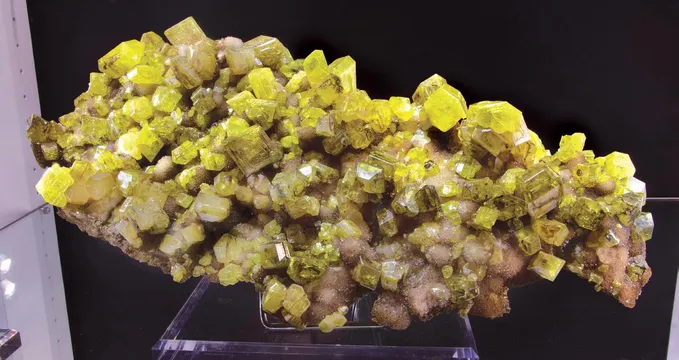
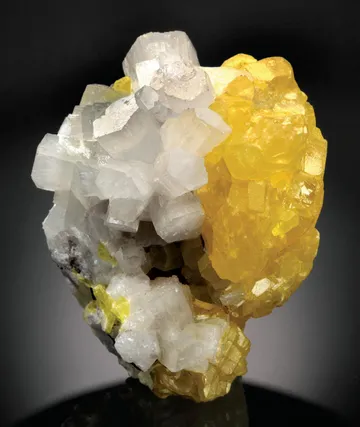
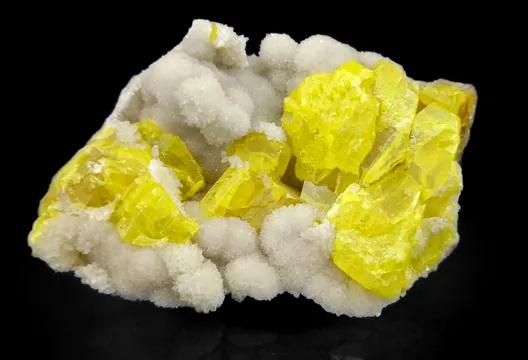
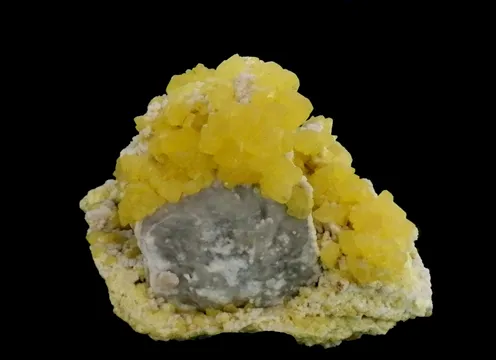
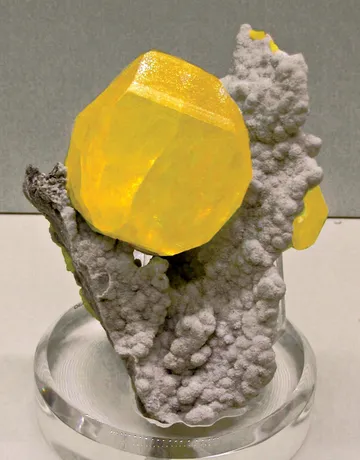
The finest Racalmuto sulfurs have the unmistakable Sicilian look: lustrous, transparent to translucent orthorhombic crystals, often blocky or bipyramidal, with sharp faces glowing against snowy sprays of aragonite or dogtooth calcite. Matrix pieces may be stained brown to black by hydrocarbons, giving the yellow sulfur the strong contrast that made the Agrigento and Caltanissetta sulfur districts famous in old European cabinets and later American collections. Racalmuto specimens are not merely attractive examples of native sulfur; they are artifacts of an extinct mining culture, a mineralogical record of low-temperature sulfur-deposit chemistry, and a collecting field where old labels, mine names, and provenance matter greatly.
Regional View
Country View
At Racalmuto the specimen suite is compact but exceptionally distinctive. Sulfur dominates the collector’s imagination, aragonite provides many of the best display matrices, and melanophlogite gives the locality rare-species importance far beyond the number of attractive specimens available. The old sulfur mines are abandoned, while the modern Racalmuto salt operation belongs to the separate industrial history of halite and potash salts; collectors today encounter the locality chiefly through old-stock sulfur specimens, documented collection pieces, and museum material.

Photo: Wikimedia Commons

Photo: Wikimedia Commons
Search for specimens: View all specimens from Racalmuto, Italy
The collectible sulfur suite belongs to the Racalmuto sulfur mines, a group of old sediment-hosted sulfur workings in the hills north and northeast of the town. Mindat’s locality hierarchy divides the basin into three practical sectors: the western Cannatone–Pernice area in Racalmuto municipality; a central sector including Fra’ Paolo, Piana di Corsa, and the Cimicia–Giona–Cozzo Tondo area near the Racalmuto–Milena boundary; and an eastern Villanova–Gibellina area, where the Gibellini mine produced many of the best-known collector specimens. This is not a single shaft locality in the modern sense, but a cluster of related zolfare developed in sulfur-bearing Messinian evaporites.
The geology is that of the Sicilian Gessoso-Solfifera province. Regional sources describe the Racalmuto area as part of the late Miocene evaporite terrain formed during the Mediterranean salinity crisis, with gypsum-sulfur limestone, clays, halite and potash-bearing units. The older sulfur orebodies were exploited in carbonate, clay and tripoli-bearing horizons; at the Gibellini mine, the sulfur was mined from three named layers: “il Bastardo,” averaging roughly 1–2 m and embedded in tripoli, and the thicker “manzo” and “regio” beds, averaging roughly 5–6 m, connected together and enclosed in clays. That stratigraphic detail matters to collectors because the best specimens are cavity and matrix pieces from a sedimentary sulfur environment, commonly associated with aragonite, calcite, gypsum, celestine, bituminous staining and late silica phases, rather than products of fumarolic crusts.
Mining history at Racalmuto is intertwined with the broader Sicilian sulfur economy of the nineteenth and twentieth centuries. Archival references record numerous zolfare in and around Racalmuto—Cannatone, Pernice, Fra Paolo, Gibellini, Pietre Bianche and others—and the area appears in nineteenth-century documents dealing with calcheroni, accidents, disputes and operators. The Florio firm, one of the great names in Sicilian industry, worked multiple sulfur mines in Sicily, including mines at Racalmuto. The Gibellini mine itself was bound up with an older territorial dispute between Racalmuto and Montedoro that ended in 1844, after which boundary adjustments following Italian unification reassigned the area to Racalmuto. Gibellini remained productive into the middle of the 1970s and is specifically credited with yielding excellent sulfur crystals.
The active mining story today is mainly salt, not collector sulfur. The Racalmuto salt mine, also known as the Pantanelle–Sacchitello–Culma Prevola mine, lies northeast of the town and is worked industrially for halite by Italkali. The salt deposit is a separate evaporite resource from the old zolfare that furnished classic sulfur specimens, and its underground operation should not be confused with collecting access to old sulfur localities. Public collecting at the abandoned sulfur workings should be regarded as highly restricted or effectively unavailable unless arranged through proper legal and landowner channels; old mine ground in Sicily is hazardous, and documented Racalmuto specimens on the market overwhelmingly come from old collections, dealer stock, museum dispersals, and historical finds.
For specimen collecting, the key name is Gibellini. It produced the Racalmuto style most prized today: sharp yellow sulfur crystals on white to gray aragonite or calcite, sometimes with hydrocarbon-darkened matrix, and occasionally with melanophlogite or celestine in the association. Documented individual pieces range from small cabinet specimens with sulfur crystals of 1–2 cm to substantial matrix plates with crystals or clusters several centimeters across. Good old labels may use “Racalmuto,” “Gibellini,” “Gibellina,” “Agrigento,” “Girgenti,” or a broader “Sicily” designation; careful collectors should preserve all such labels, as they are part of the evidence needed to separate Racalmuto material from other Sicilian sulfur classics such as Cozzo Disi, Cianciana, Comitini, Floristella, Lercara Friddi, or Caltanissetta-area mines.
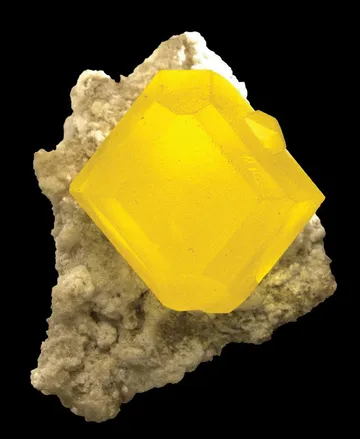
Racalmuto sulfur is prized for bright lemon-yellow to golden, transparent to translucent orthorhombic crystals, commonly blocky, bipyramidal, tabular or compound, perched on aragonite, calcite, gypsum, celestine or bituminous carbonate matrix; the best Gibellini and Racalmuto pieces show sharp, lustrous, undamaged crystals in the 1–4 cm range, with occasional larger display crystals and groups, and their quality is judged by color saturation, glassy luster, intact edges, freedom from bruising, and the strength of contrast against white aragonite or calcite. Ordinary pieces may be massive, contacted, dulled, repaired, or crowded with broken sulfur; good pieces have space, geometry and a clear Sicilian evaporite matrix, while exceptional ones combine large isolated sulfur crystals with old provenance and accessory species such as melanophlogite or celestine.
Aragonite from Racalmuto is most important as the pale matrix mineral for classic sulfur specimens: creamy white, snow-white, grayish or locally slightly stained sprays, drusy crusts, fibrous aggregates and pointed crystals that line cavities and provide a bright stage for the sulfur. On some specimens it forms dense, sparkling mounds or radiating clusters beneath sulfur crystals; on others it appears as gray drusy aragonite over sculptural plates, with calcite locally adding dogtooth crystals around the sulfur bases. Strong collector pieces show clean, undamaged aragonite that contrasts sharply with yellow sulfur, and some Racalmuto aragonite-bearing combinations show light pink fluorescence under longwave ultraviolet; isolated aragonite specimens are collectible, but the highest desirability here belongs to undamaged sulfur-on-aragonite combinations with a credible old Sicilian provenance.
Melanophlogite is Racalmuto’s great rare-mineral distinction: a silica clathrate first found in the sulfur deposits of this district, occurring as tiny regular cubes and sparkling microcrystalline crusts associated with sulfur, calcite, celestine and other late minerals. Material described from Racalmuto forms cubic crystals reported to reach about 2 mm, encrusting sulfur and associated carbonate or sulfate minerals; visually it can appear as a glittering pale, colorless, yellowish or brownish coating that is easily overlooked unless the specimen is examined under magnification. The best collector pieces are not large single crystals but meaningful combinations—melanophlogite visibly covering or accompanying good sulfur, especially with older collection provenance or type-locality association—because Racalmuto melanophlogite is both historically central to the species and genuinely scarce on aesthetic display specimens.
Other minerals documented from the Racalmuto sulfur mines include calcite, celestine and gypsum, with dolomite, quartz and cristobalite appearing in the melanophlogite literature for Racalmuto material. The wider Racalmuto evaporite district also includes the active halite resource and potash-salt mineralization in the saliferous deposit, with halite, kainite and carnallite important industrially. Melanophlogite remains the historically significant type-locality mineral tied to the Racalmuto–Giona sulfur-deposit area, while celestine with sulfur and sulfur with calcite are the notable accessory combinations collectors should watch for when a specimen carries a precise Racalmuto or Gibellini attribution.
Racalmuto sulfur is soft, brittle, heat-sensitive, and easily bruised. Even excellent crystals may show small edge nicks, contacted faces, healed pocket fractures or pressure marks; these are common in old Sicilian sulfur and should be evaluated in proportion to the specimen’s age, crystal size and overall aesthetics. Sharp, lustrous, undamaged faces are a major value factor. Avoid heat, direct sun, hot display lighting, rough handling, and tight storage with hard minerals. Sulfur can also tarnish silver and some metals, so keep it away from silver-mounted labels, silver specimens and sensitive metal objects in closed cases.
Authenticity deserves special attention. Sicilian sulfur on aragonite has a documented history of artificial pieces, including notorious 1970s-era fakes and later home-grown sulfur crystals on real matrix. Reported warning signs include sulfur that has been grown onto aragonite or gypsum matrix rather than naturally crystallized in place, corrosion of the aragonite from the growth process, suspiciously repetitive crystal forms, weak or implausible attachment, lack of natural contacts, absence of bituminous or evaporite context where expected, and labels that use only vague “Sicily” attributions while claiming a premium locality. Isotopic work has been cited as a way to distinguish some fake Sicilian sulfur specimens when the added sulfur came from non-Sicilian salt-dome sources, but collectors normally rely on provenance, morphology, matrix, attachment, old labels, and dealer confidence.
Mislabelling is common because many Sicilian sulfur localities produced superficially similar specimens. Racalmuto, Gibellini, Agrigento, Girgenti, Caltanissetta, Cozzo Disi, Cianciana, Floristella and Lercara labels have all circulated in the market, and older labels may preserve historical geography rather than modern administrative boundaries. A specimen simply labelled “Sicily” should not be upgraded to Racalmuto without evidence. Conversely, old labels using “Girgenti” for Agrigento Province or “Gibellina” for Gibellini may be legitimate and should not be discarded.
Condition is especially important in pricing. A small but pristine Racalmuto sulfur crystal on white aragonite may be more desirable than a larger damaged cluster, and old provenance can significantly improve confidence. Fine Racalmuto sulfur is not abundant in fresh production because the sulfur mines are closed; supply appears mainly through old collections, auction dispersals, and dealer recirculation. Melanophlogite-bearing pieces are much rarer than sulfur-only specimens, and attractive sulfur with visible melanophlogite should be treated as both a display specimen and a rare-species specimen.
Fluorescence is mainly a matrix consideration. Aragonite or calcite on Racalmuto specimens may fluoresce, including light pink responses reported for aragonite and bright responses reported for calcite in dealer descriptions, while sulfur itself is not the visual fluorescent focus. Use ultraviolet testing gently and briefly, and avoid heating the specimen with intense lamps. For storage, choose a padded box or stable display mount, keep relative humidity moderate, and prevent sulfur crystals from touching harder minerals.
Racalmuto’s mineral story is inseparable from the human world of the zolfara. Leonardo Sciascia, born in Racalmuto on January 8, 1921, grew up in a town whose economy and imagination were shaped by sulfur and salt. His father worked as an office employee in a local sulfur mine; his grandfather Leonardo had begun in the mines as a caruso, one of the boys who carried ore through the galleries. In Sciascia’s own remembered phrase, his grandfather had been “one of those young boys” used for transport in the Sicilian sulfur mines, entering at the age of nine after his father’s death and remaining tied to that world for life. The image is not sentimental: a child in the dark, a body in tunnels scarcely wider than itself, the family’s later literacy and clerkship wrested upward from underground labor.
That is why Racalmuto’s sulfur crystals carry more than mineralogical glamour. Sciascia’s Regalpetra—the fictional town of Le parrocchie di Regalpetra—stands next to Racalmuto in the author’s imagination, and its people are salinari, zolfatari, peasants, clerks, priests, landowners and children marked by extraction. One of the English-language biographical accounts of Sciascia describes the mines of his family’s world as “inhuman and suffocating,” troubled by fires and floods; Italian accounts emphasize that the poverty of braccianti, salt workers and sulfur miners became direct material for the 1956 book that made Sciascia’s name. The mineral collector looking at a Racalmuto sulfur-on-aragonite specimen is looking at the glittering surface of the same world that gave modern Italian literature one of its sharpest consciences.
The old technologies have their own strange afterlife in local memory. A passage preserved from Sciascia’s writing evokes the air of Regalpetra changed by the zolfare: acrid, capable of darkening household silver, even seeming to bleach or stain clothing with the smell of burnt sulfur. Into that landscape came the French engineer Gill, associated with the improved sulfur furnaces that would carry his name. Sciascia records the memory of an old zolfataro who still recalled Gill as a real person, not merely a furnace type: a man with a fine beard, approachable, and memorable because he made broth with extracts. The miner remembered the trick almost as magic—“with a spoon of mastic,” he said, Gill obtained broth. It is the sort of small detail that survives when machinery, shafts and companies have vanished.
Racalmuto’s mining geography was also a geography of disputes, concessions and jurisdictions. The Gibellini mine stood in a former fief that was contested between Racalmuto and Montedoro through the eighteenth and nineteenth centuries, with the dispute ending in 1844 and later administrative adjustments bringing the area into Racalmuto. To mineral collectors, such boundary history explains why old labels may appear inconsistent: a specimen can be “Gibellini,” “Racalmuto,” “Montedoro,” “Girgenti,” or “Agrigento” depending on the date, label writer and geographical convention. The label is not merely a name tag; it is a fragment of the mine’s political history.
The specimen-market story has its own cautionary chapter. In the 1970s, when new Sicilian sulfur specimens briefly appeared again, fabricated sulfur-on-matrix pieces circulated as well. Some were convincing because the matrix itself could be Sicilian-looking or even genuinely from appropriate material; what had been added was the sulfur crystal growth. Later discussion among collectors and mineralogists pointed to isotope analysis as a way of exposing some fakes when the sulfur source did not match the sedimentary Sicilian deposit. For Racalmuto collectors this history gives old labels and stable provenance a practical force: a small paper tag from an old cabinet may be as important as a crystal face.