A collector's guide to Agrigento Province, Italy: its geology, mining history and notable minerals, illustrated with the 137 specimens documented from this locality on EarthWonders.
Key facts
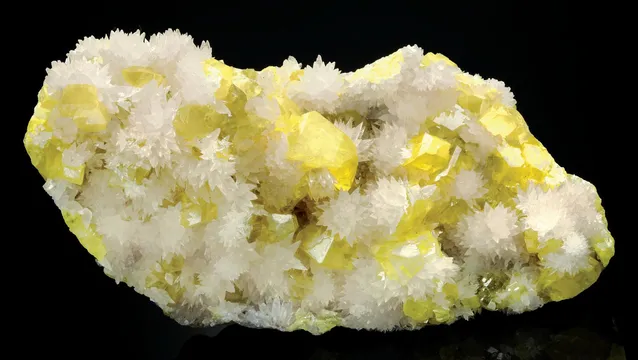
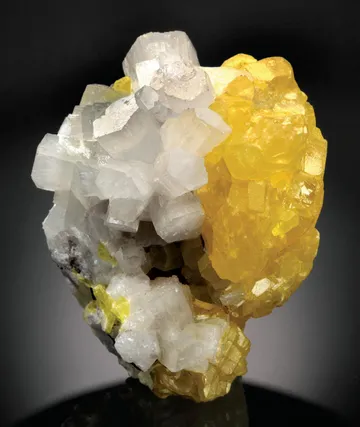
Agrigento Province is one of the defining names in classic European mineral collecting because its sulfur specimens are not a volcanic curiosity but the crystallized expression of Sicily’s great Messinian evaporite province. Here, during the late Miocene salinity crisis, gypsum, anhydrite, halite, marls, carbonates, and sulfur-bearing limestones accumulated and were later deformed into the productive gessoso-solfifera terrain of central and southern Sicily. In collector language, that geology translates into native sulfur on white aragonite, sulfur with calcite, sulfur with pale blue celestine, sulfur in gypsum, and occasionally sulfur darkened or accompanied by bituminous material—the unmistakable Sicilian look.
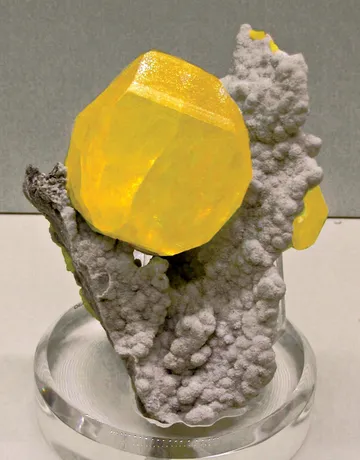
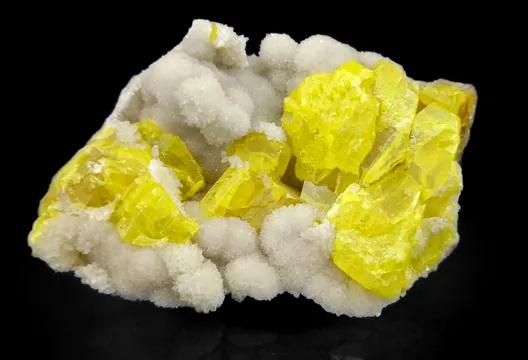
The finest Agrigento specimens have the color and presence that made Sicily the benchmark for native sulfur: lemon-yellow to honey-orange, translucent to gemmy crystals, commonly sharp modified dipyramids or blocky tabular individuals, set in high contrast against snowy carbonate or sulfate matrix. Cozzo Disi near Casteltermini, the Racalmuto mines, Cianciana, Comitini, Favara, and other old solfare produced cabinet and museum pieces that still circulate under labels reading Agrigento, Girgenti, Racalmuto, Cianciana, or simply Sicily. Those labels are part of the locality’s history: “Girgenti,” the old name for Agrigento, was used so broadly by dealers and collectors that many 19th- and early 20th-century specimens cannot now be assigned confidently to a single mine.
Regional View
Country View
Agrigento’s importance also lies in the way mining opened natural cavities—garbere, in the miners’ word—where sulfur and associated minerals could form as open-space crystals rather than merely massive ore. Those pockets made the difference between industrial sulfur and mineralogical treasure. In the best pieces the crystals do not look crowded or melted into the matrix: they stand proud, glassy, and architectural, with enough carbonate or celestine to give visual relief and enough old provenance to quiet the legitimate concerns surrounding artificial Sicilian sulfurs.

Photo: Rob Lavinsky, iRocks.com via Wikimedia Commons

Search for specimens: View all specimens from Agrigento Province, Italy
The collecting locality “Agrigento Province” is best understood as a historic mining region rather than a single mine. The sulfur-bearing ground belongs to Sicily’s Messinian evaporite succession, locally called the gessoso-solfifera series or formation: gypsum and anhydrite with marls, sulfur-bearing limestone, carbonate bodies, halite-bearing units, and bituminous material. Native sulfur was produced by low-temperature sedimentary and diagenetic processes tied to sulfate reduction in restricted marine to evaporitic settings. The result is a sulfur ore environment very different from volcanic fumarole sulfur: the prized crystals grew in cavities, fractures, replacement zones, and open spaces within the sedimentary evaporite-carbonate sequence.
The principal specimen-producing assemblage is simple but visually powerful: native sulfur with aragonite, calcite, gypsum, celestine, and bitumen or petroleum-like material. Aragonite and calcite form white to grayish matrices, twins, crusts, and pseudomorphic aggregates; celestine occurs as colorless to pale blue crystals, locally in handsome clusters; gypsum ranges from modest associated crystals to giant transparent groups in mine cavities. Halite, anhydrite, kainite, polyhalite, and other salts are part of the broader Agrigento evaporite story, especially at Realmonte and Racalmuto salt deposits, but the classic display specimens that built the collecting reputation of the province are sulfur-carbonate-sulfate combinations from the old solfare.
Cozzo Disi, near Casteltermini and Campofranco in the Platani valley, is the emblematic Agrigento sulfur mine. It arose in the Montelongo area on the Chipirdìa estate, where sulfur was noticed at the base of the mountain and early workings began in the first half of the 19th century. Ownership and management passed through aristocratic and private hands before later operation by Società Chimica Mineraria Siciliana and then the Ente Minerario Siciliano. Cozzo Disi became one of Europe’s great sulfur mines and was the last of the large Sicilian sulfur mines to close under the regional closure program of 1988; it was kept under maintenance into the early 1990s and was later identified as a mine-museum and industrial-archaeology site.
The mine’s best specimen ground was associated with large cavities in the ore. Accounts of the “Sezione Ammasso” describe an industrial-scale ore body worked on twelve levels to a depth of roughly 400 meters, and the “sezione grotte” or great garbera produced some of the locality’s most memorable sulfur and gypsum combinations. Cozzo Disi specimens are especially admired for bright sulfur crystals on aragonite, calcite after aragonite, and gypsum, including pieces where petroleum or bituminous inclusions darken the sulfur or matrix. Good Cozzo Disi pieces have clean, lustrous crystal faces and a strong sculptural relationship between sulfur and white matrix; lesser examples are massive, bruised, cloudy, or visually flat.
Cianciana, another major Agrigento sulfur center, consisted of a cluster of mines including Falconera-Grotticelli, Savarini, Passo di Sciacca, Passarello, and related workings. Mining began there in the 1840s under British involvement, was later revived locally, and by the early 20th century the district was supporting a large mining workforce. Its specimen reputation rests on garbere that yielded aragonite penetration twins, granular calcite matrix, celestine, large transparent gypsum groups, and exceptionally lustrous sulfur crystals—some reportedly reaching impressive cabinet to museum scale. Cianciana labels are prized when specific, because good material from there is far less common on today’s market than generic “Agrigento” pieces.
Racalmuto is equally important to collectors, particularly through mines such as Gibellini and related Racalmuto sulfur workings. The classic Racalmuto look includes sharp yellow sulfur crystals on white aragonite, sulfur with calcite, and very attractive celestine-sulfur combinations. Some Racalmuto and Gibellini specimens from older collections have unusually good provenance, and the locality is repeatedly represented in both dealer archives and museum collections. The Racalmuto area also belongs to the broader Messinian evaporite province, and nearby salt deposits preserve the same larger story of Sicilian evaporitic sedimentation.
Comitini and Aragona were important sulfur-mining centers as well. Comitini had a remarkable concentration of small solfare in and around the commune, including Stretto Cuvello and other named mines; aragonite, baryte, calcite, celestine, gypsum, halite, and sulfur are recorded from the area. Aragona’s mining groups included Montagna Mintini, Roccadiconti, and San Vincenzo, while the nearby Maccalube di Aragona mud-volcano field adds a different, petroleum-linked geological expression to the same regional landscape. Favara and the Agrigento municipal area include additional sulfur workings such as Ciavolotta and Lucia, with records for sulfur, gypsum, celestine, calcite, aragonite, and melanophlogite.
Collecting access today should be treated as historical and institutional, not recreational. The mines are closed, abandoned, hazardous, protected, privately held, museum-managed, or accessible only under controlled visits and special events. Old underground workings can contain unstable stopes, bad air, flooding, rotten timber, hidden shafts, and fragile industrial remains. Serious collectors should obtain specimens through established old collections, reputable dealers, museum deaccession channels where applicable, and well-documented specimen trades—not by entering old workings or collecting around mine property without explicit permission.
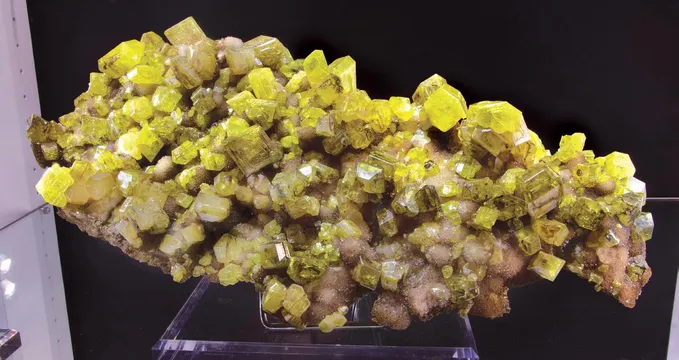
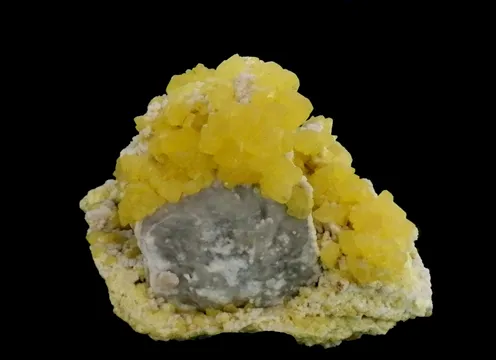
Sulfur from Agrigento Province is the mineral by which all other sulfur localities are still judged: lemon-yellow, canary-yellow, honey-yellow, orange-yellow, and occasionally bitumen-darkened crystals, commonly translucent to gemmy, with modified dipyramidal, blocky, tabular, or flattened habits perched on aragonite, calcite, gypsum, or celestine. Cianciana garbere produced lustrous crystals on granular calcite and aragonite, with reported individuals up to large cabinet scale; Cozzo Disi is famous for sulfur on aragonite, calcite after aragonite, gypsum, and bituminous matrix; Racalmuto and Gibellini produced classic sulfur-on-aragonite and sulfur-with-celestine combinations. A fine Agrigento sulfur is not merely bright: it has sharp faces, glassy luster, undamaged edges, attractive spacing, strong contrast against pale matrix, and a provenance that places it in the old Sicilian mining stream rather than among later artificial material.
Aragonite from Agrigento Province is the principal white architectural matrix for many classic sulfur specimens, occurring as colorless, white, gray, or subtly zoned prismatic crystals, penetration twins, doubly terminated crystals, crusts, and clustered aggregates. Cianciana is noted for colorless to gray aragonite twins of prismatic crystals, commonly to about 3 cm or more across, while Cozzo Disi and older “Agrigento” pieces include sulfur settled among intergrown aragonite prisms and flat-terminated forms; in many specimens the original aragonite has been partially or wholly replaced by calcite, making confirmed unreplaced aragonite combinations especially interesting. The best pieces show open, lustrous, recognizable aragonite crystals rather than chalky carbonate rubble, and collectors prize examples where bright yellow sulfur is positioned in the interstices or atop the white matrix with natural balance and minimal bruising.
Celestine from Agrigento Province occurs in the same evaporitic sulfur environment and is most desirable where it forms pale blue to bluish-gray, colorless, or milky crystals in direct association with yellow sulfur, especially from Racalmuto and related Agrigento solfare. Fine Racalmuto specimens can show fat bluish celestine crystals backed by sulfur, while other Agrigento material places celestine with aragonite, calcite, and gypsum in compact but visually rich combinations. The strongest pieces have distinct, lustrous celestine crystals rather than indistinct sulfate crusts, a clear blue or icy tone, and enough sulfur to create the classic color contrast; damaged or massive celestine without sulfur is mineralogically valid but far less competitive to advanced collectors of the locality.
Calcite from Agrigento Province is important less as a stand-alone show mineral than as a matrix, replacement, and paragenetic partner of sulfur: granular calcite from Cianciana, small white dogtooth crystals around sulfur on some Racalmuto pieces, and especially calcite pseudomorphing aragonite on Cozzo Disi specimens. These calcite-after-aragonite aggregates may form jackstraw, stalactitic, or flat-terminated sprays that preserve the original aragonite geometry while providing a sparkling white stage for vivid sulfur crystals. Good calcite-bearing specimens are judged by texture and association—the calcite should be clean, contrasting, and structurally interesting, not merely a dull carbonate base—and the finest examples combine sharp sulfur with recognizable pseudomorphic carbonate form.
Other documented minerals from Agrigento Province broaden the locality beyond sulfur classics. Gypsum is an essential associate and, in the great mine cavities, could form spectacular transparent crystals and groups; baryte is recorded from Comitini; melanophlogite, the rare silica clathrate associated with sulfur deposits, is documented from Agrigento localities including Lucia Mine at Favara and the Racalmuto area; and the Realmonte and Racalmuto salt deposits add halite, kainite, polyhalite, anhydrite, carnallite-bearing assemblages, and related evaporite minerals to the province’s mineralogical scope. Meteorite-derived minerals are also recorded from the Girgenti meteorite locality, but they belong to a separate meteoritic context rather than the sulfur-mining assemblage.
The central collecting issue for Agrigento sulfur is authenticity. Artificial “Sicilian” sulfur specimens are well documented: in the 1970s, highly convincing sulfur crystals were grown on genuine Sicilian matrix and sold as natural specimens. Later sulfur-isotope work showed that at least some manufactured pieces used non-Sicilian salt-dome sulfur crystallized over Sicilian matrix. This matters because morphology, color, luster, and association alone may not be enough to separate excellent fakes from natural pieces. For important purchases, provenance is not decoration; it is evidence. A specimen traceable to an old collection before the early 1970s, a museum record, a published photograph, or a reliable chain through known dealers carries real value.
Be cautious with large, perfect, glassy sulfur crystals on pale Sicilian matrix if the specimen has no old label, no collection history, and no explanation of how it left the mines. Crystals perched unnaturally on freshly broken matrix surfaces deserve special scrutiny. Natural clues such as bituminous inclusions, petroleum staining, coherent growth into cavities, and unbroken contacts can support credibility, but none should be treated as absolute proof. For very high-end pieces, isotope testing may be justified.
Condition is the second major issue. Sulfur is soft, brittle, heat-sensitive, and easy to bruise. Edges chip, faces scuff, and sharp points round off through careless handling. Avoid heat, direct sunlight, hot display lighting, ultrasonic cleaning, aggressive washing, and prolonged humidity swings. Do not assume that a dull film can be safely removed: many Sicilian pieces are best cleaned only by gentle air dusting or by a preparator familiar with sulfur. Old repairs, glued sulfur crystals, and reattached carbonate matrix are not unusual in the market, so examine bases and crystal contacts under magnification.
Aragonite from Agrigento may fluoresce and phosphoresce strongly, especially on sulfur-on-aragonite specimens, while sulfur itself is typically not the fluorescent feature. This can be a useful display bonus and sometimes a diagnostic clue to carbonate matrix, but fluorescence is not locality proof. Celestine and calcite associations also occur, and pale blue celestine on yellow sulfur is among the most attractive and less common combinations.
Market availability is better than for many closed European classics, but quality is uneven. Small sulfur-on-matrix specimens and damaged old pieces appear regularly; true cabinet specimens with sharp, lustrous, undamaged crystals, specific mine attribution, and older provenance are scarce and expensive. Cianciana and Racalmuto pieces with precise labels are much less common than generic Agrigento or Sicily material. Cozzo Disi remains the most familiar name to collectors, but the best old examples are increasingly locked in long-term collections.
The most vivid Agrigento collecting story comes from underground Cozzo Disi in 1949. Amedeo La Porta, then a young mining trainee, was assigned to help with work on the D’Ippolito shaft. During idle periods he practiced underground surveying and asked for a quiet place away from wagon traffic. He was directed to the third level, toward the gallery of the “sezione grotte,” where the capomastro Vincenzo Lo Presti accompanied him into the garbere. What he saw was not a modest mineral pocket but a subterranean mineral hall. The cavities extended for roughly a hundred meters in plan, and he described transparent gypsum crystals standing like walls: some 3 to 5 meters high, 8 to 16 meters long, and 2 to 4 meters thick. They were clear enough, he wrote, that people could be recognized through them. On those enormous crystals and in the cavities were thousands of sulfur crystals. For collectors accustomed to cabinet specimens, the account is almost disorienting: the matrix crystals were not centimeters but architectural slabs, and the sulfur occurred in a natural chamber large enough to walk through.
Cozzo Disi’s beauty sat beside a grim industrial record. On July 4, 1916, disaster struck the connected Cozzo Disi and Serralonga workings. Contemporary and later accounts describe one of the worst mining accidents in Italian history: 89 sulfur workers died after collapses, gas, and hydrogen sulfide emissions. The day itself entered the explanation, with reports of extreme heat—43.5 °C—and discussion of grisou, violent air blasts, and the ignition risk of open lamps. The precise cause remained debated, with some accounts emphasizing failure to fill extraction voids and others pointing to natural gas accumulation under exceptional atmospheric conditions. For a mineral collector, the disaster is a reminder that the same voids and unstable ground that made room for spectacular crystals also made these mines deadly places.
Cianciana’s story has a different rhythm: boom, isolation, revival, labor struggle, and dispersal. British interests began mining there in 1840, but poor roads made transport difficult enough that work faltered. In 1860 Vincenzo di Giovanni reached an agreement with the British owners and reopened the mines, setting the stage for a town identified with sulfur. By 1900–1905, Cianciana’s cluster of 17 mines employed more than 1,100 workers. The named mines—Falconera, Savarini, Passarello, Passo di Sciacca, and others—were not abstract labels but workplaces around which the town’s population, migration, and politics moved. In 1953, during a period of hard social conflict, the mines were occupied, and local accounts remember women entering the struggle in support of their husbands. Mining ended definitively in 1962, and the specimens that now sit in collections are survivors of that vanished landscape.
The old labels tell their own story. “Girgenti” can look satisfyingly antique on a specimen, but it is often more poetic than precise. The name may mean the city of Agrigento, the old province, the wider Girgenti-Favara-Naro mining area, the former Girgenti district, or even the commercial mining basin from which sulfur was shipped through Porto Empedocle. A 19th-century sulfur with a Girgenti label may be a superb and fully legitimate Sicilian classic while still being impossible to assign to Cozzo Disi, Racalmuto, Cianciana, or Comitini. That uncertainty is part of the locality’s collecting culture: serious labels are treasured, but old ambiguity is not automatically a flaw—it is often the honest residue of how specimens were mined, traded, and exported.