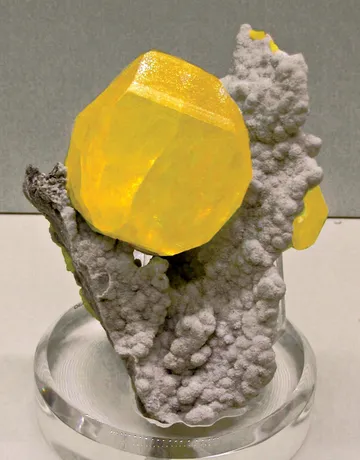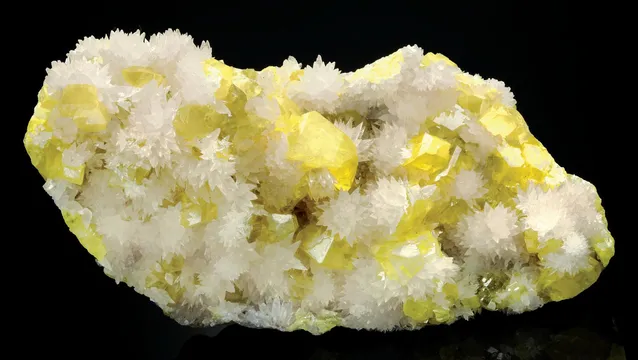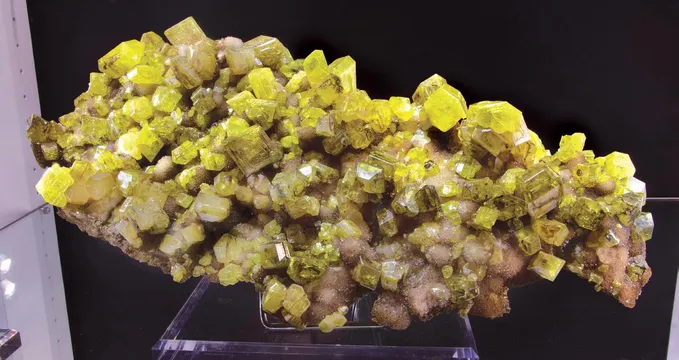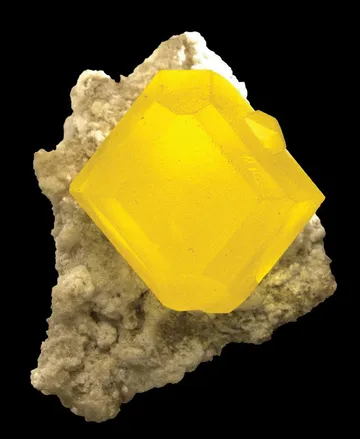
Cianciana, Sicily — historic sulfur locality producing native S8 crystals on aragonite, gypsum, and calcite; prized for color contrast and evaporite context.
Key facts
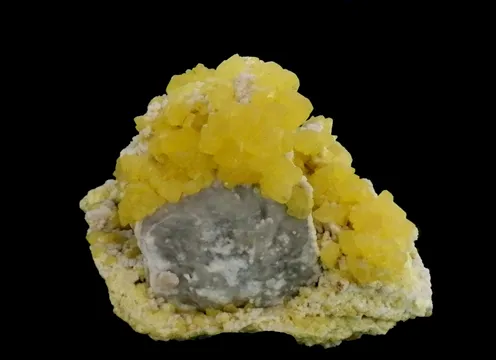
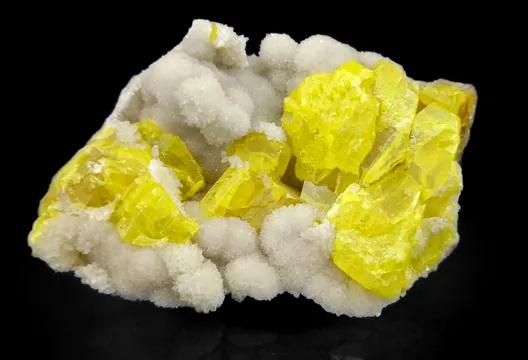
Cianciana is one of the essential Sicilian sulfur localities: a historic group of zolfare in the Province of Agrigento where native sulfur crystallized in the sedimentary evaporite world of the Messinian gypsum-sulfur series, not in a volcanic fumarole field. For collectors, the name means bright canary-yellow to honey-yellow S8 crystals on pale aragonite, calcite, gypsum, celestine, or limestone matrix—specimens whose appeal lies in the contrast between glowing sulfur and soft white, cream, or gray carbonate. The best pieces have the unmistakable Sicilian look: glassy, translucent sulfur crystals perched naturally on aragonite or granular calcite, with enough matrix to prove the geology and enough open space to let the crystals read as individuals.
The district matters historically as much as mineralogically. Cianciana’s mines formed part of the larger Sicilian sulfur industry that reshaped the island’s interior in the nineteenth and early twentieth centuries. The local mine group included names that still appear on old specimen labels—Falconera, Grotticelli, Passarello, Savarini, Passo di Sciacca, and related workings—and the ore cavities known to miners as garbere yielded some of the finest crystallized sulfur, aragonite, gypsum, and celestine specimens associated with the Sicilian sulfur fields.
Regional View
Country View
Geologically, the collector specimens make sense only in an evaporite-carbonate context. Native sulfur in this part of Sicily is tied to sulfate-rich Messinian strata and the bacterial reduction of sulfate in the presence of organic matter, methane, or hydrocarbons, with secondary carbonate growth and vug formation providing the cavities in which minerals could crystallize. In the hand specimen this origin is visible: sulfur on sugary aragonite, sulfur emerging from white gypsum, sulfur on granular calcite, or sulfur in associations that can look almost too elegant for an old industrial ore field.

Photo: Wikimedia Commons

Photo: Wikimedia Commons
Search for specimens: View all specimens from Cianciana, Italy
Cianciana lies in the sulfur-bearing interior of southern Sicily, in the Province of Agrigento. The classic collector locality is not a single neat shaft but a cluster of abandoned sulfur mines around the town, especially the Falconera-Grotticelli group and the Savarini and Passo di Sciacca mines. Older labels may use Girgenti for Agrigento, and Italian labels may use zolfo or solfara rather than sulfur mine. Local accounts divide the mining ground into two main zones: a richer northeastern area including Grotticelli, Passarello, and Falconera, and a poorer northwestern area including Passo di Sciacca and Savarini.
The deposit belongs to the Sicilian sedimentary sulfur province associated with Messinian evaporites. The ore occurred in sulfur-bearing limestones and carbonates within the gypsum-sulfur series, with gypsum, carbonate, and sulfur formed or modified during diagenetic reactions involving sulfate reduction. This is why Cianciana specimens are so often carbonate-rich: aragonite and calcite are not incidental decorations but part of the same geochemical setting that produced the sulfur. Celestine, gypsum, and limestone matrix complete the standard assemblage.
In the mine workings, the best specimen material came from open cavities in the sulfur ore vein. Miners called these hollows garbere, a Sicilian word derived from garbu, meaning a hollow tree. For the collector, that term is crucial. Massive sulfur ore is of industrial interest; garbere are where crystals had room to grow. The pockets produced lustrous yellow sulfur crystals on granular calcite, sulfur on aragonite, aragonite groups, celestine, and impressive gypsum-sulfur combinations. Most market pieces are thumbnail, miniature, or small-cabinet size, but the locality has a record of much larger crystal development, including sulfur crystals reported to exceptional cabinet scale and aragonite groups with pseudohexagonal twinned individuals several centimeters across.
Mining at Cianciana was underway by the first half of the nineteenth century. Local historical sources list nine mines by 1839, including Falconara, Cappadona, Tamburello, Polizzi, Guida, Mormino, Savarini, Balata, and Cinié. The English company Morrison-Seager & Co. appears in the mid-nineteenth-century history of the district, and Vincenzo Di Giovanni of Casteltermini is remembered locally as a central figure in the renewed development of Cianciana’s sulfur mines. By the later nineteenth century the town had shifted from an agricultural center into a mining community that attracted workers from other parts of Sicily.
The industry brought money, population growth, and infrastructure, but also hard labor, dangerous underground conditions, and repeated social conflict. Local histories describe miners working around 200 meters underground amid harmful gases, dust, humidity, collapses, and landslides. Cianciana’s miners organized and struck repeatedly; the final major strike came in 1953, when miners occupied the sulfur mines in pursuit of rights and higher wages. The mines were gradually closed afterward, with the last local mine closing in 1962. Emigration followed: many former miners and families left for northern Italy, France, Belgium, England, Germany, Canada, the United States, and other destinations.
Today Cianciana is an old-stock locality. The classic underground workings are abandoned industrial ruins, not an active collecting field, and any remaining structures, dumps, or shafts should be treated with the caution due to unstable mine land and private property. Fine specimens entering the market now are generally older recoveries moving through collections, dealers, and auctions. That old-stock character is part of their value: a sharp Cianciana sulfur with credible labels, a clean aragonite-sulfur association from Falconera, or a large gypsum-sulfur group represents a vanished mining world.
Sulfur is the signature mineral of Cianciana, occurring as bright yellow to honey-yellow S8 crystals, commonly sharp orthorhombic dipyramids or modified blocky forms on aragonite, calcite, gypsum, celestine, or limestone matrix. The finest examples show glassy to resinous luster, translucency to transparency, saturated canary color, and undamaged terminations; ordinary pieces are more massive, crusty, bruised, or dulled. Most available collector specimens are thumbnails to small cabinets with crystals from millimeters to a few centimeters, though exceptional historical material from the mine group records far larger crystal development. The classic Cianciana look is a lustrous sulfur crystal naturally seated on pale aragonite or granular calcite, with the Falconera-Grotticelli and Savarini workings especially important on specimen labels.
Aragonite from Cianciana is much more than a matrix mineral: it forms white, off-white, gray, or translucent pseudohexagonal cyclic twins and penetration-twin groups, often with channels, stepped surfaces, or dissolution textures that reflect growth in open evaporite-carbonate cavities. It is commonly associated with sulfur, either as the pale base that sets off yellow crystals or as aragonite crystals sitting over sulfur-rich matrix; fine groups with individuals around 3 cm or more are documented in the collector market. White aragonite from Cianciana may fluoresce, with reported pink to bright responses under ultraviolet light, and the best pieces combine clean twinned form, sculptural openness, and a natural sulfur association rather than simply a massive carbonate base.
Gypsum from Cianciana occurs in the same sulfur-bearing evaporite system and is best known to collectors in white, milky, colorless, or transparent groups associated with native sulfur. Some garbere were lined with gypsum and sulfur, and documented specimens show gypsum either hosting small yellow sulfur crystals or forming large display groups with sulfur included or attached. The locality is not valued for ordinary massive gypsum but for open, clean, well-crystallized gypsum-sulfur combinations—especially those with transparent or translucent gypsum blades or groups, visible sulfur, and minimal bruising to the soft, easily cleaved crystals.
The additional documented Cianciana suite is compact but important: calcite, celestine, and limestone matrix are the principal companions to sulfur, aragonite, and gypsum in the sulfur mines, while halite is recorded from the separate Cianciana salt deposit in the broader commune. Celestine is the notable rarity among the classic collector associations, most valued when it is visibly part of an old sulfur-mine specimen rather than a vague pale sulfate label; calcite is more common but essential to the familiar granular white matrix on which some of the best yellow sulfur crystals sit. Cianciana is not known as a type-locality center; its reputation rests instead on the exceptional aesthetics of a small evaporite assemblage.
Cianciana sulfur should be bought with both admiration and suspicion. Sicilian sulfur is one of the classic fraud-prone areas of mineral collecting: artificial “Sicilian” sulfurs grown on authentic Sicilian matrix have been documented in the mineral literature, and some are visually convincing enough that appearance alone may not settle the question. The problem is not that every sharp Sicilian sulfur is doubtful; it is that a flawless, strangely inexpensive, matrix-mounted sulfur without provenance deserves careful scrutiny. Old labels, institutional or long-held collection history, reputable dealer documentation, and convincing natural attachment matter greatly.
Look for sulfur crystals that are actually rooted in the matrix rather than sitting on a fresh fracture surface. Check bases under magnification for glue, unnatural contact lines, color mismatches, or sulfur that bridges the matrix in a way that looks placed rather than grown. Strong old provenance can add real value. A clean Cianciana miniature with an old European label may be more desirable than a larger but undocumented piece.
Condition is central. Sulfur is soft, brittle, and sensitive to heat and rapid temperature changes. Keep specimens away from direct sun, hot lamps, windowsills, radiators, and display cases that trap heat. Handle by the matrix only. Avoid ultrasonic cleaning, water washing, solvents, steam, or brushing the sulfur faces. Even apparently robust crystals chip easily along edges and terminations, and old Sicilian pieces often carry small contacts from mining, transport, or decades in drawers.
Aragonite and gypsum bring their own condition issues. Aragonite can be bruised, etched, or broken along projecting twins; gypsum is very soft and cleaves readily, so transparent blades and terminations should be inspected closely. UV response is an added pleasure on many aragonite-bearing pieces, but fluorescence should never be used as the sole proof of locality. For display, the safest approach is cool, dry, stable conditions, low light, and minimal handling.
Market availability is regular but selective. Small Cianciana sulfur and sulfur-aragonite specimens appear through dealers and auctions, often as old collection material. Fine pieces with saturated yellow, transparent crystals, clean aragonite or calcite matrix, and minimal damage are much less common. Gypsum-sulfur associations and good aragonite-dominant specimens are scarcer than routine sulfur miniatures, and celestine-bearing Cianciana pieces are best treated as specialist finds requiring good documentation.
Cianciana’s sulfur story begins with a village being remade by ore. Local history records nine mines already present in 1839—Falconara, Cappadona, Tamburello, Polizzi, Guida, Mormino, Savarini, Balata, and Cinié—and then a mid-nineteenth-century transformation in which the English Morrison-Seager company and Vincenzo Di Giovanni became tied to renewed mining activity. The town, once predominantly agricultural, became identified with sulfur. Workers arrived from across Sicily; land was abandoned for wages underground; the mine names entered family memory.
The human geography was severe. The mines lay away from the village, so miners left long before dawn, walking through winter cold or summer heat. Local accounts preserve the detail that some went barefoot because shoes were a luxury. Underground, the picconieri broke sulfur from the rock. The carusi, often boys and youths, carried ore toward the surface, the hard sulfur pieces scraping their already bent shoulders until they bled. To a collector, Cianciana sulfur is light, color, symmetry, and luster; to the people who mined it, it was weight, abrasion, gas, dust, humidity, and the constant possibility of collapse.
One of the starkest documented episodes concerns girls underground. A 2025 historical study of women and girls in mine labor cites Cianciana as the unusual Sicilian case where girls under fifteen carried ore underground to fathers or brothers and generally left the mines at puberty. In 1881, ninety girls were recorded working as caruse at Cianciana, paid less than boys. In 1898 an inspector encountered a small, fragile ten-year-old girl carrying sulfur ore on her shoulder; the report preserved her name, Ignazia Greco, and her birth date in Cianciana: January 16, 1888. The detail is hard to forget because it restores a person to what otherwise becomes a generalized phrase—child labor in the sulfur mines.
The social conflict did not end with the nineteenth century. Cianciana’s last major strike came in 1953, when miners occupied the sulfur mines to demand rights and higher wages. Local memory emphasizes that women joined the struggle in support of husbands and sons. The strike succeeded, but the victory came late in the life of the industry. By 1962 the mines were closed, and families began leaving in large numbers for work elsewhere. The specimens that now sit in drawers and cabinets were born from pockets, but also from a community pushed through boom, danger, labor organization, and decline.
The most vivid local legend belongs to a March 24 in the 1950s. A group of miners decided to work through the night so they could stay in town the next day for the feast of the Annunziata. No one woke at the appointed hour. Later, almost as if by an agreement no one had made, they gathered at the entrance to the Giudice gallery and found it destroyed. That was where they were supposed to have been working. The miners understood their failure to wake as the intervention of the Madonna and resolved to sponsor her feast thereafter, publicly marking their gratitude and devotion.
Even the remains of the mines have become part of the story. A local field note by Filippo Giannone describes taking his son by mountain bike to visit the old sulfur mines on Father’s Day, hoping to show him the roots of the community and the conditions under which grandparents had earned a living. What he found was loss: the physical remains had been demolished or allowed to vanish, with only signs pointing to what should have been preserved as an open-air monument of industrial memory. For mineral collectors, that disappearance gives old Cianciana labels added weight. The stones have outlasted much of the landscape that made them.