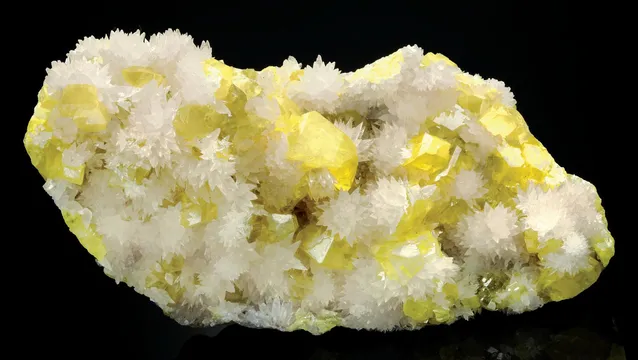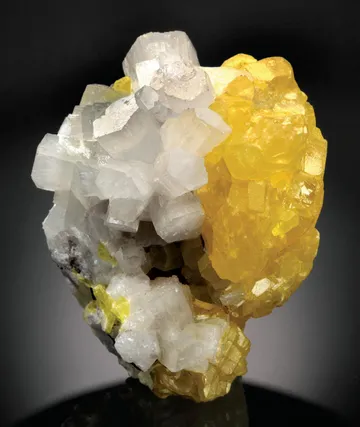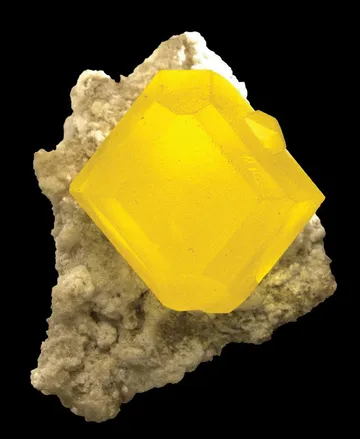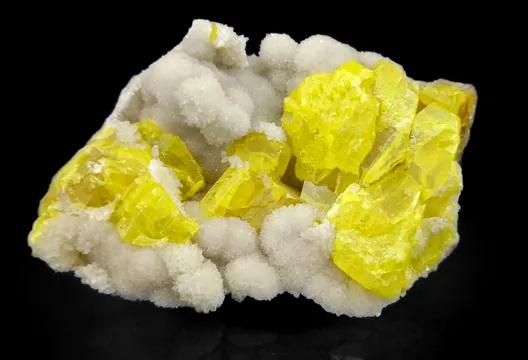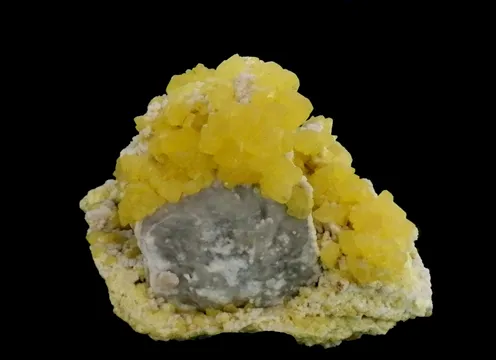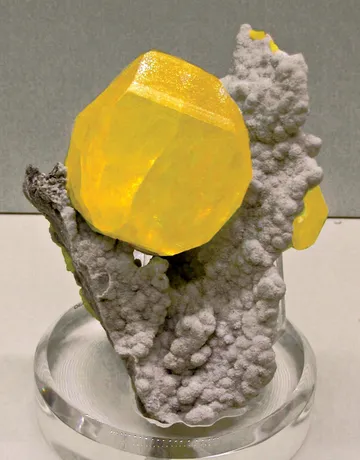
Cozzo Disi Mine, Italy — historic Sicilian sulfur locality famed for lemon-yellow dipyramidal sulfur on aragonite, a classic with high collector appeal.
Key facts
Cozzo Disi is one of the great classic sulfur localities of Europe: a deep Sicilian sulfur mine in the Casteltermini area of Agrigento Province, developed in the Messinian Gessoso-Solfifera Formation of central Sicily. To collectors, its importance is not just that it produced sulfur, but that it produced sulfur in the old Sicilian manner: sharp, lustrous, translucent to gemmy yellow crystals seated on pale carbonate or sulfate matrices, often with aragonite, calcite, celestine, gypsum, and dark bituminous material recording the hydrocarbon-rich environment in which the deposit formed. The best pieces have an unmistakable look—lemon-yellow to greenish-yellow dipyramids and flattened bipyramids, sometimes isolated and glassy, sometimes crowded in glittering groups, contrasting against white, cream, grey, or faintly greenish aragonite.
The mine belongs to the historic Sicilian sulfur belt, where native sulfur formed in evaporitic and carbonate sequences by reduction of sulfate minerals in the presence of organic matter and hydrocarbons. Cozzo Disi’s specimens express that origin particularly well. Many pieces are not clean “show sulfur” in the abstract; they are geological snapshots—sulfur crystals with bitumen stains, sulfur sitting on aragonite that may be partly coated or replaced by calcite, sulfur embedded in gypsum, and sulfur associated with pale celestine. This is why well-labeled Cozzo Disi specimens carry a premium over generic “Sicily” sulfur: the locality name connects the specimen to one of the most storied mines of the entire island.
Regional View
Country View
Historically, Cozzo Disi mattered far beyond mineral collecting. It was among the largest and most productive sulfur mines of Sicily, modernized repeatedly from the age of calcheroni and Gill furnaces through steam melting and finally flotation. It also preserves, in unusually complete form, the industrial archaeology of Sicilian sulfur mining: access tunnels, ventilation works, winch structures, power-plant remains, workshops, dwellings, old furnaces, and the later flotation plant. Underground, accounts of the “garbere”—large natural cavities intersected by the workings—give the mine an almost legendary mineralogical dimension. These cavities were described by miners and mine surveyors as rooms lined with transparent gypsum crystals of enormous size and, in places, thickly adorned with sulfur crystals.
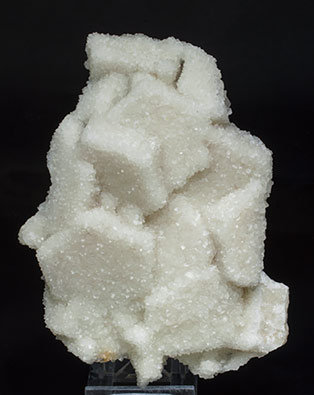
Photo: Fabre Minerals
The finest Cozzo Disi specimens reward close inspection. At a distance they may read as bright yellow sulfur on a white matrix, but the better pieces show a more complex architecture: pseudohexagonal aragonite aggregates, drusy calcite overgrowths, flattened sulfur crystals on the reverse, brown bituminous patches, and, on some specimens, strong fluorescence from the carbonate matrix under ultraviolet light. In a cabinet of world sulfur, Cozzo Disi sits with the other Sicilian classics, but its combination pieces—especially sulfur on aragonite and sulfur on calcite—have a character serious collectors learn to recognize.
Search for specimens: View all specimens from Cozzo Disi Mine, Italy
Cozzo Disi lies near Casteltermini, between Casteltermini and Campofranco in the Platani valley district of Agrigento Province, Sicily. The mine exploited native sulfur in the central Sicilian Gessoso-Solfifera Formation, the upper Miocene evaporitic succession deposited during the Messinian salinity crisis. At the mine scale, historical descriptions place the workings in a steeply dipping north–south-trending formation, dipping westward, with tripolitic marls toward the footwall, partly sulfur-mineralized limestones, and gypsum toward the hanging wall. The collector’s assemblage—sulfur with aragonite, calcite, gypsum, celestine, and bitumen—is exactly what one expects from sulfur-bearing evaporites and carbonate-rich cavities affected by hydrocarbons, sulfate reduction, later carbonate growth, and local oxidation.
The ore body that made Cozzo Disi famous was not a simple vein in the collector sense, but a large sulfur-bearing mass or lens worked on an industrial scale. The earliest access was by inclined descenderies cut in rock and fitted with stepped passages; later, the deposit was reached by horizontal crosscut galleries connected with inclined haulage ways and, eventually, by a major vertical shaft system. The mine was developed on twelve levels, with later accounts placing its depth at roughly 400 meters. Older workings used room-and-pillar methods, leaving substantial sulfur-bearing pillars as support; in the twentieth century the mine shifted toward backfilling and descending sublevel methods, and by the 1960s adopted more mechanized techniques including pneumatic drilling, electric blasting, mechanical loading, and improved haulage.
The richest and most collectible mineralization is linked in the literature and miners’ accounts to cavity zones known locally as garbere. When workings reached the 180-meter elevation in the northern part of the concession, miners encountered a richly mineralized lens with numerous cavities, one especially large cavity giving its name to the “Sezione Grande Garbera” or “sezione grotte.” These were not merely open voids in ore; they were natural mineral chambers in the evaporitic mass. Amedeo La Porta, who worked at the mine as a young surveyor in 1949, later described garbere extending for roughly a hundred meters in plan, with vertical successions of clear gypsum crystals of extraordinary size and glassy transparency. More northerly still, an enormous sulfur mass—the “Sezione Ammasso”—gave the mine its greatest industrial expansion.
The mining history is layered. The older Montelongo workings in the same district were active by the late eighteenth or early nineteenth century, with archival disputes in 1805 and 1833 over sulfur fumes damaging agriculture around Campofranco. Early exploitation was shallow and small in scale. The deeper discovery at the beginning of the twentieth century led to the opening and expansion of Cozzo Disi proper, which was listed among major active sulfur mines by the early 1900s and later received formal perpetual concession recognition in 1932. Ownership and operation passed through aristocratic and family interests connected with the Gaetani di Bastiglia, Sanfilippo, Pintacuda, Perrier, and associated condominium groups; in 1966 the Società Chimica Mineraria Siciliana became involved, and in 1970 the Ente Minerario Siciliano entered the sulfur-sector management.
Processing technology changed repeatedly at Cozzo Disi. Traditional calcheroni and earlier furnaces gave way to Gill furnaces in 1901. The mine’s steam melting plant remained a notable installation in the Italian sulfur industry, and in 1954 Cozzo Disi inaugurated Sicily’s first sulfur flotation plant, with a reported daily treatment capacity of 400 tons of sulfur ore. That flotation plant marked a major shift: it reduced production costs, improved separation of sulfur from gangue, and altered the surface layout of the mine, moving later activity toward the higher northern part of the site. In 1958 Cozzo Disi incorporated the neighboring Serralonga concession, creating the unified Cozzo Disi-Serralonga concession.
Production rose dramatically during the mine’s great expansion: one historical synthesis gives 18,700 tons in 1891 and 131,000 tons in 1912, with employment exceeding 1,000 workers and reaching 1,136 in 1903. The mine remained one of the principal Italian sulfur operations into the mid-twentieth century; after the closure of the large Perticara and Cabernardi sulfur mines in the Apennines, Cozzo Disi was widely described as the largest remaining sulfur mine in Italy. It closed under Sicily’s regional sulfur-mine closure program in 1988, with maintenance and water pumping continuing for a few years afterward. Regional legislation in 1991 established the Cozzo Disi mine-museum, but heritage assessments have repeatedly noted that management, maintenance, flooding, vandalism, theft, and safety issues have complicated stable public access.
Collectors should treat Cozzo Disi as a historic closed mine, not as an active collecting locality. The underground workings are extensive, partly flooded, locally unstable, and historically notorious for hydrogen sulfide, carbon dioxide, methane or firedamp conditions, heat, and poor ventilation. Modern speleological and technical surveys were conducted under controlled conditions with gas monitoring, ventilation, and institutional coordination; this is not a place for casual entry. Collectible material on the market comes overwhelmingly from historical mine production, old collections, dealer stock, and estate dispersals rather than modern field collecting.
Cozzo Disi sulfur is prized for sharp, lustrous, translucent to gemmy crystals in lemon-yellow, canary-yellow, greenish-yellow, and darker bituminous tones, most often as dipyramidal or flattened bipyramidal crystals on aragonite, calcite, gypsum, or celestine. Fine cabinet pieces can carry sulfur crystals from a few millimeters to several centimeters; documented collector specimens include crystals around 1.5 cm scattered richly across dogtooth aragonite, isolated crystals over 3 cm on aragonite, and larger display pieces where sulfur dominates the matrix. The most desirable examples show strong color, clean faces, good transparency, undamaged edges, and an aesthetic balance between yellow sulfur and pale matrix; ordinary pieces are duller, more massive, chipped, heat-crazed, or so heavily stained with bitumen that the crystal form is visually lost. The garbere and richly mineralized northern lens are central to the mine’s reputation, and specimens with sulfur on aragonite or calcite—especially with old collection provenance—are the classic Cozzo Disi look.
Cozzo Disi aragonite is best known as the pale architectural matrix for sulfur: white, grey-white, slightly greenish, translucent, prismatic, dogtooth, twinned, bundled, or flattened pseudohexagonal aggregates, in specimens ranging from small miniatures to large cabinet plates over 10 cm across. Good pieces show aragonite as a sculptural framework rather than a mere base, with individual pseudohexagonal or prismatic crystals still readable beneath small sulfur crystals or later drusy calcite coatings. Calcite overgrowths and pseudomorphic calcite after aragonite are a recurrent Cozzo Disi feature, so labels that call the whole carbonate “calcite” or “aragonite” without qualification deserve close inspection; ultraviolet response can be useful because many Cozzo Disi aragonite/calcite matrices fluoresce strongly, sometimes pinkish under UV. The most collectible aragonite specimens preserve sharp pseudohexagonal form, attractive fluorescence, and well-placed vivid sulfur, while lesser examples are chalky, broken, or reduced to a confused carbonate mass with little visible crystal habit.
Other minerals documented from Cozzo Disi include calcite, celestine, gypsum, and petroleum/bitumen. Calcite is especially important because it occurs both as crystals and as coatings or replacements on aragonite, creating some of the mine’s most frequently misdescribed combination specimens. Celestine appears in classic Sicilian sulfur associations and may occur as pale to slightly bluish or whitish prismatic aggregates with sulfur. Gypsum is central geologically and historically: the mine’s celebrated garbere were described as lined with immense transparent gypsum crystals, and smaller collectible gypsum-with-sulfur specimens are known. No modern verified type-locality mineral species is established for Cozzo Disi itself in standard locality lists; its rarity interest lies instead in the completeness of the sulfur–carbonate–sulfate–bitumen assemblage and in the extraordinary, mostly inaccessible gypsum crystal cavities underground.
The principal authenticity issue for Cozzo Disi is locality and association, not a broad modern flood of obvious fakes labeled from the mine. Many old Sicilian sulfur specimens entered collections simply as “Sicily,” “Agrigento,” “Girgenti,” or “Sicilian sulfur,” and later labels may over-assign them to Cozzo Disi because the name is famous. A confident Cozzo Disi label is strongest when supported by old collection provenance, a dealer or museum record, or a specimen style matching the mine’s well-documented combinations—especially sulfur on aragonite, sulfur on calcite, and sulfur with bitumen.
Sicilian sulfur fakes are a real collecting concern in the broader market. Artificial “Sicilian” sulfur specimens have been discussed in the mineralogical literature, and sulfur can be recrystallized or grown on matrix in ways that may fool collectors if provenance is weak. For Cozzo Disi, scrutinize specimens that look too perfect, too uniformly bright, or oddly attached to matrix without a believable contact relationship. Natural pieces from the mine commonly show subtle irregularities: bitumen stains, carbonate overgrowths, matrix penetration, partial embedment, small chips, or color zoning.
Mislabelling between aragonite and calcite is common and often understandable. Some Cozzo Disi specimens show calcite coating or replacing aragonite, and old labels may use “calcite” for what is now understood to be aragonite, or vice versa. Pseudohexagonal aggregates should not automatically be assumed to be pure aragonite; careful visual study, UV response, and, where value warrants, simple testing or analytical confirmation can clarify the carbonate.
Condition is critical. Sulfur is soft, brittle, and thermally sensitive. Avoid hot display lights, direct sun, closed cases that heat up, and rapid temperature swings; even modest heat can dull, crack, or craze sulfur. Handle specimens by the matrix, never by sulfur crystals. Many Cozzo Disi pieces also have delicate carbonate crusts, drusy calcite coatings, or crumbly sulfur-bearing matrix, so overly aggressive cleaning is risky. Do not wash bituminous specimens casually: hydrocarbons and porous carbonate can react poorly to solvents, detergents, or prolonged soaking, and the bitumen may be part of the specimen’s identity rather than dirt.
Under ultraviolet light, the sulfur itself is not usually the attraction; the carbonate matrix is. Aragonite and calcite from Cozzo Disi specimens may fluoresce strongly, including pink to reddish responses reported for some aragonite-rich pieces and strong longwave/shortwave fluorescence in calcite-coated aragonite specimens. UV can enhance display value, but heat from older UV lamps should be managed carefully.
Market availability is moderate for small and mid-sized sulfur specimens, but truly fine Cozzo Disi examples are much scarcer. The most desirable pieces combine bright, sharp sulfur crystals, attractive aragonite or calcite matrix, old provenance, and minimal damage. Large, sculptural sulfur-on-aragonite cabinet specimens, pieces from named old collections, and specimens with well-preserved bitumen contrast are increasingly difficult to replace.
The most vivid Cozzo Disi story begins underground, in the garbere. In 1949 a young mine surveyor, Amedeo La Porta, was assigned to assist with work connected to the D’Ippolito shaft. During idle periods he practiced underground surveying and was directed to a quiet place at the third level, away from the traffic of ore wagons. At the end of the gallery in the “sezione grotte,” the foreman Vincenzo Lo Presti accompanied him into a world that later accounts compared, inevitably, to Naica. The cavities extended, in plan, for roughly a hundred meters, and their vertical continuation was not fully known. What astonished La Porta was not merely the existence of cavities, but the glassy transparency and dimensions of the gypsum: some crystals were said to stand 3–5 meters high, extend 8–16 meters in length, and reach 2–4 meters in thickness, clear enough that a person on the other side could be recognized through them. Other accounts describe these same chambers as lined with transparent gypsum crystals and covered by thousands of large sulfur crystals. For a mineral collector, it is almost painful to imagine: an underground Sicilian evaporite cathedral, intersected by miners, then sealed away by danger, collapse, water, and time.
The mine’s most terrible day was July 4, 1916. Around 1:30 in the afternoon, while more than 500 men were working in the connected Cozzo Disi and Serralonga mines, a tremendous first blast was heard, followed by violent air shock, hydrogen sulfide, firedamp, and repeated explosions when gas met open-flame lamps. Men at the first and third levels of Cozzo Disi fled; some reached safety, while others escaped badly burned. Sixty-six workers in the Giambrone section died from burns, asphyxiation, hydrogen sulfide poisoning, and trauma. In the neighboring Serralonga mine, twenty-three workers fled along an inclined plane after hearing the first roar from Cozzo Disi; after only about 90 meters they met firedamp and were killed. The final toll was 89 dead and 34 injured. Rescue was nearly impossible. Hydrogen sulfide stopped the first rescuers at the Giambrone section. Giovanni Todari, a foreman who descended toward the cries for help, died in the attempt. At 5:00 p.m., after reports that moans had been heard, a second rescue party opened a door near the seventh crosscut and triggered another gas explosion; two rescuers later died of their burns. The next day officials from the Caltanissetta mining office arrived and two men were found alive, though one died soon afterward. Nine days later, once it was clear that fire had developed underground, the mine mouth was closed to contain the danger.
Cozzo Disi did not simply close after disaster. It kept burning. A later recollection by Franco D’Ippolito, son of engineer Giuseppe D’Ippolito, describes the new director’s first great problem in 1937: the third and fourth levels had been burning since 1919. The program, as he remembered it, was brutally simple—put it out. This was not a dramatic wall of flame, but a slow sulfur combustion like an internal calcherone, fed by limited oxygen through fractures created by the mine’s constant settling. Vapors escaped from fissures on the hills above and were quickly dispersed by the ever-present wind. The prize for solving the problem was immense: sulfur had melted and flowed through the underground workings, filling galleries with almost ready-made product. Workers opening raises in hot rock with pneumatic drills had to hold the handles with gloves to avoid burns while companions sprayed them with fresh pressurized water from below. Shifts in these hot zones lasted ten minutes, followed by thirty minutes of rest. The work could not pause, because every hour brought more oxygen to the combustion. The fire was eventually controlled, and the recovered sulfur was valuable enough to become part of the mine’s legend.
A strange wartime encounter helped push Cozzo Disi into a new technological age. On July 8, 1943, Allied forces landed in Sicily between Gela and Licata, about 70 kilometers from the mine. Among the troops passing through the sulfur district was an American captain who, in civilian life, was a qualified mining engineer. He presented himself to Giuseppe D’Ippolito with the confidence of an occupying officer and asked, through a “paisà” interpreter, to visit the mine and exchange technical views. The two engineers—one from the defeated country, one from the invading army—put aside politics in the face of rock, sulfur, and machinery. In that conversation, according to the recollection, the phrase “flottazione dello zolfo” may have been spoken in Sicily for the first time. Two years later, a first Denver, Colorado flotation plant arrived at Cozzo Disi. In 1954, the large flotation plant went into operation and became the first such sulfur-concentration installation in Sicily.
Modern explorers inherited the myth of the garbere but not easy access to them. Beginning in 2010 and continuing through 2013–2014, mining engineers, cavers, and technical teams coordinated with the Caltanissetta Mining District and Sicilian speleological organizations to try to reach the great cavities. The hazards were exactly those feared in an old sulfur mine: hydrogen sulfide, carbon dioxide, explosive atmospheres, poor air, heat, flooding, and unstable galleries. In March 2013 the team entered the Canalotto gallery, followed the Via Operai to the third level, and advanced through about one meter of water in hot, foul air with a persistent sulfur smell. After roughly 200 meters they were stopped only a few meters from the objective by a double barrier: a ceiling-high landslide in the main gallery and a stone wall blocking a possible bypass.
They then searched from the surface, hoping that evaporite fractures or a sink point might provide a natural route into the garbere. On April 13 and 14, 2013, cavers divided roughly 50 hectares into GPS-assigned search areas. They found only modest prospects: two small fractures and a collapse near the old workings and main shaft. One fracture at about 330 meters above sea level required climbing techniques and a ten-meter traverse, but closed after a few meters. Another, entered from points at 316 and 322 meters, gave only short penetrations; from the upper point, a rope allowed roughly ten meters of western progress before the passage narrowed among unstable collapsed blocks. There were gypsum speleothems—tabular, acicular, and spearhead-like—but no route to the great rooms. A nearby collapse entrance about one meter wide led, by rope, to a room roughly 10–15 meters by 5–10 meters, but the lack of airflow discouraged further exploration.
In March 2014 the team tried again underground. Before the descent, doors were opened to ventilate the third level. The first part of the Via Operai still had well-defined steps; lower down, the steps were damaged or gone. The third-level gallery remained flooded for much of its length, the water nearly a meter deep and reddish, probably from submerged rails. Near the wall behind which the garbere were thought to lie, a small concrete dam held deeper white-grey water. Gas detectors inserted into holes in the wall found low hydrogen sulfide, and the team began removing blocks. Behind the wall—gypsum blocks joined by cement mortar—was another collapse: brown clay, soaked with water, breaking old wooden supports. The way remained impassable, and the saturated clay itself could hide dangerous gas pockets.
The final 2014 attempt shifted downward. Old maps suggested that the explorers might descend along the Via Operai, enter the fourth level, and then rise by an inclined gallery back toward the elevation of the garbere. The chance seemed small: that zone had been abandoned for more than 40 years, landslides were likely, and hydrogen sulfide had historically been abundant on the fourth level. In May 2014, after what the exploration report called extreme bureaucratic difficulty, they went down again with gas meters on and gas masks ready. At the fourth level they found a dry gallery with strong airflow, ending in two walls—one of gypsum blocks with holes pulling air, the other of cement—aligned toward the garbere. They continued to the fifth level, where a wide gallery still held telephone panels and electrical controls. Hydrogen sulfide rose to 1.1 ppm in one area, then disappeared in the airflow near the gallery entrance. From there they could see the end of the elevator shaft and measure the water table: 7.09 meters below the fifth-level floor. After years of effort, the explorers believed the garbere were finally close, still hidden by walls, collapse, water, and gas.
Wilson, Wendell E.; Pagano, Renato. “Famous mineral localities: The sulfur mines of Sicily.” The Mineralogical Record, Vol. 43, No. 2, 2012, pp. 161–206. — The key modern collector-locality article for Sicilian sulfur mines, repeatedly cited for Cozzo Disi sulfur, calcite, petroleum/bitumen, and the broader Sicilian assemblage.
Wilson, Wendell E.; Bartsch, Joel A.; Mauthner, Mark. Masterpieces of the Mineral World. Houston Museum of Natural Science, 2004, pp. 182–183. — Cited by Mindat for a Cozzo Disi native sulfur specimen figured as Plate 75 from the Houston Museum of Natural Science.
Mindat — Cozzo Disi Mine locality page — Current mineral list and locality record documenting aragonite, calcite, celestine, gypsum, native sulfur, and petroleum/bitumen, with references to major publications.
Mindat — Native sulfur from Cozzo Disi Mine — Species occurrence record identifying Cozzo Disi as an excellent, world-class classic locality for native sulfur and summarizing associated minerals from photo data.
Ziegenbalg, S. B. Microbially induced sulphur and carbonate authigenesis in modern and ancient environments — Dissertation including Cozzo Disi samples of calcite, aragonite, dolomite, gypsum, and native sulfur in isotope and petrographic work on microbial sulfate reduction and carbonate/sulfur authigenesis.
Badino, G.; Vattano, M.; et al. “The Cozzo Disi Mine (Casteltermini, Sicily, Italy): a multi-disciplinary approach to record, study, preserve and develop the mining heritage in Sicily.” Hypogea 2015 proceedings. — Technical and speleological account of the mine’s preservation, flooding, hazardous atmosphere, and attempts to reach the “Grandi Garbere.”
La Russa, M. F.; Patanè, A.; Stellato, A. “New insight on a geo-heritage sulphur itineraries in Central Sicily (Italy): Challenges and perspectives.” International Journal of Geoheritage and Parks, 2024. — Recent heritage assessment describing Cozzo Disi’s mine-museum status, surface remains, twelve-level underground structure, restoration work, and access problems.
Infantino, Sebastiano. La miniera di zolfo e la sua gente: Montelongo-Cozzo Disi. Tipografia Paruzzo, Caltanissetta, 2005. — Historical work cited in the SIUSA archival record for Cozzo Disi and in later summaries of the mine’s people, ownership, and local history.
Mindat — Cozzo Disi Mine, Casteltermini, Agrigento Province, Sicily, Italy — Core locality entry with mineral list, references, and specimen-photo links.
Mindat — Native sulfur from Cozzo Disi Mine — Best quick reference for sulfur at the locality, including associated minerals and significance rating.
Mindat — Bitumen from Cozzo Disi Mine — Useful for understanding the petroleum/bitumen association seen on many Cozzo Disi sulfur specimens.
Fabre Minerals — Cozzo Disi reference specimens — High-quality dealer archive showing aragonite, calcite, sulfur, fluorescence notes, specimen sizes, and old collection provenance.
Fabre Minerals — Aragonite with sulfur, Cozzo Disi Mine — Photograph and specimen data for a Stoppani-collection aragonite-with-sulfur specimen from Cozzo Disi.
SIUSA — Miniera Cozzo Disi di Casteltermini — Archival record summarizing operators, closure legislation, transfer to regional patrimony, and bibliography.
Miniere d’Italia — Cozzo Disi-Serralonga — Detailed Italian-language history of the mine, including production, ownership, the 1916 disaster, mining methods, and modernization.
Minerali GeoArt — Miniera di zolfo Cozzo Disi — Collector-relevant Italian account of the locality, garbere, giant gypsum crystals, and sulfur/aragonite specimens.
Badino et al. — Cozzo Disi Mine multidisciplinary heritage study — Essential reading for the modern exploration attempts and the “Sicilian Naica” garbere story.
ISPRA / International Journal of Geoheritage and Parks — Central Sicily sulfur itineraries — Recent overview of Cozzo Disi within the wider Sicilian sulfur geoheritage network.
CAI / Zolfo di Sicilia PDF — Italian-language guide with a concise Cozzo Disi section, including early history, processing changes, flotation, and the 1916 disaster.
FAI — Miniera Cozzo Disi — Heritage-site summary emphasizing the mine’s industrial-archaeological importance.