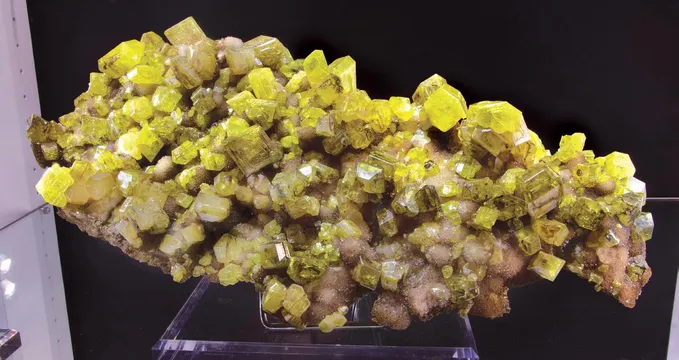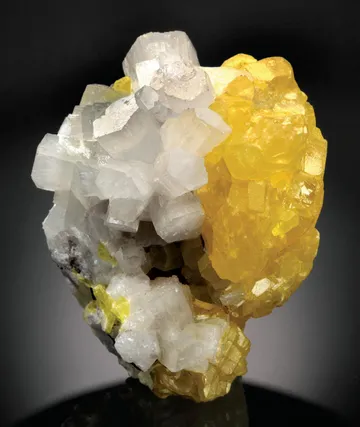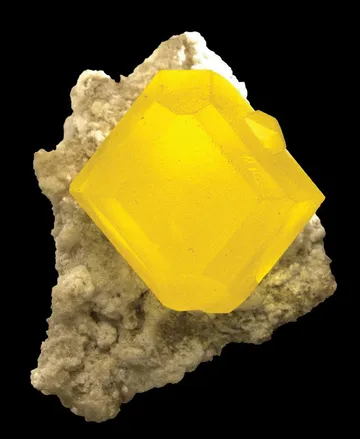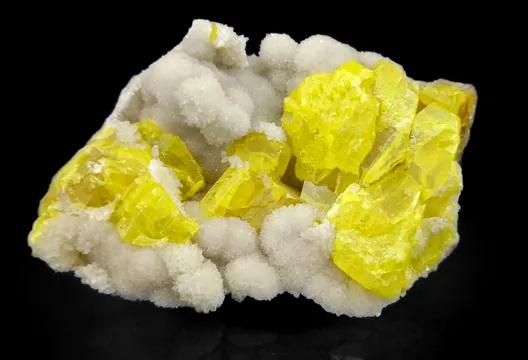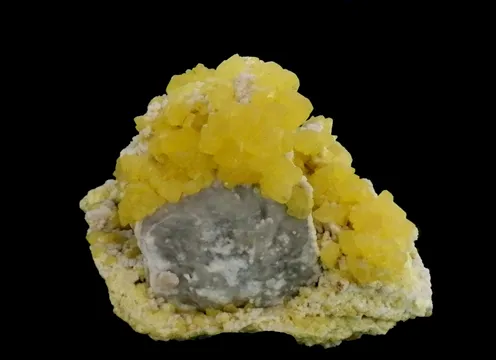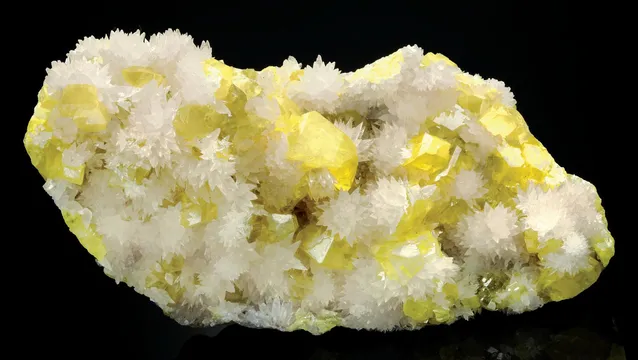
Agrigento, Italy — sulfur locality famed for lemon-yellow to honey-orange crystals on aragonite or calcite; garbere cavities yield historic display pieces.
Key facts
Agrigento is one of the great names on old sulfur labels, but collectors should read that name with historical care. “Agrigento,” and especially the older “Girgenti,” often refers not merely to the modern municipality but to the broader sulfur country of Agrigento Province: Cozzo Disi near Casteltermini, the Racalmuto district, Cianciana, Comitini, Ciavolotta near Favara and Villaggio Mosè, and a scatter of smaller solfare that fed the same collecting tradition. Together these mines sit in the central Sicilian gessoso-solfifera succession, the Messinian evaporite terrain in which gypsum, anhydrite, marl, limestone, bitumen-bearing beds, and later carbonate replacement textures created the cavities that made Sicilian sulfur famous.
The collector’s image of Agrigento is unmistakable: lemon-yellow to honey-orange native sulfur crystals, commonly lustrous, translucent, and sharply formed, perched on white to cream aragonite, calcite, gypsum, or celestine. The best pieces have both color and architecture—individual sulfur crystals placed cleanly on contrasting carbonate, not merely embedded in pale matrix. Many are fragile old specimens from mines closed for decades; the finest cabinet pieces have survived mining, handling, transport, collection storage, and the inherent softness and thermal sensitivity of sulfur.
Regional View
Country View
What makes Agrigento exceptional is not sulfur alone, but sulfur in a specimen-making environment. In the ore bodies, miners encountered garbere—large natural cavities within the sulfur-bearing horizons—where aragonite, gypsum, celestine, calcite, bitumen, and sulfur could grow with enough space to form display-quality specimens. Cianciana is specifically recorded for garbere that yielded some of Sicily’s finest aragonite, celestine, gypsum, and bright sulfur on granular calcite. Cozzo Disi, meanwhile, became the emblem of the district: a vast, long-lived mine, famous among collectors for sulfur on aragonite and among historians for its scale, technology, and disasters.
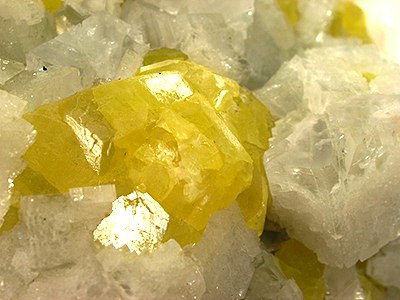
Photo: Wikimedia Commons

Photo: Wikimedia Commons
Search for specimens: View all specimens from Agrigento, Italy
Agrigento’s collectible minerals come from sedimentary sulfur deposits in Sicily’s Messinian evaporite series rather than from a volcanic fumarole environment. The host succession belongs to the central Sicilian sulfur-gypsum belt, where gypsum and anhydrite-bearing strata, bituminous marls, limestones, and secondary carbonates record the late Miocene salinity crisis and later diagenetic alteration. Modern work on Sicilian sulfur-bearing limestones treats native sulfur and associated carbonates as products of microbial sulfate reduction and hydrocarbon-influenced reactions within sulfate-rich strata. That origin explains why sulfur, aragonite, calcite, gypsum, celestine, bitumen, and evaporite salts are so closely intergrown in the collecting record.
In specimen terms, the important ore bodies were not neat veins but sulfur-rich horizons, replacement masses, and cavity systems within the evaporitic sequence. Sulfur was worked industrially wherever grades and geometry justified shafts, galleries, inclined ways, and later mechanized treatment plants. For collectors, the decisive structures were the cavities: open spaces in which sulfur could crystallize as individual orthorhombic crystals rather than as massive ore, and where aragonite or calcite could provide a white, sparkling stage for yellow crystals. Cozzo Disi is repeatedly cited for calcite pseudomorphic after aragonite, a texture common enough there that many specimens labelled “aragonite” should be checked carefully; on some old pieces the carbonate matrix is original aragonite, while on many others it has been partly or wholly replaced by calcite.
The principal “Agrigento” names on mineral labels include Cozzo Disi, Cianciana, Racalmuto, Ciavolotta, Comitini, Favara-area mines, and older label localities under Girgenti. Cozzo Disi lies near Casteltermini and Campofranco, in the Platani valley area. Archival sources trace its existence to the early 1800s, with work begun after sulfur was observed at the base of Montelongo in the Chipirdìa estate. Ownership and operation changed over time: the count of Bastiglia’s interest gave way to shared arrangements with heirs and mining engineers, So.Chi.Mi.Si. entered in 1966, and the Ente Minerario Siciliano took over in 1970. Regional Law 34 of 1988 ordered the closure of the Sicilian sulfur mines; Cozzo Disi ceased production in 1988, was maintained for a few more years, and entered regional heritage status in 1991.
Cozzo Disi was technically important as well as collectible. The old sulfur purification sequence is still legible in its remains: calcarelle, calcheroni, Gill furnaces, steam melting plant, and flotation plant. The flotation plant marked a new phase in the mine’s life and moved activity to a later, higher part of the site. The underground system was divided into twelve levels, progressively driven downward as upper workings were exhausted; the main D’Ippolito shaft and workers’ ways connected the levels, though today the deeper workings are flooded and inaccessible.
Cianciana, west-northwest of Agrigento, was a cluster rather than a single mine. Mining began there in 1840 under the British company Morrison Seager & Co., stalled because transport was difficult, and revived in 1860 when Vincenzo di Giovanni arranged to reopen and operate the mines. By 1900–1905 the Cianciana district comprised seventeen mines and more than 1,100 workers. Its specimen reputation rests on garberi that produced aragonite, celestine, gypsum, and lustrous sulfur crystals; recorded Cianciana sulfur reached large sizes, while aragonite occurred as colorless to gray penetration twins of prismatic crystals.
Racalmuto is another critical name, especially for sulfur on aragonite and for the broader evaporite assemblage. Racalmuto’s sulfur and salt mining exposed halite seams and potash-bearing evaporites as well as the classic secondary mineralization: sulfur, aragonite, calcite, celestine, gypsum, and bitumen. Old labels may be frustratingly broad—“Girgenti,” “Agrigento,” “Racalmuto,” or simply “Sicily”—and that imprecision is part of the locality’s collecting history. The old literature and specimen trade often used geographical names more loosely than modern locality databases do.
Ciavolotta, between Favara and Villaggio Mosè, is especially relevant because it lies close to the modern city of Agrigento. It was one of the major sulfur mines of the Agrigento mining district and has been identified as a mining-park heritage site. ISPRA notes the underground zubbie—large cavities filled with nearly pure mineral, with gypsum and sulfur around them—as one of the features that make Ciavolotta a rare and important mine. Modern access is heritage-oriented, not collecting-oriented; old underground sulfur mines are hazardous, legally restricted, and in many cases protected or abandoned industrial sites.
For collectors today, “Agrigento” specimens are overwhelmingly old-stock or ex-collection pieces. Productive mining has ended, underground collecting is not a practical or responsible option, and most worthwhile specimens now circulate through dealers, auctions, museum deaccessions, and private collections. The best labels identify a mine—Cozzo Disi, Cianciana, Racalmuto, Gibellini, Ciavolotta, Lucia, Stretto Cuvello—rather than only “Agrigento.” Still, a simple antique “Girgenti” or “Agrigento, Sicily” label can be desirable when the specimen is clearly of the classic sulfur-aragonite-calcite style and has credible provenance.
Agrigento sulfur is the benchmark for sedimentary native sulfur specimens: bright lemon-yellow to golden-orange orthorhombic crystals, commonly tabular to blocky, translucent to gemmy, and set on aragonite, calcite, gypsum, celestine, or bituminous carbonate matrix. Cianciana is documented for lustrous crystals in garbere, with sulfur reaching exceptional sizes; Racalmuto and Cozzo Disi are famous for sharply crystallized sulfur on white aragonite or calcite after aragonite, and some Cozzo Disi crystals contain petroleum or bituminous inclusions that give a smoky or brownish cast. Ordinary pieces are massive, bruised, chalky, or crowded; good Agrigento pieces show undamaged crystal edges, glassy faces, saturated color, strong contrast with the matrix, and a natural-looking point of attachment rather than suspiciously perfect crystals standing implausibly on a prepared base.
Agrigento aragonite is prized both as a specimen mineral in its own right and as the classic matrix for Sicilian sulfur. It occurs in white, cream, colorless, gray, and sometimes subtly zoned pseudohexagonal clusters, penetration twins, platy aggregates, and prismatic crystals, with individual crystals recorded to several centimeters in the better Sicilian sulfur mines. Cianciana is noted for colorless to gray penetration twins of prismatic crystals in garbere, while many Agrigento-market specimens show white aragonite plates or druses supporting sulfur crystals. The best aragonite pieces are bright, lustrous, architectural clusters with minimal bruising and strong fluorescence or phosphorescence when present; collectors should also recognize the common Cozzo Disi complication that calcite may replace aragonite, producing specimens that retain the aragonite form but are mineralogically calcite.
Beyond sulfur and aragonite, the Agrigento specimen suite includes calcite, celestine, gypsum, halite, sylvite, carnallite, kainite, kieserite, aphthitalite, thenardite, anhydrite, baryte, mirabilite, eugsterite, polyhalite, bitumen, quartz varieties, and rare records tied either to evaporites or to special sublocalities. Celestine is a serious associate, particularly on old sulfur specimens and in cavities; gypsum ranges from attractive transparent crystals to large groups from Cianciana and Cozzo Disi; and Racalmuto’s evaporites add halite and potash-salt interest to the district. Melanophlogite deserves special mention because old labels using “Racalmuto, Girgenti” are tied to the historical naming geography of Agrigento, though the accepted type-locality discussion centers on the Giona Mine area now placed in Caltanissetta Province; it is a classic example of why old Sicilian labels must be interpreted historically, not only by present administrative borders.
Agrigento sulfur has one of the most important authenticity problems in the mineral trade. In the mid- to late 1970s, artificial “Sicilian” sulfur specimens were produced in Italy by crystallizing sulfur onto authentic Sicilian matrix. The best of these were not crude glue jobs: they could show excellent color, size, luster, and convincing matrix relationships. Later published work demonstrated that sulfur isotope analysis could distinguish non-Sicilian source sulfur crystallized onto Sicilian matrix from genuine Sicilian sulfur. For expensive specimens, especially unusually large, perfect, cabinet-size sulfur on matrix with vague provenance, this history matters. Natural-looking attachment, bitumen inclusions, old collection history, and credible mine labels all help, but they are not absolute proof for top-end pieces.
Condition is the second major issue. Sulfur is soft, brittle, heat-sensitive, and vulnerable to abrasion along crystal edges. It should not be washed aggressively, left in a hot display case, placed in strong sunlight, or stored where it can rub against harder minerals. Fine crystals commonly show tiny bruises on corners, cleavages, or contact marks; a specimen with absolutely flawless large crystals should be admired, but also examined skeptically. Many old pieces have been trimmed, stabilized by careful mounting, or repaired after decades of collection handling, so honest condition descriptions are important.
The carbonate matrix also requires attention. White “aragonite” on an Agrigento sulfur specimen may indeed be aragonite, but calcite after aragonite is common on some Cozzo Disi material. This is not necessarily a defect—calcite pseudomorphic after aragonite is part of the locality’s mineralogy—but it affects labeling. Dilute acid testing is not recommended on valuable specimens because both aragonite and calcite react and sulfur pieces are delicate; use visual morphology, UV response, specific gravity where practical, Raman/FTIR, XRD, or a knowledgeable lab if the distinction matters.
Fluorescence adds a useful collecting dimension. Agrigento-region aragonite is documented for multi-wavelength fluorescence and phosphorescence, with pink response under longwave UV, afterglow, and white to blue shortwave reactions recorded on reference specimens. Sulfur itself is not the fluorescent attraction on most pieces; the aragonite or carbonate matrix is. Handle UV examination gently and avoid heating the specimen with lamps.
Market availability is uneven. Small sulfur-on-carbonate specimens remain obtainable, but top specimens from Cozzo Disi, Cianciana, Racalmuto, and old “Girgenti” labels are finite and increasingly tied to old collections. Well-placed sulfur crystals on clean white aragonite or calcite matrix, large single crystals with excellent luster, pieces with old labels, and specimens from named mines command far stronger interest than broken ore fragments or anonymous yellow sulfur on pale matrix. A specimen identified only as “Agrigento” can still be classic, but a precise and credible sublocality usually adds both scientific and market value.
Cozzo Disi is the mine that gives the Agrigento sulfur story its dramatic center. In one modern reprint of a Sicilian reportage, the mine appears first as a machine hidden inside a mountain: 418 miners, ten technicians, a director, and thirty-one clerks, producing nearly 300 tons of ore a day. The author describes a complete processing cycle already operating underground, with “macchine mostruose” at 700 meters depth breaking, crushing, and moving sulfur upward until it emerged as industrial powder.
The entrance itself reads like a descent ritual. To reach the workings, visitors first had to walk a gallery one kilometer long—narrow, dark, muddy, and low enough that a helmet stopped being theatrical and became essential. At the end was not daylight but a glare of neon over a shaft seven or eight meters wide. A metal platform, suspended by steel cables, dropped through the mine levels while a bell sounded at each station. Behind steel grates, faces appeared briefly: miners waiting to rise.
The mine’s geometry was explained underground, not on a classroom board, but against a wall of rock salt. The guide traced the mountain, the kilometer-long gallery, the shaft, and the twelve levels of Cozzo Disi; work was already preparing a thirteenth level another fifty meters below. In that single diagram, the collector can feel the difference between a pretty sulfur specimen and the world that produced it: a yellow crystal on aragonite is also the visible remnant of an immense underground architecture of shafts, pressure, pumps, galleries, furnaces, and men.
Cozzo Disi is also remembered for catastrophe. On July 4, 1916, around 13:30, explosions tore through the mine. Workers on the first and third levels fled; some reached safety, others emerged burned by firedamp. In the Giambrone section, sixty-six workers died from burns, asphyxiation, hydrogen sulfide poisoning, and trauma. Twenty-three more from the nearby communicating Serralunga mine fled down an inclined plane, made only about ninety meters, and were overtaken by gas. The disaster killed eighty-nine miners and injured thirty-four, making Cozzo Disi a site of national mining tragedy as well as mineralogical fame.
After closure, the mine’s story became one of preservation repeatedly begun and repeatedly interrupted. The 1988 regional law ended production, but Cozzo Disi was maintained until 1992, with water removal still operating. Later, funding restored surface buildings and a short underground circuit from the flotation gallery to a level fifteen meters below, an early attempt at underground mining tourism. Yet flooding, theft, collapse, and lack of continuous management left much of the complex inaccessible. Witnesses nevertheless described mineralogical wonders still inside: large garbere, decimetric gypsum crystals, and, on the third level, cavities compared to a small Sicilian Naica.
The community memory has not faded. In Casteltermini, exhibitions and local association events have gathered gas masks, miners’ helmets, hammers, lamps, lunch bags, black-and-white photographs, work booklets, plans, newspaper clippings, and samples of yellow sulfur. The objects are modest beside a fine crystal specimen, but they belong to the same story. A sulfur crystal from Agrigento is not simply a colorful mineral; it is a survivor from an industry that shaped towns, families, migration, literature, labor politics, and the landscape of central Sicily.