Poggio Balate, Italy — fluorite-barite locality producing cobalt-blue to blue-green cubic fluorite with zoning and baryte rosettes, prized by collectors.
Key facts
Poggio Balate is a small hill at the northwestern foot of Monte San Calogero, near Termini Imerese in the Metropolitan City of Palermo, Sicily, but its reputation among collectors is far larger than its footprint. The locality is a carbonate-hosted, fault-controlled hydrothermal fluorite-barite occurrence in the Mesozoic Crisanti Formation, developed especially in brecciated Tithonian limestones rich in Ellipsactinia fossil fragments. In the field the mineralization is tied to fractures, corroded limestone surfaces, karst cavities, and fault-wall openings: precisely the kind of broken, reactive carbonate architecture that can turn an unassuming hilltop into a classic specimen locality.
For collectors, Poggio Balate means blue to green cubic fluorite, often transparent enough to reveal internal phantoms, cloudy white cores, and fluid inclusions. The best specimens have saturated cobalt-blue or blue-green color, sharp cubic form, satin to lustrous faces, and enough translucency to show their growth zoning. The locality also produced pale blue and grey-green examples, fluorite on white or cream matrix, and pieces with baryte as ivory-white rosettes, tabular plates, or compact crusts. Older literature notes cubic fluorite crystals as large as 12 cm across, while modern market pieces from the better recent finds more often show aggregates of 1–4 cm cubes with strong color and attractive zoning.
Scientifically, Poggio Balate is not just another attractive fluorite occurrence. It was central to a cluster of Palermo-led geochemical studies in the 1980s on rare-earth elements, stable isotopes, strontium isotopes, and fluid inclusions in northwestern Sicilian fluorite-barite mineralization. Those studies helped frame the deposit as a low-temperature hydrothermal system dominated by heated meteoric waters interacting with Mesozoic limestone, with organic-rich beds contributing methane and hydrocarbons to some inclusions. That is part of the locality’s appeal: the same features that make the crystals visually alive under the loupe also record a distinctive Sicilian hydrothermal story.
Regional View
Country View
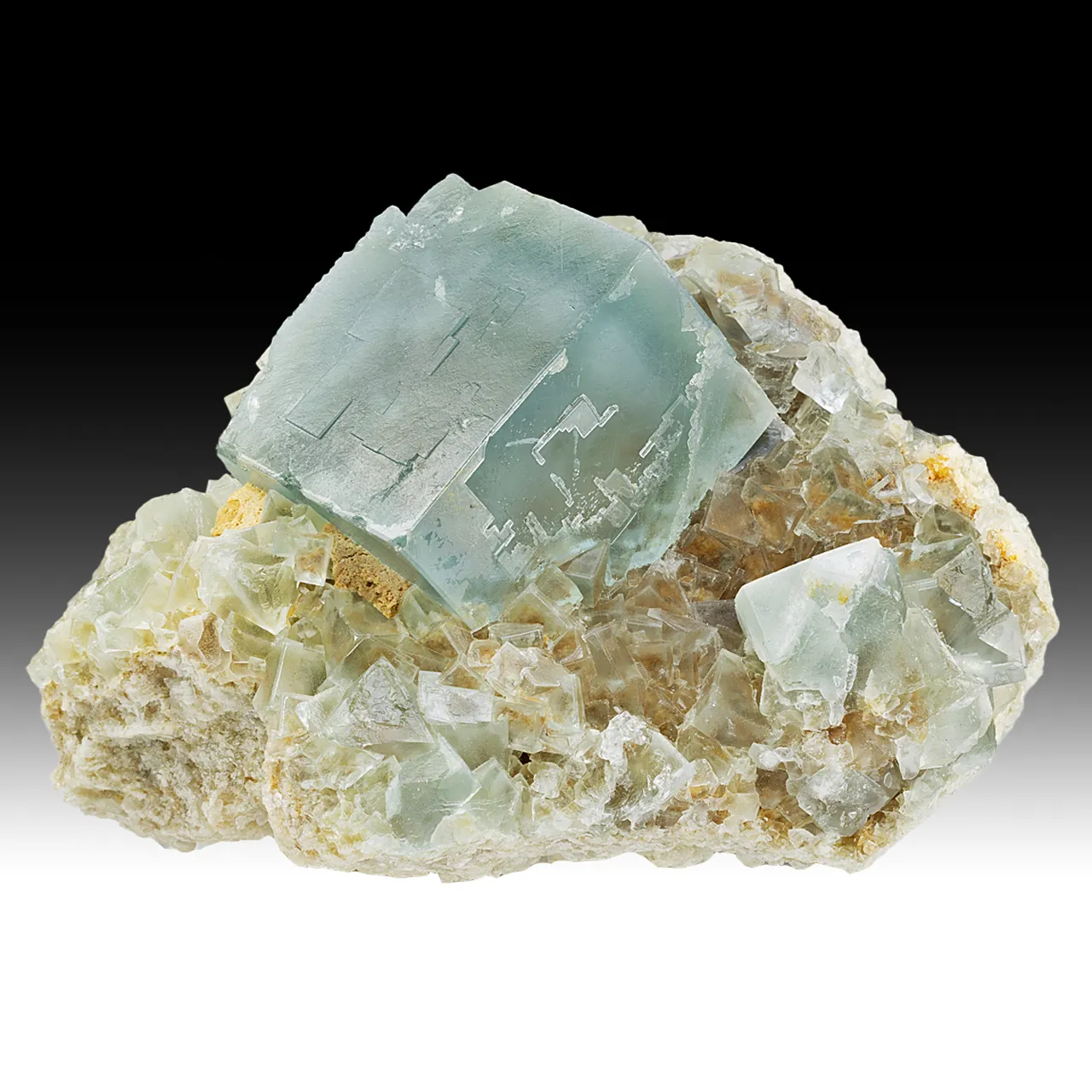
Photo: EarthWonders
The hill lies beside a protected natural landscape, the Monte San Calogero oriented nature reserve, established for the Mesozoic limestone-and-dolomite mountain system and its natural communities. Poggio Balate itself is described as partly outside the reserve perimeter, but the broader setting is a regulated landscape of karst, faults, steep limestone, private land, and protected ground. That combination has shaped the locality’s modern collecting history: no large mine dumps, no industrial underground workings to comb through, and no predictable “new pocket” season—just a small, heavily collected hill where a few episodes of natural exposure, road work, and patient local searching brought exceptional fluorite into circulation.
Search for specimens: View all specimens from Poggio Balate, Italy
Poggio Balate is listed mineralogically as a hill locality in Termini Imerese, Palermo, Sicily, with the classic occurrence centered on a low limestone relief at the northwestern side of Monte San Calogero. The coordinates generally given for the locality are about 37° 57' 45" N, 13° 42' 36" E. It is not a “mine” in the conventional sense of a named commercial operation; it is an outcropping mineralized hilltop and surrounding occurrence where fluorite and baryte occupy fractures, cavities, veins, encrustations, and altered portions of Mesozoic carbonate rocks.
The deposit type is best understood as a carbonate-hosted fluorite-barite hydrothermal mineralization. The mineralized rocks are mainly brecciated limestones with Ellipsactinia of Tithonian age within the Crisanti Formation, with the mineralized limestone package lying between older bedded cherts with rhythmic shale interbeds and younger silicified limestones. The broader stratigraphic context belongs to the Imerese facies, a Mesozoic sedimentary succession in northern Sicily that includes carbonate, dolomitic, siliceous, marly, and terrigenous units. At Poggio Balate, the reactive limestone beds mattered: published and field accounts emphasize that fluorite and baryte are concentrated in the Jurassic carbonate breccias and, to a lesser degree, in Cretaceous calcarenitic levels, while siliceous beds such as radiolarites and cherty micrites were comparatively unreceptive.
Structurally, the occurrence sits in a broken landscape of monoclinal blocks separated from the main Monte San Calogero structure by post-Pliocene and Quaternary disjunctive tectonics. A major ENE-WSW fracture separates the low Poggio Balate relief from the higher Monte San Calogero massif, and the hill is further affected by smaller faults. Those faults and open fractures acted as pathways and traps: the mineralization is described chiefly as cavity filling, vein material, and crusts or encrustations on faulted walls. The most collectible fluorite grew where open space allowed cubic crystals to develop, particularly on corroded karst surfaces, in gaping fractures, and in pockets within the limestone rather than as shapeless replacement masses deep in tight rock.
The ore assemblage is simple but distinctive. Fluorite and baryte dominate. Calcite and quartz are documented associates, with aragonite and iron oxides reported as minor phases, and dickite also recorded from the locality. Baryte occurs in several habits: compact whitish crusts on limestone, massive pearly white material in cavities and veinlets, and thin tabular crystals or rosettes associated with fluorite. Calcite appears both as late carbonate and as part of the altered carbonate system; isotopic studies distinguished rhombohedral and scalenohedral calcites associated with the fluorite-barite event. Quartz is usually subordinate as small crystals or vein material and is far less important visually than the fluorite.
Mining history at Poggio Balate is better described as discovery, study, and collecting history than production history. The mineralization was reportedly discovered in the early 1970s during field investigations for a geology thesis, when loose fluorite fragments on the ground were initially mistaken for bits of broken bottle glass. Subsequent checking of the surrounding limestone outcrops revealed that the occurrence was not just a scatter of isolated crystals: baryte was abundant enough in places to form thick crusts, and the fluorite-barite mineralization extended around the hill within a radius of a few hundred meters. Because of the small size and discontinuous volume of the mineralized bodies, it did not develop into a documented industrial fluorite or baryte mine.
Later activity unintentionally improved exposure. In the late 1980s, earthworks for a road and service structures connected with mobile-phone antennas reportedly exposed substantial fluorite- and baryte-rich veins, drawing the attention of local collectors. A much later collecting wave is represented by the 2019–2020 pockets, which supplied modern cabinet specimens of saturated cobalt-blue fluorite with clear to white cores, vivid blue phantoms, and stepped or partially frosted cubic faces. These recent pieces are the ones most familiar in today’s international specimen trade.
Access today should be approached conservatively. Monte San Calogero is a protected natural area, and official sources list the reserve within the municipalities of Termini Imerese, Caccamo, and Sciara, with geology among its protected values. Poggio Balate is described as partly outside the reserve, but that does not make unrestricted collecting appropriate. The hill is a small, depleted, partly vegetated and karstified terrain with sharp limestone, cavities, steep or broken ground, and a long history of collector pressure. Serious collectors should treat old labels and documented provenance as more realistic avenues than field collecting, and any field visit requires local permission, attention to reserve boundaries, and avoidance of disturbance to protected or private land.
Poggio Balate fluorite is overwhelmingly cubic, with colors documented as grey, green, and blue, and with the best collector pieces showing transparent to translucent blue, cobalt-blue, or blue-green cubes on pale fluorite, baryte, calcite, quartz, or limestone matrix. Old literature and locality summaries record crystals reaching 12 cm across, but most available specimens are smaller: miniatures and small cabinets with cubes from a few millimeters to several centimeters, often grouped as ridges, stacks, or intergrown clusters. The prized modern material from the 2019–2020 pockets is recognized by saturated blue outer zones over cloudy white or colorless cores, sharp phantoms, occasional thin purple edging, satin luster, and preferential frosting on selected faces; lesser pieces tend to be grey-green, bruised, cleaved, heavily contacted, or so cloudy that the internal zoning is lost. Fluid inclusions are a key Poggio Balate signature, commonly two-phase liquid-rich aqueous inclusions, with rarer hydrocarbon-rich or three-phase inclusions tied to the locality’s organic-bearing sedimentary setting.
Other documented minerals from Poggio Balate include baryte, calcite, quartz, aragonite, dickite, iron oxides, and the limestone host rock itself. Baryte is the most important companion species, present as crusts, massive pearly white cavity fillings, tabular crystals, and rosettes on or among fluorite; attractive baryte-fluorite pieces are much scarcer on the market than fluorite-only specimens. Quartz is generally a minor associate, though fluorite with quartz is documented photographically. Aragonite, dickite, calcite, and iron oxides are mineralogically useful in reconstructing the carbonate alteration and late-stage cavity environment, but they are not the reason collectors seek the locality. No accepted IMA type-locality species are tied to Poggio Balate; its rarity is instead in the locality-specific fluorite habit, color zoning, fluid-inclusion record, and unusual Sicilian low-temperature hydrothermal setting.
The most common problem with Poggio Balate specimens is condition, not authenticity. Fluorite from the locality is cleavable and commonly shows bruised cube edges, contacted backs, broken corners, cleaves, or pocket-wall damage. Even strong pieces may have some edge wear, because the crystals often grew in tight or partly filled cavities and were recovered from limestone rather than from clean, open vugs. Matrix pieces can be bulky and friable where fluorite sits on pale fluorite, baryte, calcite, or altered limestone; check the underside carefully for trimming, repaired matrix, and concealed contact zones.
Color should be judged under more than one light source. The best Poggio Balate fluorites can look intense cobalt blue under cool LED light and shift toward blue-green or teal in other lighting. Some pieces have cloudy centers and vivid blue edge phantoms; this is a desirable locality feature, not a defect, when the zoning is sharp and the crystals remain transparent enough to show it. Pale blue specimens are legitimate, as are grey-green examples, but unusually vivid color on a badly worn or poorly formed piece should be evaluated against provenance and photography conditions. Published and dealer descriptions also document shortwave or longwave ultraviolet fluorescence in some specimens, including purple or bright responses, but fluorescence is variable and should not be treated as the sole proof of origin.
Mislabelling is plausible because “Monte San Calogero,” “Termini Imerese,” and “Poggio Balate” are sometimes used loosely on labels, and nearby fluorite-barite occurrences such as Rocca Grande, Cozzo Famo, Case Scillato, and Monte Stingi belong to the same regional mineralized system. A precise Poggio Balate label is preferable, especially for specimens attributed to the 2019–2020 pockets. Older labels may also generalize the locality as “San Calogero area” or “Termini Imerese”; such labels are not necessarily wrong, but they are less specific.
No well-documented treatment tradition is associated with Poggio Balate fluorite in the specimen literature, and natural zoning, phantoms, fluid inclusions, and surface frosting are normal for the locality. Still, standard fluorite cautions apply: avoid ultrasonic cleaning, heat, acids, and prolonged direct sunlight tests. Use only gentle water cleaning on stable specimens, and avoid soaking pieces with porous baryte, calcite-rich matrix, clay, or iron-oxide coatings.
Market availability is limited but not negligible. The locality is represented by a modest number of modern specimens on specialist platforms, with a concentration of recent blue material from the 2019–2020 finds and scattered older or self-collected Italian pieces. Fine examples with saturated blue color, visible phantoms, sharp cubic architecture, minimal damage, and credible provenance are much scarcer than ordinary pale or contacted specimens. Large old-style crystals approaching the historically cited maximum size should be considered exceptional and should carry strong provenance.
The origin story of Poggio Balate has the charm of a field geologist’s accident. In the early 1970s, Francesco Speciale was examining the Termini Imerese countryside for a geology thesis when he climbed a winding track made by grazing animals. Underfoot, mixed with soil and vegetation, were glints that at first looked like broken bottle bottoms. They were not glass. They were fluorite. The recognition changed the hill from a piece of limestone pasture into a mineral locality: nearby outcrops showed baryte as thick crusts on carbonate rock, and the “curiosity” underfoot became the clue to a true fluorite-barite deposit around the crown of Poggio Balate.
The smallness of the hill is part of the story. Field accounts describe the mineralization as extending around the little summit within only a few hundred meters, yet it was persistent enough that careful searching could reveal fluorite in rock crevices, beneath soil trapped under the vegetation, and even in stones used in dry walls built to hold olive-cultivated ground. That image—collector fluorite hidden in the agricultural fabric of the hill—is very Poggio Balate. The locality was never a cavernous mine with rails and stopes; it was a karstic limestone surface where crystals could appear in the worn edges of rural Sicily.
A second chapter came near the end of the 1980s, when practical construction work did what collectors often cannot do: it opened fresh rock. Road work and service construction connected with antenna installations reportedly exposed rich fluorite-barite veins. The finds drew mineral enthusiasts to a hill that had already been known in academic circles, and some of the material that circulated afterward preserved the distinctive Poggio Balate look—cubic fluorite with blue, green, or grey tones, baryte crusts, and pocket textures that speak of fractures and carbonate cavities rather than conventional mine veins.
The modern collecting story belongs to the 2019–2020 pockets. These produced some of the most recognizable Poggio Balate specimens in today’s trade: compact cabinet pieces of saturated cobalt-blue fluorite, sometimes as rows or stacks of intergrown cubes, with cloudy white centers and sharp blue outer phantoms. One documented specimen shows a row of large cubes, the largest about 4.0 x 3.4 cm, with smaller cubes up to 2.5 cm, transparent satin luster, blue zoning, and minor but expected edge wear. Another modern description notes a 7 cm aggregate with deep green to deep blue color and a largest crystal of 4 cm. These are not merely attractive fluorites; they are the pieces that made a small Sicilian hill feel newly alive to international collectors half a century after its first recognition.