Sulfur — vivid canary-yellow crystals with resinous luster; rare euhedrals, famed Sicilian mines and top localities; fragility boosts collecting value and care.
Key facts
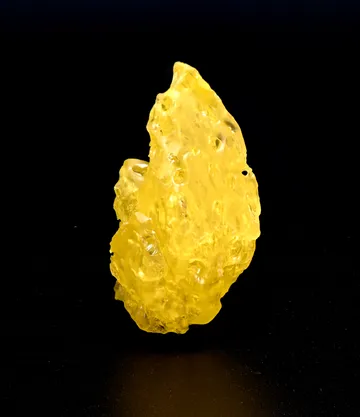
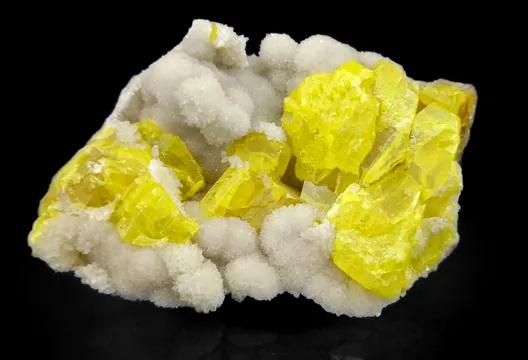
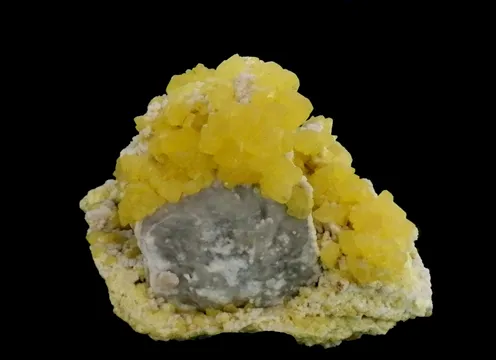
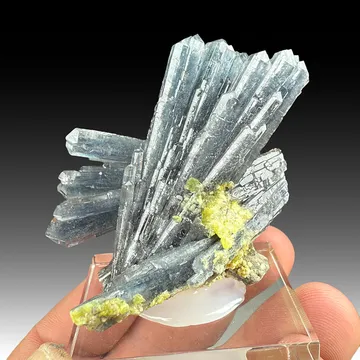
Sulfur is one of the most visually distinctive native elements, renowned for its electric canary-yellow color, resinous-to-greasy luster, and often spectacular orthorhombic crystals. The best crystals form sharp bipyramids or thick dipyramidal prisms, frequently showing fine striations and growth steps. Classic specimens display sulfur perched on snow-white aragonite or calcite, sometimes with velvety gypsum or asphaltic bitumen for stark contrast. Colors range from bright lemon-yellow through golden to amber; rare pieces show orange tones. Transparency varies from waxy-opaque to gemmy and internally glowing when backlit.
Collectors are drawn to sulfur’s unique look and its storied history, especially the legendary Sicilian mines that supplied Europe in the 18th–19th centuries and filled museums with huge, flawless crystals. While massive sulfur is common in volcanic regions, fine euhedral crystals are far scarcer and highly prized. Because sulfur is very soft and heat sensitive, perfect, damage-free crystals on aesthetic matrix are genuinely scarce—particularly larger ones—pushing the best examples into elite status.
Sulfur has been collected for centuries, with Sicily serving as the archetype of quality and abundance in the 1800s. These historic finds established the species as a cabinet essential. The 20th century brought strong Mexican and Polish occurrences that refreshed the market with bright, sharp crystals, while microcrystalline sublimates from active volcanoes (e.g., Vesuvius, Japan’s Miyake Island) captivate micromounters.
Today, sulfur remains popular across all levels of collecting. Miniatures and thumbnails with perfect form and lively color are accessible, while large, undamaged Sicilian matrix pieces or top Mexican crystals command premium prices. Beyond aesthetics, sulfur’s fragility and sensitivity add to its allure—caring for a fine sulfur is part of the collector’s craft, and pristine examples carry an unmistakable prestige.
While sulfur occurs widely in volcanic and evaporite environments, a handful of localities stand out for producing iconic, world-class specimens. Below are notable sources with strong reputations among collectors.
Agrigento Province is synonymous with classic sulfur. The district’s historic mines yielded textbook orthorhombic crystals—canary-yellow, lustrous, and often gemmy—on showy white aragonite, calcite, or gypsum, sometimes accented by black bitumen. Many of the great 19th-century European museum pieces originated here, establishing standards for color, form, and composition that remain benchmarks. Collectors especially value balanced matrix displays with sharp, undamaged crystals and strong contrast.
Cianciana is renowned for sharply faceted sulfur crystals—often thick dipyramids—ranging from bright lemon to rich golden hues. Associations with aragonite, calcite, and bitumen are classic, and the overall “Sicilian look” is unmistakable. Larger crystals from Cianciana tend to be clean and lustrous, sometimes approaching a glowing, gemmy quality when lit. Fine matrix specimens with multiple undamaged crystals are highly desirable.
Poland’s Tarnobrzeg area (notably the Machów and Jeziorko deposits) produced modern classics in the late 20th century: brilliant lemon-yellow sulfur crystals on calcite or baryte. These specimens are admired for crisp, highly lustrous faces and textbook geometry. Many are wonderfully bright and clean, and fine matrix pieces with multiple pristine crystals are among the most admired non-Sicilian sulfurs.
The El Desierto Mine is a premier Mexican source known for sharp, translucent to transparent sulfur crystals—often elongated, well-striated, and intensely colored. These occur on attractive white to cream matrices, creating classic contrast similar to Sicilian material but with its own style. Choice examples exhibit glassy luster and glowing interiors under strong light.
Sulfur is exceptionally sensitive. Proper care preserves color, luster, and structure for decades.
With careful selection and thoughtful care, sulfur can be one of the most charismatic highlights of a collection—its radiant color, historic provenance, and delicate nature combining to create enduring appeal.