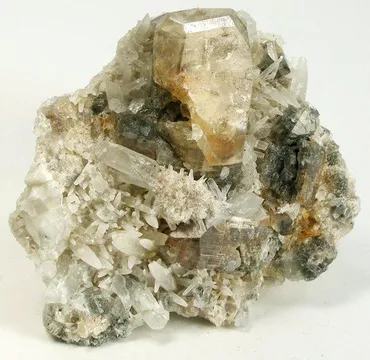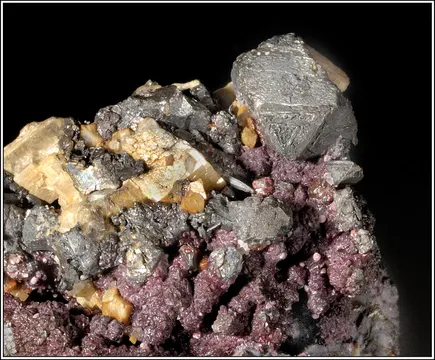
A collector's guide to Schlema-Hartenstein mining district, Germany: its geology, mining history and notable minerals, illustrated with the 48 specimens documented from this locality on EarthWonders.
Key facts
Schlema-Hartenstein is one of the essential modern Saxon ore districts: a collector locality where old Erzgebirge silver-cobalt-nickel-bismuth tradition meets the colossal twentieth-century uranium workings of SAG/SDAG Wismut. Mineralogically, the district is not a single picturesque mine but a complicated vein field around Bad Schlema, Alberoda, Niederschlema, and Hartenstein, within the western Erzgebirge metallogenic province. Its specimens reflect repeated hydrothermal events: quartz-calcite-pitchblende veins, dolomite-pitchblende veins, selenium-rich assemblages, and later Bi-Co-Ni-Ag-U mineralization that introduced native bismuth, ruby-silver minerals, native arsenic and silver, cobalt-nickel arsenides, sulfides, selenides, tellurides, and carbonates.
For collectors, the district has two reputations that overlap beautifully. The first is cabinet mineralogy: metallic native bismuth, deep red proustite and pyrargyrite, native silver, arsenic, nickeline, skutterudite, safflorite, calcite, dolomite, siderite, quartz, and uncommon secondary arsenates and sulfates. The second is research mineralogy: Niederschlema-Alberoda has yielded an exceptional U-Se-polymetallic suite, including the type minerals schlemaite and mgriite, plus rare Bi selenides and Se-bearing sulfosalts known mainly as polished-section treasures rather than showy cabinet specimens.
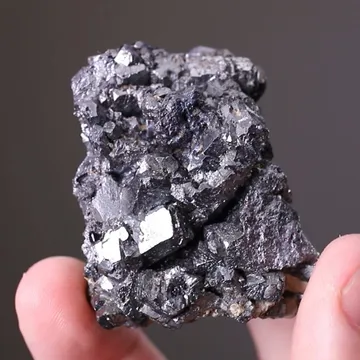
The best Schlema-Hartenstein specimens have an unmistakably Erzgebirge look. Native bismuth is usually not the gaudy rainbow hopper material sold as laboratory bismuth; it is natural, heavy, silvery gray to tin-white metal, commonly tarnished pinkish, brownish, bluish, or yellowish, in compact crystalline masses, skeletal aggregates, or small sharp crystals on carbonate or arsenide-rich matrix. Proustite and pyrargyrite, when fresh and protected from light, are dark cherry-red to nearly black-red, sometimes in sharp prismatic or blocky crystals on quartz, calcite, dolomite, chalcopyrite, or arsenic. Carbonates are not just background: dolomite and calcite are part of the vein architecture, the pocket lining, and often the mineral that either preserves or conceals the ore crystals.
Regional View
Country View
The district’s modern physical emblem is Shaft 371 at Hartenstein, the preserved Wismut shaft complex in the Poppenwald valley of the Zwickauer Mulde. Its steel headframe and associated buildings connect the specimens in drawers to a very real industrial landscape: deep mine levels, radiometric ore sorting, water handling, ventilation, cooling at depth, and the later remediation of enormous waste heaps. Shaft 366 at Alberoda is equally important for collectors because its Brahmaputra vein and related workings supplied celebrated silver minerals, including proustite, pyrargyrite, stephanite, acanthite, and native silver from deep levels during the Wismut era.

Photo: Wikimedia Commons

Photo: Wikimedia Commons
Search for specimens: View all specimens from Schlema-Hartenstein mining district, Germany
The Schlema-Hartenstein mining district lies in the western Erzgebirge of Saxony, between the Bad Schlema–Aue-Alberoda area and Hartenstein. In mineral-collection usage the name commonly covers specimens from the broader Schlema-Alberoda-Hartenstein district, with important sublocalities including Shaft 366 at Alberoda, Shaft 371 at Hartenstein, Shaft 38 at Niederschlema, and specific veins or “Lose” localities within those workings.
Geologically, the specimen suite belongs to a vein-type uranium-polymetallic system developed in Paleozoic rocks of the western Erzgebirge, at the intersection of major structural trends including the Lößnitz-Zwönitz syncline and the Gera-Jáchymov fault zone. The Roter Kamm structure is a key boundary feature between the Schneeberg Bi-Co-Ni-Ag-U deposit to the southwest and the Schlema-Alberoda uranium deposit to the northeast. The productive rocks include contact-metamorphosed Paleozoic sequences near the late-Variscan Aue-Gleesberg granite massif, and the deposit was cut by an extraordinary density of faults, fissures, and hydrothermal veins.
The principal ore bodies were fissure veins and vein clusters rather than broad stratiform bodies. Hydrothermal fluids used repeatedly reactivated fractures, and the resulting vein mineralization is classically divided into multiple assemblages. The late-Variscan quartz-calcite-pitchblende association is regarded as the primary uranium stage, with pitchblende dated around 275 Ma in the published geological literature. Later magnesium-carbonate-pitchblende and Bi-Co-Ni assemblages overprinted or reworked earlier uranium veins, producing dolomite-ankerite-carbonate veins with uraninite, selenium minerals, hematite, fluorite, sulfides, arsenides, and native metals.
For collectors, the important practical point is that specimen quality is strongly tied to these vein stages. Native bismuth belongs especially to the Bi-Co-Ni-Ag-U overprint and commonly occurs with cobalt-nickel arsenides, carbonates, quartz, and later secondary minerals. Proustite and pyrargyrite occur in silver-rich zones, notably at Shaft 366, where the Brahmaputra vein and other veins were famous for superb Ag minerals. Calcite and dolomite are not merely “matrix” but integral vein minerals; they line fractures, encase metallic ore, preserve delicate crystals from damage, and sometimes must be removed or etched to reveal bismuth or silver minerals.
The mining history is layered. The broader Schneeberg-Schlema region was mined from the fifteenth century for silver and associated metals such as cobalt, nickel, bismuth, copper, and iron. By the early twentieth century, Oberschlema was known for radioactive waters used in spa culture; after the Second World War, those waters and known uranium indications helped draw Soviet exploration into the district. Large-scale uranium mining began in 1946 and continued until the end of 1990, with residual closure work into 1991. The Schlema-Alberoda deposit was mined by SAG/SDAG Wismut and later became one of the great examples of Wismut’s industrial uranium enterprise.
Production figures vary slightly by how the broader field is counted, but the scale is never in doubt. Schlema-Alberoda produced roughly 80,000 tonnes of uranium in the postwar Wismut period, and the Niederschlema-Alberoda mine field alone is recorded at more than 73,000 tonnes of uranium. More than 1,000 uranium-bearing veins were explored and mined to depths approaching 2,000 m, with the largest ore concentrations between roughly 500 and 1,500 m depth. Published descriptions of the mine emphasize the enormous underground development: thousands of kilometers of horizontal workings, tens of millions of cubic meters of underground voids, deep mine temperatures around 65 °C, ventilation and cooling challenges, water handling, and rock-mechanical hazards.
Shaft 371, begun in 1956 and commissioned in 1959, became the principal modern shaft of the Aue mining operation. It was a major hoisting, man-riding, material, and intake-air shaft, and at times employed up to 3,000 people at the shaft complex. The preserved site includes the shaft building, a 50 m steel headframe, machine house, winding machinery, and administrative and functional buildings. The shaft complex is now part of the UNESCO-listed Mining Region Erzgebirge/Krušnohoří, and Wismut GmbH continues to use the site for remediation and heritage purposes.
Shaft 366 at Alberoda has special mineral-collector significance. Mineralatlas records it as a former Wismut shaft whose dump has been leveled, partly relocated, recultivated, and crossed by a road feeder today. The shaft was sunk beginning in March 1955 and reached a final depth of 683 m. Its Brahmaputra vein was especially productive for silver minerals in the 1960s on levels from about -585 m to -675 m, yielding well-formed stephanite, pyrargyrite, acanthite, native silver curls, and proustite. Other veins reached through Shaft 366 included Dürre Henne, Nelson, Rio Tinto, and Seim.
Collecting access today should be treated as essentially closed unless permission is explicitly granted by the responsible owner or operator. The old underground workings are not collector-accessible, dumps have been remediated or capped, and radiological and heavy-metal safety issues are real. The legitimate modern routes into the district are documented old specimens, museum holdings, dealer-provenance pieces, and visits to authorized heritage displays such as the Wismut deposit collection at Shaft 371, where minerals, rocks, maps, profiles, and documentation from the Saxon-Thuringian uranium districts are shown.
The notable specimen finds span several different collecting styles. Shaft 366 produced classic ruby-silver and silver specimens from named veins and deep levels, including proustite on calcite from the Brahmaputra vein at about -650 m and proustite crystals to 2.8 cm on quartz from the Nelson vein at the -675 m level in 1960. Shaft 371 and Shaft 38 are repeatedly associated with native bismuth, including etched pieces liberated from calcite or dolomite and much rarer unetched bismuth crystals on dolomite or siderite. The Opal vein or Opal Lose at Shaft 371 is particularly important in collector lore for sharp native bismuth crystals.
Native bismuth from Schlema-Hartenstein is the district’s signature native-element specimen: silvery gray to tin-white, often with pink, yellow-brown, blue, or subdued iridescent tarnish, occurring as compact crystalline masses, laminar or skeletal aggregates, reticulated clusters, and, in the best pieces, sharp freestanding crystals on dolomite, siderite, calcite, or quartz. Much crystallized bismuth from the district was originally enclosed or overgrown by calcite and dolomite, so many specimens were acid-prepared; etched examples from Shaft 371 and Shaft 38 are far more common than unetched matrix pieces. Collector reports record ordinary massive dump pieces reaching many kilograms, but the cabinet rarities are intact free-grown crystals, sometimes described from the Opal vein of Shaft 38 with crystals to a few centimeters, or sharp lustrous Shaft 371 crystals in the millimeter to centimeter range. Good Schlema-Hartenstein bismuth is natural-looking rather than synthetic-looking: dense, metallic, structurally irregular, well seated on Erzgebirge carbonate or arsenide matrix, and preferably accompanied by documented sublocality information such as Shaft 371, Shaft 38, or Opal Lose.
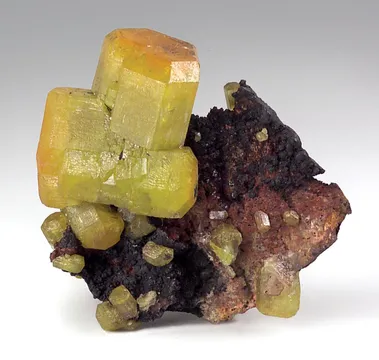
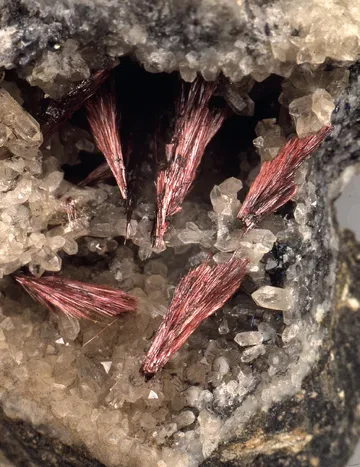
Proustite from Schlema-Hartenstein is a classic red-silver mineral of the silver-rich parts of the Wismut-era vein system, especially Shaft 366 at Alberoda, where the Brahmaputra vein and related veins produced notable specimens during the 1960s from levels around -585 m to -675 m. The best pieces show deep ruby to dark cherry-red prismatic crystals or complex radiating groups on quartz, calcite, dolomite, arsenic, or with associated pyrargyrite and chalcopyrite; documented examples include proustite on calcite from the Brahmaputra vein at the -650 m level and proustite crystals to 2.8 cm on quartz from the Nelson vein at the -675 m level, found in 1960. Fine examples are judged by color freshness, transparency or translucency at the edges, crystal definition, lack of bruising, and protection from light; ordinary pieces may be dark, massive, or microcrystalline red-silver ore, whereas top Schlema-Hartenstein proustites combine recognizable ruby-silver habit, named-shaft provenance, and an undisturbed carbonate or quartz matrix.
Pyrargyrite from Schlema-Hartenstein belongs to the same silver-mineral chapter as proustite, but with a typically darker red to blackish-red appearance and a stronger association with the silver sulfosalt suite of Shaft 366. The Brahmaputra vein is specifically noted for excellent silver minerals from the 1960s on the -585 m to -675 m levels, including pyrargyrite, in part pseudomorphous after stephanite, along with stephanite, acanthite, native silver curls, and proustite. EarthWonders’ documented Shaft 366 example shows proustite on well-formed intergrown blocky pyrargyrite crystals to 1.3 cm with sparse chalcopyrite on calcite-dolomite matrix, which is exactly the sort of association collectors should prize here. The strongest specimens have bright, well-terminated blocky or prismatic crystals, deep internal red where thin edges transmit light, and clear association with the classic silver veins; dull, massive “ruby silver” without visible form or with uncertain locality sits a tier below.
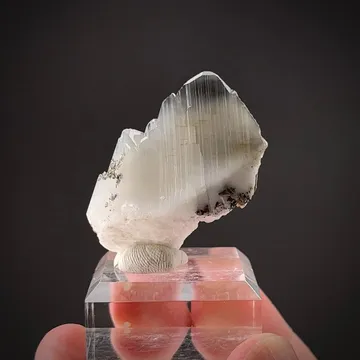
Dolomite at Schlema-Hartenstein is far more than a neutral matrix mineral: it is one of the characteristic carbonates of the dolomite-ankerite-pitchblende and selenium-bearing vein stages and one of the main hosts that preserves native bismuth, uraninite, selenides, and silver minerals. In specimen terms it appears as white, cream, gray, tan, or slightly pinkish rhombohedral to blocky carbonate, sometimes intergrown with calcite and carrying chalcopyrite, proustite, pyrargyrite, bismuth, uraninite, arsenides, or rare selenides. Shaft 366 specimens document calcite, chalcopyrite, and dolomite from the Dürre Henne vein, while Shaft 371 and related Hartenstein material are known for dolomite with native bismuth and uranium-polymetallic associations. The best dolomite-bearing pieces are those where the carbonate is architecturally useful: clean rhombohedra or blocky crystals setting off red-silver minerals or metallic bismuth, rather than merely massive vein fill.
Calcite is one of Schlema-Hartenstein’s central gangue and display minerals, present in quartz-calcite-pitchblende veins, carbonate-rich overprints, and silver-mineral pockets, and it commonly appears as white, colorless, gray, or pinkish-gray crystals, massive vein filling, or intergrown calcite-dolomite matrix. At Shaft 366 it is documented with proustite from the Brahmaputra vein at the -650 m level, with dolomite and chalcopyrite from the Dürre Henne vein, and in broader associations with pyrargyrite, proustite, chalcopyrite, and other Ag minerals. At Shaft 371, calcite occurs with hematite and in uranium-polymetallic vein assemblages, and it may enclose or cover bismuth crystals that collectors later reveal by preparation. As a collectible species from this district, calcite is best when it provides sharp, clean matrix contrast or distinctive crystal form; massive calcite alone is common, but calcite carrying undamaged proustite, pyrargyrite, bismuth, chalcopyrite, hematite, or labeled uranium-vein associations becomes locality-significant.
Beyond the featured species, Schlema-Hartenstein is exceptional for native arsenic, native silver, acanthite, stephanite, polybasite, xanthoconite, realgar, nickeline, nickelskutterudite, skutterudite, safflorite, löllingite, siderite, hematite, fluorite, quartz, uraninite, coffinite, clausthalite, tiemannite, berzelianite, eucairite, umangite, klockmannite, naumannite, hessite, native tellurium, and many other ore minerals. Its research importance is even stronger in polished section: schlemaite, a Cu-Pb-Bi selenide named for the Schlema-Alberoda ore field, has its type locality at Shaft 371, where type material came from hydrothermal Se-bearing dolomite-ankerite veins. Mgriite, a Cu-As selenide, is also recorded as a type-locality mineral from Schlema-Alberoda. Rare bismuth minerals documented from the Niederschlema-Alberoda U-Se-polymetallic deposit include watkinsonite, nevskite, bohdanowiczite, matildite, wittichenite, bismuthinite, and aikinite-bismuthinite solid-solution material. Whewellite is a distinctive collector rarity from Shaft 366 and Shaft 371, known for attractive twins, and witherite is recorded from deep Shaft 371 material, including the Beryll vein at the -1305 m level.
The first authenticity warning is unavoidable: most brightly rainbow-colored “bismuth crystals” in the general mineral trade are synthetic. Natural Schlema-Hartenstein bismuth should not resemble large laboratory hopper crystals with electric color and no matrix. Genuine district material is typically compact, heavy, gray-white to silvery, tarnished, irregularly crystallized, skeletal, or matrix-bound, commonly associated with calcite, dolomite, siderite, quartz, arsenides, cobalt-nickel minerals, secondary arsenates, or Wismut-era labels.
Preparation is a second major issue. Because many crystallized bismuth specimens were covered by calcite or dolomite, acid etching has long been part of the Schlema-Hartenstein bismuth market. Etched specimens are not automatically bad—many attractive examples exist only because carbonate was removed—but overcleaning can erase the paragenetic story. Unetched free-grown bismuth on dolomite or siderite is much rarer and more desirable. Secondary coatings such as erythrite or bieberite may look messy to a casual buyer but can be valuable evidence of the cobalt-bearing vein environment.
Proustite and pyrargyrite require light discipline. Fresh proustite is prized for ruby-red color, but prolonged light exposure darkens it. Old Schlema red-silver specimens may naturally be very dark, especially pyrargyrite, but a completely blackened proustite with lost luster is less desirable than a protected, deep red crystal group. Display under low light, avoid sunny cases, and photograph quickly under controlled lighting.
Condition matters intensely. Native bismuth is soft and easily bruised; sharp crystal edges, bright faces, and delicate skeletal structures are vulnerable. Proustite and pyrargyrite can chip, abrade, or detach from carbonate matrix. Calcite and dolomite matrices may show acid preparation, contacts, or old repairs. For high-end pieces, examine whether the metallic or red-silver crystals are naturally seated or glued into vugs, whether carbonate removal left etched scars, and whether labels support a specific sublocality such as Shaft 366, Shaft 371, Shaft 38, Brahmaputra vein, Nelson vein, or Opal Lose.
Mislabelling is plausible because the Erzgebirge contains many neighboring and historically overlapping silver, cobalt, bismuth, and uranium districts. “Schlema,” “Hartenstein,” “Schlema-Alberoda,” “Niederschlema-Alberoda,” “Schacht 371,” and “Schacht 366” may all appear on labels, sometimes accurately and sometimes as broad trade shorthand. Conversely, older specimens may be labelled simply “Saxony,” “Erzgebirge,” or “Schlema.” Strong matrix associations, old German labels, Wismut-era provenance, dealer archives, and sublocality precision all add confidence.
Radioactivity is relevant but should be treated with proportion, not panic. Uraninite and pitchblende specimens from Schlema-Alberoda can be significantly radioactive, and some associated matrix may carry uranium minerals or radon-related concerns. Store radioactive pieces responsibly, avoid prolonged close storage near living areas, do not abrade or saw them without appropriate controls, wash hands after handling, and keep dusty or friable uranium-bearing material contained. Native bismuth, proustite, pyrargyrite, calcite, and dolomite specimens without uranium ore are not automatically radioactive, but mixed Wismut vein pieces should be checked with a survey meter if there is any doubt.
Market availability is uneven. Small bismuth and red-silver pieces appear periodically, but fine, aesthetic, sublocality-specific Schlema-Hartenstein specimens are not abundant. The strongest demand is for crystallized native bismuth on matrix, sharp Shaft 366 proustite or pyrargyrite with old labels, native silver or acanthite from the Brahmaputra vein, and well-documented uranium-polymetallic associations. Research rarities such as schlemaite, mgriite, watkinsonite, nevskite, and bohdanowiczite are generally microanalytical or polished-section material rather than conventional display specimens.
The district’s collector story begins with a spa town and ends in one of Europe’s deepest industrial uranium mines. Oberschlema’s radioactive waters were already being used for spa purposes in the early twentieth century, and the old radium-spa identity became one of the clues that drew postwar uranium exploration into the area. After 1946, Soviet and then Soviet-East German uranium operations transformed the valley. What had been a spa landscape became a strategic mining landscape, and the town paid for the ore beneath it: mining subsidence and fractures became so severe that the center of the former Radium Spa Oberschlema had to be demolished. Wismut’s own heritage account notes that from 1952 the entire spa quarter had to be torn down because of serious mining damage.
Shaft 371 has one of the most memorable origin stories in the district. Work began on April 4, 1956, when Wismut’s Object 11 started sinking the shaft. On May 1, 1959, it was handed over to Object 09; because of that Labor Day commissioning, it entered Wismut history as the “Jugendschacht 1. Mai,” the Youth Shaft May 1. By the 1960s it had become the key hoisting shaft of the Aue mining operation, and the numbers are still startling: a shaft tube roughly 1,000 m deep, about 7 m in diameter in Wismut’s heritage description, mining to more than 1,800 m, and a workforce at the shaft complex that reached up to 3,000 people.
The underground world below Schlema-Alberoda was not simply deep; it was hot, wet, and mechanically difficult. Published Wismut heritage material describes rock temperatures of about 65 °C at great depth, special ventilation and cooling requirements, rock-burst-prone ground conditions, and a mine whose energy consumption reached the scale of a medium-sized town. Between 1949 and 1990, more than 1,000 uranium-bearing veins were explored and mined down to roughly 2,000 m. The mine workings covered about 22 km² at surface, with about 4,200 km of horizontal development and around 40 million m³ of underground voids. For a collector holding a 3 cm proustite or a 5 cm bismuth, those figures give the specimen a different gravity.
Shaft 366 tells a more intimate mineral story. Its Brahmaputra vein became famous for silver minerals, particularly in the 1960s on levels between -585 m and -675 m. Mineralatlas records stephanite, pyrargyrite partly pseudomorphous after stephanite, acanthite, native silver curls, and proustite from that vein. A realgar on arsenic specimen from the Brahmaputra vein is recorded as a 7.5 x 7 cm piece found in 1963. Another documented specimen from the same shaft is proustite on calcite from the Brahmaputra vein at the -650 m level, measuring 5.3 x 3 cm. A particularly attractive record from the Nelson vein notes proustite crystals to 2.8 cm on quartz, a 4.5 x 4 x 3 cm specimen found in 1960 at the -675 m level and later in the Hans-Günther Penndorf collection.
There is a classic bismuth collector’s paradox here: many of the very best crystals were hidden. Collector commentary on Schlema-Hartenstein bismuth notes that most crystallized pieces were overgrown by massive calcite and/or dolomite. The carbonate protected the bismuth, but it also meant that the crystals often had to be acid-prepared before they became displayable. Massive bismuth pieces of 10, 20, or more kilograms were reportedly found on the dumps of Shaft 371 and Shaft 38, but those heavy masses were not the great prizes. The rare treasures were unetched, free-grown crystals on dolomite or siderite—specimens with the metal already exposed by nature rather than chemistry.
Modern Shaft 371 has acquired a second life as heritage. In March 2011 the last large Wismut shaft was finally sealed. The buildings remained, and the shaft complex became part of the UNESCO World Heritage Mining Region Erzgebirge/Krušnohoří in 2019. In 2025, the “No Secret” pop-up exhibition opened in the historic machine house at the former Youth Shaft May 1. More than 1,300 visitors came during the first exhibition weekend. The most striking detail is that even some former miners who had spent their working lives riding into Shaft 371 were seeing parts of the machine-house installations for the first time; during production, those areas had been strictly off limits.