A collector's guide to Pingwu Co., China: its geology, mining history and notable minerals, illustrated with the 370 specimens documented from this locality on EarthWonders.
Key facts
For collectors, “Pingwu” almost always means the high Xuebaoding W-Sn-Be crystal occurrence near Huya township in northern Sichuan: a remote alpine deposit whose best specimens look unlike anything else in the Chinese mineral canon. Its fame rests on a simple but spectacular visual language—golden-orange scheelite in sharp tetragonal dipyramids, pale blue to colorless tabular beryl, black lustrous cassiterite, silvery green-gray muscovite, white albite, quartz, fluorite, apatite, and the rare tin-bearing sulfide and hydroxide minerals that occasionally ride the same mica-rich matrix. This is not a routine pegmatite locality in the classic granitic-pocket sense. Modern studies describe the Xuebaoding occurrence as a hydrothermal to greisen-type W-Sn-Be system related to highly evolved Pankou and Pukouling leucogranites, with mineralized veins and pockets cutting marble and schist around the granites.
The great collecting appeal is the contrast. On fine pieces, the muscovite is not merely matrix; it is a sculptural bed of overlapping blades, like stacked silver-green leaves, from which orange scheelite, glassy beryl, black cassiterite, and occasional fluorite or apatite stand out in strong color separation. The deposit is especially significant because coarse, aesthetic scheelite, cassiterite, and beryl occur together as euhedral, partly gem-quality crystals—an association that is geologically unusual and visually unmistakable. Commercial and scientific attention grew strongly after abundant coarse crystals became known in the 1990s, though the occurrence had been explored earlier and has long been tied to small-scale high-elevation mining.
Regional View
Country View
The locality name deserves care. Older labels may say “Mt. Xuebaoding,” “Pingwu Mine,” “Pingwu beryl mine,” or simply “Xuebaoding, Sichuan.” More precise modern usage places the major specimen locality at the Pingwu beryl mine, Huya township, Mount Little Xuebaoding, Pingwu County, Mianyang, Sichuan, China. The mineral workings lie in a rugged high mountain district near, but not on, the main Xuebaoding summit; the actual specimen ground is associated with Little Xuebaoding and adjacent mineralized zones rather than the famous peak itself.

Photo: Wikimedia Commons

Photo: Wikimedia Commons
Search for specimens: View all specimens from Pingwu Co., China
The collectible material comes from the Xuebaoding W-Sn-Be deposit near Huya township, about 14.5 km northwest of Huya Town in Pingwu County. The deposit lies in the Songpan-Ganzi orogenic belt, near the eastern margin of the Tibetan Plateau and the northern Longmenshan region. The important geological actors are small, highly evolved leucogranitic intrusions—especially the Pankou and Pukouling granites—emplaced into Upper Triassic metasedimentary rocks of the Zhuwo series, including schist, slate, marble, and related units. Studies describe the granites as peraluminous and enriched in alkalis and volatile components, a chemical character that helps explain the unusual concentration of Be, W, Sn, F, and P minerals in coarse crystals.
The deposit is best understood as a granite-related hydrothermal and greisen-type crystal occurrence rather than a conventional large pegmatite field. Mineralization is fracture controlled. In marble, veins are better defined; in schist, mineralization may be more stockwork-like, brecciated, or poddy. The most collectible assemblages occur where fluids moved through tensile fractures and cavities, leaving a quartz-rich core and a coarse, mineral-rich margin. A muscovite fringe commonly separates vein and host rock, and many display specimens are, in effect, pieces of this mica-rich selvage carrying large crystals that grew into open space.
Published descriptions divide the mineralization into zones or vein types according to host rock and assemblage. In granite, muscovite and beryl dominate. At the transition from granite toward marble, beryl, cassiterite, and muscovite become important. In the marble-hosted main mineralized parts, the classic collector assemblage appears: beryl, cassiterite, scheelite, fluorite, apatite, muscovite, calcite, quartz, feldspar, and needle-like tourmaline. One modern study gives typical crystal-size ranges in the mineralized vein margins as beryl 0.5–15 cm, cassiterite 1–30 cm, scheelite 1–30 cm, K-feldspar and albite 1–25 cm, muscovite 1–3 cm, fluorite 1–10 cm, and apatite 0.5–3 cm. These ranges are not a guarantee of specimen quality, but they explain why the locality made such a sudden impression on the international market: the crystals were large enough to be dramatic, and the pockets preserved them on contrasting mica-rich matrix.
Mining has been described as artisanal to small-scale rather than a large modern industrial specimen operation. The occurrence was known and explored from the 1950s, but its world-class collector reputation developed as abundant coarse crystals entered the market in and after the 1990s. Dealer and collector labels show activity through at least the early 2000s and 2000s, with specimen dates appearing for beryl, fluorite, scheelite, cassiterite, and kesterite-mushistonite pieces. The deposit has been described in collector literature as a high-elevation operation with roughly a hundred miners living near the workings, a significant minority of whom concentrated on specimen recovery for the collector market.
Access today should be treated as restricted and not comparable to casual public field collecting. The locality is remote, high, and physically demanding, and the workings are associated with active or formerly active mining areas rather than a public collecting site. Serious collectors should assume that legal specimens are acquired through established dealers, collections, or documented market channels, not by independent collecting. The best labels preserve both the market name and the more precise locality hierarchy: Pingwu beryl mine, Huya township, Mount Little Xuebaoding, Pingwu Co., Mianyang, Sichuan, China.
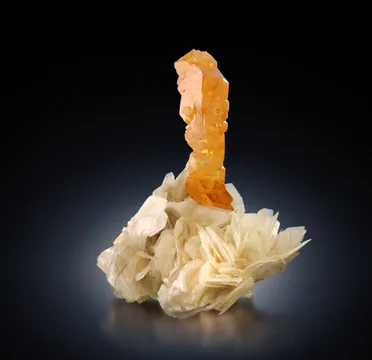
The most famous finds were pockets and vein margins that produced combination specimens: scheelite perched on muscovite; tabular aquamarine or goshenite with muscovite and cassiterite; cassiterite twins or aggregates in mica with calcite; fluorite with beryl, scheelite, and muscovite; and rare kesterite coated by green to yellowish mushistonite. The locality is most admired when several of these minerals occur naturally together without crowding: an orange scheelite crystal isolated on a nest of mica, a pale tabular beryl hovering above muscovite, or black cassiterite anchoring an otherwise pale matrix. Large size alone is not enough here; placement, undamaged edges, transparency, color, and the integrity of the mica matrix matter enormously.
Pingwu scheelite is the defining species of the Xuebaoding occurrence: lustrous yellow, honey, butterscotch, orange-yellow, to rich golden-orange crystals, typically sharp tetragonal dipyramids that collectors often describe as pseudo-octahedral. The best crystals sit on bladed muscovite and may be associated with tabular aquamarine or goshenite, black cassiterite, fluorite, fluorapatite, albite, calcite, and quartz. Scientific work on Xuebaoding scheelite documents color zoning and yellow-orange hues tied to rare-earth-element substitution, especially light REE such as La, Ce, Pr, and Nd replacing Ca in the scheelite structure; gemological work also notes stronger blue-white fluorescence under shortwave UV than under longwave UV. Ordinary pieces are duller, chipped, crowded, or embedded; good examples have complete high-luster faces, warm saturated color, translucency to gemminess at edges or terminations, and clean contrast against pearly muscovite.
Muscovite is the essential stage on which the Pingwu classics are built. At Xuebaoding it forms pale gray, silvery, green-gray, or champagne-toned books and blades, commonly as dense overlapping rosettes or shingled plates lining vein margins. It is part of the greisen-style quartz-muscovite assemblage and commonly forms the fringe between mineralized veins and host rock. Scheelite, beryl, cassiterite, fluorite, fluorapatite, albite, quartz, calcite, and kesterite-mushistonite specimens are all judged in part by how well the muscovite matrix frames the major crystals. The finest muscovite is bright, pearly, and undamaged, with crisp blades rather than crushed mica; lesser examples have bruised, bent, oxidized, or trimmed mica that weakens the overall architecture of the specimen.
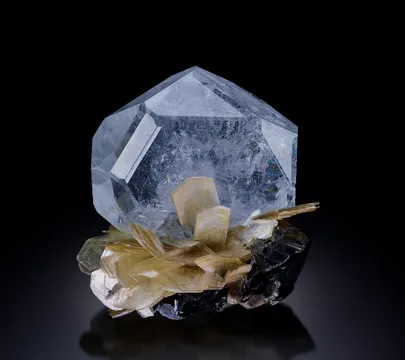
Pingwu aquamarine is famous for its flattened, tabular habit rather than the tall prismatic habit collectors expect from many pegmatite aquamarines. Crystals are typically pale blue to very pale blue, transparent to translucent, and commonly lie like glassy hexagonal plates on muscovite, with cassiterite, albite, scheelite, quartz, fluorite, or feldspar as companions. Studies of Xuebaoding beryl show that early blue aquamarine and later colorless goshenite can occur within the same evolving hydrothermal system; the blue material tends to be most prized when the color is even, the plate is complete, and the broad basal faces remain lustrous rather than etched or abraded. Fine aquamarines from here are not usually about saturated color; they are about clarity, tabular geometry, aerial placement, and the distinctive high-contrast association with pale mica and black cassiterite.
Beryl from Pingwu includes pale aquamarine and colorless goshenite, and the locality is one of the classic modern sources of tabular beryl specimens. Research describes Xuebaoding beryl as mostly colorless and transparent, rarely with a blue tint, and characteristically shortened along the c-axis, producing flat crystals dominated by basal pinacoid faces with smaller prism and pyramidal faces. Crystals studied from the deposit commonly carry high Na and Li contents, though recent work argues that chemistry alone does not explain the tabular habit. On specimens, beryl may occur with muscovite, albite, cassiterite, scheelite, quartz, fluorite, and apatite; the best beryl pieces show complete hexagonal outlines, glassy broad faces, delicate blue or water-clear color, minimal edge wear, and natural positioning on the mica-rich vein margin.
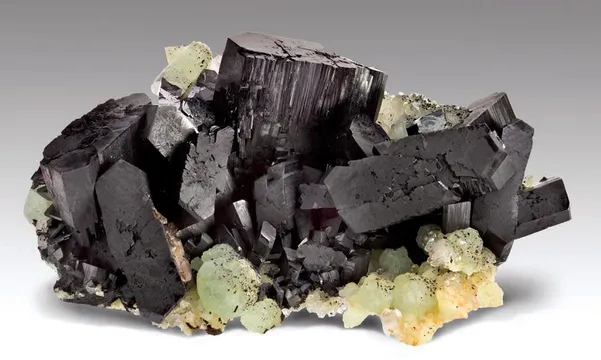
Pingwu cassiterite is the dark counterpoint to the locality’s pale beryl and orange scheelite: black to deep brown-black, highly lustrous crystals, commonly twinned, and locally reaching impressive sizes in the mineralized vein margins. It occurs with muscovite, beryl, scheelite, calcite, albite, quartz, and fluorite, and it is especially desirable when sharp black crystals are perched cleanly among mica blades rather than buried in massive matrix. Published studies give cassiterite one of the major roles in the transition and marble-hosted mineral assemblages, and U-Pb work on Xuebaoding cassiterite has helped constrain the timing of mineralization. Superior specimens have bright mirrorlike faces, recognizable twin form, clean separation from the matrix, and intact edges; ordinary examples are commoner as contacted, cleaved-looking, crowded, or partly embedded black masses.
Kesterite from Pingwu is a locality rarity rather than a volume species, and it is best known from specimens coated by mushistonite. Documented pieces show pseudo-tetrahedral crystals to over a centimeter, black on fresh break but commonly hidden under yellowish to green mushistonite alteration, often on muscovite and sometimes with calcite or fluorapatite. About a dozen specimens were reported as reaching the market in two lots in 2001 and 2002 before chemical analysis identified them as kesterite, making these pieces among the great specialist rarities of the Xuebaoding suite. Quality hinges on crystal form visible beneath or through the coating, attractive green mushistonite coverage, association with locality matrix, and credible analytical or provenance history; untested black sulfide-looking material from the district should not be accepted casually as kesterite.
Quartz is structurally important at Pingwu even when it is not the star of the specimen. The mineralized veins are often described with quartz-rich centers and coarse crystal margins, and quartz occurs with muscovite, beryl, scheelite, cassiterite, fluorite, albite, calcite, apatite, and tourmaline. On collector pieces it may appear colorless, whitish, or opalescent, sometimes as vein quartz supporting mica and accessory crystals rather than as isolated showy points. The best quartz-bearing Pingwu specimens are valued because the quartz helps create an open, undisturbed pocket architecture or because it hosts well-placed scheelite, beryl, or cassiterite; ordinary quartz-dominant pieces without the classic W-Sn-Be species are far less compelling unless they preserve unusually clean associations or inclusions.
Albite is both a rock-forming component of the associated leucogranites and a common accessory on Pingwu display specimens. In the veins it occurs with muscovite, beryl, cassiterite, scheelite, fluorite, apatite, K-feldspar, and quartz, and published descriptions place albite among the coarse minerals of the vein margins, locally in centimeter-scale crystals or aggregates. On specimens it is usually white to off-white, providing pale architectural mass beneath tabular beryl or scheelite; it may also appear with colorless goshenite, helping distinguish some cleaner beryl pieces from the darker cassiterite-rich associations. The better albite-bearing pieces show crisp, clean white feldspar that supports rather than obscures the main crystals; bruised, chalky, or overgrown albite can make an otherwise important specimen look heavy.
Fluorapatite is a documented but much less common member of the Pingwu collector assemblage. It belongs to the marble-hosted main mineralized zone with beryl, cassiterite, scheelite, fluorite, muscovite, calcite, quartz, and tourmaline, and studies list apatite among the coarse vein-margin minerals, generally in smaller crystals than beryl, scheelite, or cassiterite. Specimen records describe fluorapatite with scheelite on muscovite and, more rarely, in kesterite-mushistonite associations with muscovite and calcite. The best pieces show identifiable apatite crystals that add color or paragenetic interest without being lost in mica; for most collectors, fluorapatite is valued as a refined accessory that documents the F-P-rich chemistry of the system rather than as the dominant display mineral.
Calcite at Pingwu is part of the marble-hosted environment and appears in several specimen associations, especially with cassiterite, muscovite, scheelite, fluorapatite, and kesterite-mushistonite. It may form pale cream to yellowish crystals or “poker-chip” style plates among muscovite and cassiterite, and it also appears as an inclusion or accessory phase in scheelite-related mineralogical studies. As a display mineral it is secondary in importance, but good calcite can soften and brighten the dark cassiterite-mica association or complete a paragenetic suite. Condition is crucial: calcite is softer and more acid-sensitive than the locality’s beryl, scheelite, and cassiterite, so bruised edges, cleaved faces, and etched surfaces are common drawbacks.
Other documented Pingwu/Xuebaoding minerals include fluorite, microcline or K-feldspar, tourmaline-group minerals including schorl, dravite-schorl compositions and foitite-related material, pyrite, chalcopyrite, sphalerite, galena, molybdenite, ilmenite, biotite, sericite, and rare mushistonite. The locality is not chiefly celebrated as a type-mineral locality; its mineralogical importance lies in the unusual W-Sn-Be-F-P assemblage, the size and quality of the common species, and the presence of rare tin minerals such as kesterite and mushistonite in collector-quality specimens.
The first authenticity issue is locality wording. Old “Mt. Xuebaoding” or “Pingwu Mine” labels are part of the history of the material, but they can blur several geographically distinct workings and peaks in a rugged district. A strong modern label should retain the old wording if present while adding the current collector-locality phrasing: Pingwu beryl mine, Huya township, Mount Little Xuebaoding, Pingwu Co., Mianyang, Sichuan, China. Be especially cautious with specimens labeled simply “Mianyang Mine” or “Sichuan” unless the mineral association and provenance are convincing.
No broad, well-documented industry of fake Pingwu scheelite has become a standard warning in the literature, but the economics of the best pieces make ordinary specimen cautions essential. Scheelite-on-muscovite, beryl-on-muscovite, and cassiterite-on-muscovite pieces should be examined for glued crystals, repaired matrix breaks, filled contacts, and mismatched luster or dirt at attachment points. The locality’s natural combinations can be spectacular, so improbably perfect multi-species pieces are not automatically false—but they deserve careful magnification, UV inspection for glue, and provenance questions.
Condition is often the deciding factor. Scheelite can be chipped along exposed edges and apexes; beryl plates commonly show edge bruising, cleaved corners, or etched broad faces; cassiterite may have contacted growth faces or broken terminations; muscovite blades bend, abrade, and shed easily. Matrix trimming is common and not inherently a problem, but over-trimming can leave a specimen looking sawed, flat-backed, or unstable. Good Pingwu pieces should feel like a coherent pocket fragment rather than an assemblage of attractive crystals crowded onto mica.
Shortwave UV is useful for scheelite, which may show blue-white fluorescence; longwave response can be weak or absent, and molybdenum content can affect fluorescence behavior. Do not use UV response alone as proof of locality, but it is a helpful check for scheelite identification and for spotting some adhesives. Calcite-bearing pieces should be kept away from acids. Mica-rich specimens should be handled from the matrix, not by projecting crystals, and stored where loose muscovite blades will not be crushed by neighboring specimens.
Market availability remains better than for many single-pocket classics because Pingwu material entered the collector market in real quantity, but top examples are far scarcer than the locality name suggests. Small scheelite-on-muscovite and beryl-on-muscovite pieces are regularly encountered. Large, undamaged, saturated orange scheelite crystals; fine tabular aquamarine with cassiterite; sharp cassiterite twins on bright mica; fluorite-bearing combinations; and kesterite-mushistonite specimens are much less common and command a significant premium.
The story of Pingwu is inseparable from altitude and misdirection by mountains. “Xuebaoding” means Snow Treasure Crown, and the famous summit rises to 5,588 m in the Minshan range, but the specimen locality is not simply a mine on that summit. Published work points out that the main Xuebaoding peak is several kilometers away from the specimen ground and hidden by intervening ridges; the peak actually visible from the locality is Little Xuebaoding, rising above the valley at 5,443 m. In a district where valley floors and adjacent peaks may differ by thousands of meters, it is easy to understand why labels, local usage, and collector shorthand tangled the geography for decades.
The collecting romance is also a story of lateness. The occurrence was known from the 1950s, yet the specimens that made the locality famous did not flood the collector imagination until the 1990s, when large, coarse, bright crystals began to appear. Suddenly, China was producing orange scheelite crystals good enough to reset expectations for the species, flattened beryls that looked like pale blue windows set in mica, and black cassiterites with the gloss and mass of serious tin-ore classics. It arrived at the moment when Chinese mineral localities were becoming central to the world market, and Pingwu instantly had a look collectors could identify across a room.
Field accounts and lecture abstracts emphasize the physical difficulty of the place. The workings lie high above tree line on the eastern edge of the Tibetan Plateau, with the locality described at elevations above 4,200 m and related localities reaching still higher. A trip to the mine could mean a full day of travel and nearly 3,000 m of relief above the adjacent valley floor. Researchers and visitors have described pouring rain, landslide obstacles, long approaches, and natural hazards as part of the reason systematic study lagged behind collector fame. The phrase “mining above the clouds” is not advertising poetry here; it captures the practical problem of extracting delicate crystals from a remote alpine mineral system and getting them down to the specimen trade intact.
The scientific story is equally appealing because the specimens posed a genuine puzzle. Beryl is classically expected in granitic pegmatites; tungsten and tin deposits have their own familiar settings; but Pingwu put beryl, scheelite, and cassiterite together in large, euhedral, often gemmy crystals. That combination forced mineralogists to look closely at hydrothermal fluids, marble-hosted fractures, volatile-rich evolved granites, and the role of open space in vein cavities. The best cabinet specimens are therefore not just beautiful objects; they are hand specimens of a geological problem.