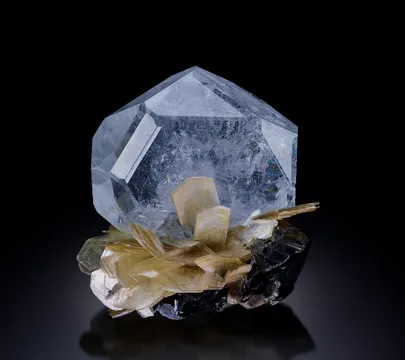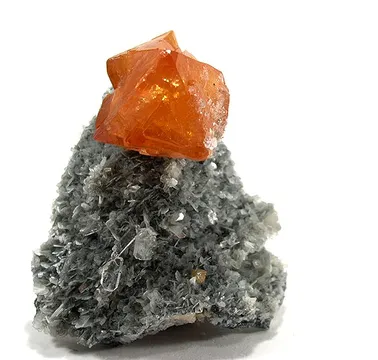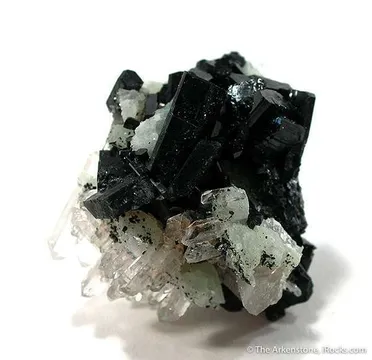
Hongxizhen Mining Area, China — Meigu basalt locality yielding babingtonite, prehnite, quartz, and epidote; prized for sculptural cavities and collector appeal.
Key facts
Hongxizhen Mining Area is one of those modern Chinese specimen localities whose fame rests on a deceptively simple assemblage: glossy black babingtonite, apple- to water-green prehnite, glassy quartz, and dark green epidote from cavities and fracture zones in the basalt country around Meigu County, Liangshan Yi Autonomous Prefecture, Sichuan. The locality entered the collector market under the long-used Western label “Hongquizhen Quarry,” but the better reading of the Chinese place name is Hongxizhen, or Hongxi Town. Even that tidy label hides a more complicated reality: the best-known specimens came from an informal hillside prospecting area rather than a conventional, named, legally operating quarry.
Mineralogically, Hongxizhen belongs to the broader Meigu County suite of low-temperature hydrothermal minerals in Emeishan basalt. Vesicular cavities, interlayer glide fractures, and open druses in altered basalt provided space for quartz, epidote, prehnite, and babingtonite to grow. This is precisely why the best pieces have a sculptural, open-cavity look rather than the blocky appearance of massive ore: translucent prehnite hemispheres and rosettes form pale green cushions, quartz points rise as clear to lightly smoky or pale amethystine accents, and tabular to prismatic babingtonite crystals sit in sharp black contrast.
Regional View
Country View
The historical importance of the locality is clearest in babingtonite. Before the great Chinese basalt-cavity finds, collectors still thought of fine babingtonite in terms of the old New England traprock quarries and a few European and Indian localities. Hongxizhen and related Chinese occurrences changed the visual standard for the species. The best Meigu-area pieces are not merely “good for China”; they are species-level specimens, with black, lustrous, sharply edged crystals perched on pastel prehnite and bright quartz. Ordinary examples can be busy, contacted, dull, or etched, but the great ones have separation, luster, and a dramatic color contrast that reads across a room.
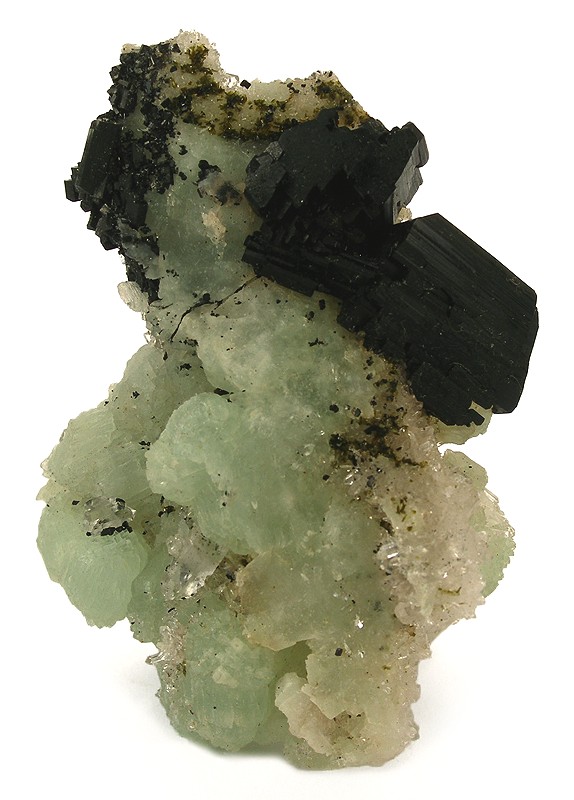
Photo: Wikimedia Commons
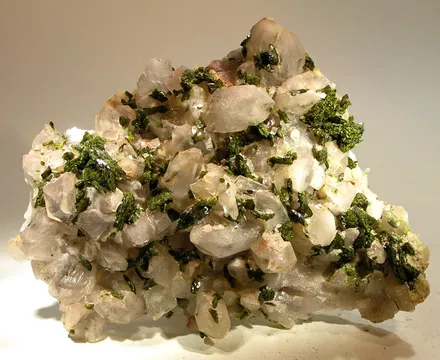
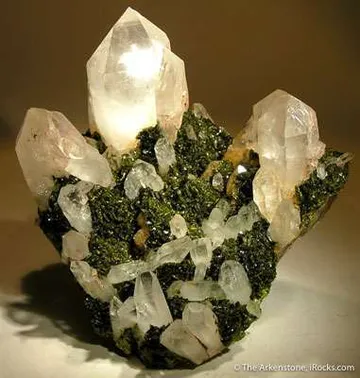
The quartz-epidote side of the locality deserves equal respect. Hongxizhen quartz can be glassy and nearly transparent, sometimes faintly smoky or pale violet, and commonly carries epidote as dark green blades, sprays, inclusions, or surface growths. Some specimens show red hematite inclusions or reddish tones in the quartz, linking the aesthetic appeal directly to the iron-rich basaltic environment.

Photo: Wikimedia Commons
Search for specimens: View all specimens from Hongxizhen Mining Area, China
Hongxizhen Mining Area is best understood not as an ore mine but as a specimen-producing basalt cavity locality in Meigu County, Sichuan. Public locality records place it under Hongxizhen mineral prospect, Meigu County, Liangshan Yi Autonomous Prefecture, Sichuan Province, China, with coordinates only estimated at broad regional precision. The older label “Hongquizhen Quarry” is a persistent dealer-label relic; the Chinese character 溪 is “xi,” not “qui,” and the locality was not a formal commercial quarry in the usual sense. Hongxi was formerly treated as a township-level area and became Hongxi Town in the 2021 administrative framework.
The geological setting is the Meigu County exposure belt of Emeishan basalts. These basalts contain vesicles, druses, and fracture openings capable of hosting well-crystallized low-temperature hydrothermal minerals. Regional work on Meigu rock crystal describes several mineralizing stages: amethyst and multicolored quartz in basalt vesicles; banded, milky, and colorless quartz with tabular epidote in interlayer gliding fractures and cavities; and later hematite-rich assemblages in volcanic breccia cavities, druses, and veins. Fluid-inclusion work cited for the Meigu basalt quartz deposits gives low-temperature hydrothermal conditions, roughly 150–190 °C, with relatively low salinity fluids dominated by H2O and SO2 with minor CH4.
For collectors, the important “ore bodies” are therefore not sulfide veins or formal stopes but open spaces in altered basalt. Babingtonite appears in the Ca-Fe-SiO2-rich portion of the assemblage, prehnite in rounded to radiating aggregates, epidote as tabular to bladed crystals and sprays, and quartz as clear, smoky, milky, pale violet, and hematite-included crystals. The iron budget of the basaltic host is written all over the specimens: green epidote, black babingtonite, red hematite inclusions, and the occasional hematite-stained quartz all belong to the same broad chemical story.
Mining history is short, informal, and poorly documented compared with major Chinese ore mines. The public record describes a hillside prospect worked by local farmers, with the locality’s commodity essentially being mineral specimens. Western-market specimens circulated by the mid- to late 2000s, and many labels from that period read “Hongquizhen Quarry, Meigu Co., Liangshan, Sichuan.” Quartz with epidote specimens have been specifically described as collected around 2004–2006; classic babingtonite-prehnite specimens appear in trade by at least 2010 and were already being discussed as coming from a small, previously insignificant locality.
Collecting access today should be regarded as closed. The best-documented locality notes state that the specimen area lies on a mountain between Hongxi Town and Mabian County and belongs to a forest reserve; mining activity and specimen removal there are described as illegal or banned. That means modern specimens should be treated as old-stock, collection-dispersal, or pre-ban material unless accompanied by clear, lawful provenance. The collecting story has also created label confusion: “Hongquizhen Quarry,” “Hongxizhen Quarry,” “Hongxizhen Unnamed Mining Area,” and “Hongxizhen mineral prospect” may all refer to the same collector-market source, while nearby Meigu County localities and the better-known Qiaojia babingtonite occurrences in Yunnan can be confused with it.
Notable finds include classic babingtonite on prehnite with quartz, solid or nearly solid clusters of tabular black babingtonite, prehnite with chrysocolla “balls,” quartz with epidote and hematite inclusions, and large display specimens in which sprays of epidote climb through or over jackstraw clusters of quartz. Some of the finest babingtonite crystals reported from this material are 2–4 cm, with individual specimens documented at 3 cm, 3.7 cm, and even 4 cm crystals. Better epidote-quartz pieces show bladed green epidote sprays, fan-like clusters, and flattened crests on or around glassy quartz, including highly aesthetic small cabinets and a few large-cabinet display pieces.
Hongxizhen babingtonite is the locality’s signature mineral: lustrous black to charcoal-black tabular and prismatic crystals, commonly perched on pale green prehnite and accented by clear quartz. The most attractive pieces show sharp, separated crystals rather than crowded black crusts, and collectors prize high luster, clean terminations, and unetched faces; some locality examples are duller, etched, or discolored. Classic crystals commonly fall in the 1–3 cm range, with documented specimens carrying 3 cm, 3.7 cm, and 4 cm crystals; the strongest display pieces place these black crystals on translucent botryoidal or rosette prehnite so the color contrast is immediate. The best old material is associated with the early Chinese basalt-cavity production that reset expectations for the species, and fine Hongxizhen examples remain especially desirable when they retain natural luster, good balance, and undamaged projecting crystals.
Prehnite from Hongxizhen forms the pale green stage on which much of the locality’s drama is built: translucent water-green to apple-green botryoidal aggregates, radiating balls, rosettes, and in better cases small crystallized surfaces with real sparkle. It occurs with babingtonite, quartz, epidote, and the much scarcer chrysocolla association; locality photo data and dealer records repeatedly show quartz and babingtonite as its most familiar companions. Good pieces have fresh color, translucency, three-dimensional rounded growth, and pleasing contrast with black babingtonite or glassy quartz, while ordinary pieces may be contacted, flat, or weathered. The rarest prehnite combinations carry dark blue-green chrysocolla spheres sprinkled over the green prehnite, sometimes with clear quartz, and these have long been described in the trade as elusive, esoteric Hongxizhen specialties rather than common prehnite stock.
Hongxizhen quartz ranges from colorless rock crystal to lightly smoky, milky, pale violet, and amethystine material, typically as glassy prismatic crystals in open basalt cavities and fracture-zone druses. It is more than a matrix mineral here: clear quartz points frame babingtonite and prehnite, large quartz clusters host epidote sprays, and some crystals contain red hematite phantoms or inclusions plus green epidote inclusions, giving unusually complex interior scenes. Documented specimens include cabinet to large-cabinet plates with quartz crystals around 2.5–4.2 cm and larger showpieces with broad, transparent quartz groups; the best examples are bright, lustrous, minimally bruised, and either carry well-placed epidote on the surface or preserve sharp inclusions without becoming muddy. Pale amethystine quartz with epidote and dolomite is documented from the locality, and the subtle violet cast is a desirable bonus when the quartz remains transparent.
Epidote from Hongxizhen is usually dark forest-green to bright green, occurring as bladed, tabular, fan-like, radial, and spray-like aggregates on quartz and prehnite or as inclusions within quartz. The most prized epidote-quartz specimens show lustrous, translucent blades positioned as sculptural sprays against transparent or lightly smoky quartz; individual epidote sprays of 1.5 cm are common enough to define the style, while larger radial clusters around 4 cm and dramatic vertical ribbons of many small crystals are recorded from exceptional pieces. Good examples have strong green color, glassy luster, separation from the quartz, and minimal rubbing on the exposed blade edges. Ordinary pieces tend to be visually darker, crowded, or bruised, while the best small-cabinet specimens show epidote apparently wrapping or climbing around a doubly terminated quartz crystal.
Other documented Hongxizhen minerals include chrysocolla, dolomite, hematite, and quartz var. amethyst. Chrysocolla is the standout rarity: dark greenish-blue to blue-green spherical aggregates on prehnite, sometimes with quartz, and far scarcer in the market than babingtonite-prehnite or epidote-quartz combinations. Dolomite appears in association with quartz and epidote, including as colorless spherical inclusions or associated crystals in quartz plates. Hematite is important both as a listed species and as the likely cause of red inclusions and reddish casts in some quartz. No type-locality mineral is attached to Hongxizhen in the standard public locality record; the locality’s status rests instead on the quality and aesthetics of its basalt-cavity silicates.
The first authenticity issue with Hongxizhen is the label. A specimen labeled “Hongquizhen Quarry” is not necessarily wrong in the historical trade sense, but it is an outdated and misleading form of the locality name. “Hongxizhen mineral prospect,” “Hongxizhen Unnamed Mining Area,” and “Hongxizhen Mining Area” are better modern collector-market formulations. Be alert for confusion with Qiaojia County, Yunnan, another major Chinese babingtonite-prehnite source; Qiaojia material can be superb, but it is not Hongxizhen. Likewise, Meigu County has multiple mineral occurrences, so “Meigu, Sichuan” alone is not enough for a refined label.
No well-documented widespread Hongxizhen fake industry has emerged in the sources consulted, but the usual Chinese-market caution applies: ask about repairs on projecting quartz and babingtonite, check whether black babingtonite luster has been artificially enhanced, and examine prehnite surfaces for oiling or resinous concealment of bruising. A dealer note for a high-end babingtonite explicitly cautions that babingtonite luster can be enhanced by coatings, while describing that particular piece as natural and untreated; that is a useful reminder to examine glossy black crystals under strong light. True babingtonite should show mineral luster and crisp faces, not a greasy film pooled along edges or in low spots.
Condition matters greatly. Babingtonite crystals are hard enough for normal cabinet handling but have cleavage and brittle edges; exposed terminations and sharp tabular corners are easily nicked. Prehnite hemispheres can be bruised or abraded, especially on broad display surfaces. Epidote sprays are vulnerable at their crests, and quartz clusters often show peripheral contact points from the original cavity walls. Because many fine pieces are floaters or partial floaters, make sure a suspiciously perfect underside is natural rather than sawed, glued, or heavily trimmed.
Hongxizhen specimens are not fluorescent specimens in any major collecting sense, and the locality is valued for form, color contrast, and paragenesis rather than ultraviolet response. Handling is straightforward: keep specimens dry, avoid aggressive chemical cleaning, do not oil prehnite, and protect projecting quartz, epidote, and babingtonite with a fitted box or acrylic base.
Rarity varies sharply by combination. Commonest in the trade are prehnite-quartz-babingtonite specimens and quartz-epidote combinations, though fine old examples are increasingly collection-dispersal material rather than fresh production. Top babingtonite-prehnite pieces with lustrous 2–4 cm crystals command strong prices. Epidote-quartz display pieces can also be expensive when sculptural, large, and undamaged. Prehnite with chrysocolla is distinctly scarcer and should be considered a specialty association for Chinese-suite collectors.
For years, the Western mineral trade told a tidy story on the label: “Hongquizhen Quarry, Meigu County, Sichuan.” It sounded like a conventional quarry, the sort of place one could point to on a map and imagine benches, trucks, and regular production. The later correction is more interesting. The “qui” was a reading error; the character 溪 gives Hongxi, not Hongqui. Then the “quarry” dissolved as well. The locality turned out not to be a formal, named quarry but an informal hillside prospect, worked locally for specimens, with the best collecting area described as lying on a mountain between Hongxi Town and Mabian County. The polished dealer label had hidden a much rougher collecting reality.
That confusion has followed the specimens into collections. A cabinet piece with a 2.2 cm doubly terminated babingtonite on green prehnite, quartz to 1 cm, and crystallized prehnite rosettes on the back entered the public photographic record before March 2010 under the old “Hongquizhen Quarry” label. The description already carried the flavor of a small, newly important Chinese source: a previously insignificant locality, worked by farmers, suddenly producing babingtonite specimens whose luster and contrast made the old classics look small and severe by comparison.
Another small specimen became a benchmark for just how rich the locality could be. It was only 5.4 x 4.6 x 3.6 cm, yet one orientation showed radiating prismatic black babingtonite to 4 cm long, while another revealed a 3 cm tabular crystal. That is the sort of miniature that teaches collectors to distrust size categories: a small specimen can still carry major crystals if the pocket grew them cleanly and left them exposed.
The quartz-epidote material tells a different visual story. One 2022 benefit-auction specimen, 16.0 x 14.5 x 10.5 cm, was described as a “vertical ribbon” or “vertical worm” of bright epidote, 8 cm from top to bottom, rising out of a nest of spiky quartz. It had been donated by Jordi Fabre/Fabre Minerals to benefit mineral institutions and societies, was valued at $2,000–2,500, and sold for $1,400. That sale captured Hongxizhen’s second life in the market: even after the field source had quieted, the best pieces kept reappearing through old dealer stock, charity auctions, and collection dispersals.
The rare prehnite-chrysocolla pieces have their own collector folklore. A 2023 auction of a Kurt Hefendehl specimen, only 5.9 x 3.7 x 2.7 cm, emphasized how seldom the association appeared after more than a decade. Hefendehl’s collection reportedly exceeded 6,000 specimens, and the Hongxizhen piece carried the kind of provenance that matters when a locality is no longer producing. The bidding rose from a $10 opening to a $575 closing price, a revealing result for a modest small cabinet whose power lay not in size but in an odd association: green prehnite with dark greenish-blue chrysocolla in a locality better known for black babingtonite.
Zhang Liangju, Rao Can, Zhang Changlong, Ruan Qingfeng, Lei Wei, Liao Baoli, and He Tao (2008), “四川美姑玄武岩中水晶矿的组成与成矿作用” (“Mineralization and Composition of Rock Crystal in Mineral Deposits in Basalt of Meigu, Sichuan”), Journal of Guilin University of Technology, 28(3), 289–294 — The key regional technical paper for Meigu basalt-hosted quartz mineralization, mineral stages, epidote associations, hematite inclusions, and low-temperature hydrothermal fluid data.
Zhang Liangju, Ruan Qingfeng, Rao Can, Zhang Changlong, Lei Wei, Liao Baoli, and He Tao (2008), “Discovery of and research on babingtonite in the drusy cavities of basalt,” Acta Mineralogica Sinica, 28(4), 360–366 — A technical study of Chinese Emeishan-basalt babingtonite, documenting black tabular crystals, low-temperature weakly oxidizing alkaline formation conditions, and Ca-Fe-SiO2-rich solutions.
Mindat reference record for Zhang et al. (2008) Geological Review 73(6), 786–792 — A useful bibliographic pointer to Meigu-related work on iron-oxide inclusions in rock crystals and associated regional references.
Guanghua Liu, Robert M. Lavinsky, Eugene S. Meieran, Harrison H. Schmitt, Thomas P. Moore, and Wendell E. Wilson (2013), Crystalline Treasures: The Mineral Heritage of China, supplement to The Mineralogical Record, January–February 2013 — Major illustrated publication on Chinese mineral specimens; includes a 15 cm babingtonite with prehnite labeled from Hongquizhen, Meigu County.
Mindat specimen record R81-7CW, Babingtonite on Calcite — Documents a Hongxizhen/Hongquizhen specimen with calcite crystals to 3 cm and a jet-black babingtonite crystal 3.7 cm long.
Mindat specimen record A4K-T2Q, Quartz, Epidote, Dolomite — Documents pale violet quartz with epidote and dolomite from Hongxizhen, added to the public record in September 2026.
Wikimedia Commons file: Babingtonite-Prehnite-bab09a.jpg — Publicly licensed Rob Lavinsky/iRocks photograph of a 7.8 x 6.9 x 3.2 cm babingtonite-prehnite-quartz specimen from the old Hongquizhen label suite.
Wikimedia Commons file: Epidote-Quartz-245508.jpg — Publicly licensed Rob Lavinsky/iRocks photograph of an 8.5 x 6.0 x 3.5 cm epidote-quartz specimen from the locality.
Mindat: Hongxizhen mineral prospect, Meigu County, Liangshan Yi, Sichuan, China — The central public locality record, with corrected locality name, access caveats, and the documented mineral list.
Mindat: Meigu County, Liangshan Yi, Sichuan, China — Regional context for Meigu County basalt cavities, Emeishan basalt mineralization, and related references.
Journal of Guilin University of Technology: Mineralization and Composition of Rock Crystal in Mineral Deposits in Basalt of Meigu, Sichuan — Technical paper for the basalt-hosted quartz, epidote, hematite inclusion, and low-temperature hydrothermal setting.
CAOD/Oriprobe: Discovery of and research on babingtonite in the drusy cavities of basalt — Abstract and bibliographic details for the Chinese babingtonite study relevant to the Emeishan basalt cavity environment.
Wikimedia Commons: Hongquizhen Quarry category — Publicly licensed photographs of classic babingtonite-prehnite and related specimens under the historical label.
EarthWonders: Epidote with Quartz from Hongxizhen Mining Area — Useful modern specimen record explaining the Hongquizhen/Hongxizhen name issue and the forest-reserve collecting problem.
MineralAuctions: Babingtonite on Prehnite, Hongxizhen mineral prospect — Recent auction example showing the continued market strength of fine old-stock babingtonite-prehnite material.
MineralAuctions: Babingtonite and Prehnite with Quartz, Hongquizhen Quarry — Detailed trade discussion of early Chinese babingtonite finds, luster, size, treatments, and market scarcity.
MineralAuctions: Epidote on Quartz, Hongquizhen Quarry — Important large-cabinet epidote-quartz example from the 2022 Dallas Mineral Collecting Symposium benefit auction.
MineralAuctions: Prehnite with Chrysocolla, Hongxizhen Unnamed Mining Area — Good reference for the rare prehnite-chrysocolla association and Kurt Hefendehl provenance.
Minfind: Quartz with Epidote from Hongxizhen mineral prospect — Archived dealer listing for quartz with epidote, hematite inclusions, collection date around 2004, and current-market context.
Crystal Classics: Epidote with Quartz, Hongquizhen Quarry — Dealer record with dimensions, condition note, locality-name discussion, and description of fan-like epidote on quartz.