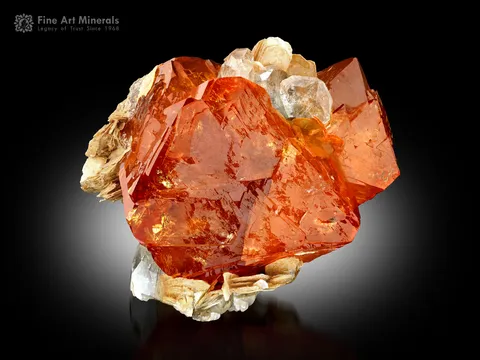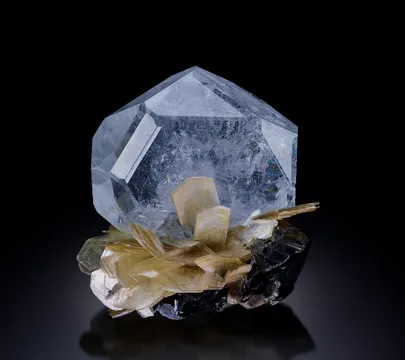
Sichuan, China — a premier mineral locality with orange scheelite, Meigu epidote-quartz, and quartz-barite; sought for cabinet-size specimens and diverse local…
Key facts
Sichuan is not a single collecting story so much as a mineralogical province: high Tibetan-margin greisen veins in the north, MVT-style Pb-Zn systems around the Sichuan Basin margin, rare-earth carbonatite and syenite complexes in the Mianning-Dechang belt, Panxi layered mafic intrusions tied to the Emeishan large igneous province, and a suite of specimen-producing quartz, epidote, and barite localities that have circulated through the international mineral market under sometimes maddeningly abbreviated labels. For collectors, the name most often evokes three visual families. First are the Mount Xuebaoding/Pingwu classics: orange scheelite, pale blue to colorless tabular beryl, black cassiterite, muscovite, fluorite, apatite, and quartz from a high-elevation W-Sn-Be greisen-hydrothermal system. Second are the Meigu County epidote-quartz pieces: frosted to glassy quartz sprays carrying dark green, lustrous epidote in bladed, fanlike, and “rose” aggregates, with amethyst or hematite phantoms on the better examples. Third are the Jinkouhe labels: quartz and barite combinations, sceptered or doubly terminated quartz, and tabular barite crystals that range from colorless to pale yellow and bluish, frequently with condition issues that make truly crisp pieces much scarcer than the sheer number of old show specimens might suggest.
Regional View
Country View
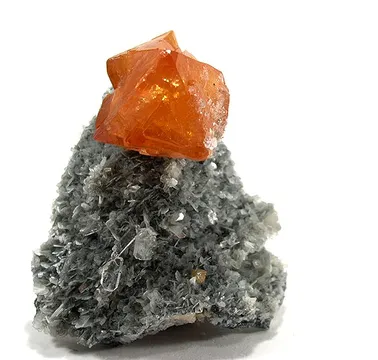
Sichuan’s specimen fame rose sharply with the influx of fine Chinese minerals in the 1990s and early 2000s. Xuebaoding became one of the defining Chinese localities of that era because it produced minerals of pegmatite-like cabinet presence from a system that is not simply a normal granitic pegmatite. The best Xuebaoding specimens have a disciplined architecture: glassy orange scheelite dipyramids or squat “pseudo-octahedra” poised on shimmering muscovite; tabular aquamarine or goshenite plates set into mica; black cassiterite, fluorite, and quartz completing the association. Meigu epidote-quartz added a different aesthetic—more alpine-looking and textural, with green epidote stitched through pale quartz sprays—while Jinkouhe barite-quartz and scepter quartz gave collectors a Sichuan quartz line that is at once attractive, affordable in ordinary grades, and surprisingly elusive in fine condition.

Photo: Wikimedia Commons

Photo: Wikimedia Commons
Search for specimens: View all specimens from Sichuan, China
Because “Sichuan, China” is a provincial locality rather than a single mine, the collector must read every specimen label with care. The most important specimen-producing districts sit in very different geological environments. Xuebaoding, in the Pingwu area northwest of Huya town, belongs to the Songpan-Ganzi orogenic belt at the eastern edge of the Tibetan Plateau. The mineralized ground lies near Little Xuebaoding rather than on the summit of the better-known Mount Xuebaoding itself, at roughly 3900–4200 m elevation, in rugged country of strong relief, marble bands, schist, and small leucogranite bodies. The W-Sn-Be mineralization is associated with Mesozoic leucogranite intrusions and greisen-style quartz-muscovite veins and stockworks. The veins are fracture-controlled, commonly developed in marble and schist close to the granite contacts, and carry the association that made the locality famous: scheelite, cassiterite, beryl, muscovite, quartz, fluorite, apatite, albite, feldspar, and locally tourmaline.
The Xuebaoding ore bodies are not massive open cavities on the scale of a pegmatite quarry; the important collectible crystals came from vein and cleft systems where late magmatic to hydrothermal fluids were able to move through brittle carbonate and schistose host rocks. Published work divides the setting into veins in granite, transitional granite-marble environments, and marble-hosted veins rich in muscovite, beryl, calcite, scheelite, cassiterite, fluorite, apatite, tourmaline, and minor quartz. Collectors prize the contrast between the relatively simple mineral chemistry and the remarkably large, clean, well-shaped crystals. This is why Xuebaoding feels visually like a pegmatite locality while geologically remaining a greisen-hydrothermal W-Sn-Be system.
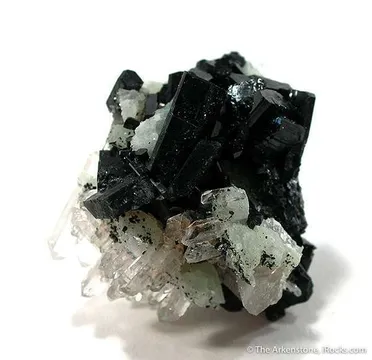
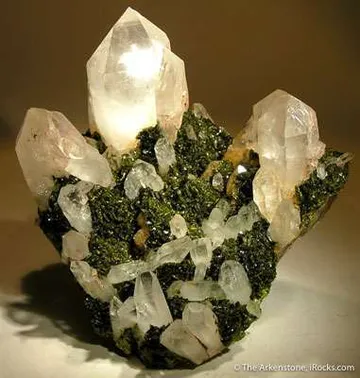
Meigu County, in Liangshan Yi Autonomous Prefecture, is the source of the epidote-quartz material generally seen under Hongquizhen, Hongxizhen, Shuangmaoshan, Waxi, or simply “Meigu, Sichuan” labels. These specimens entered the market in quantity during the early to mid-2000s, with later dealer references noting that fresh production had dried up and that the better examples had become harder to replace. The typical pieces are quartz clusters partly coated, pierced, or overgrown by lustrous dark green epidote. Some specimens include amethystine zones, hematite or iron-oxide phantoms, and transparent outer quartz layers enclosing epidote sprays. The locality nomenclature is unsettled in the trade, and many older labels are imprecise, but the collector look is consistent: pale quartz sprays or “jackstraw” clusters carrying green epidote in small, brilliant aggregates.
Jinkouhe District, in Leshan, is the principal Sichuan name behind many quartz-barite specimens. Mindat treats “Jinkouhe” as a broad district label and explicitly warns that it is often used vaguely for multiple localities within the area. Its documented mineral list includes baryte, quartz, amethyst, rock crystal, scepter quartz, galena, sphalerite, pyrite, rhodochrosite, and a suite of manganese minerals associated with the Dawashan manganese deposit, including bementite, braunite, hausmannite, manganite, pyrolusite, and related species. In the mineral trade, Jinkouhe is best known for clear to milky quartz crystals with tabular barite and for distinctive included or sceptered quartz; the finest examples are clean, transparent, sharp-edged, and undamaged, whereas much of the material shows edge wear, scratched prism faces, chipped terminations, or abrasion from mining and transport.
Sichuan’s economic mineral framework is broader still. The Panxi or Panzhihua-Xichang region contains layered mafic intrusions and Fe-Ti-V oxide, Cu-Ni, and PGE mineralization tied to the Emeishan large igneous province. The Maoniuping rare-earth deposit in Mianning is a major carbonatite-related light rare-earth system in which bastnäsite occurs with fluorite, barite, calcite, quartz, aegirine-augite, amphiboles, and related REE minerals. The Wusihe Pb-Zn deposit in Hanyuan County is a large carbonate-hosted system on the Sichuan Basin margin, notable in recent mineralogical work for germanium-rich species, including the newly approved wusiheite and the thiogermanate ruizhongite. These deposits are not all specimen localities in the same commercial sense as Meigu or Xuebaoding, but they explain why Sichuan appears in both mineral cabinets and modern strategic-mineral literature.
Collecting access today should be regarded as closed or indirect unless a collector has explicit, current local permission. Xuebaoding specimens came from mining and prospecting activity in high mountain terrain rather than from an organized public collecting site. Meigu and Jinkouhe specimens are normally encountered through dealers, older collections, show stock, and auction material rather than as legally accessible field-collecting destinations for visiting hobbyists. Precise mine names, operators, and pocket locations are inconsistently recorded on labels, especially for older Chinese export material; the safest modern practice is to preserve all original labels, note whether a piece is from Pingwu/Xuebaoding, Meigu/Hongxizhen-Hongquizhen, or Jinkouhe, and avoid “upgrading” a vague Sichuan label into a more specific mine name without documentary support.
Quartz from Sichuan is not a single style: at Xuebaoding it is part of the W-Sn-Be greisen-hydrothermal vein assemblage with muscovite, beryl, scheelite, cassiterite, fluorite, apatite, and feldspar; at Meigu it forms frosted to glassy sprays and jackstraw clusters that host or enclose deep green epidote, sometimes with amethystine color, hematite phantoms, or iron-oxide inclusions; at Jinkouhe it is seen as colorless to milky crystals, scepters, doubly terminated crystals, and barite-bearing groups, including pieces famous for mobile three-phase fluid inclusions. Good Sichuan quartz is judged less by sheer size than by clarity, undamaged terminations, balanced association, and clean display geometry: a sharp quartz cluster lifting translucent barite blades, a doubly terminated Jinkouhe scepter without rubbed edges, or a Meigu cluster where epidote is included rather than merely scattered on broken surfaces will outrank an ordinary, bruised cabinet cluster every time.
Sichuan epidote specimens most strongly mean the Meigu County material sold under Hongquizhen, Hongxizhen, Shuangmaoshan, Waxi, and related labels: lustrous dark green to pistachio-green crystals in bladed, fanlike, rosette, radial, and coating habits on quartz. Individual epidote crystals are generally small, but the best examples build sculptural aggregates—green sprays climbing over milky quartz, fan groups perched on smoky or colorless crystals, or epidote included in the outer growth zones of transparent quartz. Cabinet specimens can be dramatic, but quality depends on contrast, luster, clean quartz terminations, and whether the epidote is sharply crystallized rather than a dull green crust; many trade pieces are attractive, but truly balanced groups with rich color, intact quartz, and crystallization all around have become less common since the main early-2000s production.
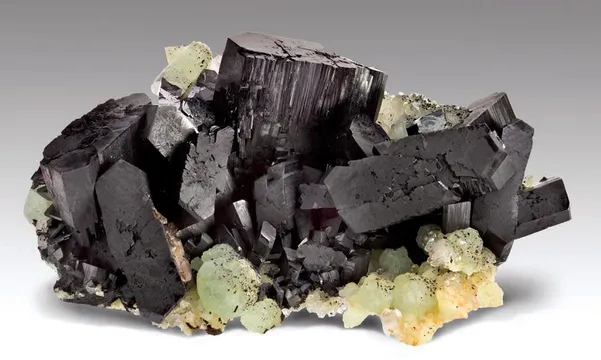
Under the American spelling “barite,” Sichuan collector specimens most often point to Jinkouhe quartz associations: tabular to bladed BaSO4 crystals, commonly colorless, pale yellow, honey-toned, or faintly bluish, set among white to transparent quartz needles and short prisms. Dealer and collection records document barite crystals from a few centimeters to large cabinet scale, including doubly terminated crystals and second-generation yellow coatings on earlier barite, but the locality is unforgiving in condition; edge bruising, cleavage nicks, and scratched quartz faces are common. Better pieces show crisp, glassy or satiny barite blades standing freely on a quartz matrix, with transparency, zoning, and undisturbed crystal edges separating them from ordinary jumbled quartz-barite groups.
Using the IMA spelling “baryte,” Sichuan’s BaSO4 story extends beyond the familiar Jinkouhe specimen market. Baryte is documented from Jinkouhe District, including the Dawashan manganese deposit, and it is also a major gangue and ore-stage mineral in the Mianning-Dechang rare-earth belt, especially the Maoniuping carbonatite-related REE system where barite-bastnäsite, fluorite-barite-calcite, and related assemblages are important to the deposit’s evolution. Collector-grade baryte from Sichuan is still judged by the Jinkouhe aesthetic—transparent tabular crystals on quartz with minimal abrasion—but the broader provincial setting gives the species added geological depth, linking display specimens to Sichuan’s larger Ba-, F-, CO3-, and REE-rich hydrothermal systems.
Other Sichuan minerals deserve serious collector attention even when they are not the headline species on EarthWonders. Xuebaoding produced world-class scheelite, tabular beryl varieties including aquamarine and goshenite, black cassiterite, muscovite, fluorite, apatite, albite, and rare kesterite-mushistonite associations. The province also includes notable type-locality and rare-species records: jinshajiangite from the Luku Mine in the Panzhihua area; haitaite-(La) from Haita town, Miyi County; mianningite from the Maoniuping REE district; ruizhongite and the newly approved wusiheite from the Wusihe Pb-Zn deposit; tongxinite from the Baxi gold deposit in Zoigê; and wumuite and tewite from the Panzhihua-Xichang region near the Sichuan-Yunnan boundary. These are not common hand-specimen species, but they make Sichuan far more than a quartz-epidote-barite province.
Sichuan material is widely available in the market, but the availability is uneven. Meigu epidote-quartz is still seen with some frequency, though the more sculptural, undamaged, richly colored early-production pieces are increasingly collection-held. Jinkouhe quartz-barite ranges from affordable miniatures to impressive cabinet specimens, but fine condition is the bottleneck. Xuebaoding scheelite, beryl, and cassiterite combinations remain Chinese classics, with top association pieces commanding strong prices and minor pieces appearing far more often than museum-level examples.
The most important authenticity issue is locality precision. “Sichuan” is often the only reliable part of an old label. “Jinkouhe” is especially broad and has been used for a number of district localities; published locality notes also warn that some epidote-amethyst specimens formerly attributed to Jinkouhe actually belong to the Hongxizhen/Hongquizhen material from Meigu County. Do not convert “Jinkouhe, Sichuan” into a specific mine without supporting labels, dealer records, or analytical documentation. Likewise, Hongquizhen, Hongxizhen, Shuangmaoshan, Waxi, and Meigu labels may represent overlapping or inconsistently translated trade names, and the safest catalog wording is often the exact label plus a note on the broader Meigu County assignment.
Condition is the second major concern. Jinkouhe quartz is notorious for bruised terminations, worn edges, and scratched broad faces, partly because many crystals were mined and packed as bulk show material. Barite cleaves easily and can show small edge nicks even when the specimen looks clean at first glance; examine blade margins under oblique light. Epidote-quartz groups from Meigu often have many small quartz points, so “minor peripheral nicks” can be acceptable, but damage to the central quartz termination or to a prominent epidote fan sharply affects value. Xuebaoding scheelite can be heavily repaired or glued if it has detached from muscovite; check the contact zones, look for unnatural resin sheen, and be wary of a bright scheelite perched too perfectly on loose mica without believable attachment.
Treatments and enhancement concerns are mostly the standard ones for Chinese display specimens rather than a single well-documented Sichuan scandal. Quartz may be acid-cleaned; iron staining can be either natural and attractive or partially removed; repaired barite, reattached scheelite, and composite quartz-barite pieces should be considered possible in the trade. For Meigu pieces, dark green minerals should be checked carefully if the exact species matters, because chlorite-group minerals, amphibole-like material, and epidote can be visually confused in included or coating habits. When buying at higher levels, ask for old labels, provenance, UV behavior for scheelite, and close-up photographs of attachments and terminations.
Handling considerations are straightforward but important. Barite is heavy, relatively soft, and cleavable, so it should not be cleaned ultrasonically or packed with quartz points pressing into its edges. Meigu epidote-quartz has many projecting quartz tips and brittle green aggregates; wrap with void space rather than pressure. Scheelite is dense and often sits on delicate muscovite, so support the matrix rather than the crystal. Fine Xuebaoding scheelite fluoresces strongly enough in many specimens to be useful for confirmation and display, but fluorescence intensity can vary and should not be the only test for identification.
One of the most revealing Sichuan specimen stories comes not from a mining camp but from a laboratory microscope. GIA examined a doubly terminated scepter quartz from Jinkouhe that weighed 200.28 ct and measured 75.03 × 21.76 × 17.98 mm—large for the kind of included quartz that had been sold for years at Tucson and other shows. The authors noted the problem collectors already knew from the trays: many Jinkouhe crystals had been damaged by mining methods and by packing many crystals together for transport. Good terminations were scarce, broad faces were often scratched, and edges commonly showed chips. This particular crystal survived in a cotton-lined box and was essentially undamaged.
Under magnification, the specimen became stranger. Nomarski differential interference contrast showed light etching on the prism faces. Inside were primary fluid inclusions with black organic compounds as the solid phase. One inclusion contained a gas bubble that moved freely across the full length of its chamber, but the bubble was coated with a metallic-looking substance. In the photomicrographs it looked like a tiny stainless-steel ball bearing rolling through the quartz. The authors could not identify the coating with certainty and suspected an organic compound. For collectors, the episode neatly explains why a clean Jinkouhe quartz can be much more than “another Chinese quartz”: in a fine example, preservation, inclusions, and locality character all converge.
The Xuebaoding story begins with geography that fooled people as much as the minerals dazzled them. Published field descriptions explain that the collecting locality commonly called Xuebaoding is not actually on the famous 5588 m Mount Xuebaoding peak. The workings lie near Little Xuebaoding, in country where high ridges, deep valleys, and extreme relief make orientation difficult. The mountain itself is about 5.3 km northwest of the locality and not visible from it, separated by ridges and by Sigenxiangfeng. Confusion between the two peaks persisted locally into the 1980s. The mineralized zones sit along marble and schist near small granite bodies, with white mine tailings tracing a nearly horizontal marble band across steep alpine terrain. That setting gives the specimens their odd dual personality: they look like elegant cabinet minerals from a pegmatite pocket, yet they come from a high, fracture-controlled greisen-hydrothermal system on the edge of the Tibetan Plateau.