Jinkouhe District, China — quartz-barite crystals with colorless to smoky quartz and barite; Dawashan Mn-deposit minerals add rarity, a prime locality for stri…
Key facts
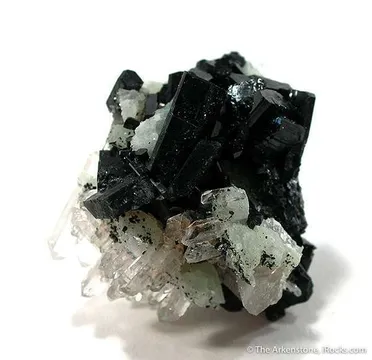
Jinkouhe District, in the mountains of Leshan Prefecture in southern Sichuan, occupies one of those awkward but rewarding places in mineral collecting where a broad administrative name, a specimen-producing crystal area, and a studied ore district have all been folded into the same label. For collectors, “Jinkouhe” means above all the elegant quartz-and-barite combinations that began appearing on the international market around the early 2000s: bright, colorless to smoky quartz groups with thick, tabular to blocky barite crystals perched between the quartz points or lifted above them like small architectural slabs. The best pieces have a Chinese-mineral aesthetic that is immediately recognizable—clean, glassy quartz, white to pale yellow or faintly bluish barite, strong three-dimensional form, and a surprising lightness of composition despite barite’s weight.
Geologically, the district is more than a specimen locality. The Dawashan Mn deposit, within Jinkouhe District, is a well-documented marine sedimentary manganese deposit connected with Late Ordovician Wufengian strata, including the Daduhe unit, and is hosted in chert, siliceous dolomite, minor limestone, and black shale. Published work on Dawashan and the nearby Jiaodingshan Mn-Co deposit describes manganese mineralization in algal-reef facies, with Dawashan developed in pinnacle-reef settings and with ores rich in rhodochrosite, kutnohorite, hausmannite, braunite, manganosite, and bementite. That scientific side of Jinkouhe explains why locality lists include a serious manganese assemblage, while the collecting world remembers the place for quartz, baryte/barite, and the occasional dark included or smoky quartz.
Regional View
Country View
A good Jinkouhe specimen rewards close inspection. The ordinary material can be rather pale-on-pale: white barite on white quartz, attractive but lacking contrast. The better pieces solve that problem by form—barite crystals standing upright, quartz sprays radiating through the mass, or a single doubly terminated quartz crossing the composition. The finest examples add color: smoky quartz with Alpine-looking transparency, pale yellow zoning in barite, blue-tinged blocky barite, or iron-tinted quartz tips that can look golden before cleaning.
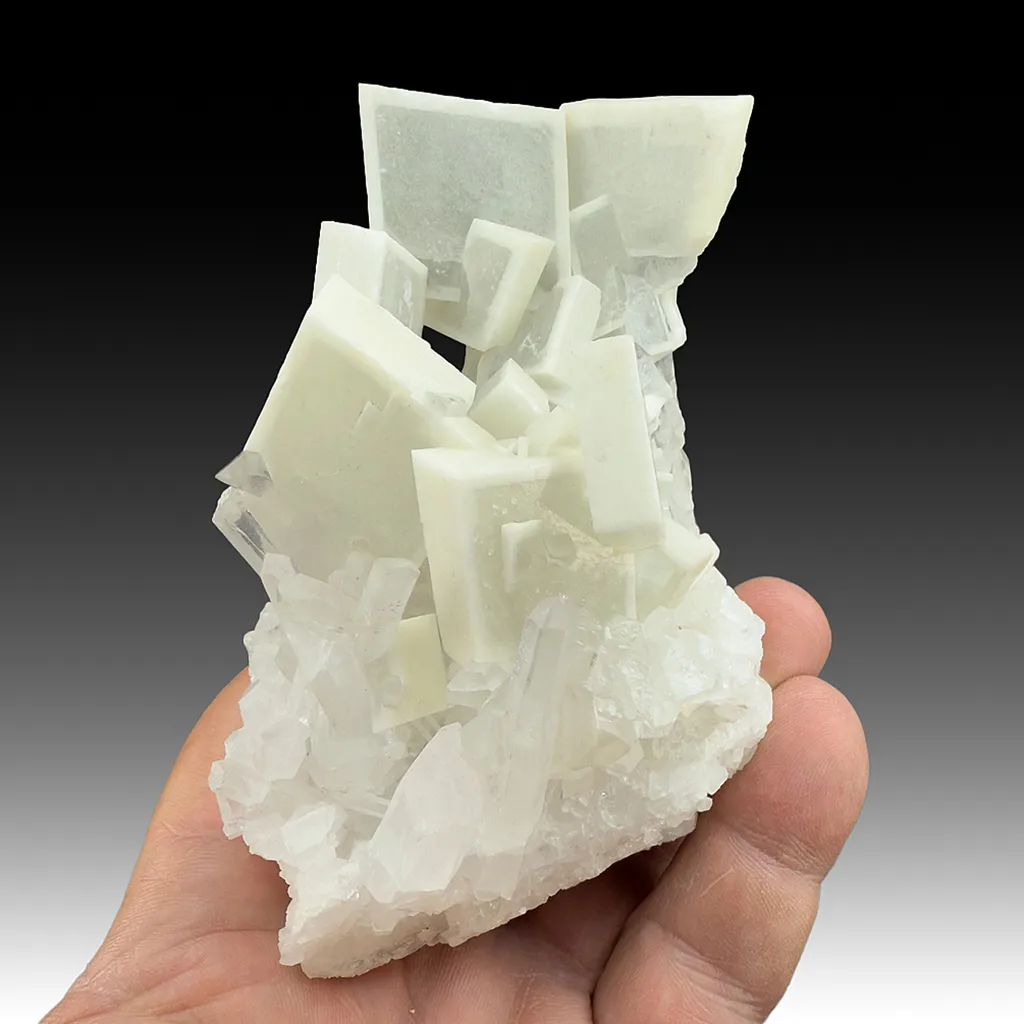
Photo: EarthWonders
Search for specimens: View all specimens from Jinkouhe District, China
Jinkouhe District is a county-level district of Leshan, Sichuan Province. In specimen commerce the name has often been used broadly, and labels may read simply “Jinkouhe,” “Jinkouhe, Leshan,” or occasionally “Jinkouhe, Ebian,” reflecting trade usage around the Dadu River area rather than a rigorously mapped individual pocket. That imprecision matters: the district includes documented manganese mineralization at Dawashan, while some quartz and epidote labels circulating under Jinkouhe have later been questioned or reassigned to other Sichuan localities.
The best-studied deposit is Dawashan, a marine sedimentary manganese deposit. Mindat records the deposit at approximately 29°20' N, 102°55' E and describes it as hosted by chert, siliceous dolomite, minor limestone, and black shale of the Ordovician Wufeng Formation. The classic 1999 Ore Geology Reviews paper by Fan, Hein, and Ye places Dawashan and Jiaodingshan in a roughly 2 m-thick Daduhe unit of Late Ordovician Wufengian age, formed in a gulf between the Chengdu submarine rise and the Kangdian continent. Dawashan is described as a pinnacle-reef system; individual pinnacle reefs range from tens of meters to several hundred meters in length, and the No. III ore body was described as about 14 m high and visible in an open-pit exposure.
The manganese ores are mineralogically and texturally complex. They include rhodochrosite and kutnohorite carbonate ores, manganese oxides and silicates such as hausmannite, braunite, manganosite, and bementite, and textures described as massive, banded, laminated, spheroidal, and cryptalgal. The published interpretation is not a simple vein model: porous reef facies provided the locus for metasomatic replacement during early diagenesis, with manganese reacting with carbon dioxide generated during oxidation of organic matter in the zone of sulfate reduction. Cobalt, nickel, copper, barium, lead, and zinc geochemistry ties the district into a larger metal-bearing sedimentary system on the western Yangtze margin.
The mining history visible in official Chinese district and prefectural planning material is modest rather than industrially spectacular. A Leshan gazetteer-style source records that, by the early 2000s, Jinkouhe had exploited eight kinds of mineral resources, including phosphorus, silica stone, lead-zinc, manganese, limestone, humic soil, silicified dolomite, and rock crystal. It lists two manganese mines and notes that the shallow oxidized ore of the Dawashan manganese mine had been exhausted and the mine closed, with cumulative manganese ore production of more than 400,000 tonnes. The same source names Yangshanping crystal mine and Dawashan manganese mine among closed mines in the district, and gives 2001 mining output and value for the district as small in scale.
Specimen production appears to have been separate in character from the published ore geology: small workings in steep Dadu River terrain, producing quartz clusters and barite-on-quartz combinations rather than large quantities of collector-grade ore minerals. Chinese collector accounts describe the quartz-barite area as distributed along steep slopes and cliffs by the Dadu River, extending for about 15 km, with several hand-dug adits reportedly set hundreds of meters above the valley floor. Japanese collector notes similarly describe miners climbing from the riverbed to high workings and carrying quartz specimens back down in straw-packed loads. These accounts fit the specimens: fragile quartz clusters and tabular barite plates that would not survive careless bulk mining.
Collecting access today should be regarded as closed, private, or at least highly restricted unless proven otherwise through current local permission. The district includes active and former mines, steep cliff country, protected scenic and ecological areas nearby, and a documented pattern of mine closures and regulated mineral rights. Mindat’s locality pages also caution that Jinkouhe has been used vaguely on labels. For collectors, the practical path is therefore specimen-market due diligence rather than field collecting: ask for old labels, dealer provenance, acquisition date, and whether the piece is a true quartz-barite Jinkouhe specimen or a Sichuan epidote-amethyst specimen that has inherited the Jinkouhe name incorrectly.
Quartz from Jinkouhe is best known as bright clusters of colorless to smoky prismatic crystals, often with barite perched on or among the points; documented market specimens include water-clear quartz with transparent baryte, smoky doubly terminated floater groups from 2009 with individual quartz crystals to about 8 cm, and large cabinet quartz plates around 18 to 18.5 cm across with gemmy crystals to roughly 8 cm and dark inclusions. The characteristic “good” Jinkouhe quartz is not merely clear quartz—it has crisp, upright, pencil-like crystals, clean luster, open spacing that lets the barite read as a separate species, and enough lack of bruising that the delicate terminations still look fresh. Ordinary pieces tend toward crowded white-on-white clusters, while the best pieces show either smoky color, strong double terminations, graceful V-shaped or radiating architecture, or sharply contrasting tabular barite.
Barite from Jinkouhe, using the common American spelling favored by many dealers, occurs as thick tabular, blocky, and sometimes doubly terminated crystals on crystallized quartz; recorded pieces range from small cabinet specimens with sharp crystals around 3 cm to large cabinet plates with colorless tabular crystals approaching 6 to 8 cm, and one dealer-described large-cabinet piece measured 21 x 13 x 5 cm with double-terminated barite crystals to 8 cm on quartz. The locality’s strongest barite specimens show glassy faces, lightly frosted edges, pale yellow or bluish zoning, and enough transparency to reveal phantoms or internal texture; weaker examples are simply white barite on white quartz, heavy and undramatic unless the crystals stand up in an especially sculptural arrangement. Because barite cleaves easily, undamaged edges and intact corners are major value points here.
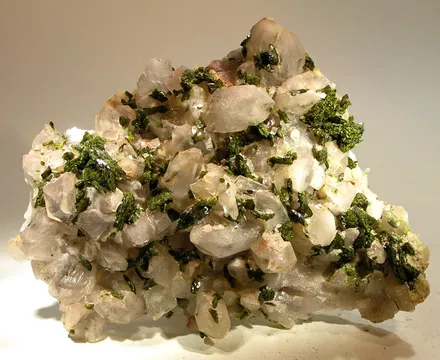
Epidote attributed to Jinkouhe should be treated as a locality problem before it is treated as a species problem: Mindat currently marks epidote for Jinkouhe as an erroneous literature or label entry and states that epidote and amethyst specimens attributed to Jinkouhe in fact come from the Hongxizhen mineral prospect or related Meigu County epidote-amethyst localities in Liangshan Yi, Sichuan. The specimens involved are attractive—deep green, lustrous epidote sprays and plates on quartz or amethyst, sometimes with hematite inclusions—but those habits are precisely what separates them from the classic Jinkouhe quartz-barite suite. For a collector, a “Jinkouhe epidote” with amethyst or green epidote on quartz should be catalogued cautiously, ideally as an old trade label pending correction, rather than accepted as solid evidence for epidote from Jinkouhe District.
Baryte, the spelling used by Mindat and much of the international mineralogical literature, is the same species as barite, BaSO4, and the Jinkouhe occurrence is the locality’s signature collectible companion to quartz. Mindat photo data record baryte overwhelmingly associated with quartz, and dealer and collector descriptions consistently emphasize frosty to transparent tabular crystals, colorless to milky white material, occasional pale yellow tips or zones, and rarer blue or golden examples. The most desirable baryte pieces from Jinkouhe are those in which the baryte crystals appear suspended among quartz points or rise cleanly above a quartz matrix, with broad glassy faces, crisp rectangular outlines, minimal edge bruising, and enough contrast that the specimen does not collapse visually into a white mass.
Other documented minerals from Jinkouhe District are concentrated in the Dawashan manganese assemblage and include bementite, braunite, calcite, chlorite group minerals, dolomite, galena, goethite, groutite, hausmannite, hematite, kutnohorite, magnetite, manganite, manganosite, pyrite, pyrochroite, pyrolusite, rhodochrosite, siegenite, sphalerite, and the obsolete field term “psilomelane.” The collector-grade quartz-barite pocket material should not obscure the scientific importance of those manganese minerals: Dawashan is a notable Ordovician reef-hosted Mn deposit, and bementite, manganosite, hausmannite, braunite, kutnohorite, and rhodochrosite are central to the published ore descriptions. No verified type-locality mineral for Jinkouhe District was found in the checked sources, so claims of type-locality status should be treated skeptically unless accompanied by a primary mineralogical citation.
Jinkouhe is a locality where label accuracy matters. “Jinkouhe” has been used as a broad or vague trade label, and the most important known mislabelling issue involves epidote and amethyst specimens. Epidote-on-quartz or epidote-on-amethyst material long seen under Jinkouhe labels has been reassigned in Mindat’s locality notes to Hongxizhen or related Meigu County localities, and experienced collectors have noted that the quartz-barite Jinkouhe material and the epidote-amethyst Meigu material are visually distinct once both are known. A serious label should ideally specify Jinkouhe District, Leshan, Sichuan for quartz-barite, and a separate Meigu/Hongxizhen locality for epidote-amethyst.
Condition is the central practical issue. Jinkouhe barite has excellent visual geometry but three perfect cleavages and a habit that exposes wide, vulnerable edges. Expect small nicks along plate edges, bruises on terminal faces, cleaved-back corners, and repaired matrix contacts on larger pieces; these are not automatic deal-breakers, but they must be reflected in price. Quartz terminations are also vulnerable because many specimens are open sprays rather than compact plates. On high-end pieces, inspect every quartz point and the perimeter of every barite blade under side lighting.
Cleaning and color require a nuanced eye. Chinese collector accounts state that newly mined yellow quartz and yellow barite from Jinkouhe can owe their color to surface iron staining rather than internal yellow inclusions, and that many white, transparent specimens have been cleaned with dilute hydrochloric acid. Acid cleaning of iron-stained quartz is common in the mineral trade and not necessarily fraudulent, but it affects interpretation: bright white quartz with very clean recesses may have been chemically cleaned, while “citrine” color on Jinkouhe quartz should not be assumed to be true internal citrine color without evidence. Avoid paying a citrine premium for what is essentially iron-stained quartz.
Fluorescence is not a defining trait for most Jinkouhe material, but at least one commercial large-cabinet barite-on-quartz specimen has been described as fluorescent under longwave ultraviolet light. Because baryte fluorescence can vary with activators and impurities, use UV response as an interesting observation, not as a locality proof. Handling should be conservative: support pieces from the quartz matrix or base, never by a projecting barite plate, and avoid ultrasonic cleaning.
Market availability is moderate but uneven. Jinkouhe quartz-barite specimens are common enough that cabinet and small-cabinet pieces appear regularly through dealers and collections, yet genuinely fine examples—transparent barite, strong color zoning, pristine edges, and dramatic quartz architecture—are much less common. Older 2003–2004 style pieces, good 2009 smoky quartz floaters, and large display plates with barite to several centimeters all deserve more careful provenance tracking than generic modern stock.
The field image that stays with Jinkouhe is not a broad open quarry but a steep river gorge. Chinese collector notes describe the quartz-barite area along the Dadu River as a line of workings on precipitous slopes and cliffs, extending for about 15 km. The mountains there are not gentle collecting hills: the account describes peaks rising more than 1,000 m from the valley, with several hand-dug adits set about 800 m above the valley floor. That topography explains why so many Jinkouhe pieces feel like pocket recoveries rather than mine-run ore—delicate quartz and barite specimens brought down from difficult, high openings rather than blasted from a convenient bench.
A Japanese collector account gives the same locality a human scale. Jinkouhe is described as a small mine southwest of Leshan where attractive 10 cm quartz clusters were extracted from the side of a steep mountain. Miners reportedly climbed from the riverbed up roughly 500 m to reach the workings, entered adits high on the slope, and then carried the collected quartz back down packed in straw. Anyone who has handled a Jinkouhe barite-on-quartz specimen will recognize the logic of that packing: a broad baryte plate can be ruined by one knock, and a spray of transparent quartz points is only as good as the terminations that survive the descent.
One Chinese collector’s personal account captures the way Jinkouhe entered private collections, not as anonymous bulk stock but as memorable individual pieces. The writer recalls that the first barite crystal specimen in his collection came from Sichuan Jinkouhe, and later describes a 16 x 12.7 x 8 cm quartz-barite specimen from his early collecting period. The barite on that piece had a main plate about 6 x 6 x 1.5 cm—large enough, and especially thick enough, to stand out among Jinkouhe pieces. Another smaller specimen, acquired during a 2016 mineral group auction, was remembered less for size than composition: white, icy quartz clustered like pencil points, with two main prismatic quartz crystals forming a V and pale yellow barite set between them as if placed there by hand.
The same account gives an important cautionary detail about color. A yellow Jinkouhe quartz acquired in 2020 is described as a dense cluster of small pencil-like crystals, with some tips brightly tinted like mango quartz. But the writer emphasizes that freshly mined yellow quartz and yellow barite from Jinkouhe owe that yellow to iron staining on the surface, not to yellow mineral inclusions locked inside the crystals. Many of the clean white transparent pieces, he notes, have been washed with dilute hydrochloric acid. That small observation is exactly the kind of field-to-market information collectors need: the prettiest color on a Jinkouhe quartz tip may record the pocket environment and cleaning history rather than a separate mineral phase.
Fan, Delian; Hein, James R.; Ye, Jie (1999), “Ordovician reef-hosted Jiaodingshan Mn-Co deposit and Dawashan Mn deposit, Sichuan Province, China,” Ore Geology Reviews, 15(1–3), 135–151. The principal modern English-language paper on Dawashan’s Ordovician reef-hosted manganese geology, ore facies, geochemistry, and genetic interpretation.
USGS Publications Warehouse record for Fan, Hein & Ye (1999). Bibliographic record with abstract, DOI, authorship, and citation details for the Dawashan and Jiaodingshan Mn-Co study.
Wang, Xingfen (1989), “Mn deposits with a genetic mechanism of algae and fungus, Dawashan, Sichuan,” Geology and Prospecting, 25(12), 8–11. Cited by Mindat for Dawashan manganese minerals including braunite, dolomite, groutite, hausmannite, hematite, magnetite, manganite, manganosite, pyrochroite, and rhodochrosite.
Qu, Hongjun (1992), “On palaeostructural control of the Jiaodingshan-type Mn deposits,” Geology and Prospecting, 28(6), 1–5. Cited by Mindat for a broad Dawashan assemblage including baryte, quartz, sulfides, oxides, carbonates, and manganese minerals.
Mindat reference record for Fan, Hein & Ye (1999). Useful cross-reference showing the Dawashan mineral occurrences tied to the Ore Geology Reviews paper.
Fabre Minerals reference specimen page including Jinkouhe quartz, smoky quartz, and baryte with quartz. Documents market-recognized Jinkouhe specimens, including a 2009 smoky quartz floater and quartz with transparent baryte.
Barite with Quartz, specimen 9851051 — Weinrich Minerals. Specimen video linked from Weinrich’s page for a 21.0 x 13.0 x 5.0 cm Jinkouhe barite-on-quartz large-cabinet specimen.
Barite with Quartz, specimen 9851332 — Weinrich Minerals. Specimen video linked from Weinrich’s page for a 29.0 x 22.0 x 4.5 cm Jinkouhe plate with colorless tabular barite crystals.
Barite with Quartz (1140) — EarthWonders. Short specimen media for an EarthWonders Jinkouhe barite-on-quartz cabinet specimen.
Mindat: Jinkouhe District, Leshan, Sichuan, China — The central locality page, especially useful for the current mineral list, label warnings, and the epidote/amethyst misattribution note.
Mindat: Dawashan Mn deposit, Jinkouhe District, Leshan, Sichuan, China — Deposit-level page for Dawashan, including coordinates, host-rock summary, and the manganese assemblage.
Mindat: Baryte from Jinkouhe District — Occurrence page with photo-data associations showing the importance of quartz-baryte combinations.
Mindat: Quartz from Jinkouhe District — Occurrence page noting quartz varieties and the possibility that some quartz labels may refer to Hongxizhen material.
USGS: Ordovician reef-hosted Jiaodingshan Mn-Co deposit and Dawashan Mn deposit, Sichuan Province, China — Authoritative abstract and publication metadata for the key Dawashan ore-geology paper.
ScienceDirect: Ordovician reef-hosted Jiaodingshan Mn-Co deposit and Dawashan Mn deposit, Sichuan Province, China — Publisher page for the same Ore Geology Reviews article, with additional abstracted details.
Fabre Minerals: China reference specimens including Jinkouhe — Dealer archive documenting water-clear quartz with baryte, smoky quartz, and 2003–2009 Jinkouhe material.
Weinrich Minerals: Barite with Quartz, Jinkouhe, specimen 9851051 — Large-cabinet Jinkouhe barite-on-quartz description with crystal size, dimensions, and video link.
Weinrich Minerals: Barite with Quartz, Jinkouhe, specimen 9851332 — Large plate of Jinkouhe barite on quartz, useful for size range and fluorescence note.
EarthWonders: Barite with Quartz (1140), Jinkouhe District — Marketplace record illustrating the typical white tabular barite-on-quartz habit.
Well Arranged Molecules: Barite on Quartz, Jinkouhe — Dealer description of a blue, blocky barite-on-white-quartz specimen from older Jinkouhe finds.
Well Arranged Molecules: Jinkouhe specimen list — Useful notes on ordinary white Jinkouhe barite versus rarer colored pieces and older circa-2004 material.
The Mineralogical Record: What’s New in the Mineral World, Report 67 — Market report noting Jinkouhe quartz groups carrying transparent tabular barite, including an 18 cm example.
Meipian: 金口河水晶、重晶石 — Chinese collector field-and-specimen note with vivid descriptions of the Dadu River cliff workings, specimen sizes, and iron-staining/acid-cleaning observations.
鉱物たちの庭: 重晶石 Barite — Japanese collector note describing Jinkouhe as a small mountain-side quartz locality, with comments on miners carrying specimens down from high workings.
Leshan mineral-rights planning PDF — Official regional planning source with broader Leshan mineral-resource context and Jinkouhe lead-zinc and manganese setting.