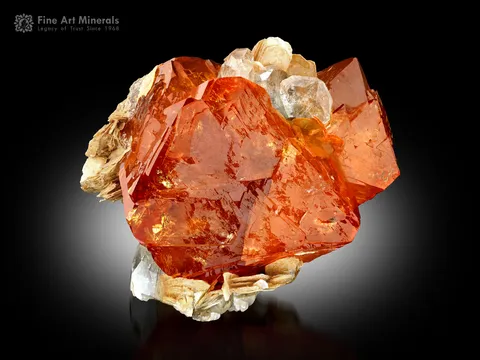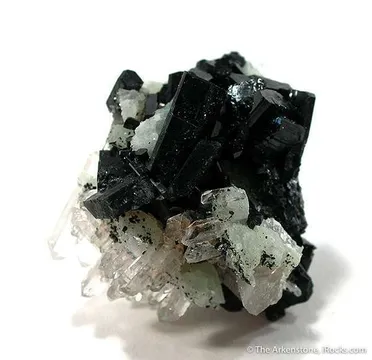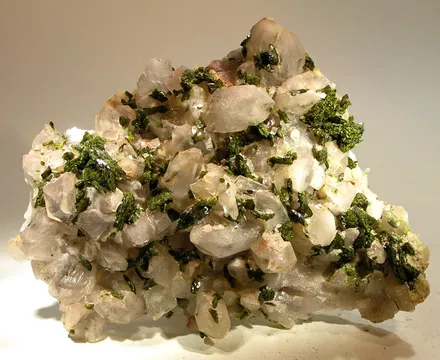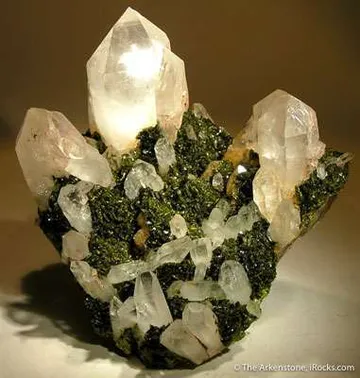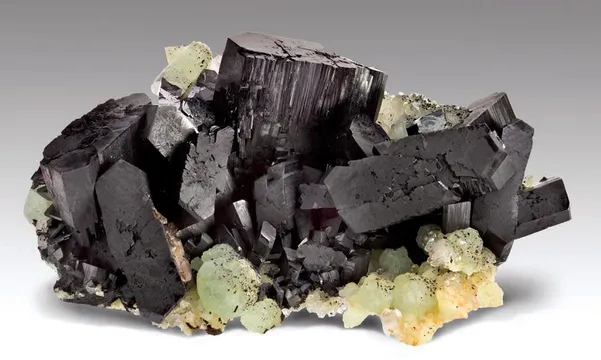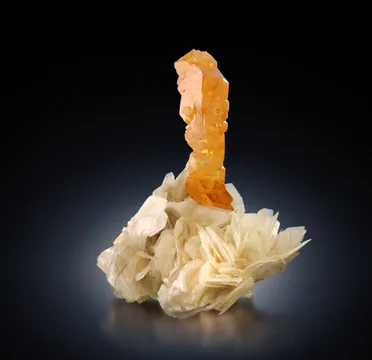
Mount Little Xuebaoding, China: a premier W-Sn-Be locality with large euhedral scheelite, cassiterite, muscovite, and rarer tin minerals prized by collectors.
Key facts
Mount Little Xuebaoding is one of the great modern Chinese specimen localities: a high, cold, visually dramatic W-Sn-Be system in northern Sichuan that gave the collector world orange scheelite, tabular beryl, black cassiterite, pearly muscovite, fluorite, apatite, and rare tin minerals in combinations that look almost designed for the cabinet. The principal specimen-producing occurrence is generally catalogued today as the Pingwu beryl mine, Huya township, Mount Little Xuebaoding, Pingwu County, Mianyang, Sichuan, China, although many older and trade labels read simply “Mt. Xuebaoding,” “Pingwu,” “Huya,” “Hujia,” or “Songpan.” For serious collectors, that naming tangle is not trivial: the celebrated specimens belong to the Xuebaoding massif collecting tradition, but the most precise modern locality wording places many of them on the Pingwu side around Mount Little Xuebaoding and associated W-Sn-Be veins.
Geologically the locality is not a simple pegmatite story, despite the beryl and the coarse crystal size. The Xuebaoding system is an unusual granitic-hydrothermal to greisen-type deposit associated with highly fractionated alkali granites, especially the Pankou and Pukouling granites, intruded into Triassic marble and schist in the Songpan-Ganzi orogenic belt. The ore fluids exploited fractures, joints, vein margins, pods, breccia zones, and brittle marble horizons; in the best cavities and selvages they deposited large, euhedral crystals rather than ordinary disseminated ore. That is why the locality matters: tungsten, tin, and beryllium occur together here as aesthetic, often gemmy, open-space crystals in a way that is rare among world ore deposits.
The best specimens have a distinctive “Xuebaoding look.” Scheelite is typically golden yellow, honey, orange, or burnt orange in sharp tetragonal dipyramids that collectors often call pseudo-octahedra. Cassiterite is jet black to deep brown-black, lustrous, often twinned, and commonly set into a mica-rich matrix. Beryl ranges from colorless goshenite to pale blue aquamarine and occasional pinkish morganite, commonly as thick tabular hexagons rather than the long prisms expected from many pegmatite localities. Muscovite provides the stage: silvery, pearly, bladed books and plates that cradle, frame, or contrast the darker and warmer-colored crystals. In fine pieces, the locality’s signature is not just one mineral but the choreography of several—scheelite on mica with aquamarine nearby, cassiterite nested among mica blades, or pale beryl standing against black cassiterite and honey-brown muscovite.
Regional View
Country View
Specimen production became internationally important in the 1990s and early 2000s, when coarse beryl, scheelite, cassiterite, fluorite, apatite, muscovite, and associated rarities entered the collector market in quantity and quality high enough to redefine expectations for Chinese minerals. The orange scheelites quickly became global classics; the tabular beryls became instantly recognizable; and the rare kësterite-mushistonite material gave the locality a specialist following beyond display specimens alone. Scientifically, the locality has attracted repeated study because its combination of W, Sn, and Be, its evolved granitic association, its marble-schist host rocks, and its large hydrothermal crystals make it an exceptional natural laboratory for ore-forming fluids.

Photo: Wikimedia Commons
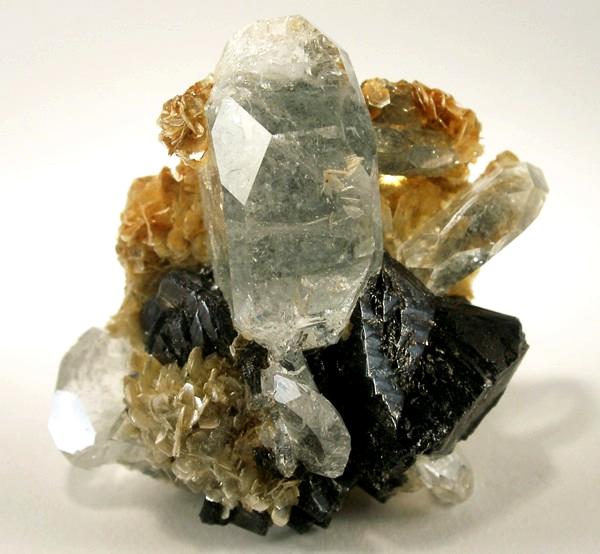
Photo: Wikimedia Commons
Search for specimens: View all specimens from Mount Little Xuebaoding, China
The collector locality lies in Pingwu County, Mianyang, Sichuan, in the mountainous country northwest of Huya. In modern locality hierarchy the key specimen source is the Pingwu beryl mine at Huya township, Mount Little Xuebaoding; the broader locality and deposit names include Mount Little Xuebaoding, the Xuebaoding deposit, and the Xuebaoding W-Sn-Be mining area. The famous “Mt. Xuebaoding” trade label is understandable because the whole collecting tradition is tied to the Xuebaoding massif, but careful labels should preserve older wording while adding the more precise Pingwu beryl mine or Mount Little Xuebaoding context where supported.
The deposit is a W-Sn-Be granitic-hydrothermal system associated with the Pankou, Pukouling, and related small albite-rich granitic intrusions. These granites are highly fractionated, peraluminous, enriched in alkalis such as Li, Rb, and Cs, and intruded Triassic metasedimentary rocks dominated by marble, schist, quartz schist, and related carbonate-bearing units. The mineralization is concentrated close to the granite contacts, commonly within tens of meters to less than about 100 m from the intrusions, where fractures and joints carried volatile-rich fluids into brittle marble and more ductile schist.
The ore bodies are best understood as mineralized veins, vein networks, pods, breccia bodies, and open cavities rather than broad massive ore. Published geological descriptions divide the mineralized veins into three practical zones. Zone I is granite-hosted and dominated by muscovite, tourmaline, and beryl. Zone II is transitional, between granite and metamorphic country rock, and carries beryl, cassiterite, tourmaline, and muscovite. Zone III is the principal specimen zone in the marble-schist country rock, with beryl, cassiterite, scheelite, fluorite, calcite, tourmaline, apatite, albite, and other minerals. In collector terms, Zone III is the source environment most consistent with the classic orange scheelite, cassiterite, beryl, and mica combinations.
The veins commonly have quartz-dominant centers and coarse-grained mineral margins. Mineralogical studies describe margins with beryl, cassiterite, scheelite, feldspar, albite, muscovite, fluorite, and apatite, with a muscovite fringe or selvage separating vein from host rock. This architecture explains many display specimens: crystals are not randomly scattered through the matrix but perched on mica-rich vein selvages or cavity walls, often with quartz or albite in the background and carbonate or fluorite in the richer marble-hosted pockets. Coarse crystals in the veins have been reported in centimeter to decimeter ranges, with beryl, scheelite, and cassiterite capable of forming unusually large, well-shaped individuals.
Geochronology places the mineralizing event in the Early Jurassic. Cassiterite U-Pb work and 40Ar-39Ar dating of muscovite intergrown with cassiterite gave overlapping ages around 193–194 Ma, tying tin-polymetallic mineralization closely to the evolved granitic system. Other studies on scheelite, fluid inclusions, tourmaline chemistry, and beryl structure refine the picture: magmatic hydrothermal fluids, interaction with carbonate host rocks, changing pH and volatile chemistry, and open fractures together produced the coarse, clean crystals that collectors prize.
Mining history began as an ore and prospecting story but became a specimen story. The veins have been known and prospected since the 1950s, while the international collector market began seeing significant specimen production especially from the late 1990s onward. Collector accounts from the early 2000s describe a high-altitude camp worked by roughly 100 miners, about one third of whom devoted their time to recovering specimens for the collector market. That detail captures the locality’s unusual economics: an undamaged orange scheelite on muscovite, or a fine aquamarine-cassiterite association, could be more valuable as a mineral specimen than as ore.
The best-known production period for collector-quality material was roughly the late 1990s through the early 2000s, with notable finds continuing to circulate afterward as old stock, dealer inventory, collection releases, and auction specimens. The 2001–2003 period is especially important for the famous green-coated rare tin-mineral pieces: kësterite crystals coated or associated with mushistonite and malachite, initially nicknamed “pandaite” before analytical work and collector scholarship clarified the assemblage. Those pieces remain one of the locality’s most memorable rarities.
Collecting access today should be considered restricted and unsuitable for casual field collecting. The locality is high, remote, environmentally sensitive, and associated with protected mountain country; modern dealer and collector commentary consistently treats new specimen recovery as greatly reduced or effectively halted compared with the boom years. Serious collectors should focus on specimens with strong provenance, old labels, reputable dealer history, and transparent repair disclosure rather than attempting field access.
Notable finds include large orange scheelite crystals on muscovite; scheelite-aquamarine combinations; cassiterite on muscovite plates; aquamarine with cassiterite; goshenite or pale aquamarine with albite and muscovite; fluorite with beryl or scheelite; pink to purple fluorapatite; euclase; topaz; and the kësterite-mushistonite-malachite material that gave the locality a place in the literature of rare tin minerals. Among display minerals, the locality’s finest specimens combine sharpness, luster, undamaged crystal edges, balanced matrix, and the unmistakable contrast of orange, pale blue or colorless, black, and silver-white.
Muscovite from Mount Little Xuebaoding is the visual and geological framework of the locality: pearly silver, pale gray, honey-brown, or champagne-toned books and bladed aggregates forming fringes along mineralized veins and providing the matrix for the famous scheelite, cassiterite, and beryl specimens. In the veins, muscovite occurs both as a granite-related mineral and as a coarse selvage between mineralized vein and host rock; studies of the deposit describe muscovite-rich assemblages in granite-hosted Zone I, cassiterite-beryl-muscovite associations in transitional Zone II, and mica-bearing margins in the richer marble-schist-hosted mineralization. Individual mica books on collector pieces are commonly in the millimeter to low-centimeter range, while plates and nests can be much larger; good muscovite specimens here are judged less by isolated mica perfection than by how the blades frame focal crystals without obscuring them. The finest pieces have bright, undamaged mica with crisp books, natural sparkle, and strong contrast—orange scheelite, pale aquamarine, black cassiterite, or fluorite set cleanly above the mica rather than buried in a dull, bruised mass.
Cassiterite from Mount Little Xuebaoding is among the locality’s premier minerals, typically forming highly lustrous black to deep brown-black crystals on muscovite, with many examples showing sharp prismatic forms, complex terminations, twinning, or stacked intergrowths. It is most characteristic of the transitional and marble-hosted mineralized zones: Zone II includes beryl, cassiterite, tourmaline, and muscovite, while Zone III adds scheelite, fluorite, calcite, apatite, and the richest specimen associations. Geological descriptions report cassiterite crystals in the veins from about 1 cm to much larger sizes, and the collector market has long prized thumbnail to cabinet pieces where glossy black cassiterite stands in relief against pale mica, especially when joined by tabular aquamarine or orange scheelite. Good pieces have bright, mirrorlike faces, clean terminations, minimal bruising on exposed edges, and a composition that lets the cassiterite read as the main subject rather than as an indistinct dark mass; the best combinations add pale blue beryl or muscovite in a way that emphasizes the crystal architecture.
Aquamarine from Mount Little Xuebaoding is part of the locality’s unusual beryl suite, which ranges from water-clear goshenite through faintly blue aquamarine and rare pinkish morganite, most famously as thick, tabular hexagonal crystals with broad basal pinacoids, short prism faces, and a low aspect ratio. Scientific work on Xuebaoding beryl emphasizes that it is commonly colorless and transparent, rarely distinctly blue, and often enriched in Li and Na; collectors nevertheless use “aquamarine” for the pale blue crystals when the color is evident. The crystals occur with muscovite, albite, cassiterite, scheelite, quartz, fluorite, and tourmaline, especially in the granite-proximal and transitional vein zones and in richer marble-hosted pockets where the full W-Sn-Be assemblage developed. Typical display crystals range from small thumbnails to several centimeters, with larger tabular plates and clusters much sought after; the best aquamarine pieces here are sharp, glassy, thick rather than wafer-thin, undamaged around the basal edges, and set on contrasting mica or cassiterite so the faint blue color and unusual tabular habit can be read immediately.
Scheelite is the emblem mineral of Mount Little Xuebaoding: golden yellow to honey-orange, butterscotch, and burnt-orange crystals, typically as sharp tetragonal dipyramids with a pseudo-octahedral appearance, perched on muscovite and commonly associated with beryl, cassiterite, quartz, fluorite, albite, calcite, apatite, or tourmaline. The richest scheelite belongs to the main marble-schist-hosted Zone III assemblage, where beryl, cassiterite, scheelite, fluorite, calcite, and tourmaline occur together in coarse vein margins and cavities. Published studies of the veins report scheelite in centimeter to decimeter ranges, while collector-quality crystals are commonly smaller but can reach impressive cabinet size; classic locality summaries describe lustrous translucent to gemmy orange crystals up to roughly 8 cm on an edge, and scientific work on faceted Xuebaoding scheelite ties the celebrated yellow-orange hue to light rare-earth elements such as La, Ce, Pr, and Nd substituting into the crystal structure. A top scheelite specimen from here needs more than size: it should have saturated color, transparency or at least glowing translucency, sharp undamaged edges, lively luster, strong placement on mica, and ideally a meaningful association such as aquamarine, cassiterite, fluorapatite, fluorite, or calcite.
Other documented minerals from the Mount Little Xuebaoding and Pingwu beryl mine system include albite, quartz, smoky quartz, fluorite, calcite, dolomite, K-feldspar, topaz, euclase, fluorapatite, tourmaline-group minerals including schorl, foitite, and oxy-dravite, rutile, pyrite, molybdenite, bournonite, boulangerite, geocronite, magnetite, ilmenite, bixbyite-(Fe), hausmannite, pyrolusite, wulfenite, malachite, mushistonite, vismirnovite, and kësterite. The locality is not the type locality for the better-known mushistonite or vismirnovite species, but its rare tin-mineral assemblage is unusually important to collectors: kësterite crystals coated with greenish mushistonite and malachite from the early 2000s are among the most celebrated non-mainstream specimens from the district, and an unnamed Fe-Sn oxide of the kyzylkumite group has also been reported from the Pingwu beryl mine material. Pink to purple apatite, fluorite combinations, and euclase are less central to the market than scheelite, cassiterite, beryl, and muscovite, but they give the locality real depth for suite builders.
Authentication for Mount Little Xuebaoding specimens is usually less about whether the species exists at the locality and more about three practical issues: precise locality wording, repair disclosure, and visual consistency with known Xuebaoding material. A believable classic specimen usually shows some combination of pearly muscovite, orange scheelite, tabular beryl, black cassiterite, quartz, albite, fluorite, apatite, or calcite. Labels that say “Mt. Xuebaoding,” “Pingwu,” “Huya,” “Hujia,” “Songpan,” or “Ping Wu beryl mine” can all occur in the trade; none is automatically wrong, but a high-value specimen should preserve old labels and add modern clarification where possible.
Documented restoration is a real concern. Xuebaoding scheelite crystals can be large, exposed, heavy, and brittle; muscovite matrices split easily; and specimens had to survive extraction from high-altitude workings and a long supply chain. Published auction descriptions have documented expert repair joins to muscovite matrix and restoration through part of a major scheelite crystal using UV-fixed epoxy, color matching, and luster matching. That is the kind of restoration that can be invisible in a glamour photograph and nearly invisible in normal room light.
Examine scheelite under magnification at the ridges, apexes, and contact points with matrix. Chips on exposed edges are common; a few tiny bruises may be acceptable on an otherwise strong specimen, but reglued crystals, polished faces, filled clefts, and restored terminations must be priced accordingly. Use raking light to look for discontinuities in luster, unnatural color patches, glue menisci at the mica contact, and lines crossing more than one face. If possible, examine with shortwave and longwave ultraviolet light: repaired areas, glues, and fills may respond differently from natural scheelite or mica.
Muscovite condition matters more than many buyers first realize. The mica is often the specimen’s architecture, and broken books, crushed edges, or unstable plates can make a specimen difficult to display safely. Handle these pieces by the strongest part of the matrix, not by scheelite crystals or elevated mica clusters. Avoid ultrasonic cleaning, soaking, acids, and aggressive brushing. Dusting should be gentle and dry; a stable custom base is strongly recommended for cabinet pieces with elevated focal crystals.
Scheelite fluorescence is an added attraction but not a substitute for daylight quality. Xuebaoding scheelite commonly shows a blue to bluish-white response under shortwave UV, and research on the locality’s scheelite has documented fluorescence features related to rare-earth chemistry. Fluorescence varies from specimen to specimen, and matrix minerals or repairs may complicate what the lamp shows. Buy the crystal first for form, color, luster, transparency, and condition; treat UV response as a bonus and as a useful inspection tool.
Mislabelling is most common at the level of beryl variety and locality precision. Many Xuebaoding beryls are colorless goshenite or only faintly blue, and the word “aquamarine” is sometimes used loosely in the trade for very pale crystals. “White aquamarine” should be treated as a marketing phrase, not a mineralogical variety. Likewise, “Mount Xuebaoding” should be understood as a broad historic trade label unless documentation supports a narrower mine attribution.
Rarity is tiered. Small scheelite-on-muscovite pieces and modest cassiterite or beryl specimens are still obtainable through dealers and auctions. Fine, unrepaired, well-balanced scheelite with strong orange color is much scarcer. Top combinations—scheelite with aquamarine, cassiterite, fluorapatite, fluorite, or calcite; major tabular aquamarine on cassiterite; and early-2000s kësterite-mushistonite pieces—are genuinely difficult and often move through private collections rather than ordinary retail channels. Because fresh production is now limited relative to the early boom years, provenance, old-stock status, condition reports, and repair disclosure carry increasing weight in price.
The first great Xuebaoding story is a story of names. The collector label “Mt. Xuebaoding” sounds singular and straightforward, but the specimens come from a mountain world where geography, trade habit, and local access routes overlap. “Xuebaoding” means “Snow Treasure Crown,” and the larger Mount Xuebaoding peak rises to 5,588 m in the Minshan range. Yet many of the mineral specimens long sold under that name are tied more precisely to the Pingwu beryl mine around Mount Little Xuebaoding, reached from the Pingwu and Huya side. Old labels may read Pingwu, Songpan, Huya, Hujia, Mt. Xuebaoding, or Shuijingchang. The last name is especially memorable: it has been translated in collector accounts as “crystal site,” which is almost too perfect for a place that put orange scheelite, pale beryl, black cassiterite, and silver mica into the same pockets.
The physical setting shaped the collecting history. The workings sit in high mountain country, above the comfortable world of ordinary mine visits, with specimen localities commonly described around 3,800–4,700 m elevation. The region is also giant-panda country, part of the environmentally sensitive Minshan landscape that gave rise to Berthold Ottens’ memorable German article title about the world’s best scheelites “between pandas and eternal ice.” That phrase endured because it is accurate in spirit: this was not a lowland industrial mine producing mineral specimens as a by-product of easy access. It was a high, difficult, seasonal mountain operation where intact crystals had to be found, extracted, protected, packed, and carried out before they ever reached a dealer’s table.
A collector account from the early 2000s gives the mining camp a striking scale: about 100 miners lived near the site, and roughly a third of them worked specifically on specimens for the collector market. That number says much about the locality’s transformation. Xuebaoding began as a W-Sn-Be ore occurrence, but the economics of beauty changed behavior underground. A sharp orange scheelite standing on mica, a tabular aquamarine balanced on cassiterite, or a rare tin-mineral pocket could be worth far more alive as a specimen than crushed as ore.
One of the most repeated specimen stories involves an unusual scheelite find from the “other side of the mountain” from the former main adits. The photographed specimen measured 6.2 x 4.4 x 3.3 cm, with crystals to 2 cm. Instead of the familiar equant pseudo-octahedra, the crystals were distorted into fat triangular shapes, slimmer in one dimension, yet gemmy at the terminations. The associated note captures the pulse of a pocket discovery: a small trickle of material, news spreading among collectors, and a piece that stood apart from the standard orange-on-mica Xuebaoding model while still being unmistakably from that mountain world.
Another pocket became famous because it was misnamed before it was understood. Between 2001 and 2003, miners recovered specimens of rare kësterite coated or associated with greenish mushistonite and malachite. Before proper identification, the material was called “pandaite,” a nickname that could only have come from this locality’s blend of giant-panda landscape and collector folklore. Once studied and placed correctly, the material became more than a curiosity: the kësterite crystals were recognized by collectors as among the largest and finest known for the species, and mushistonite from Xuebaoding entered discussions not merely as a coating but as a clue to the tin-rich ore-forming process.
The locality also has a cautionary story for high-end buyers. A richly colored scheelite on muscovite, described at auction as a burnt-orange, translucent, sharp small-cabinet specimen, carried an explicit repair disclosure: the piece had an expert repair join to the muscovite matrix and restoration across part of the scheelite crystal, with UV-fixed epoxy and matched color, luster, and translucency. That episode is worth remembering because it is not a scandal; it is an education. Xuebaoding scheelite can be magnificent, heavy, brittle, and difficult to extract. Restoration may be skillful enough to fool a casual inspection. The right response is not cynicism, but disciplined buying: ask, inspect, use UV, and value disclosure as part of the specimen.