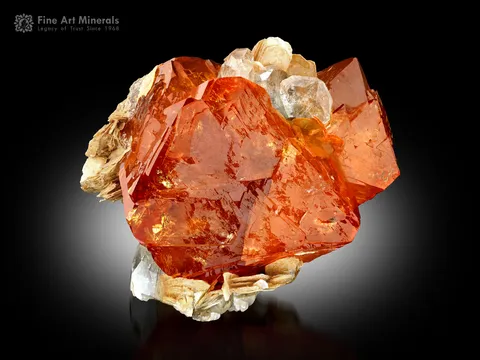
A collector's guide to Meigu County, China: its geology, mining history and notable minerals, illustrated with the 55 specimens documented from this locality on EarthWonders.
Key facts
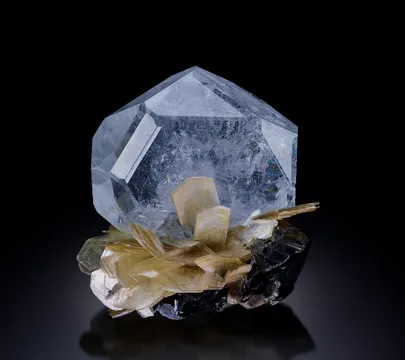
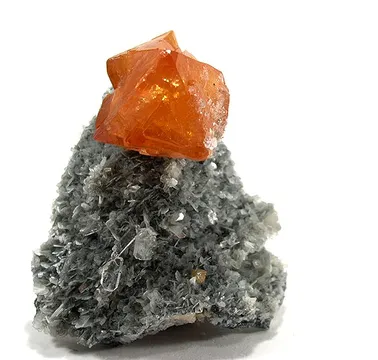
Meigu County, in Liangshan Yi Autonomous Prefecture of southern Sichuan, is one of China’s most distinctive modern basalt-cavity specimen districts. Its collector reputation rests on mineralized voids, fractures, and interlayer-gliding zones in Emeishan basalt: a setting that produced transparent to amethystine quartz, lustrous epidote rosettes, apple- to mint-green prehnite balls, and the black babingtonite-group crystals for which the locality became internationally famous. The best Meigu specimens have the unmistakable “Chinese basalt pocket” look—glassy quartz points carrying dark green epidote fans, pale green prehnite hemispheres, or jet-black tabular babingtonite crystals with a metallic-vitreous flash.
Regional View
Country View
The county is not a single mine in the ordinary sense. “Meigu” on older labels may refer broadly to several mineral occurrences and small workings, notably the Hongxizhen mineral prospect, Ganzhizhou Mine, and Shuangmaoshan epidote mines. Hongxizhen is especially important to collectors, but many older labels use the spelling “Hongquizhen Quarry,” a name now recognized as both misspelled and misleading: Hongxi is the relevant Chinese place name, and the specimen occurrence was a hillside prospect rather than a true quarry.

Photo: Rob Lavinsky, iRocks.com / Wikimedia Commons
Meigu’s historical significance is twofold. In mineral collecting, it helped redefine expectations for babingtonite: the Chinese basalt occurrences yielded large, lustrous, aesthetic black crystals with prehnite and quartz, material that many dealers and collectors regarded as surpassing older classic East Coast U.S. babingtonites in size and visual impact. In Chinese gem and specimen collecting, Meigu also became associated with attractive “garden quartz” and Nanhong agate-style silica in basalt cavities—specimens in which multiple generations of quartz enclose or carry epidote, hematite, dolomite or other colored inclusions.

Photo:
Search for specimens: View all specimens from Meigu County, China
The specimen deposits of Meigu County are best understood as low-temperature hydrothermal cavity mineralization in Emeishan basalt. The same regional basaltic pile that hosts Meigu’s collector minerals also underlies studied Nanhong agate orefields in the county. Published work on Meigu Nanhong agate describes ore-hosting basalt as mainly vesicular to amygdaloidal basalt; thin-section work records plagioclase and pyroxene as major primary components, with quartz, chlorite, calcite, cryptocrystalline aggregates, and local epidotization in the altered rock. In some agate-bearing amygdales, the filling sequence begins with cryptocrystalline quartz, continues through recrystallized platy or granular quartz, calcite and fibrous chlorite, and ends with fibrous or cryptocrystalline quartz that gives the cavities their zoned structure.
Geochemically, the studied Meigu Nanhong basalt is alkaline basalt with ocean-island-basalt-like trace-element patterns and high-Ti Emeishan affinities. The published interpretation places it in a continental intraplate extensional setting, related to mantle-plume magmatism at the margin or waning stage of the Emeishan plume system. For specimen collectors, the practical consequence is more immediate: basalt cavities, fractures, and amygdales created the open space, and late fluids supplied silica, calcium, iron, aluminum, copper and minor manganese to crystallize quartz, prehnite, epidote, babingtonite-group minerals and secondary copper silicates.
Several mineralized belts are documented in the county’s Nanhong agate field. The Jiukou belt has discontinuous surface exposure for more than 1 km and visible thickness of about 1–5 m; the Lianhe, or Luomoyida, belt is exposed discontinuously for about 0.8 km with visible thickness of about 0.8–3 m; and the Waxi belt is exposed discontinuously for more than 1 km with visible thickness of about 1–3.5 m. Although those figures refer to the agate-bearing basalt system rather than every individual collector pocket, they give a sense of the scale and continuity of cavity-bearing basalt in the district.
Hongxizhen, long seen on labels as “Hongquizhen Quarry,” is the core collector locality for many prehnite-epidote-quartz and babingtonite combinations. Modern locality notes identify it as a mineral prospect on a hillside, worked by local farmers, with the formal quarry name regarded as erroneous. The occurrence is described as lying on a mountain between Hongxi Town and Mabian County, within a forest reserve, where mining activity is not legal. This matters for modern collecting: the classic material is overwhelmingly old-stock, dealer-stock, or collection-recycled material rather than a locality where responsible field collecting access can be assumed.
The Shuangmaoshan epidote mines represent another Meigu occurrence. They are recorded as a group of small mines high on a mountainside at roughly 3000 m elevation, about an hour’s drive east of Meigu; documented minerals there are epidote and quartz. Field notes record at least two mine entrances and an aerial ropeway, but heavy snow prevented mineral collecting during the reported visit. Specimens from Shuangmaoshan tend to be discussed as epidote-quartz rather than the richer Hongxi-style prehnite-babingtonite assemblage.
The Ganzhizhou Mine appears on labels for prehnite, quartz, siderite, native gold and specimens sold or cataloged as manganbabingtonite. It is less precisely located in public collector databases, and some identifications attached to this name require care. The locality has been used for prehnite and babingtonite-group material, but modern notes specifically warn that manganbabingtonite identifications need substantiation because Meigu babingtonites analyzed in the literature contain only minor manganese. The same source expresses doubt about large, well-formed chalcopyrite crystals attributed to this basalt-hosted environment.
Production reached the specimen market in several pulses. Hongxi quartz with epidote was reportedly collected in quantity in the mid- to late 1990s. Scientific papers on Meigu quartz and babingtonite appeared in 2008, documenting mineralization in basalt cavities and the low-temperature hydrothermal system. Dealer records show prehnite-quartz and prehnite-babingtonite-quartz specimens circulating by 2009 and 2010, and many fine babingtonite and epidote display specimens are described as early-2000s to 2010–2015 classics. Today, top examples are best found through established collections, older dealer inventories, and auctions rather than fresh production.
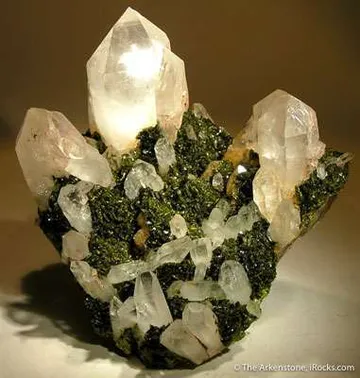
Quartz from Meigu is not merely matrix; it is one of the locality’s defining species. Published work on basalt-hosted rock crystal in Meigu separates the quartz mineralization into stages: early amethyst and “three-color-layer” quartz in basalt vesicles; later banded, milky and pure colorless quartz with platy epidote in interlayer-gliding fractures or drusy cavities; and a later volcanic-fragmental stage dominated by hematite with epidote, chlorite, chalcedony and agate. Collector specimens range from small amethystine, inclusion-rich “garden quartz” to glassy colorless crystals several centimeters long, and dealer records include showy quartz plates with bright green epidote fans to about 10 mm and individual quartz crystals reported to several centimeters. The best pieces are transparent, undamaged, three-dimensional groups in which the quartz carries visible internal hematite or epidote inclusions, sugary secondary quartz, or sharp contrasting epidote and prehnite rather than merely cloudy fractured points.
Meigu prehnite is prized for its compact hemispheres and bladed-botryoidal balls perched on quartz and epidote, most often in pale apple-green, mint-green, “water green,” or occasionally soft golden tones. Hongxizhen specimens commonly show spherical prehnite aggregates from about 1–3 cm across on glassy quartz, with associated olive-green epidote microcrystals; one well-described Hongquizhen example measured 5.9 x 5.9 x 3.8 cm and carried a translucent light green prehnite ball just under 3 cm on epidote and epidote-included quartz. The best pieces here are not massive crusts: they are airy combinations where discrete prehnite balls are cleanly isolated on clear quartz or serve as a pastel platform for glossy black babingtonite-group crystals, with minimal bruising to the rounded aggregate edges.
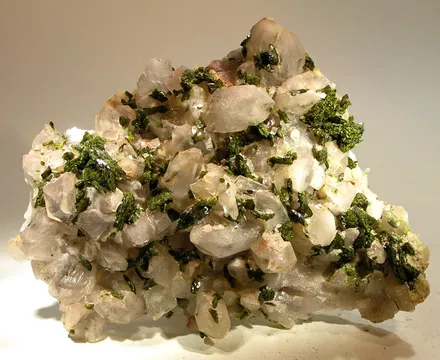
Epidote from Meigu occurs as dark olive to bright green tabular blades, fan-like sprays, rosettes, microcrystalline crusts and inclusions in quartz, with Hongxizhen and Shuangmaoshan both documented epidote-quartz sources. A dealer-described Hongxizhen quartz specimen carried lustrous, translucent to glassy, fan-like epidote groups to 10 mm; another Hongquizhen display specimen from the 2010–2015 period showed an 8 cm “vertical ribbon” of sparkling epidote rising from a nest of spiky quartz. Hongxi-style epidote is especially recognizable when it forms small rose-like crowns on quartz or appears as green inclusions inside later colorless quartz growth. Quality depends less on individual crystal size than on luster, saturated green color, sharp rosette form, contrast against clear quartz, and whether the association preserves the delicate pocket architecture without peripheral crushing.
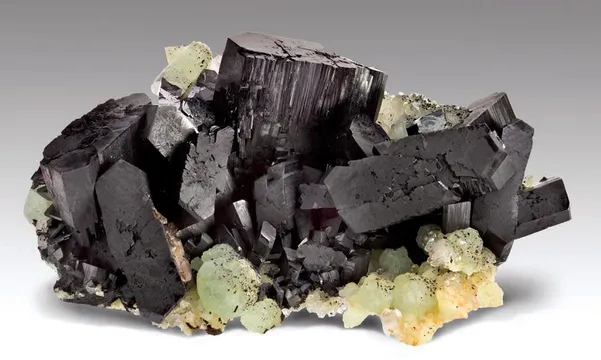
Specimens from Meigu have been sold and cataloged as manganbabingtonite, especially from the Ganzhizhou Mine, but serious collectors should approach the name analytically rather than visually. The black tabular to prismatic babingtonite-group crystals from Meigu are spectacular, but the published study of Meigu babingtonite reports only minor MnO, typically about 2–3 wt.%, and modern locality notes state that manganbabingtonite identifications from Ganzhizhou need substantiation because the source is not known to be manganese-rich. Where confirmed or responsibly labeled as babingtonite-manganbabingtonite series material, the prized specimens are glossy black triclinic plates on mint-green prehnite and quartz; top examples show sharp, highly lustrous crystals in the 2–4 cm range, while the older literature on Meigu babingtonite documents coarse first-generation tabular crystals up to about 25 x 20 x 10 mm intergrown with prismatic quartz and a second generation of minute bright black crystals with bipyramidal rock crystal.
Chrysocolla from Meigu is an unusual minor specialty rather than a common product of the district. The best-documented pieces are from Hongxizhen/Hongquizhen and show blue-green chrysocolla as isolated balls or patches on gemmy quartz crystals; a photographed 6.5 x 6.3 x 2.5 cm specimen was described as a very small find with blue-green balls scattered across clear quartz, visually distinct from the more massive “wall-to-wall” chrysocolla habit familiar from many copper deposits. Good Meigu chrysocolla specimens rely on color contrast and isolation: bright turquoise-blue to green rounded aggregates cleanly positioned among quartz points are far more desirable than dark, smeared copper staining or indistinct green crusts, and the best labels should specify Hongxizhen rather than only “Sichuan.”
Other minerals documented from Meigu County include babingtonite, calcite, chalcopyrite, dolomite, graphite, hematite including specularite, lepidocrocite, native gold, siderite, pumpellyite-subgroup material, agate, amethyst, chalcedony, milky quartz and rock crystal. No valid type-locality mineral is documented from Meigu in the sources consulted; manganbabingtonite’s type locality is the Rudnyi Kaskad deposit in Russia, not China. The rarities that matter most to Meigu collectors are therefore not type-locality species but locality-sensitive associations: babingtonite-group crystals on prehnite and quartz, hematite-included or epidote-included “garden” quartz, minor chrysocolla-on-quartz, and questionable but market-visible labels such as manganbabingtonite and chalcopyrite from Ganzhizhou.
Meigu labels deserve close reading. “Hongquizhen Quarry” is the classic market label, but the more accurate modern name is Hongxizhen mineral prospect; “qui” is a transliteration error for “xi,” and the site was not a formal quarry. Specimens labeled only “Meigu,” “near Meigu,” or even “near Meigu, Yunnan” may reflect older dealer shorthand for a broad basalt-pocket district spanning southern Sichuan and northeastern Yunnan, not a precise collecting spot. For serious locality suites, Hongxizhen, Ganzhizhou, Shuangmaoshan, Waxi, or another sublocality should be preserved whenever it is reliably present.
The most important species-level caution is babingtonite versus manganbabingtonite. Meigu produced superb black babingtonite-group crystals, but published analyses of Meigu material report low manganese, and locality notes specifically flag manganbabingtonite at Ganzhizhou as needing substantiation. Unless a specimen is accompanied by analytical data, conservative labels such as “babingtonite,” “babingtonite-group,” or “babingtonite-manganbabingtonite series” are safer than an unqualified manganbabingtonite label.
There are also locality-attribution concerns around chalcopyrite and native gold. Ganzhizhou has been used on labels for native gold, quartz, prehnite, siderite and chalcopyrite, but large well-formed chalcopyrite crystals from the Meigu basalt environment have been described as doubtful in modern locality notes. Native gold from Ganzhizhou appears in catalog records and collector posts, but it is not part of the mainstream Hongxi prehnite-epidote-quartz pocket assemblage; a gold specimen should be judged by provenance and, when valuable, by independent confirmation.
Condition issues are typical of basalt-cavity material but especially important here because the best Meigu specimens are architectural. Quartz points are easily bruised along exposed terminations and perimeter contacts; prehnite balls can be flattened, scuffed, or partly dissolved; epidote rosettes break into dull green granular patches when mishandled; and black babingtonite-group crystals lose much of their appeal if the broad faces are chipped or the luster is dulled by pocket clay or cleaning. Natural high luster is a major value driver on babingtonite-group pieces, and at least one dealer note explicitly warns that luster can be enhanced by coatings, so inspect black crystals under strong oblique light for unnatural film, pooled gloss in crevices, or residue around contacts.
Most Meigu minerals are not collected for fluorescence, and there is no widely documented diagnostic fluorescence for the main Meigu assemblage. Handling should emphasize mechanical protection rather than light sensitivity: keep delicate epidote sprays and quartz points from rubbing against boxes, do not ultrasonic-clean fragile prehnite-babingtonite combinations, and avoid aggressive acids unless you know exactly what carbonate or iron-oxide coatings you are trying to remove. The delicate multi-generation “garden quartz” pieces are best left as natural pocket specimens; inclusions and internal color zoning are the whole point.
Market availability is uneven. Small prehnite-quartz or epidote-quartz specimens still appear regularly, often from old stocks, and modest pieces can remain affordable. Truly fine Hongxizhen babingtonite on prehnite and quartz, large sculptural epidote-on-quartz display pieces, and colorful inclusion-rich “garden quartz” from the early finds are far less available. Auction records show a broad spread: modest prehnite-epidote-quartz combinations have sold in the tens of dollars, while elite babingtonite and dramatic epidote display specimens have sold or been valued in the low thousands.
The most persistent Meigu story begins with a mistaken name. For years, collectors knew the locality as “Hongquizhen Quarry,” a neat label that sounded official enough to pass unquestioned through shows and collections. The modern correction is more interesting: it is Hongxi, not Hongqui, and the occurrence was not a quarry at all. It was a hillside prospect connected with Hongxi Town, formerly Hongxi Township before 2021, on a mountain between Hongxi and Mabian County. That mountain lay inside a forest reserve, which turns a tidy cabinet label into a much messier field reality: the celebrated Chinese prehnite-epidote-quartz and babingtonite combinations came from workings that were never a conventional legal specimen quarry.
Chinese collector accounts preserve the atmosphere of the early Hongxi activity. In the mid- to late 1990s, local farmers reportedly found quartz and epidote on a forested mountain slope at about 3000 m elevation, in a reserve whose highest peak reached 4148 m. The first material was not necessarily spectacular by single-crystal standards—dark green to nearly black epidote crystals around 10 mm, ordinary-looking quartz in many pieces—but the association was fresh, abundant and visually distinctive. The epidote formed little flat rosettes and crowns, commonly perched on earlier quartz, and later colorless quartz could trap green epidote and red hematite inclusions inside the crystals.
The same accounts describe a rough and improvised style of mining. Around seventy people were said to have worked the mountain. They searched for quartz veins by stripping the ground surface, damaging trees in the process, and when signs suggested a pocket or productive vein below, they drilled holes, loaded explosives and blasted. If a crystal-bearing vein appeared, the work changed character: simple hand tools were used in an effort to remove specimens intact. The contrast is very Meigu—destructive searching followed by painstaking extraction once a pocket opened.
The “garden quartz” chapter is the most romantic. Hongxi quartz became known for multiple generations of growth, sometimes described by Chinese collectors as a “three generations under one roof” style of quartz crystallization. The earliest quartz generation was often amethystine to reddish-purple or purple-brown, with short prismatic forms and rounded inclusion spots. Later colorless quartz could be larger, with individual crystals reported up to about 20 cm long and around 3 cm across. In the most admired “garden” pieces, transparent later quartz enclosed green epidote, yellow dolomite, and red hematite-bearing quartz or inclusions, creating miniature landscapes inside and upon the crystal group.
Then, as with so many specimen localities, abundance collapsed into memory. One Chinese account looks back on a time when epidote-quartz from Hongxi could be bought by the ton for a few hundred yuan, and contrasts it with the present rarity of the best garden quartz, scattered into private collections and seldom seen. The account closes with the collector’s admonition “且玩且珍惜”—roughly, enjoy them, and treasure them while you can.
Shuangmaoshan adds a colder, higher-altitude footnote to the county. The recorded mines sit high on a mountainside at about 3000 m, roughly an hour east of Meigu. A visitor reported seeing two mine entrances and an aerial ropeway, but heavy snow prevented collecting. That brief note says a great deal: Meigu’s specimen story is not only dealer trays of polished-looking combinations, but steep Sichuan terrain, winter access problems, and small workings at elevations where weather can end a collecting day before it begins.