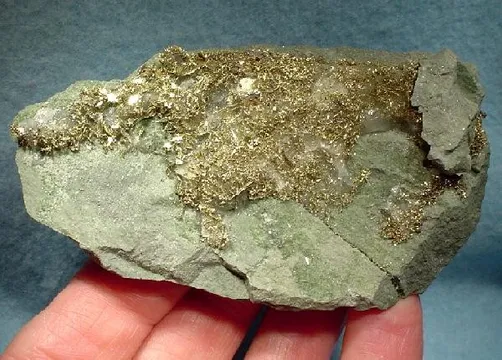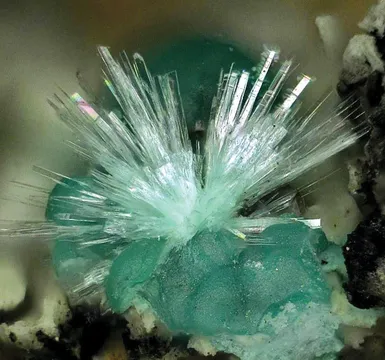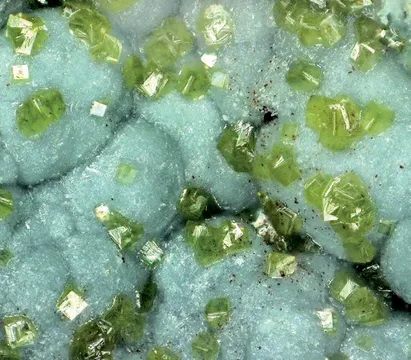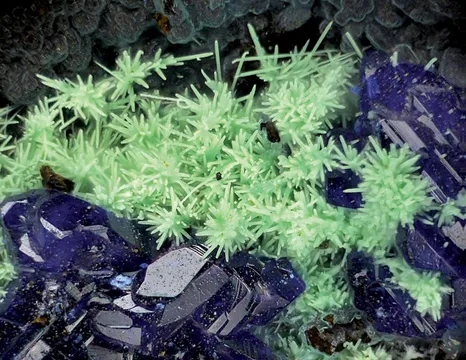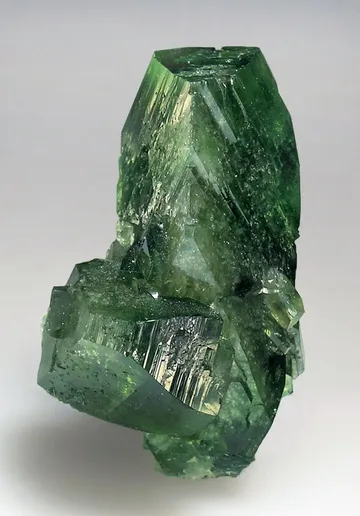
Phoenix mine, USA - a premier locality for native copper, analcime and zeolites; prized for sculptural copper forms and classic Lake Superior associations.
Key facts
Phoenix is one of the old names that serious Keweenaw collectors still say with a little extra care. The mine lies at Phoenix, in Houghton Township, Keweenaw County, Michigan, on the north end of the Lake Superior native-copper district, where Mesoproterozoic basalt flows of the Portage Lake Volcanics were fractured, altered, and mineralized by copper-bearing hydrothermal brines. Unlike most copper districts, the prized ore here was not chiefly chalcopyrite or other sulfides but native copper itself: metallic copper filling fissure veins, pockets, amygdules, and brecciated openings in basalt, accompanied by native silver and a classic low-temperature suite of zeolites, prehnite, calcite, quartz, epidote, pumpellyite, apophyllite, and later copper oxides.
Phoenix matters to collectors out of proportion to its economic rank. It was an early fissure-vein producer, opened originally as the Lake Superior mine in 1844 and renamed Phoenix in 1849, and it ultimately became far more famous for specimens than for tonnage. Its best copper pieces are sculptural rather than merely heavy: branching arborescences, leaf and moss copper, spinel-law twins, tetrahexahedral forms, red cuprite-coated copper, and copper crystal groups perched against white, pinkish, or colorless analcime and pale apophyllite. The mine is also one of the signature American localities for old-time analcime, especially lustrous trapezohedra and twinned or epitaxially overgrown crystals that can sometimes be recognized as Phoenix material even when a label has been lost.
Regional View
Country View
The collecting personality of Phoenix is a fissure-mine personality: erratic ore, rich pockets, old stopes, and specimens that reward careful reading of matrix and associations. The most desirable pieces are not simply “Michigan copper,” but recognizable Phoenix specimens with a balanced combination of sharp copper, uncleaned or attractively oxidized patina, and associated analcime, apophyllite, calcite, quartz, epidote, or prehnite. Museum pieces from the mine have long circulated through the great Copper Country collections, and modern examples generally come from old collections rather than new collecting, since the Phoenix piles are now on private property and access is not granted because of caving ground.


Search for specimens: View all specimens from Phoenix mine, USA
Phoenix is best understood as a group of closely related fissure-vein workings at the base of the Keweenaw greenstone bluff rather than as a single simple mine. The historic Phoenix property worked several mineralized fissures that crossed the stratified basalt sequence, including the Phoenix, Robbins or West, St. Clair, and Babbitt veins, with related old workings often discussed under the broader Phoenix-area mine group. These fissure veins were steep, narrow, locally rich, and irregular—exactly the style that made the early Keweenaw mines both seductive and maddening. In favorable shoots they carried masses, barrel copper, leaf copper, and crystallized copper; between shoots they could pinch abruptly into poor ground.
Geologically, the setting is the northern Keweenaw Peninsula section of the Lake Superior native-copper district. The host rocks are part of the Portage Lake Volcanics, a thick sequence of billion-year-old basaltic lava flows and interflow units associated with the Midcontinent Rift. The Phoenix workings sit below and beside the prominent Greenstone Flow, one of the great lava flows that forms the high escarpment—the “greenstone bluff”—along this part of the peninsula. At the mine site the collecting and teaching value is not only the mineralization but the outcrop itself: the bluff exposes flow layering, lower ophitic basalt, columnar jointing, and the coarse-textured pegmatitic zone of the flow.
The ore was native-copper mineralization in fissures and adjacent porous openings, with native silver also historically important. Old records describe the principal product as mass and barrel metallic copper, with stamp rock subordinate and uneven. The mine’s production history reflects that geometry. It could deliver astonishing masses, yet its narrow and irregular vein character meant the company had to open constant new ground simply to keep ore moving. Historic summaries record Phoenix as producing 16,632,536 pounds of copper and 25,000 ounces of silver during its operating life, a modest figure compared with the great amygdaloid and conglomerate lode giants farther south, but an important one in the history of Keweenaw fissure mining and mineral collecting.
The earliest chapter began in 1844, when the Lake Superior mine was opened by the Bay State Mining Company on an outcropping fissure vein. Work had started even earlier under the Lake Superior Copper Company organization, after mineral lands became available in the 1840s; Dr. Charles T. Jackson examined the property and reported several veins. In August 1845 the company put into operation what is described in early histories as the first stamp mill on Lake Superior, though it proved poorly suited to the task. The mine was reorganized as the Phoenix Copper Company in 1849, and over the following decades it operated under changing managements, interruptions, and reorganizations. The Phoenix Consolidated Copper Company was organized in 1899, controlling the old Phoenix, St. Clair, Garden City, and related properties; by the early 1900s production was increasingly concentrated in the St. Clair fissure and West Vein ground. Work ended in 1905, after which the properties passed into the Keweenaw Copper Company orbit; Calumet & Hecla later dewatered and repaired two Phoenix shafts in the late 1920s, but that revival did not develop into sustained mining.
Historically important finds came from both the old mine workings and later collecting of the dumps. Early records mention ancient pits, a 600-foot adit, copper masses measured in thousands of pounds, and one immense Phoenix-property mass reported at more than 500 tons. The mine’s collector fame, however, rests on pocket specimens: crystallized copper with red cuprite and black tenorite patina, copper with analcime, copper with apophyllite, crystallized silver, fine calcite, and the distinctive Phoenix analcime habits. The West Vein is especially important to collectors because it yielded pseudocubic calcite and some of the classic analcime-calcite associations; mineralogical literature also records opaque gray bipyramidal apophyllite from the West Vein.
Collecting access today should be treated as closed unless a current landowner grants explicit permission. Older collecting guides and geologic field stops describe a Phoenix poor-rock pile and amygdaloid minerals, but current locality notes state that the Phoenix piles are on private property and that the owners do not grant access because of caving ground. Serious collectors should therefore regard modern Phoenix specimens as old-collection material, dealer-circulated material, or museum material, not as something to be obtained by visiting the site with a hammer. The distinction matters: a good old Phoenix label, especially one tying a specimen to West Vein, St. Clair, Robbins/West, a named collector, or a museum duplicate, adds real value.
Copper from Phoenix is the mine’s defining species and occurs as crystallized native copper, arborescent groups, leaf copper, moss copper, and copper with analcime, calcite, quartz, epidote, prehnite, apophyllite, cuprite, and tenorite; the best examples show sharp, three-dimensional crystal architecture rather than merely hackly metal, with bronze to red-brown surfaces, spinel-law twins, elongated branches, and locally tetrahexahedral crystals. Cabinet pieces are known, but many fine Phoenix coppers are thumbnails to small cabinets, and the most desirable pieces combine a graceful copper “tree” or lattice with an old, unforced patina and a specific Phoenix association such as analcime or apophyllite; ordinary pieces are heavier, massive, acid-brightened, poorly crystallized, or only generally labeled “Michigan.”
Phoenix apophyllite is reported mineralogically as fluorapophyllite-(K), one of the latest cavity and fissure minerals in the Lake Superior copper district, and Phoenix examples occur as clusters of colorless plates, as opaque gray bipyramidal crystals from the West Vein, and as small sparkling crystals coating or accompanying native copper and analcime. The classic collector look is not a large Indian-style apophyllite cabinet specimen but a refined Keweenaw association: glassy to pale, generally small crystals adding brilliance and paragenetic complexity to copper or analcime; good Phoenix pieces are crisp, undamaged combinations with apophyllite visibly perched on copper or analcime, while ordinary examples may require magnification or lack the contrast that makes the association immediately legible.
Analcime is the great non-metallic Phoenix species, known from the mine as colorless to pinkish trapezohedra and twinned crystals, with Penfield describing crystals to about 1 cm in 1885 and later museum and dealer specimens showing larger crystals, including examples around 3.5 cm; Phoenix analcime occurs on calcite and native copper and with apophyllite, quartz, and other late hydrothermal minerals. The finest examples have lustrous, well-isolated, glassy to porcelain-white or pale pink trapezohedra on contrasting dark copper, greenish epidote-pumpellyite matrix, or carbonate, and the mine is especially prized for unusual crystals with reentrant grooves or epitaxial overgrowths of a later analcime generation—an idiosyncratic Phoenix habit strong enough to help attribute unlabeled specimens.
Calcite from Phoenix is a late vein and pocket mineral found with native copper, analcime, epidote, quartz, prehnite, and related Keweenaw gangue minerals, and the mine is specifically noted for fine crystals with vicinal forms as well as pseudocubic crystals from the West Vein. The most locality-sensitive Phoenix calcites are the amber-colored pseudocubic crystals associated with analcime from a West Vein find, a style considered distinctive for the mine; collector-grade examples are attractive when the calcite is sharp, translucent, and well positioned against copper or analcime, while ordinary material tends to be cleaved, bruised, massive, or visually dominated by matrix rather than crystal form.
Phoenix prehnite is an early-recorded Keweenaw classic: excellent specimens were described from vein Number 5, with colors ranging from white through yellow and several greens to rare pinkish-orange, and some material is coated by quartz and calcite or occurs as pseudomorphs after calcite. For collectors the appeal is usually textural and contextual rather than single-crystal size—botryoidal, fibrous, or compact prehnite in intimate association with copper, quartz, calcite, or altered basalt—and the better pieces show fresh color, well-preserved rounded or pseudomorphous surfaces, and a convincing Phoenix provenance, since green Keweenaw prehnite without a strong label is easily reduced in the market to a generic Copper Country occurrence.
Cuprite at Phoenix is most important as the red alteration film and coating on native copper crystals, commonly accompanied by darker tenorite, rather than as freestanding show crystals; it gives many Phoenix copper specimens their characteristic deep red, maroon, or mottled red-and-black patina. The best pieces use that cuprite color to enhance the copper architecture—red-coated branches, latticework, spinel twins, and arborescent tetrahexahedral crystals—while lesser pieces are merely tarnished or oxidized without good form; because cuprite films can be partly natural, partly mine-age, or affected by cleaning history, serious collectors prize old labels, untouched surfaces, and color that looks coherent rather than artificially brightened.
Other documented Phoenix minerals broaden the locality beyond its six headline species. Native silver is one of the historical highlights and appears in the mine’s production record as well as collector accounts. Quartz, epidote, pumpellyite-(Mg) including chlorastrolite, natrolite, laumontite, stilbite-subgroup minerals, datolite, baryte, dolomite, ankerite, microcline or adularia, hematite, chrysocolla, atacamite, domeykite, babingtonite, and tenorite are all part of the verified Phoenix mineral suite. Baryte is a special sleeper: the West Vein is represented in the A. E. Seaman Mineral Museum by lustrous colorless-to-white bladed crystals about 13 cm across, a size and quality that make it far more than a footnote. The list is not led by a formal type-locality species, but by locality-specific habits and associations—above all the Phoenix analcime overgrowths, West Vein pseudocubic calcite, and cuprite-tenorite coated copper.
Phoenix specimens should be judged first by provenance. Because “Michigan copper,” “Keweenaw copper,” and “Lake Superior copper” are common broad labels, an old tag naming Phoenix, Phoenix Mine, West Vein, Robbins or West Vein, St. Clair, or a named Copper Country collector carries real importance. Many genuinely old specimens have passed through generations of collections, and labels from respected dealers, museum duplicates, or old regional collections often matter as much as a centimeter of size. Conversely, an attractive copper with only a vague Michigan label should not be upgraded to Phoenix merely because it has a red-and-black patina or an analcime association.
No well-established Phoenix-specific fake tradition is known in the way that some classic gem-crystal localities have identifiable manufactured pieces, but the broader Keweenaw copper market has recurring problems: over-cleaning, acid-brightening, polished or tumbled pieces sold as natural specimen copper, repaired branches, added matrix, and overly confident locality attributions. Many Phoenix coppers were cleaned historically to remove basalt and carbonate, and a careful acid job can reveal crystals without destroying the specimen; an aggressive one leaves unnaturally bright, etched, or lifeless surfaces. The most desirable Phoenix pieces preserve a stable bronze, brown, red cuprite, or red-and-black cuprite-tenorite surface rather than a raw pink penny color.
Condition is particularly important on copper branches and analcime combinations. Copper is malleable, so bent tips, compressed branches, and clipped arborescences are common; on thin latticework, a missing side branch can change the whole silhouette. Analcime crystals are much more brittle and show bruising as dull spots on edges and corners; good Phoenix analcime should be checked under angled light for chipped trapezohedron edges and repairs at the matrix contact. Calcite is easily cleaved, apophyllite plates can be nicked, and prehnite coatings may be abraded or dulled by dump exposure.
Cuprite and tenorite coatings should be handled as mineral surfaces, not as tarnish to remove. Cleaning a red Phoenix copper can erase much of its collector character. Avoid harsh acids or commercial copper cleaners on old specimens, especially if analcime, calcite, apophyllite, prehnite, quartz, or baryte is present; carbonate and zeolite associations can be damaged or loosened, and even robust copper can be aesthetically ruined by stripping its mature surface. Store copper in a stable, dry environment and keep it away from acidic materials, fresh oak, sulfur-bearing papers, and damp cardboard. Analcime and apophyllite need no special light protection, but they do reward dust-free display.
Market availability is uneven. Small Phoenix coppers and mixed matrix specimens appear periodically, but high-quality, well-provenanced crystallized copper with analcime or apophyllite is scarce. Strong analcime specimens from Phoenix are genuinely competitive Copper Country classics, especially when crystals are isolated, lustrous, pinkish or porcelain-white, and larger than the usual centimeter-scale material. Cuprite-coated copper has a wider market because it appeals visually even to non-specialists, but the best pieces are those with both Phoenix provenance and a refined crystal habit. Prehnite, calcite, and apophyllite combinations are less frequently offered and can be underappreciated when compared with showier copper, making them attractive targets for advanced Keweenaw-suite collectors.
Phoenix began with the optimism and improvisation of the first Lake Superior copper rush. In the mid-1840s the Lake Superior Copper Company controlled a sweeping tract, and Dr. Charles T. Jackson’s examination of the ground encouraged work near Eagle River. The operation was primitive by later Keweenaw standards: shallow shafts, small crews, trial veins, and a stamp mill bought in Detroit and put to work in August 1845. That mill is remembered as the first stamp mill on Lake Superior, but not as a triumph. It was an early experiment, installed before anyone fully understood how this native-copper rock should be treated, and early accounts frankly say it proved unsuccessful.
The old histories contain one of the most vivid silver episodes in Copper Country mining. The main shaft had been sunk on a pocket of copper and silver that soon ran out. In the attempt to recover the vein, a tunnel was driven under the river at a depth of about 90 feet from the top of the shaft. There the miners struck an ancient water-worn crevice filled with gravel and stream accumulations. In that old channel were about 18,000 pounds of copper and an unknown amount of silver. The unknown part is the sting in the story: much of the silver was reportedly appropriated by miners before the company could account for it. One piece weighing 8 2/3 pounds did reach company hands and was recorded as going to the Philadelphia Mint.
The Phoenix property was also a place of extravagant masses. Early work in ancient pits at the New Phoenix reportedly produced 1,200 pounds of copper from a depth of only 10 feet, and a 600-foot adit yielded a copper mass of 2,300 pounds. Later reports went far beyond that. A mass upward of 500 tons was reported from the Phoenix property and described in contemporary mining statistics as possibly the largest mass ever discovered in copper mining. The practical reality behind such a boast was not a tidy museum specimen but a brutal mining problem: huge native-copper masses had to be cut apart underground, often by chiseling, drilling, wedging, and patient labor before they could be hoisted and shipped.
The mine’s good years never erased its irregular nature. In the mid-1860s the Phoenix vein pinched badly just when copper prices were high, dragging output down for several years. Then the ground widened again. By 1869 it yielded nearly 400 tons of ingot copper, by 1870 about 500 tons, and in 1871 more than 1.3 million pounds of refined copper. The pattern reads like a fissure miner’s lesson in humility: a narrow vein could starve a company, then suddenly open into masses rich enough to revive it.
One of the darker Phoenix incidents came in 1873, when an explosion of dualin killed Captain John Hoatson and five men. Later newspaper accounts of another Phoenix explosive accident noted 100 pounds of dualin being transferred from its original package to a bag when the explosion occurred, and remarked that only one similar explosion had previously occurred in a Michigan copper mine—also at Phoenix, nearly a quarter-century earlier. The mineral specimens that survive from these mines often look serene in cases, but the old Phoenix record is full of the hazards behind them: explosives, heavy masses, caving ground, deep wet workings, and narrow stopes driven through uncertain rock.
Collectors have their own Phoenix story, quieter but just as enduring. Some mines are remembered because they paid dividends; Phoenix paid only one historical dividend of note, but its specimen dividend has lasted for more than a century. A copper chisel-chip fan from Phoenix, illustrated in the Mineralogical Record, preserves a different kind of artifact: a 17 cm fan made by miners as a gift for important visitors and as a demonstration of hammer-and-chisel skill. It was displayed for years in the Calumet & Hecla offices. In a district famous for natural copper sculpture, that fan is a reminder that the miners themselves were also shaping copper underground—sometimes to extract ore, sometimes to show mastery, and sometimes to make a presentation piece worthy of the strange metal they worked every day.
Christopher J. Stefano and Philip Persson, “The Phoenix Mine, Keweenaw County, Michigan,” The Mineralogical Record, vol. 54, January–February 2023 — The most important modern collector-focused treatment of Phoenix, with history, locality context, and illustrated copper, analcime, calcite, apophyllite, and cuprite specimens.
S. L. Penfield, “Crystals of analcite from the Phoenix Mine, Lake Superior Copper Region,” American Journal of Science, Series 3, vol. 30, 1885, pp. 112–113 — The classic 19th-century crystallographic note on Phoenix analcime.
A. E. Seaman Mineral Museum / Michigan Technological University, “Analcime,” from Robinson, G. W., 2004, Mineralogy of Michigan by E. W. Heinrich, updated and revised — Documents Phoenix analcime, including Penfield’s crystals, larger museum examples, associations, and Copper Country context.
A. E. Seaman Mineral Museum / Michigan Technological University, “Copper,” from Robinson, G. W., 2004, Mineralogy of Michigan by E. W. Heinrich, updated and revised — Lists Phoenix among the Keweenaw localities for excellent crystals, leaf copper, moss copper with analcime, and arborescent groups.
A. E. Seaman Mineral Museum / Michigan Technological University, “Fluorapophyllite,” from Robinson, G. W., 2004, Mineralogy of Michigan by E. W. Heinrich, updated and revised — Records Phoenix apophyllite as colorless plates and West Vein opaque gray bipyramidal crystals, with illustrated Seaman Museum specimens.
A. E. Seaman Mineral Museum / Michigan Technological University, “Calcite,” from Robinson, G. W., 2004, Mineralogy of Michigan by E. W. Heinrich, updated and revised — Notes fine Phoenix calcite crystals and pseudocubic West Vein material.
A. E. Seaman Mineral Museum / Michigan Technological University, “Prehnite,” from Robinson, G. W., 2004, Mineralogy of Michigan by E. W. Heinrich, updated and revised — Records excellent Phoenix prehnite from vein Number 5, including color range, coatings, and pseudomorphs.
A. E. Seaman Mineral Museum / Michigan Technological University, “Cuprite,” from Robinson, G. W., 2004, Mineralogy of Michigan by E. W. Heinrich, updated and revised — Describes Phoenix cuprite chiefly as a red patina on native copper crystals, commonly with tenorite.
A. E. Seaman Mineral Museum / Michigan Technological University, “Baryte,” from Robinson, G. W., 2004, Mineralogy of Michigan by E. W. Heinrich, updated and revised — Documents Phoenix baryte, including a significant West Vein specimen of lustrous colorless-to-white bladed crystals in the Seaman Museum collection.
Tom Rosemeyer, “Copper-bearing Fissure Veins, Keweenaw County, Michigan, Lake Superior Native Copper District, Part 1,” Rocks & Minerals, 84(4), 2009 — A key modern treatment of Keweenaw fissure-vein geology and collecting context, including Phoenix-area veins.
Mines and Mineral Statistics, Michigan, 1905 — Contemporary state mining report with Phoenix Consolidated Copper Company details, property acreage, principal fissures, production, and closure conditions.
History of the Upper Peninsula of Michigan, 1883, Phoenix Copper Mine excerpt — Historical narrative of the Lake Superior and Phoenix companies, early mill, silver pocket, production, operators, and 19th-century mine development.
Mindat: Phoenix Mine, Phoenix, Houghton Township, Keweenaw County, Michigan, USA — The essential locality database page, with mineral list, history, collecting-access note, references, and photo gallery.
Michigan Technological University Keweenaw Geoheritage: Phoenix Mine — Concise field-stop style overview of the mine site, greenstone bluff, remaining workings, and collecting context.
National Park Service: Keweenaw National Historical Park Geodiversity Atlas — Authoritative overview of the Midcontinent Rift and Keweenaw native-copper geologic setting.
Michigan State University: Copper Range — Useful regional explanation of the Keweenaw copper-bearing volcanic rocks, fissures, amygdules, native copper, and silver.
Visit Keweenaw: Rock Picking in the Keweenaw — Practical current guidance on legal rockhounding, private mine lands, and organized collecting opportunities in the Keweenaw.
Wikimedia Commons: Cuprite-Copper from Phoenix Mine — Freely viewable image and licensing data for a cuprite-coated Phoenix copper specimen.
Wikimedia Commons: Native Copper from Phoenix Mine, University of Arizona Mineral Museum — High-resolution museum-display photograph of Phoenix native copper from the Dr. Edward David collection.