A collector's guide to Phosphate Stope, USA: its geology, mining history and notable minerals, illustrated with the 23 specimens documented from this locality on EarthWonders.
Key facts
Phosphate Stope is the collector’s name for the most mineralogically fertile part of the Silver Coin Mine near Valmy in the Iron Point Mining District of Humboldt County, Nevada. It is not a large showpiece locality in the conventional cabinet-specimen sense; its importance lies in micromount mineralogy, in which millimeter and sub-millimeter crystals record a remarkably complex supergene reaction system. The parent deposit was a small Pb-Zn-Ag vein system in thin-bedded quartzite, argillite, and phosphatic argillite. Sulfide-bearing quartz and baryte veins carrying argentiferous galena, sphalerite, and pyrite were emplaced along faults and fractures; later vadose oxidation generated acidic fluids that leached phosphate and aluminum from the phosphatic wall rocks and redeposited them along fractures, bedding planes, seams, and pocket surfaces.
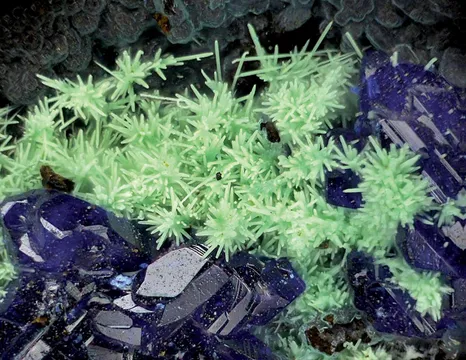
For collectors, the stope matters because that reaction sequence produced one of the great modern suites of American secondary phosphates: crystalline turquoise, fluorwavellite, fluorowardite, meurigite-Na, iangreyite, krásnoite, perhamite, plumbogummite-group species, kidwellite, lipscombite/zinclipscombite, variscite-strengite, and associated arsenates, vanadates, halides, and iron oxides. The best specimens are typically small, richly zoned, and best appreciated under magnification: blue monoclinic turquoise crystals perched with white sprays of fluorwavellite on baryte; cream laths and tufts of meurigite-Na; pearly tablets of iangreyite and related perhamite-group minerals; dark green to brown balls of zinclipscombite; yellow ferribushmakinite microcrystals; and, in the rarest case, deep crimson blades of crimsonite on plumbogummite-coated quartz.
Regional View
Country View
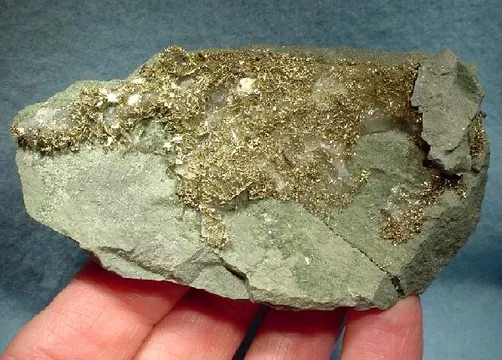
The locality’s specimens have an unmistakable “Silver Coin” look: pale, oxidized siliceous matrix with tiny seams, vugs, and crusts of secondary minerals whose colors are often concentrated in minute but sharply crystallized areas. Unlike many phosphate localities where alteration is dominated by massive coatings, Phosphate Stope specimens can carry several visually distinct mineral generations on a single small chip. That localized, shifting chemistry is part of the charm and part of the challenge: visual identification alone is frequently unsafe, and the locality has rewarded collectors who combine careful trimming, high magnification, and analytical confirmation.


Photo: Wikimedia Commons
Search for specimens: View all specimens from Phosphate Stope, USA
Phosphate Stope is a stope within the Silver Coin Mine, a small silver and base-metal deposit near Valmy, in the Iron Point Mining District of north-central Nevada. The district lies in the broader Basin and Range setting, and the mine is developed in Paleozoic sedimentary rocks cut by mineralized structures. Published locality descriptions place the Silver Coin mineralization in thin-bedded quartzite, argillite, and phosphatic argillite, with quartz and baryte veins carrying pyrite, argentiferous galena, and sphalerite. The crucial ingredient for the later collector minerals was the phosphatic character of the wall rock: once sulfides oxidized, acidic fluids could attack those beds and mobilize phosphate and aluminum into a set of fracture-controlled secondary assemblages.
The stope system at Silver Coin is usually discussed as several specimen-producing areas named for their dominant mineralogy: the Phosphate Stope, Copper Stope, Arsenate Stope or Arsenate Drift, and Silver Stope. The Phosphate Stope is the most celebrated of these because it concentrated a dense sequence of secondary phosphate deposition. One reported arsenate-to-phosphate transition in the stope runs through mawbyite, duftite, zincian olivenite or mimetite, then fluorapatite, fluorite, and finally wavellite/fluorwavellite. In the main part of the Phosphate Stope, a simplified sequence has been given as baryte, probable smithsonite later replaced by goethite, lipscombite and kidwellite, plumbogummite-group minerals, meurigite-Na, fluorapatite, fluorowardite, leucophosphite, turquoise, variscite-strengite, and wavellite/fluorwavellite. That order should not be imagined as a neat layer cake across the whole mine; the specimens themselves show that equilibrium changed repeatedly over very short distances.
The original ore history was modest. The Silver Coin group was described as a group of five unpatented claims, and the principal working was the Silver Coin shaft. Production is reported for 1918 to 1924, totaling 693.5 dry tons of ore containing 30,854 ounces of silver, with minor lead and a small gold content. The main shaft was inclined about 30 degrees to a depth of roughly 165 feet, with additional shallow shafts, open cuts, surface trenches, and later underground collecting areas. Other summaries of the Iron Point District note limited silver production before 1920 and modest workings through the district; the Silver Coin Mine’s fame among mineral collectors, however, came long after the economic mining.
By the late 1980s and 1990s, the mine had become a known field-collecting locality for microminerals, and specimens from the Phosphate Stope and related workings entered private collections, study suites, museum collections, and new-mineral research. A 2006 Friends of Mineralogy field note described collecting primarily inside the main adit, with pocket-bearing altered shale producing seams and cavities. Later research pushed the species count from roughly 90 reported minerals to more than 130 for the mine, with the vast majority attributed to the Phosphate Stope.
Access must be treated conservatively. Historical collecting accounts describe accessible underground workings, but the site is an abandoned mine with underground hazards, changing ownership or claim status, and potential private-property or mineral-rights issues. Collectors should not attempt a visit without current permission from the land and/or mineral-rights holders, current claim-status checks, and abandoned-mine safety precautions. From a specimen-market standpoint, most desirable Phosphate Stope pieces now come through micromount collections, older field-collected lots, study material associated with Paul Adams and other western U.S. micromounters, and occasional modern collections that have documented exact stope provenance.
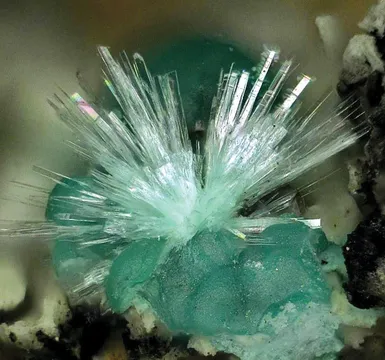
The signature mineral of the locality in the collecting sense is crystalline turquoise, CuAl6(PO4)4(OH)8·4H2O. Silver Coin turquoise is not the massive gem material that made other Nevada districts famous; it occurs as tiny blue to blue-green crystals and aggregates, commonly with fluorwavellite, baryte, quartz, and other late phosphates. Good pieces show isolated blue crystals or crusts under the microscope, sometimes with radiating white fluorwavellite sprays. This habit is one reason the mine became known among micromounters: it offers turquoise as a true crystal specimen rather than simply as lapidary rough.
Fluorwavellite, Al3(PO4)2(OH)2F·5H2O, is central to the Phosphate Stope story. Material from Silver Coin was used in the modern characterization of fluorwavellite as the fluorine analogue of wavellite, and an extensive EDS survey reported that wavellite-like specimens from the Silver Coin Mine correspond to fluorwavellite. In practical collecting terms, that means older labels reading “wavellite” from Silver Coin should be treated carefully; many, and perhaps essentially all analyzed wavellite-like Silver Coin specimens, are fluorwavellite. The mineral appears as white to clear or pale sprays, tufts, and radial aggregates, commonly on quartz, goethite, baryte, kidwellite, turquoise, variscite, and other phosphates.
Fluorowardite, NaAl3(PO4)2F2(OH)2(H2O)2, is one of the great Silver Coin species. It was described from the mine as the fluorine analogue of wardite and occurs as colorless, white, or cream-colored tetragonal-pyramidal crystals up to about 0.1 mm across. In the Phosphate Stope assemblage it belongs to the aluminum-, sodium-, and fluorine-rich part of the secondary phosphate system and is associated with minerals such as alunite, baryte, fluorapatite, goethite, kidwellite, iangreyite, krásnoite, leucophosphite, lipscombite/zinclipscombite, meurigite-Na, plumbogummite, turquoise, variscite, and quartz.
Meurigite-Na, NaFe3+8(PO4)6(OH)7·6.5H2O, has its type locality at the Silver Coin Mine and occurs as radial sprays of cream-colored flattened fibers or thin laths up to about 0.4 mm long. It is a late-stage mineral in the iron-rich phosphate sequence and is one of the species that made Silver Coin a research locality rather than merely a collecting stop. It is visually subtle, but for systematic collectors it is a key label name.
Iangreyite, Ca2Al7(PO4)2(PO3OH)2(OH,F)15·8H2O, was described from Silver Coin and the Krásno ore district in the Czech Republic. At Silver Coin it forms thin colorless to white or cream hexagonal tablets, reported up to about 0.4 mm in diameter and only about 0.02 mm thick. Its associations—meurigite-Na, plumbogummite, kidwellite, lipscombite, strengite, chalcosiderite, wardite, leucophosphite, wavellite/fluorwavellite, goethite, baryte, quartz, and F-rich perhamite—place it firmly in the late, hydrous, aluminum-rich phosphate assemblage. For the micromounter, iangreyite is a mineral of pearly tablets and delicate cleavage, not of hand-specimen drama.
Krásnoite, a fluorophosphate analogue related to perhamite, was described from both the Huber open pit in the Czech Republic and the Silver Coin Mine. At Silver Coin, crystals are reported larger than at Krásno in some material, with individual plates reaching about 0.4 mm. It belongs to the same family of late-stage hydrous aluminum phosphate alteration products that includes perhamite and iangreyite, and its recognition underscores the unusual fluorine-rich character of the Silver Coin secondary system.
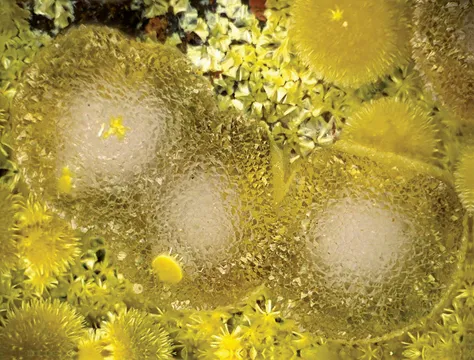
Ferribushmakinite, Pb2Fe3+(PO4)(VO4)(OH), is one of the locality’s most distinctive rarities. It was found in the Phosphate Stope as a low-temperature secondary mineral with plumbogummite, mottramite, bromine-rich chlorargyrite, and baryte on massive quartz. The crystals are yellow, slightly flattened prisms up to about 0.2 mm long, commonly forming X-shaped and sixling twins. Earlier material had been identified as heyite before detailed work showed it to be a new Fe3+ analogue of bushmakinite.
Crimsonite, PbFe3+2(PO4)2(OH)2, is the stope’s most evocatively named phosphate. It was collected from the ceiling of the Phosphate Stope on a single small specimen and described as the phosphate analogue of carminite. The crystals occur as subparallel aggregates of deep red blades or plates up to about 0.1 mm, on plumbogummite coating quartz, with fluorwavellite, goethite, hematite, hentschelite, and variscite in the associated assemblage. Its best description is microscopic but memorable: crimson-red, adamantine, and vanishingly scarce.
Zinclipscombite, ZnFe3+2(PO4)2(OH)2, is another key Silver Coin species. It occurs as dark green to brown coatings, balls, and fine crystal clusters and is closely tied to the lipscombite-rich portions of the assemblage. Later discussion of Silver Coin material noted that much of the dark lipscombite-like material from the Phosphate Stope and Arsenate Drift is zinc-rich enough to be considered zinclipscombite rather than true lipscombite, making analysis especially important for accurate labeling.
The plumbogummite group and related crandallite-type minerals provide much of the locality’s white, cream, yellowish, and earthy-to-pearly microtexture. Plumbogummite, crandallite, gorceixite, iangreyite, krásnoite, and perhamite are repeatedly cited from the Phosphate Stope paragenesis. These are not minerals to buy by color alone. Several can look like pale crusts, rosettes, compact balls, or fine tabular aggregates, and species boundaries may depend on chemistry that is invisible in the hand.
Other important Phosphate Stope minerals include kidwellite, leucophosphite, variscite, strengite, fluorapatite, baryte, goethite, hematite, hentschelite, mottramite, chlorargyrite including bromine-rich varieties, malachite, aurichalcite, mawbyite, duftite, mimetite or zincian olivenite, fluorite, and quartz. The locality rewards assemblage collecting: a modest-looking chip can carry an ordered record of sulfide oxidation, phosphate liberation, halogen enrichment, and repeated micro-environmental shifts in pH, redox state, and available cations.
Phosphate Stope specimens are primarily micromount and analytical specimens. Their value rests less on size than on exact provenance, association, confirmation, and preservation of delicate microcrystals. A rich thumbnail with verified fluorowardite, iangreyite, ferribushmakinite, or crystalline turquoise can be far more desirable to a specialist than a larger but poorly documented piece of oxidized matrix.
Label discipline is critical. The most common locality issue is not deliberate fakery but overconfident visual naming. Older “wavellite” labels from Silver Coin may represent fluorwavellite. Dark green “lipscombite” may prove zinc-rich enough to be zinclipscombite. Pale plumbogummite-group or perhamite-related crusts can be impossible to separate visually from iangreyite, krásnoite, crandallite, gorceixite, or perhamite without analytical work. Likewise, yellow lead-vanadate/phosphate micros require caution because ferribushmakinite was once mistaken for heyite. For important purchases, look for XRD, Raman, EMPA/EDS notes, or a chain of custody to well-known Silver Coin researchers or micromount collections.
Condition issues are typical of hydrous secondary phosphate microminerals. Thin tablets, sprays, and fibrous laths are easily bruised by trimming, air abrasion, ultrasonic cleaning, or careless cotton wrapping. Many specimens are best left on their original matrix and mounted in small boxes with a fixed orientation. Water, acids, and aggressive solvents should be avoided. Even when a mineral is chemically stable, the assemblage may include soft, porous, or brittle crusts that are mechanically vulnerable.
Fluorescence is not the locality’s main selling point. Several described rare species from the Silver Coin suite, including iangreyite, ferribushmakinite, krásnoite, and crimsonite, have been reported as non-fluorescent under longwave and shortwave ultraviolet light. Collectors should not use lack of fluorescence as a negative diagnostic. Color, habit, association, and above all analytical confirmation are more meaningful.
No well-documented, locality-specific epidemic of fake Phosphate Stope specimens has surfaced in the literature I reviewed. The more serious risk is mislabeling: Silver Coin Mine material attributed too broadly without the stope named, Phosphate Stope specimens sold as generic “Nevada turquoise,” or visually assigned rare species that are actually more common associated phosphates. Because the stope has produced a long list of visually similar, late-stage hydrous phosphates, the safest market language is precise but modest: “fluorwavellite, visually identified,” “plumbogummite-group mineral,” “zinclipscombite, analyzed,” or “ex Paul Adams material,” rather than a cascade of unverified rare names.
Market availability is intermittent. Commoner Silver Coin pieces with turquoise, fluorwavellite, variscite, kidwellite, baryte, or green lipscombite/zinclipscombite-like material appear from time to time in micromount dealer stocks and older collection dispersals. Verified type-locality or co-type species—especially fluorowardite, iangreyite, krásnoite, meurigite-Na, ferribushmakinite, and crimsonite—are much scarcer, and crimsonite should be regarded as a research-level rarity rather than a routinely obtainable collector species.
The Silver Coin Mine’s modern story has the flavor of a locality discovered twice. The first discovery was economic: a small silver mine in the desert hills near Valmy, worked in the early 20th century, producing ore rich enough to average more than 44 ounces of silver per ton during its principal production period. The second discovery was mineralogical, and it belonged to micromounters. Long after the last meaningful silver shipments, collectors learned that the mine’s altered phosphatic shale and quartz veins held a far more intricate treasure than the old ore books suggested.
A 2006 field account by Wes and Deb Gannaway captures the practical collecting scene before the locality became fully enshrined in new-mineral literature. They described basing out of Winnemucca and visiting the Silver Coin as an “old favorite,” about one mile north of Interstate 80 at the Iron Point interchange. The main adit was apparently conspicuous—“almost large enough to drive a truck into”—and the productive collecting began about 30 feet inside, on a low shelf to the right. Their method was direct and old-fashioned: break out larger chunks, carry them into the open, and reduce them until seams and pockets appeared. They also mentioned a pile of rocks just left of the adit as a source of pocket-bearing material. To anyone who has trimmed Nevada micromount material on a tailgate, the description is instantly recognizable: the specimen is not found as a display piece, but liberated chip by chip from altered shale.
The 1991 ferribushmakinite story shows how long Silver Coin specimens could wait before revealing their identity. Richard W. Thomssen of Carson City collected yellow crystals in May of that year. They were attractive enough to notice, twinned enough to be memorable, and were initially identified by powder X-ray diffraction as heyite. Only later, after more detailed examination including crystal-structure determination and electron-microprobe analysis, did the crystals prove to be a new mineral species: ferribushmakinite. The description is one of those satisfying micromineral reversals where an already interesting specimen becomes scientifically new because someone returns to it with better questions and better instruments. The crystals were not large—only about 0.2 mm—but their X and sixling twins made them visually distinctive under the microscope.
Crimsonite is an even more concentrated episode. It was found on a single small specimen from the ceiling of the Phosphate Stope. The crystals were deep red blades or plates, no more than about 0.1 mm, growing on plumbogummite that coated quartz. In a locality dominated by whites, creams, greens, blues, and earthy iron colors, a crimson lead iron phosphate must have stood out like a tiny signal flare. Its name deliberately echoes carminite, because crimsonite is the phosphate analogue of that red arsenate. For collectors, the important point is the intimacy of the occurrence: one little ceiling specimen, one small patch of red blades, and a new species hidden in a stope already famous for rare phosphates.
The most revealing story, however, is not a single pocket but the repeated widening of the mine’s species list. Early collecting accounts spoke of roughly 90 species. Later summaries pushed the number above 130, with the Phosphate Stope carrying most of that diversity. That increase did not come from spectacular new caverns lined with large crystals; it came from examining tiny crusts, questionable “wavellite,” pale tablets, green balls, and yellow specks closely enough to show that Silver Coin was a geochemical laboratory. The best specimens are therefore not simply pretty micros. They are records of a small Nevada silver mine where sulfides, phosphatic argillite, fluorine, lead, zinc, copper, iron, vanadium, arsenic, and acidic vadose water combined to produce a mineral suite far larger than the mine itself.
Adams, P. M. (2015). “Phosphate Mineral Paragenesis at the Silver Coin Mine, Humboldt County, Nevada.” 42nd Rochester Mineralogical Symposium Program Notes. — Concise paragenetic summary of the Silver Coin stopes, including the Phosphate Stope sequence and the list of type or co-type species then recognized.
Thomssen, R. and Wise, W. S. (2004). “Species list: Silver Coin mine, Iron Point district, Edna Mountains, Humboldt Co., Nevada, USA.” International Micromounters Journal, 13, 7–8. — Early published species list repeatedly cited by later Silver Coin new-mineral papers.
Kampf, A. R., Adams, P. M., Kolitsch, U., and Steele, I. M. (2009). “Meurigite-Na, a new species, and the relationship between phosphofibrite and meurigite.” American Mineralogist, 94, 720–727. — Type description of meurigite-Na from the Silver Coin Mine, including its late-stage paragenesis.
Mills, S. J., Kampf, A. R., Sejkora, J., Adams, P. M., Birch, W. D., and Plášil, J. (2011). “Iangreyite: a new secondary phosphate mineral closely related to perhamite.” Mineralogical Magazine, 75, 327–336. — Co-type description of iangreyite from Silver Coin and Krásno, with Silver Coin crystal habit and associations.
Mills, S. J., Sejkora, J., Kampf, A. R., Grey, I. E., Bastow, T. J., Ball, N. A., Adams, P. M., Raudsepp, M., and Cooper, M. A. (2012). “Krásnoite, the fluorophosphate analogue of perhamite, from the Huber open pit, Czech Republic and the Silver Coin mine, Nevada, USA.” Mineralogical Magazine, 76, 625–634. — Description of krásnoite from the Czech Republic and Silver Coin, important for the fluorine-rich perhamite-related assemblage.
Kampf, A. R., Adams, P. M., Housley, R. M., and Rossman, G. R. (2014). “Fluorowardite, NaAl3(PO4)2(OH)2F2·2H2O, the fluorine analog of wardite from the Silver Coin mine, Valmy, Nevada.” American Mineralogist, 99, 804–810. — Type description of fluorowardite, one of the hallmark fluorine-rich phosphates from Silver Coin.
Kampf, A. R., Adams, P. M., Nash, B. P., and Marty, J. (2015). “Ferribushmakinite, Pb2Fe3+(PO4)(VO4)(OH), the Fe3+ analogue of bushmakinite from the Silver Coin mine, Valmy, Nevada.” Mineralogical Magazine, 79, 661–669. — Type description documenting ferribushmakinite from the Phosphate Stope, including its earlier misidentification as heyite.
Kampf, A. R., Adams, P. M., Mills, S. J., and Nash, B. P. (2016). “Crimsonite, PbFe3+2(PO4)2(OH)2, the phosphate analogue of carminite from the Silver Coin mine, Valmy, Nevada, USA.” Mineralogical Magazine, 80, 925–935. — Type description of crimsonite, collected from the ceiling of the Phosphate Stope.
Kampf, A. R., Adams, P. M., Barwood, H., and Nash, B. P. (2017). “Fluorwavellite, Al3(PO4)2(OH)2F·5H2O, the fluorine analog of wavellite.” American Mineralogist, 102, 909–915. — Modern characterization of fluorwavellite using Silver Coin and Wood Mine material, with direct relevance to older “wavellite” labels from Silver Coin.
Chukanov, N. V., Pekov, I. V., Möckel, S., Zadov, A. E., and Dubinchuk, V. T. (2006). “Zinclipscombite Zn(Fe3+)2(PO4)2(OH)2 – a new mineral.” Proceedings of the Russian Mineralogical Society, 135(6), 13–18. — Type description of zinclipscombite from the Silver Coin Mine, cited in later Silver Coin work.
Mindat: Silver Coin Mine, Valmy, Iron Point Mining District, Humboldt County, Nevada, USA — The main locality page for the mine, with geology, production history, species list, photos, and references.
Mindat: Turquoise from Phosphate Stope, Silver Coin Mine — Occurrence page documenting turquoise specifically from the Phosphate Stope, including associated fluorwavellite, quartz, and baryte in photo data.
Mindat: Fluorwavellite gallery and locality notes — Useful for recognizing the Silver Coin fluorwavellite habit and for the note that analyzed Silver Coin wavellites correspond to fluorwavellite.
Friends of Mineralogy Newsletter, Summer 2006: “Collecting the Silver Coin Mine” — Field-collecting account with practical observations on the adit, pocket-bearing altered shale, and common-to-rare Silver Coin species.
USGS Scientific Investigations Report 2004-5236: Iron Point District section — Regional mining and environmental summary for the Iron Point District, including Silver Coin production context and commodities.
Western Mining History: Silver Coin Mine — MRDS-derived mine summary with location, elevation, commodities, and land-status caution.
Nevada Bureau of Mines and Geology / Nevada State Publications: The Nevada Mineral Industry 1986 — Documents 1980s Silver Coin Mining Co. heap-leach listing and lessee information.
CaltechAUTHORS: Fluorowardite article record — Accessible abstract and bibliographic record for the fluorowardite type description.
RRUFF: Crimsonite type-description PDF — Full PDF of the crimsonite description, one of the most important Phosphate Stope papers.
RRUFF: Fluorwavellite type-characterization PDF — Full PDF documenting fluorwavellite and its Silver Coin occurrence.