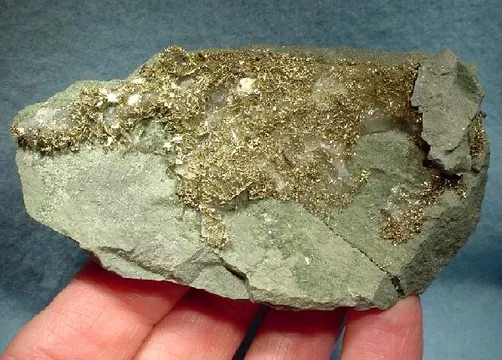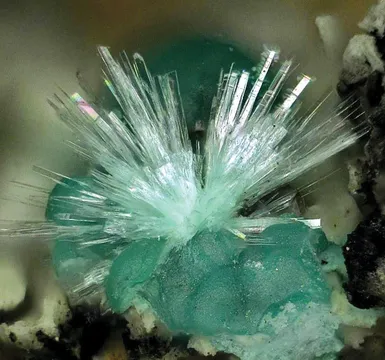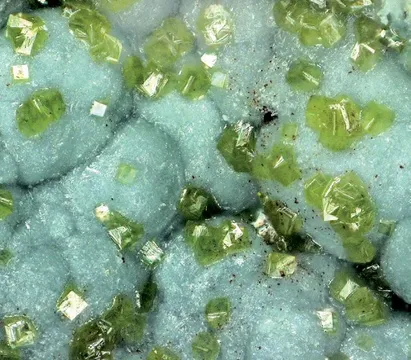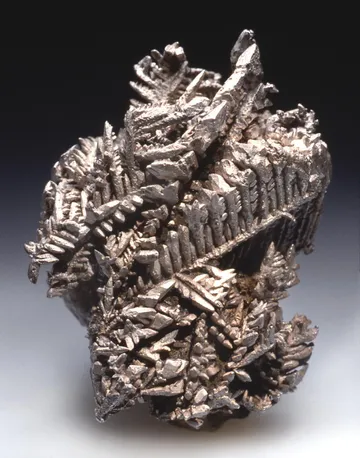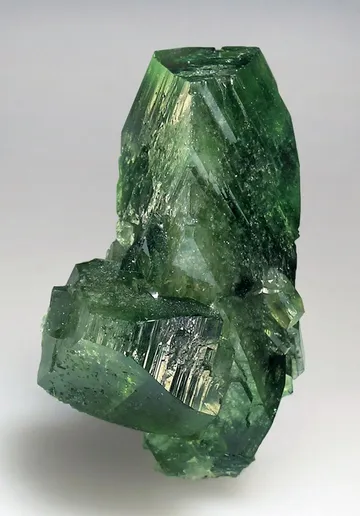
Mount Diablo pit, USA - Nevada oxidized silver deposit in the Candelaria district, prized for vivid micromounts of azurite, olivenite, and malachite.
Key facts
Mount Diablo pit is the specimen face of the Candelaria silver camp’s modern open-pit era: a Nevada oxidized silver deposit where nineteenth-century underground workings, early heap-leach mining, and a surprisingly delicate micro-mineral suite intersect in the same scar on the north side of the Candelaria Hills. The pit is part of the Candelaria Silver Mine in the Candelaria Mining District of Mineral County, western Nevada, a dry Great Basin locality whose best collector specimens come not as big cabinet showpieces but as intensely colored, millimeter-scale secondary copper and arsenate minerals on fractured, altered ore-zone rock.
Geologically, the importance of Mount Diablo lies in the Lower Candelaria Shear, the principal mineralized structure in the district and the best-developed ore host in the Mount Diablo area. The broader deposit is an epigenetic silver system localized in faulted and sheared zones related to regional thrusting, with quartz stockwork, sericite alteration, dolomitization, iron and manganese oxides, and oxidized lead-zinc-copper-silver minerals replacing and coating fractured sedimentary and intrusive host rocks. In collector terms, that means the familiar bright blue azurite and green malachite here are not isolated copper-mine curiosities; they are late oxidation products in a polymetallic silver camp whose primary and relict mineralogy includes pyrite, galena, sphalerite, acanthite/argentite, jamesonite, chalcopyrite, arsenopyrite, and silver chlorides.
The best Mount Diablo pit specimens are crisp micromounts and small miniatures: rich blue azurite, apple- to olive-green olivenite, and bright green conichalcite and malachite perched on pale, bleached, iron-stained, or manganese-stained matrix. Their appeal is in contrast and locality specificity. A fine piece should show sharp color separation, sparkling crystal or botryoidal texture, and enough matrix to make the Candelaria origin intelligible rather than merely decorative.
Regional View
Country View
Historically, the pit also matters because it cut through ground once worked from the old Mount Diablo Mine and associated workings. The nineteenth-century mine was one of the camp’s major producers, while the open-pit operation of the late twentieth century transformed the district from a hard-rock silver camp of narrow oxidized lodes into a bulk-tonnage, heap-leach silver operation. Collectors should understand Mount Diablo pit specimens as products of that transition: most of the attractive secondaries were rescued from benches and oxidized zones exposed by mining, not from a long-established public collecting ground.
Search for specimens: View all specimens from Mount Diablo pit, USA
Mount Diablo pit is a sublocality of the Candelaria Silver Mine, in the Candelaria Mining District, Mineral County, Nevada. The locality is recorded at about 38° 9' 23" N, 118° 5' 1" W, and lies in the Candelaria Hills, a sparsely vegetated, arid to semi-arid part of the Great Basin. The mine area sits roughly around the 6,000-foot elevation range, with a paved access road leaving U.S. Highway 95 south of Mina and running toward the Candelaria mine site. That road access should not be mistaken for collecting access: the mine property has been under corporate ownership, reclamation, and renewed exploration review, and casual collecting in the pit should be treated as closed unless explicit permission has been obtained.
The deposit is best described as a structurally controlled, epigenetic silver-base metal system with strong oxidation. In the Mount Diablo area, mineralization is principally developed in the Lower Candelaria Shear rather than the Pickhandle Gulch Thrust, which is more important at Northern Belle and Lucky Hill. The Lower Candelaria Shear is a north-dipping, bedding-parallel deformation zone in the lower part of Member 1 of the Candelaria Formation. In the Mount Diablo pit area it was reported to reach more than 100 feet in thickness, with mineralization closely tied to the limits of shearing. Host rocks and associated intrusives were sericitized, silicified by irregular milky quartz veins and stockwork, and locally dolomitized.
The ore geology explains the specimen assemblage. In the oxidized upper part of the shear, fractured and brecciated sediments were coated and impregnated with hematite, goethite, limonite, jarosite, and lesser manganese oxides, accompanied by secondary lead, zinc, copper, silver, and arsenate minerals. Silver occurred chiefly as native silver and chlorargyrite/cerargyrite in microscopic grains; the commercial ore was not visually spectacular in the way of classic native silver wires, but it was chemically rich and produced a broad oxidation suite. Beneath the oxide zone, the shear contained pyritic quartz stockworks in dark carbonaceous siltstone, with disseminated and massive-lens sulfides and sulfosalts including pyrite, sphalerite, galena, jamesonite, chalcopyrite, arsenopyrite, and acanthite/argentite.
The older mining history begins with the Candelaria district’s silver discoveries in the 1860s, followed by substantial development in the 1870s and 1880s. The Mount Diablo Mine, southeast of the Northern Belle ground, produced almost continuously underground from 1873 to 1892, with peak production in the 1880s. As the shallow bonanza oxidized lodes were depleted and mining reached more refractory sulfide mineralization, the camp declined sharply in the early 1890s, compounded by weak silver prices.
The modern pit belongs to the district’s large-tonnage, low-grade era. Exploration interest resumed in the mid twentieth century, and in 1976 Congdon and Carey entered a partnership with Occidental Minerals, with Oxymin as operator, to evaluate shallow low-grade deposits at Lucky Hill and Mount Diablo for cyanide heap leaching. Plant construction began in 1979, the first doré bullion was poured in 1980, and the operation was regarded as one of the largest U.S. silver mines of its time. Oxymin suspended mining in 1982 during depressed silver prices. NERCO Minerals acquired the majority interest and restarted mining in early 1983, working additional reserves at Mount Diablo and Lucky Hill and later at Northern Belle. By 1987, NERCO was mining from Mount Diablo and Northern Belle at a rate reported as 5.5 million tons of ore per year. Mount Diablo production continued until 1990, when low silver prices again forced suspension.
Kinross later acquired the property through corporate succession and resumed mining in January 1994, mainly at Northern Belle but also with lesser production from Mount Diablo and smaller pits. Mining ceased at the end of April 1997, stockpiled ore was hauled to the leach pads in May, and processing of leach solutions continued into early 1999. Kinross reclamation and closure work followed; later technical reports describe recontoured and seeded waste dumps, haul roads, and leach pads, with mine and mill buildings removed. Silver Standard subsequently held the property, and Silver One Resources has since reported mineral-resource and metallurgical work on the Candelaria project, including the Mount Diablo and Northern Belle resource areas.
Specimen-wise, the most useful documented Mount Diablo find information points to material collected on the 5810-foot bench around 1990, notably by Kelly Starnes. These pieces include olivenite and mixed malachite-olivenite-azurite micromount material photographed at millimeter fields of view. That bench provenance is valuable on labels because it ties the specimens to a precise horizon within the open-pit exposure, rather than vaguely to “Candelaria” or “Mount Diablo.” The pit’s collectible suite is therefore strongly a micro-collector’s suite: azurite, malachite, olivenite, conichalcite, pharmacosiderite, segnitite, variscite, hemimorphite, smithsonite, cerussite, chlorargyrite, and related oxide-zone species on altered silver-base metal ore.
Azurite from Mount Diablo pit is best appreciated as a vivid secondary copper carbonate from the oxidized silver-base metal shear, commonly associated with malachite and, on documented micromount material, olivenite. The most persuasive pieces show saturated royal- to midnight-blue crystals, druses, or crusts set against pale altered matrix or green malachite/arsenate accents; ordinary pieces tend to be merely blue stains or incomplete patches on iron-stained rock. Published and online specimen documentation points to millimeter-scale fields of view, especially material from the 5810-foot bench collected around 1990, so “large” Mount Diablo azurite should be judged relative to a micromount locality rather than to Arizona or Tsumeb cabinet standards.
Olivenite is one of the signature collector minerals of Mount Diablo pit because it records the arsenic-bearing side of the oxidized copper assemblage. Documented specimens from the 5810-foot bench show olivenite in millimeter-scale fields of view, including pieces with malachite and azurite; colors range through olive, yellow-green, and darker green, with the best material presenting as distinct crystal aggregates or sharp granular to acicular patches rather than anonymous green coating. Good Mount Diablo olivenite is therefore a locality-sensitive micromount: the value is in clean crystal texture, contrast with blue azurite or green malachite, and a precise Mount Diablo pit label, especially one preserving the bench and 1990 collecting context.
Conichalcite from Mount Diablo pit is part of the same oxidized copper-arsenate environment that produced olivenite, but it is generally a subtler collector species here: expect green crusts, drusy coatings, or fine-grained aggregates rather than dramatic large crystals. Its significance lies in the calcium-copper-arsenate chemistry of the altered, carbonate-bearing, iron- and manganese-oxide-rich silver ore zone, where groundwater oxidation of copper and arsenic-bearing primary minerals generated a secondary suite on fractures and cavities. The best Mount Diablo conichalcite pieces are those with bright, fresh green color, identifiable texture under magnification, and convincing association with the pit’s azurite-malachite-olivenite assemblage; dull green films without analysis or strong provenance are easy to overinterpret.
Other minerals documented from Mount Diablo pit include acanthite, annabergite, aragonite, calcite, cerussite, chalcophanite, chlorargyrite, galena, greenockite, hemimorphite, malachite, muscovite, pharmacosiderite, pyrite, quartz, segnitite, siderite, smithsonite, sphalerite, tremolite, variscite, and wulfenite. The broader Candelaria district is considerably richer, with about 80 documented valid species and the type-locality phosphate whiteite-(CaMgMg) recorded from the Northern Belle/Argentum area rather than from Mount Diablo pit itself. For Mount Diablo labels, the rarities most worth preserving and verifying are the arsenates and phosphates—especially pharmacosiderite, segnitite, variscite, olivenite, and conichalcite—because visually similar green or brown coatings can easily be confused without analytical support.
Mount Diablo pit is not a locality with a well-known tradition of fabricated or treated specimens, but it is a locality where mislabelling is a real risk. “Mount Diablo” may be confused with the Mount Diablo mercury mine in Contra Costa County, California, and older labels may blur the distinction between the historic Mount Diablo Mine, the later Mount Diablo open pit, the Candelaria Silver Mine, and the nearby Northern Belle pit. A strong label should read, at minimum, “Mount Diablo pit, Candelaria Silver Mine, Candelaria Mining District, Mineral County, Nevada, USA.” If it records the 5810-foot bench or a collector such as Kelly Starnes, preserve that information.
Condition is usually a bigger concern than deception. Many of the attractive species are thin fracture coatings, tiny sprays, or druses on friable altered matrix. Azurite and malachite can be rubbed, bruised, or dulled by handling; olivenite and conichalcite are commonly best under magnification and may lose much of their appeal if dusty or over-cleaned. Avoid acids and aggressive cleaning, especially on mixed carbonate-arsenate specimens. A soft air bulb, very gentle brushing, and a covered micromount box are safer than washing.
Because the locality includes arsenate minerals such as olivenite, conichalcite, pharmacosiderite, annabergite, and segnitite, collectors should treat loose dust with respect. Normal cabinet display is not a problem, but avoid grinding, trimming without dust control, licking, or prolonged skin contact with powdered material. Wash hands after handling, keep fragments away from children and pets, and store micro specimens so that loose grains cannot circulate through drawers.
Market availability is modest. Mount Diablo pit azurite and olivenite appear occasionally, especially as micromounts and small specimens from older 1990s collecting, while conichalcite and rarer arsenates or phosphates are scarcer and often need analytical confidence. The best pieces are not necessarily the largest; they are the ones with sharp color, intact microcrystals, multiple diagnostic species in association, and a label specific enough to distinguish Mount Diablo pit from the broader Candelaria district.
Candelaria was a town made by silver and starved by water. The veins cropped out in barren country, while the earliest practical water was miles away near Columbus Salt Marsh. Before pipelines and rail connections softened the hardship, everything needed for mining and living had to be hauled across desert. The price of water became part of the camp’s identity: historical-marker accounts record water falling from $1.00 to $0.05 per gallon after water was piped from Pinchower Creek and Trail Canyon. Western Mining History gives an earlier boom-camp detail that feels even more immediate: alkali-laden water hauled from Columbus cost 4.5 cents a gallon, while a bath cost two dollars.
The town’s newspaper had one of the best names in Nevada mining journalism: the Candelaria True Fissure. It first appeared on June 5, 1880, and the name was more than a pun. To a silver camp hoping to rival the Comstock, a “true fissure vein” meant persistence at depth, not a surface pocket soon to be exhausted. The name was a boast, a geological argument, and a business prospectus folded into one masthead.
The Mount Diablo Mine entered its dividend years just as litigation shook the neighboring Northern Belle. In 1883, the Holmes Mining Company sued the Northern Belle for trespass and won $360,000 in damages. The following year, the Northern Belle properties and Belleville reduction mills were sold by the U.S. marshal and absorbed into the Holmes operation, later known as the Argentum. Around the same time, Mount Diablo became a heavy producer and began paying dividends of its own. The numbers from 1883 are striking: total costs for mining, milling, transport, overhead, taxes, and other expenses were reported at $44 per ton, yet the ore yielded $56 per ton in bullion. As mined, it must have carried at least about $65 per ton, roughly 60 ounces of silver per ton. In the Callison stope, ore stretched 100 to 140 feet along strike, was worked 110 feet down dip, and reached 12 feet wide in $200 ore.
The camp could be brutal. In October 1879, a Wells, Fargo & Co. stage left Candelaria at 3:30 in the morning and was stopped about a quarter mile from town by two men stepping out of the sagebrush. They ordered the driver to throw out the Wells Fargo box and made off with several thousand dollars in bullion. A sheriff’s posse went into the desert after them. Only a month later, on a pay day in the mines, two rival saloon keepers and faro-bank owners quarreled badly enough that one man was knocked senseless and a pistol shot followed in the street.
The old newspaper clippings are full of the camp’s uneasy mix of prosperity and danger. On March 18, 1884, Johnny Evans, employed at the Mount Diablo Mine and formerly foreman of the Northern Belle, was killed by a blast at 11 o’clock at night. In August 1890, seventeen-year-old Charles Barlow died at the Candelaria Water and Milling Company’s mill after falling about twenty feet near a belt and pulley while the battery was being restarted. Such details are grim, but they matter: the specimens now sitting under glass came from a district built by men working narrow oxidized lodes, dry mills, tramways, stamps, and later open-pit benches under conditions that were never romantic at the time.
One of the best camp stories belongs to A. J. Holmes and the rival mill town of Belleville. According to a reminiscence by S. T. Kelso, Holmes was prospecting the Northern Belle when his supplies ran low. Short of cash, he asked a Columbus storekeeper for credit and was refused. Forced to make a long supply trip with his burros to Wadsworth, he swore he would someday cause “the grass to grow in the streets” of Columbus. When the Northern Belle became rich, Holmes chose a new mill site at Belleville, developed water by tunnel and pipeline, and built mills there rather than feeding Columbus. Kelso noted dryly that Holmes could not literally make grass grow in Columbus’s borax-laden streets, but he did live to see the town dwindle into a white spot on the desert.
The late twentieth century added a different kind of drama: old stopes and nineteenth-century ground were swallowed into a modern open-pit operation. Mount Diablo pit mining excavated underground workings of the old Mount Diablo and associated mines, turning a camp of shafts, stopes, and narrow high-grade lodes into benches, haul roads, crushers, and heap-leach pads. For collectors, that is the hidden reason Mount Diablo pit specimens are so tightly tied to benches and rescue collecting. The pit made the oxidized mineral zones visible, but only temporarily; once mining stopped and reclamation advanced, those collecting windows effectively closed.
Ben M. Page (1959), Geology of the Candelaria mining district, Mineral County, Nevada, Nevada Bureau of Mines and Geology Bulletin 56 — The classic district-scale geological treatment, with history, production, formations, structure, ore deposits, photographs, and a color geologic map.
Adolph Knopf (1923), The Candelaria silver district, Nevada, U.S. Geological Survey Bulletin 735-A — Early federal account of the camp, including the Mount Diablo Mine, bonanza oxidized ore, production, and the structure of the old silver district.
Paul M. Adams (2019), “The Candelaria district, Mineral County, Nevada,” The Mineralogical Record, 50(2), 125–161 — The key modern collector-oriented article on Candelaria mineralogy, including updated district species records and rare phosphate/arsenate occurrences.
Stephen B. Castor and Gregory C. Ferdock (2004), Minerals of Nevada, Nevada Bureau of Mines and Geology Special Publication 31 — The standard statewide mineralogical catalog cited for many Candelaria district species.
James A. McCrea (2020), Technical Report on the Heap Leach Pads within the Candelaria Property, Mineral and Esmeralda Counties, Nevada, prepared for Silver One Resources Inc. — Useful for modern mine history, access setting, reclamation status, geology, oxidation, and resource context.
Pincock, Allen & Holt / Mark G. Stevens (2001), Candelaria Project, technical report — Important historical technical report for Mount Diablo and Northern Belle resources, drilling, soluble silver methodology, and post-open-pit resource estimates.
Mindat reference record: Paul M. Adams (2019), “The Candelaria district, Mineral County, Nevada” — Useful cross-reference for mineral occurrences tied to the Adams article.
Mindat occurrence record: Azurite from Mount Diablo pit — Documents azurite from the pit and its common photo associations with malachite and olivenite.
Mindat occurrence record: Olivenite from Mount Diablo pit — Documents Mount Diablo olivenite, including association with azurite and malachite and Kelly Starnes material.
Mindat occurrence record: Conichalcite from Mount Diablo pit — Documents conichalcite as a believed-valid Mount Diablo pit species tied to the Adams Candelaria article.
Mindat: Mount Diablo pit, Candelaria Silver Mine, Mineral County, Nevada — Core locality page for coordinates, hierarchy, and the documented Mount Diablo pit mineral list.
Mindat: Candelaria Silver Mine — Broader mine page with history, geology, operators, and district-level mineral context.
Mindat: Candelaria Mining District — Best single online overview of the district’s broader mineral diversity, including nearby sublocalities and the district type-locality record.
Silver One Resources: Candelaria Project — Current corporate project page for ownership, technical reports, resources, and modern exploration status.
Silver One Resources: Candelaria Resources — Resource and technical-details page for Mount Diablo and Northern Belle drilling and estimates.
Nevada Bureau of Mines and Geology: Page, 1959, Bulletin 56 — Source page for the classic Candelaria district geology bulletin.
USGS Bulletin 735-A: Knopf, The Candelaria silver district, Nevada — Historic geological and mining account, especially valuable for the nineteenth-century Mount Diablo Mine.
Western Mining History: Candelaria, Nevada — Readable mining-camp history with production figures, town photographs, and Candelaria boom-period context.
Western Mining History: Candelaria Mine — Mine database entry tying the Candelaria Mine to its modern open-pit identity and Mount Diablo pit.
Western Mining History: Mount Diablo Mine — Historic mine entry for the Mount Diablo silver mine that preceded the open-pit exposure.
Nevada State Historic Preservation Office: Candelaria and Metallic City — Concise state historical-marker summary of Candelaria, Metallic City, water costs, and early mining history.
Forgotten Nevada: Candelaria — Long-form ghost-town history with transcribed period accounts, including Mount Diablo Mine episodes and camp-life details.
Mineralogical Record Vol. 50, No. 2, 2019 — Back-issue page for Paul M. Adams’s collector article on the Candelaria district.