Northern Belle pit, USA - Nevada’s micromineralogical locality at Candelaria, yielding colorful phosphates, cacoxenite and turquoise; prized for micromounts.
Key facts
Northern Belle pit is the modern open-pit expression of one of Nevada’s great old silver lodes: the Northern Belle–Argentum workings at Candelaria, in the Candelaria Hills of Mineral County. To ore geologists it is a structurally controlled silver-gold system in the lower Candelaria Formation and associated altered rocks of the Pickhandle Gulch complex, where vein, veinlet, stockwork, shear-zone and manto-style mineralization were repeatedly fractured, altered, oxidized and mined. To specimen collectors, however, its special appeal is much narrower and more unusual: a suite of tiny, brilliantly colored secondary phosphates developed in iron-stained seams, gossanous cavities and altered shale/quartz matrices around an old silver camp better known historically for bullion than for display minerals.
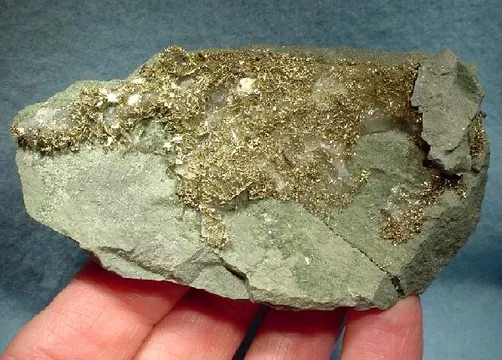
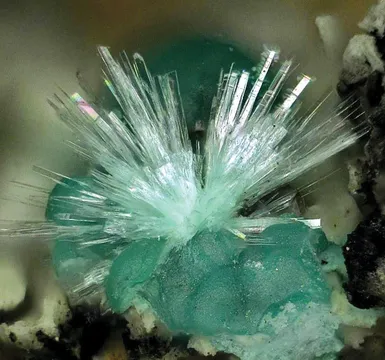
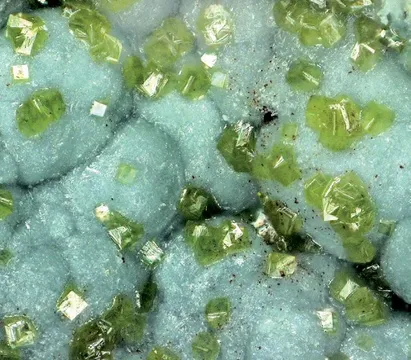
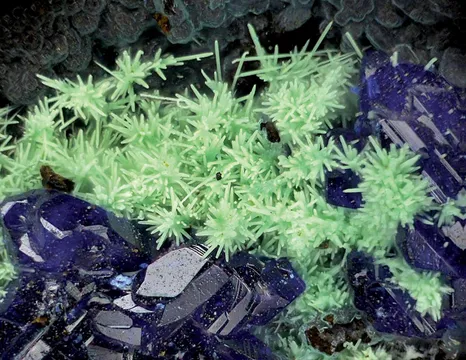
The locality’s specimen character is emphatically micromineralogical. The best Northern Belle pieces are not large cabinet-show stunners; they are close-range treasures—golden sprays of cacoxenite on rusty gossan, colorless to pale phosphates tucked into seams, pale green variscite, blue-green turquoise, libethenite, wavellite, fluorapatite, fluorwavellite, collinsite, gordonite, overite, montgomeryite and the type-species whiteite-(CaMgMg). The color palette is that of an oxidized western silver mine crossed with a phosphate occurrence: ocher, brown and black iron-manganese staining offset by vivid green copper phosphates and delicate, glassy to silky microcrystals.
Regional View
Country View
Historically, Northern Belle sits at the hinge between two very different collecting stories. The first is the bonanza story: high-grade oxidized silver ores discovered in the 1860s, developed into one of Nevada’s leading silver mines in the 1870s and 1880s, then folded into the Argentum property after a famous legal fight with the Holmes Mining Company. The second is the modern collector story: late-20th- and early-21st-century micromount collecting and analytical work that showed the pit and related Northern Belle mine area to be an unexpectedly rich secondary phosphate locality, important enough to yield a new jahnsite-group mineral, whiteite-(CaMgMg).
The deposit is also geologically instructive because the old silver ore and the later collector phosphates reflect different chapters in the same fractured rock volume. The productive silver veins followed faults and shears; the oxidized zone was deep, irregular and iron-stained; phosphate-bearing seams appear to have drawn phosphorus from sedimentary phosphate nodules in the lower Candelaria Formation. In hand specimen this means a good Northern Belle label should lead you to look for texture first: brecciated quartz and altered shale, brown jarosite-limonite coatings, tiny cavities, and millimeter-scale sprays or druses that reward a microscope far more than a loupe.
Search for specimens: View all specimens from Northern Belle pit, USA
Northern Belle pit is part of the Candelaria Silver Mine in the Candelaria Mining District, Mineral County, Nevada, about 15 miles south of Mina and just off the U.S. Highway 95 corridor. The pit consumed portions of the historic Northern Belle and other old workings, and the name “Argentum” is historically tied to the same mine complex. In older literature the Candelaria camp was also associated with the Columbus district name, reflecting the early settlement and water source at Columbus, several miles away on the margin of the salt marsh.
The ore deposit is best understood as a structurally controlled silver-gold-base-metal system rather than a single clean fissure vein. The classic district studies describe silver-bearing veins, veinlets, lenses and shoots occupying mineralized faults and shears. A particularly favorable horizon lies just above the Diablo grit bed, in the lower part of the Candelaria Formation, although Northern Belle also includes veins that depart from that simple stratigraphic control. Regionally the system is tied to repeated deformation in the Walker Lane–Basin and Range structural setting, with the Golconda and Pickhandle Gulch thrust architecture, the Lower Candelaria shear, later faults, altered mafic-ultramafic rocks, shale, chert, dolomite, felsic dikes and hydrothermal alteration all contributing to ore control.
The Candelaria Formation is crucial for collectors because its lower shale beds are not merely ore hosts; they also contain phosphatic material. Page’s district work records ellipsoidal phosphatic nodules up to about three-quarters of an inch long in the lower Candelaria Formation near turquoise and variscite veinlets. That observation helps explain why an old silver mine later became a secondary phosphate locality. Fluids moving through fractured, oxidized, iron-rich rock could mobilize phosphate, aluminum, calcium, magnesium, copper and iron into the small seams that now yield the micromount species.
The primary silver ore at Northern Belle was not a simple native-silver bonanza in the mineral-collector sense. Historic polished-section work on Northern Belle sulfide ore found pyrite as the dominant metallic mineral, with dark sphalerite bands, rare arsenopyrite, minute chalcopyrite exsolution blebs, microscopic galena and extremely fine lead-antimony needles in quartz. Page emphasized that the high silver content of the Northern Belle ore still lacked an adequate mineralogical explanation in the samples then studied. In the oxidized zone, historical mine records and later summaries list silver values carried largely by secondary silver minerals such as chlorargyrite, with iron oxides, manganese oxides, jarosite and other supergene products masking much of the gangue.
Mining history at Northern Belle began in the broader Candelaria rush after silver veins were discovered in 1863 and the district was organized the same year. The early camp developed slowly because it was remote, dry, metallurgically difficult and divided among many holdings. Northern Belle changed that. By the mid-1870s the mine had become the engine of the district: two 20-stamp mills were built at Belleville, where water was available, and roasting furnaces were installed because the ore was refractory. In April 1875 Northern Belle began monthly dividends, and for about ten years it produced spectacular bullion values.
The early Northern Belle period ended dramatically in 1883–1884, when the Holmes Mining Company sued the Northern Belle company for ore allegedly taken from adjoining ground. The requested damages were $1,500,000; the jury awarded $360,000. Northern Belle ceased operations as a company, and the mine and Belleville reduction works were sold by the U.S. marshal on March 20, 1884 to the Holmes Mining Company. The Northern Belle and Holmes properties were thereafter consolidated under the Argentum name, although the Northern Belle mine name persisted.
After the early oxidized bonanza years, Candelaria declined sharply. Tailings were re-treated at Columbus and Belleville in the 1910s, and the Candelaria Mines Company briefly revived activity after 1918. The Northern Belle shaft was reopened again in the early 1950s by Argentum interests hoping to explore sulfide ore on deep levels and treat old dump material, but the water system, railroad and infrastructure of the old camp had already disappeared or been dismantled.
The modern open-pit phase began after mid-20th-century exploration recognized large-tonnage, low-grade silver mineralization left near surface. Congdon and Carey, working with Occidental Minerals, explored and developed the property in the late 1970s; production began in 1980 but was suspended in 1982 amid low silver prices. NERCO Minerals restarted operations in 1983 and began mining the Northern Belle pit in 1985. By 1987 the Northern Belle and Mount Diablo pits were supplying a combined production rate reported at 5.5 million tons of ore per year. Kinross acquired the property in the 1990s and resumed mining in January 1994, with production chiefly from Northern Belle and lesser output from Mount Diablo, Georgine and other small pits. Mining ceased in 1997, leach operations continued into early 1999, and reclamation was completed or advanced in the following years.
The site today should be treated as a controlled mine property, not as a casual collecting ground. The Candelaria project has been owned and explored by modern resource companies, with Silver One Resources reporting acquisition of a 100% interest in 2023 and publishing an updated NI 43-101 mineral resource estimate in 2025. The old mine area includes open pits, reclaimed dumps and leach pads, possible unstable highwalls, old underground workings, and active or periodically active exploration targets. Collecting access requires permission from the land and mineral-rights holder and appropriate mine-safety precautions; the presence of a Mindat locality marker or old collecting history is not permission to enter.
The notable specimen finds appear to have come principally from oxidized, iron-stained material and phosphate-bearing seams exposed by the historic and open-pit workings. Kelly Starnes self-collected micromineral material around 1989–1990 that documented cacoxenite, wavellite, turquoise, libethenite, variscite, chlorargyrite and related species. Paul M. Adams later collected and documented further phosphate material, including specimens requiring EDS and XRD confirmation for species such as fluorapatite, montgomeryite and overite. This analytical collector work is why Northern Belle is now known far beyond its modest specimen size: its best pieces are tiny, but they are mineralogically dense.
Cacoxenite from Northern Belle pit is a true micromount species, occurring as golden-yellow to honey-brown acicular sprays and tufts on rusty gossanous matrix rather than as large cabinet crystals. Verified Northern Belle photos show fields of view on the order of only 1.5 mm and scale bars around 1 mm, so attractive examples depend on density, freshness of the silky needles, sharp radial habit, and contrast against dark iron-stained quartz or gossan. The species is documented from collector material associated with the pit’s oxidized phosphate suite, including the same small-scale environment that yielded wavellite, turquoise, variscite, libethenite and chlorargyrite. Better pieces are those in which the cacoxenite is visibly crystalline and golden under magnification; ordinary pieces can look merely ocherous or dusty until examined with strong light and a microscope.
Northern Belle’s broader mineral list is unusually rich for a locality whose famous ore was silver rather than phosphate. Documented minerals from the pit include alunite, bindheimite, chlorargyrite, collinsite, fluorapatite, galena, gordonite, jamesonite, jarosite, libethenite, montgomeryite, overite, pyrite, quartz, rhodochrosite, turquoise, variscite, wavellite and whiteite-(CaMgMg). Whiteite-(CaMgMg), CaMg3Al2(PO4)4(OH)2 · 8H2O, is the standout scientific rarity: its type locality is the Northern Belle mine, also known historically as the Argentum mine, where it occurs as a low-temperature secondary mineral in seams in dark massive quartz with embedded pyrite, associated with crandallite, fluorwavellite, montgomeryite and variscite/metavariscite. Fluorwavellite, collinsite, gordonite, overite, montgomeryite and whitlockite make the assemblage especially attractive to systematic phosphate collectors, while chlorargyrite and bindheimite tie the micromineral story back to the oxidized silver-antimony orebody.
Northern Belle specimens should be bought and curated with the expectations appropriate to a micromount locality. Most of the desirable species are tiny, delicate and easily overlooked; a “large” Northern Belle phosphate specimen may still have its essential mineralogy confined to seams only a few millimeters across. A stereo microscope, not just a hand lens, is the correct tool for judging quality.
The most common authenticity issue is not deliberate fakery but loose locality discipline. “Northern Belle,” “Argentum,” “Holmes,” “Candelaria Silver Mine,” “Candelaria district,” and “Northern Belle pit” have overlapping but not identical meanings in old labels and modern databases. The pit consumed portions of older workings, while whiteite-(CaMgMg) is described from the Northern Belle mine/Argentum mine. For ordinary collector purposes the names are closely related, but for a systematic collection the label should preserve the original wording and, where possible, distinguish Northern Belle pit material from the broader Candelaria Silver Mine or from nearby Mount Diablo, Lucky Hill, Potosi and other district localities.
A second concern is species verification. Several Northern Belle phosphates are visually similar at micromount scale, especially colorless to white calcium-magnesium-aluminum phosphates in seams. Montgomeryite, overite, collinsite, gordonite, fluorwavellite, wavellite and whiteite-(CaMgMg) should not be assigned casually from appearance alone unless the specimen comes with reliable analytical or collector provenance. EDS, Raman and XRD work have been important in establishing parts of the assemblage. Pieces labeled only by color—“green phosphate,” “wavellite,” “variscite,” or “turquoise”—deserve caution.
Condition problems are typical of oxidized-mine micromounts. Cacoxenite needles can be crushed, matted with dust, obscured by iron oxides, or damaged by careless washing. Jarosite-rich material may be friable. Tiny phosphates can detach from seams if the matrix is trimmed aggressively or vibrated in shipping. Avoid ultrasonic cleaning; use only gentle air, a soft brush when appropriate, and minimal moisture. Keep specimens dry and stable, especially those containing porous gossan or sulfate-rich alteration products.
Collectors should also be alert to misleading “cacoxenite in quartz” marketing language from the broader mineral trade. Northern Belle cacoxenite is a gossan/seam micromineral occurrence, not the polished amethyst “super seven” material commonly sold under metaphysical labels. A legitimate Northern Belle cacoxenite specimen should have a Nevada Candelaria provenance and should show golden sprays or tufts on an iron-stained matrix at microscopic scale.
Market availability is limited but not impossible. Northern Belle pieces appear mainly through micromount collections, specialist phosphate collectors, and occasional dealer stock rather than mainstream show flats. Cacoxenite from the locality is scarcer than the common species name might suggest; whiteite-(CaMgMg) and analytically confirmed associated phosphates are substantially rarer and should be considered systematic-species material first and aesthetic specimens second. The strongest pieces combine clear provenance, analytical confidence where needed, and a photogenic micro-scene: golden cacoxenite or glassy phosphate sprays against brown jarosite-gossan, with enough relief and contrast to reward magnification.
The old Candelaria story begins in a place that seemed designed to resist a mining boom. Silver veins were found in 1863, but the district lay in a barren, water-poor part of western Nevada. The first town, Columbus, grew five miles southeast of the principal mines where water could be obtained, on the edge of the Columbus salt marsh. Even promising ore could not immediately overcome the practical problems: the camp was remote, the ores needed complex treatment, and the veins were split among many small owners. Early crushings were encouraging—small lots returned $50 to $200 per ton—but Candelaria did not truly ignite until Northern Belle proved it could produce at scale.
When Northern Belle did take off, the camp’s geography had to bend around water. The mills were not built right at the mine; two 20-stamp mills went up at Belleville, eight miles to the west, because that was where water was available. One mill was erected in 1873 and another in 1876, with roasting furnaces added because the ore was refractory. By April 1875, Northern Belle was paying monthly dividends, and for a decade it produced roughly a million dollars a year in bullion. That single mine transformed the district from a difficult prospect into one of Nevada’s foremost silver camps.
Candelaria’s confidence even showed in its newspaper. The town near the mine was started in 1876, and on June 5, 1880, the Candelaria True Fissure appeared. The name was a miner’s boast: a “true fissure” was the dream of every Nevada camp that wanted to rival the Comstock. The phrase captured the era perfectly—geology, optimism and advertising compressed into a masthead. Two years later, in 1882, the camp gained a 27-mile water pipeline from the White Mountains and a narrow-gauge railroad branch from the Carson & Colorado, linking the district to broader Nevada commerce.
Then came the lawsuit that ended the Northern Belle company as a corporate force. In 1883 the Holmes Mining Company, whose ground adjoined Northern Belle, sued for trespass and demanded $1,500,000 for ore allegedly taken from Holmes ground. The jury awarded $360,000. Northern Belle ceased operations as a company, and on March 20, 1884 the mine and the Belleville reduction mills were sold by the U.S. marshal to Holmes. By then Northern Belle had yielded more than $10,000,000 in bullion and had paid $2,122,500 in dividends. The property survived under the Argentum name, but the legal blow closed one of the great chapters of Nevada silver mining.
Page’s 1959 description of the ghost town gives the later scene a different texture. By his time Candelaria had only a few buildings left, but the old underground workmanship still lingered: careful stone work and polished woodwork, much of it attributed to Chinese laborers, remained visible in the lower levels of the Mount Diablo mine. The town itself had nearly vanished during World War II after the water system disintegrated, the buildings fell apart, and the old infrastructure ceased to support even small intermittent mining.
One of the most collector-relevant field details is the humble source of Northern Belle’s phosphate minerals. Page described turquoise and variscite occurring as discontinuous veinlets, commonly less than 0.01 inch to about 0.6 inch thick, splitting and changing thickness within a few feet. Rarely could a zone be traced more than 50 or 100 feet, yet several thousand pounds of commercial material had been laboriously hand-picked from shallow pits and trenches. One such site lay about 100 feet west of the glory hole at the discovery vein of the Holmes-Northern Belle area on the summit of Candelaria Mountain. Nearby lower Candelaria Formation shale contained small ellipsoidal phosphatic nodules, giving later mineralogists the key to the locality’s phosphate chemistry.
The modern open pit added its own hazards to the old underground maze. A 1989 University of Nevada thesis examined the effect of abandoned workings on the slope stability of the Northern Belle pit. The study considered hillslopes riddled with drifts, stopes and adits, and concluded that old workings near pit faces could contribute to tensile and shear stress in weak rock units, producing isolated bench failures, rock topples and raveling during excavation. For collectors, that is more than engineering history: it is a reminder that the tempting old workings and pit slopes of Candelaria are not benign ruins.
Adams, Paul M. (2019), “The Candelaria district, Mineral County, Nevada,” The Mineralogical Record, 50(2), 125–161 — The key modern collector-oriented district article; Mindat indexes Northern Belle occurrences from it including alunite, collinsite, gordonite, jarosite and whiteite-(CaMgMg).
Kampf, Anthony R.; Adams, Paul M.; and Nash, Barbara P. (2016), “Whiteite-(CaMgMg), CaMg3Al2(PO4)4(OH)2·8H2O, a new jahnsite-group mineral from the Northern Belle Mine, Candelaria, Nevada, U.S.A.,” The Canadian Mineralogist, 54(6), 1513–1523 — Original description of whiteite-(CaMgMg), the locality’s most important type-mineral contribution.
Whiteite-(CaMgMg), Handbook of Mineralogy PDF — Concise mineralogical summary with crystal habit, optical data, chemistry, associations and type-material information for the Northern Belle type material.
Hålenius, U.; Hatert, F.; Pasero, M.; and Mills, S. J. (2016), “CNMNC Newsletter No. 31,” Mineralogical Magazine, 80(4), 691–697 — IMA approval notice listing whiteite-(CaMgMg), IMA 2016-001, from the Northern Belle mine, Candelaria district, Mineral County, Nevada.
Page, Ben M. (1959), Geology of the Candelaria Mining District, Mineral County, Nevada, Nevada Bureau of Mines Bulletin 56 — Foundational district geology covering stratigraphy, structure, ore deposits, production history, turquoise-variscite veinlets and the phosphatic nodules relevant to later phosphate mineral discoveries.
Knopf, Adolph (1923), “The Candelaria Silver District, Nevada,” U.S. Geological Survey Bulletin 735-A — Classic early federal study of the Candelaria silver camp and its ore geology, including the historical Northern Belle context.
Thomson, B.; Fallick, A. E.; Boyce, A. J.; and Rice, C. (1994), “The Candelaria silver deposit, Nevada — preliminary sulphur, oxygen and hydrogen isotope geochemistry,” Mineralium Deposita, 29, 318–329 — Isotope study interpreting Candelaria as a magmatic-hydrothermal system with meteoric-water influence.
Rehwoldt, Eric Bruce (1989), Effects of Abandoned Underground Workings on Open Pit Slope Stability, University of Nevada, Reno thesis — Engineering thesis focused directly on the Northern Belle pit and the stability implications of old drifts, stopes and adits.
McCrea, James A. (2025), Technical Report on the Candelaria Property, Mineral and Esmeralda Counties, Nevada, prepared for Silver One Resources — Current NI 43-101 technical report for the broader Candelaria project, including Northern Belle resource and mining-history context.
Mindat: Northern Belle pit, Candelaria Silver Mine, Candelaria Mining District, Mineral County, Nevada, USA — Best single locality page for the verified mineral list, coordinates, historical aliases and specimen-photo links.
Mindat: Candelaria Silver Mine — Broader mine-level context for Northern Belle, Mount Diablo and related pits within the Candelaria Silver Mine.
Western Mining History: Candelaria Mine — Useful MRDS-derived summary of commodities, deposit model, workings, ownership and production history.
Silver One Resources: Candelaria, Nevada project page — Current operator project page with modern resource, reclamation, infrastructure and exploration context.
Silver One Resources: 2025 Candelaria mineral resource news release — Current summary of the updated NI 43-101 resource and modern project status.
Silver One Resources: 2022 drilling results at Candelaria — Includes down-dip drilling intercepts near Northern Belle and Mount Diablo.
Mindat photo: Cacoxenite from Northern Belle pit, Photo ID 1587149 — Golden cacoxenite sprays on gossan, collected in 2018 and shown at a 1.5 mm field of view.
Mindat photo: Cacoxenite from Northern Belle pit, Photo ID 444062 — Kelly Starnes self-collected cacoxenite micromount from about 1989, imaged with a 1.0 mm scale bar.
Mindat photo: Wavellite and turquoise from Northern Belle pit, Photo ID 444068 — Kelly Starnes self-collected micromount documenting part of the pit’s aluminum-copper phosphate assemblage.
Mindat: Whiteite-(CaMgMg) — Mineral species page for the Northern Belle/Argentum type-locality jahnsite-group phosphate.
Mindat: Fluorwavellite from Northern Belle pit — Occurrence page for fluorwavellite at Northern Belle, with associated photo-data references.