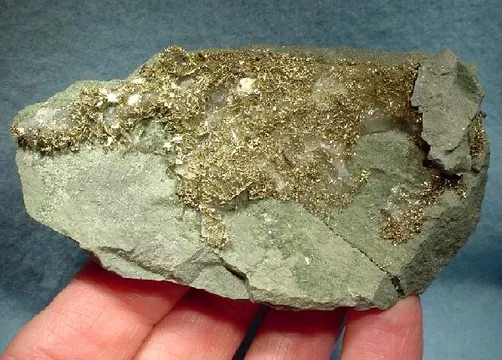
Blackbird mine, USA - iconic Idaho locality known for green ludlamite crystals and purple to blue vivianite, with prized matrix specimens and collecting appeal.
Key facts
The Blackbird mine is one of the great American paradoxes: a hard, strategic cobalt-copper mine in the high Salmon River Mountains of east-central Idaho, and at the same time a classic locality for delicate, jewel-like phosphate specimens. Geologically it sits in the central Idaho cobalt belt, within Mesoproterozoic metasedimentary rocks of the Apple Creek Formation of Yellow Lake in the Lemhi subbasin of the Belt-Purcell Basin. The ore zones are cobalt-copper-gold mineralized, folded, biotitized and locally silicified argillite-siltite units and related breccias; the ore minerals are chiefly cobaltite and chalcopyrite, with pyrite, pyrrhotite, arsenopyrite, safflorite and linnaeite as important associates. For collectors, however, Blackbird’s fame rests on two phosphates that look almost impossibly refined for such a metallurgical mine: bright apple-green ludlamite and the distinctive purple to blue-purple vivianite that has made the locality instantly recognizable in old American collections.
Regional View
Country View
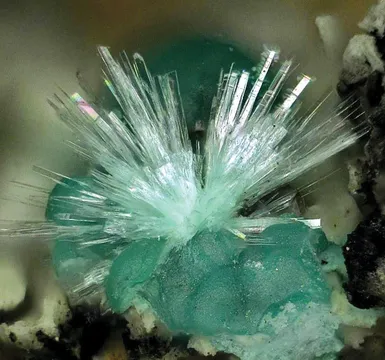
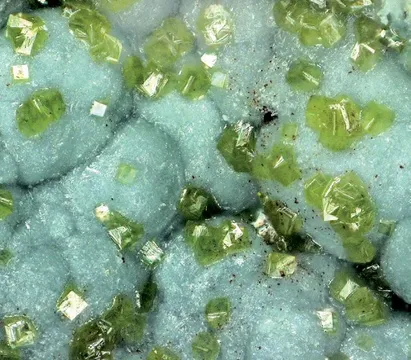
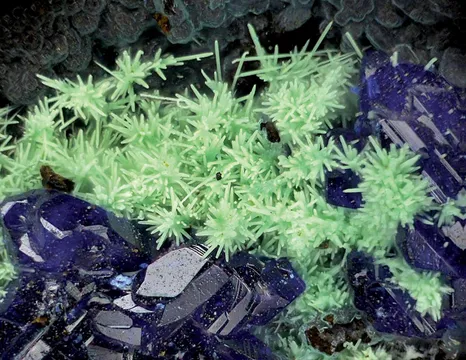
Blackbird specimens have a very specific look. The finest ludlamites are not massive green coatings but sharp, lustrous, transparent to translucent green crystals and sprays on thin matrix, often best appreciated under magnification where the wedge-shaped terminations and glassy faces become apparent. The best vivianites are equally distinctive: elongated prismatic to blade-like crystals, commonly dark on first glance but glowing violet, grape-purple, blue-purple or purple-green when properly backlit. Matrix examples, especially those combining purple vivianite with green ludlamite, are scarce and greatly prized because much of the old material was collected as fragile small groups or detached crystals, and because the matrix can weather, crumble or shed crystals with handling.
Historically, Blackbird matters far beyond the cabinet. The district was prospected in the 1890s, developed through several early episodes, and became a nationally important cobalt source during the mid-20th century, especially from 1949 into the 1960s. The mine later became a major environmental remediation site because of acid mine drainage and metal-bearing tailings and waste rock. That closure history is part of why Blackbird minerals have such collector gravity today: the old underground workings and open pit are not an active collecting ground, and fine specimens are essentially legacy pieces from old finds and dispersed collections.
Search for specimens: View all specimens from Blackbird mine, USA
The Blackbird mine lies west to southwest of Salmon, Idaho, in Lemhi County, in a rugged part of the Salmon-Challis National Forest marked by steep forested canyons, high ridges and deep drainage into Blackbird Creek, Big Deer Creek and Panther Creek. The mine complex is usually treated as the central locality of the Blackbird Mining District and the Idaho cobalt belt. The district has given its name to the “Blackbird Co-Cu” deposit model: sediment-hosted, cobalt-copper mineralization in Proterozoic metasedimentary rocks, subsequently modified by deformation, metamorphism, brecciation and later hydrothermal events.
The ore is hosted principally in fine-grained siliciclastic metasedimentary strata, especially banded siltite and argillite of the Apple Creek Formation of Yellow Lake, formerly discussed in much of the older literature under Yellowjacket Formation terminology. In the Blackbird mine area, certain argillite-rich intervals were converted to biotitite, locally containing more than 75 percent hydrothermal greenish biotite, and these biotite-rich rocks are preferentially mineralized. Stratabound ore zones occur in folded, sheared and altered beds, with additional discordant lodes and sulfide-rich breccias. The Blackbird structural block contains important ore zones including the Idaho, Chicago, Brown Bear, Blacktail, Dandy and Merle zones, with the Blacktail zone developed as an open pit and extensive underground workings on several zones.
The primary ore suite is cobaltite and chalcopyrite with pyrite and pyrrhotite, plus varying arsenopyrite, safflorite, linnaeite, enargite, sphalerite, galena and native gold and silver. Gangue and alteration minerals include quartz, biotite, chlorite, tourmaline, ankerite, siderite, calcite and muscovite. Later oxidation and secondary mineralization produced such collector minerals as erythrite, malachite, cuprite, chalcocite, jarosite, heterogenite and nontronite. The phosphate specimens for which collectors know Blackbird—ludlamite and vivianite—belong to this late, delicate secondary-mineral story rather than the robust cobalt-copper ore assemblage.
Mining history at Blackbird is complicated because many named claims, adits and ore zones were gradually connected or consolidated. The district was first prospected about 1893; early development took place at the Brown Bear mine around 1899–1902, at the Haynes-Stellite during 1917–1920, and at the Uncle Sam mine in the late 1930s and early 1940s. During World War II, the U.S. Bureau of Mines and U.S. Geological Survey investigated the district, and Calera Mining Company, the Blackbird Division of Howe Sound Company, began underground development from the Calera adit in 1945. The most sustained production came after 1949, when Blackbird became a serious strategic cobalt operation. Mining and processing continued intermittently through several companies and operating campaigns into the late 1960s, and Noranda later refurbished facilities and drove exploration work around 1981–1982 before the property ceased operation.
Old mine records describe a substantial underground system, multiple haulage levels and numerous adits, crosscuts, drifts, raises and shafts. The 6850 haulage level and mill remains are repeatedly noted in geological mapping of the area. The Blacktail open pit, Dandy zone, Idaho zone, Chicago zone and Brown Bear zone are especially important in mining descriptions, while the wider district includes Sunshine, Ram, Haynes-Stellite, Uncle Sam and other named zones and prospects. The Dandy zone is geologically notable because younger sulfide-matrix breccias there cut older folded cobaltite-biotite ore and associated mafic dikes.
Specimen production was never the purpose of the mine, which explains both the scarcity and the uneven preservation of fine pieces. The celebrated vivianite material is old-find material, repeatedly described in collection and dealer records as having come from finds of the 1950s and 1960s. The richest examples show translucent purple crystals to several centimeters on quartz, altered schistose matrix, siderite, ludlamite and pyrrhotite-bearing matrix. The classic ludlamites are likewise old material; important pieces in modern auctions and museum-linked collections include large, thin matrix plates covered with small, sharp green crystals, as well as thumbnails with more prominent crystal groups.
Collecting access today should be considered closed. The mine is inactive, the core mine lands include patented private claims and the surrounding mine complex is subject to environmental remediation and access restrictions. The site contains sealed or flooded workings, unstable mine openings, waste rock, tailings, metal-contaminated drainage and engineered remediation features. Blackbird specimens now reach collectors almost entirely through old collections, dealers, auctions and estate dispersals rather than field collecting.
Blackbird ludlamite is one of the classic North American expressions of the species, prized for bright apple-green to yellow-green crystals that can be glassy, sharp and surprisingly gemmy when fresh. The typical collector specimen is a small matrix piece or thin plate carrying scattered to dense crystals, commonly only a few millimeters across, but the best pieces show well-formed wedge-terminated crystals, sprays or clustered groups with enough transparency and luster to stand apart from ordinary green phosphate crusts. It is documented with vivianite, siderite, quartz and altered sulfide-bearing matrix, and the most desirable Blackbird pieces combine freshness of color, undamaged terminations, three-dimensional crystal relief and an old, secure provenance; association pieces with purple vivianite are especially coveted because both Blackbird signature phosphates rarely occur together on a single attractive specimen.
Blackbird vivianite is famous above all for its unusual purple to blue-purple color, a hue rarely seen so characteristically in vivianite from other localities. The crystals are generally elongated prismatic to blade-like, occurring as singles, upright groups and small matrix clusters on white quartz, dark altered schistose rock, siderite-bearing matrix, ludlamite and oxidized sulfides; published and dealer-documented examples include crystals around 2 to 3 cm, with larger cabinet pieces made important by multiple sharp crystals rather than by one giant individual. Many specimens look dark in ambient light but reveal violet, indigo, purple-green or bi-colored interiors with gentle backlighting. The best pieces have complete terminations, translucency, visible purple color without harsh lighting, stable matrix and an old collection history; ordinary pieces are darker, cleaved, detached, faded, or mounted on friable matrix that threatens the crystal group.
Beyond ludlamite and vivianite, Blackbird’s mineral list reflects a cobalt-copper-arsenic ore system rather than a broad aesthetic-specimen locality. Documented minerals include cobaltite, chalcopyrite, pyrite, pyrrhotite, arsenopyrite, safflorite, linnaeite, enargite, sphalerite, galena, chalcocite, cuprite, native copper, native silver, native gold and electrum, with oxidation products such as erythrite, heterogenite, malachite, jarosite, hematite, limonite and nontronite. Blackbird is not the type locality for ludlamite or vivianite, nor is it known chiefly as a type locality for an IMA mineral species; its “type” importance is instead geological, as the reference locality for the Blackbird cobalt-copper deposit style. For collectors of rarities, the most meaningful Blackbird non-phosphates are cobaltite-rich ore specimens, erythrite as the cobalt bloom of the system, linnaeite and safflorite in the ore assemblage, and historically labeled ore-suite specimens tying the specimen directly to a named zone or old Blackbird operator.
Blackbird material rewards disciplined buying. The locality’s strongest market identity is narrow: purple vivianite and fine green ludlamite. Specimens labeled only “Blackbird Mine, Idaho” should be examined for whether they are actually from the Blackbird mine proper, the broader Blackbird mine complex, the Chicago Mine, Copper Queen Claim, or another prospect in the district. That distinction matters most for collectors who value exact locality provenance, because “Blackbird” is used loosely in older labels and dealer shorthand.
No widely documented industry of fabricated Blackbird vivianite or ludlamite fakes appears in the collector literature, but mislabeling and over-selling are realistic concerns. Ordinary dark vivianite from other localities should not be accepted as Blackbird purple vivianite without provenance, and detached crystals on improbable matrix deserve scrutiny. Vivianite and ludlamite together on one attractive thumbnail is possible from Blackbird, but uncommon; association pieces should be checked carefully for natural attachment, matrix consistency and credible collection history.
Condition is the central issue. Vivianite is light-sensitive and can darken through oxidation and dehydration-related alteration; Blackbird purple material should be stored away from direct sunlight and strong UV-rich display lighting. Backlighting for photography should be brief and gentle. Old specimens may already have darkened, and a crystal that looks nearly black in normal light may still show purple internally at thin edges, so evaluation should include both ambient and transmitted light. Cleavage is common, terminations are easily bruised, and the matrix can be weak, especially where oxidized pyrrhotite, siderite, clayey alteration or old sulfide-rich rock has deteriorated.
Ludlamite is softer and more fragile than it looks. The small green crystals can be sharp but brittle, and old thin plates are vulnerable to abrasion, flaking and edge loss. Avoid wet cleaning, ultrasonic cleaning or aggressive air abrasion on Blackbird phosphate specimens. Dust removal should be minimal, dry and mechanical only, ideally with a very soft brush and support beneath the matrix. Good storage means low light, stable humidity, acid-free labels and no pressure on exposed crystals.
Market availability is thin but real. Small ludlamite thumbnails and micros appear more often than fine purple vivianite matrix pieces, but both are old-stock localities and the finest material tends to surface only when established collections are dispersed. Recent auction and dealer records show small attractive vivianites selling in the hundreds of dollars, association thumbnails higher when both species are present, and top cabinet or small-cabinet purple vivianites commanding substantially more depending on color, completeness and provenance. Provenance to older collections such as Jack Nieburger, Harold Urish, Jack Halpern, Les Presmyk, De Natura, university collections or well-known dealer archives adds confidence and desirability.
The Blackbird story begins, in local memory, with a person named Little Tommy. In 1892, a Lemhi Indian by that name is credited in Russell Steele’s account with making the first mineral discoveries at the future mine site: copper and gold first, and then cobalt, the metal that would bring the isolated canyon into the machinery of war, defense contracts and mid-century mining life. That origin story is a reminder that the Blackbird locality was never merely a mineral-specimen pocket; it was a place where a remote Idaho drainage became tied to World War I, World War II, the Korean War and the American search for strategic minerals.
By the 1950s, the mine had made a small community in the canyon. Cobalt, Idaho, downstream from the workings along Panther Creek, had residences for Blackbird employees, a school, a store, a recreation hall, a bar, a bowling alley and the improvisational infrastructure of a company town far from broadcast towers and city comforts. Russell Steele’s family lived there from 1949 to 1952, and again in 1956 and 1957, leaving a set of memories as concrete as ore bins and tailings dams. In one account, his father returned first, hired as a swing-shift cat skinner while crews were clearing a mountaintop for the new open pit. The rest of the family followed from California in June, towing a rented trailer behind Grandpa George’s green Chevy two-door, with a Siamese cat named Mean Tu and a Lewellen Setter named Freckles in the traveling party.
The road to Cobalt was not gentle. Near Mount Borah, Freckles bolted after a jackrabbit through a barbed-wire fence and vanished toward the mountain. The family searched and called, then finally had to drive on, the children crying in the back seat. Less than 500 feet later the dog came limping out of the sagebrush with blood on the white fur of his right hind leg, and the boys shouted for their mother to stop. Freckles climbed into the back seat, where the children wrapped his torn leg with the damp wash rag they had been using against the heat.
Once in Cobalt, ordinary domestic life took on hardrock-camp color. A neighbor, Virgil “Windy” Schofield, came over to warn the family that his small black-and-white terrier was a “cat killer” and that he would not be responsible if it killed Mean Tu. Before the warning had fully settled, Mean Tu launched from under a tablecloth onto the terrier’s back and rode the dog straight through the screen door. The dog retreated under the Schofield house through a 4-inch by 4-inch foundation vent and stayed there for two or three days, apparently using the hole to scrape the cat off its back. After that, Mean Tu often sat on the picket fence while the humbled “cat killer” rarely left the house.
The same canyon inventiveness brought television to Cobalt. Walt Lea, an electrician and former neighbor, gave Steele a spool of yellow blasting wire for a homemade radio antenna, adding the practical camp advice: “If anyone asks where you got this, tell’em you found it. Stuff is always falling off trucks around here.” Soon afterward Walt took him by green company pickup up Panther Creek, past the Panther Creek Inn, across a rickety wooden bridge near the sawmill below the tailings dam, and up a steep road that Steele’s father had cut into the mountain in 1951 while logging Douglas fir for mine timbers. On a high clearing stood a homemade rhombic antenna, roughly 100 feet on a side, strung on lodgepole posts with reclaimed Forest Service telephone wire on ceramic insulators. It was tuned to Channel 3 in Idaho Falls, about 150 miles away. A propane generator, storage batteries and a tube amplifier in a small hut powered the translator from five o’clock news until a spring clock shut it down at ten. The apparatus brought Cobalt the Cold War, national politics, Jackie Gleason, Milton Berle, I Love Lucy, prize fights, wrestling and baseball—rebroadcast from a lonely ridge into a mining town tucked in the canyon below.
The open pit stories are rougher. Steele, then a young summer worker, bought a shiny new hard hat with his first paycheck. It fell from his truck onto the haul road just as an old Euclid haul truck, number 1268, came over the rise trailing black diesel smoke. The driver, nicknamed “the Pig,” had a reputation for meanness, and Steele was sure the 20-ton machine would flatten the hat for sport. He swung the surplus Army 4x4 water truck hard to recover it, but the world tilted; the passenger-side window filled with brown dirt, and the truck rolled. Water poured from the tank. Steele killed the engine, climbed out the driver’s window, grabbed the hard hat before the Euclid reached it, and walked up to the shop expecting to be fired because the crew had been warned: damage equipment and you’re gone. Instead, after the foremen checked that he was unhurt, he was sent to grease a D-4 Cat for the rest of the shift. That evening, Ted Maestretti came to the family house, sat down for coffee and told him he was now on evening shift as a driller’s helper.
That job taught him how mountains were taken apart. The drill crew worked patterns of twenty holes, about ten feet apart in three rows. Into each hole went one and a half bags of nitrogen fertilizer, followed by three gallons of diesel fuel. A six-inch piece was cut from a three-foot-long, three-inch-diameter tube of high explosive, pierced with a screwdriver, tied with primer cord and lowered into the hole. The drill cuttings were shoveled back in as stemming, the holes were linked with primer cord and an electric blasting cap was taped to the joined ends. When the plunger went down, the hillside lifted six to ten feet, fell back, and filled the sky with dust and raining stones. Steele later understood the dents in the driller’s hard hat.
The most memorable Blackbird field story may be the water truck driver and the bear. At dusk near the small dam on Big Flat Creek, the driver struggled to start the pump that filled the truck tank. He had left the truck door open with his lunch box on the seat. When he returned, a bear stood between him and the cab, tearing into the lunch. The driver tried to scare it off, failed, and ran cross-country through the dark toward the open pit, leaving the pump running. The night foreman later found the truck at the dam with the lights on and water pouring out, but no driver, no lunch box and no bear. Hours later the driver came out of the woods behind the pit, having steered himself through the darkness by the sound of the mining operation. He lasted one more week, then quit, convinced the bear was still out there waiting.