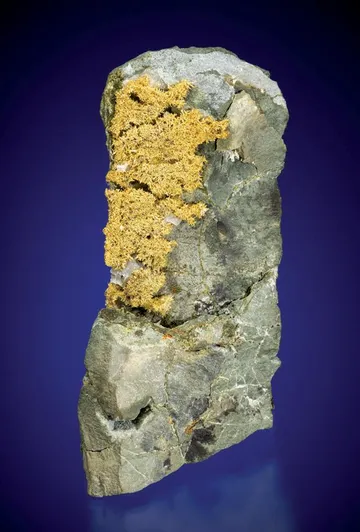
Olinghouse Mining District — Nevada locality famed for specimen gold, pale-yellow to bright wires and leaves in calcite and quartz, prized by collectors.
Key facts
Olinghouse is one of the great late-20th-century surprises in American specimen gold: a relatively small Nevada district whose best pieces are instantly recognizable, not as waterworn nuggets or chunky vein metal, but as pale-yellow to bright, intricate wires, leaves, and nestlike crystalline aggregates perched in vugs and fractures in altered volcanic rock. The district lies on the east side of the Pah Rah Range in southeastern Washoe County, near Wadsworth and northeast of Reno, within the northern Walker Lane structural province. Its gold belongs to a low-sulfidation epithermal vein system hosted chiefly by Miocene volcanic rocks—andesite, basalt, flow breccia, laharic and volcaniclastic units of the Pyramid Sequence—cut by northeast-trending faults and dikes. For collectors, Olinghouse matters because commercial mining briefly intersected specimen-quality cavities in the 813 pit and related Green Hill workings, releasing a finite suite of delicate golds on pale calcite, quartz-lined fractures, and gray-green altered andesite.
Regional View
Country View
The best Olinghouse specimens are architectural rather than massive. Under magnification the gold often resolves into spinel-twinned wires, flattened leaves, tiny octahedral faces, and loose “nest” aggregates that appear to have grown into open space and then been revealed by etching away calcite. The color can be unusually soft for native gold because much of the material is electrum-rich; some pieces acquire a warm yellow, iridescent, or even dark tarnish with time. Matrix specimens are especially desirable when the gold sits high and clean against pale calcite or gray-green andesite, with quartz druse adding sparkle and scale.

Photo: Wikimedia Commons
Historically, Olinghouse bridges two eras of Nevada gold mining. The district was prospected in the 1860s, organized as White Horse near the end of the 19th century, and worked through small lode and placer operations before a short-lived railroad-and-stamp-mill boom in 1907. Nearly a century later, open-pit heap-leach mining by Alta Gold brought the district back into view, both economically and mineralogically. That modern mining exposed the specimen gold for which Olinghouse is now known; when operations shut down, the collectible output effectively became a closed chapter rather than an ongoing supply.
Search for specimens: View all specimens from Olinghouse Mining District, USA
The Olinghouse district, also known historically as the White Horse district, occupies the east flank of the Pah Rah Range in southeastern Washoe County, Nevada. The principal mines and placers lie around Olinghouse Canyon, Green Hill, Frank Free Canyon, Tiger Canyon, and nearby workings northwest of Wadsworth. In mining-district terms the area extends from the Truckee River Canyon northward toward Big Mouth Canyon, and in specimen terms the name “Olinghouse” most often refers to the Olinghouse Mine and especially the 813 pit of the Alta Gold operation.
Geologically, the district is a volcanic-hosted epithermal gold-silver system developed along northeast-trending faults of the Olinghouse fault zone. The productive structures include closely spaced, near-parallel veins and vein swarms along faults, shear zones, and dike margins. Modern descriptions place the principal host rocks in the Pyramid Sequence, a Miocene package of vesicular basalt, andesite, flow breccias, lahars, and volcanic sediments, overlain by younger volcanic units of the Kate Peak Formation and underlain locally by older Oligocene to Miocene tuffs, rhyolitic rocks, ash-flow material, and lahars. Gold mineralization is especially tied to small open-space quartz-calcite veins and altered wall rock adjacent to dikes and fault structures.
The alteration at Olinghouse is important but not always spectacular at the surface. A broad propylitic halo affects several square miles of the central district, with chloritization of mafic minerals and alteration of plagioclase to calcite, sericite, epidote, and albite. Near the veins, feldspar alteration becomes more intense, with K-feldspar and sericite replacing plagioclase; epidote increases toward the central district. This subdued alteration, the presence of old workings, placer gold, and the abundance of small gold-bearing veins were among the best exploration guides during modern drilling.
The ore mineralogy is dominated by native gold and electrum, with pyrite generally sparse and commonly oxidized. Quartz and calcite are the most familiar gangue minerals on specimens, and the collectible pieces often preserve open-space vein textures. Associated minerals recorded from the district include galena, sphalerite, chalcopyrite, pyrite, K-feldspar including adularia, epidote, clinozoisite, heulandite-group and stilbite-group zeolites, laumontite, scheelite, and secondary iron and manganese oxides. Tellurides are a notable undercurrent in the district’s mineralogy: hessite, petzite, coloradoite, rucklidgeite, and the rare lead tellurite-tellurate mineral girdite have all been recorded from Olinghouse or its sublocalities.
Mining history began early by Nevada standards. The district was reportedly prospected in 1860, with the first locations in Fort Defiance Canyon in 1864. Frank Free located the Green Mountain mines in Olinghouse Canyon in 1874, and much of the early production later came from that part of the district. The camp took its later name from Elias Olinghouse, a teamster and sheepman who settled in the canyon and then became involved in the mining activity around him. The district was organized as White Horse in 1899, and production peaked in the years around 1900 to 1903.
The early district was both a lode and placer camp. Gold-bearing placers were worked in ravines tributary to Olinghouse Canyon and around Green Hill before 1900, with the placer gold interpreted as derived from the nearby quartz-calcite-gold veins. Historical descriptions note subangular gravels, commonly shallow to moderate in depth, with gold concentrated near bedrock. The placer gold was not especially pure by bullion standards, averaging around 680 to 700 fine in older reports, consistent with the district’s electrum-rich character.
The most dramatic early infrastructure was the 1907 Nevada Railroad and the associated 50-stamp mill scheme. A standard-gauge line was built from a Southern Pacific junction near Wadsworth to Olinghouse to haul ore from the Buster mines to a mill near the Truckee River. The operation was short-lived: the mill reportedly ran only about three months, and regular railroad service ended in November 1907. The district then returned to intermittent small-scale work, leasing, and episodic exploration rather than sustained major production.
Modern exploration transformed the district. Western Goldfields drilled in the area in 1986 but did not control the heart of the system. Phelps Dodge acquired a central land position in 1991 and drilled reverse-circulation and core holes by 1993, then sold its interest. Alta Gold purchased the Olinghouse property in 1994, advanced an aggressive drilling and permitting program, and planned open-pit mining of multiple structures, including Green Hill and the larger Payback area. Drilling defined near-surface mineralization at Green Hill and deeper high-grade intervals with visible gold. The mine entered production in September 1998, using open-pit methods, gravity recovery for higher-grade ore, agglomeration, and heap leaching.
Alta’s Olinghouse operation was brief and troubled. Heap-leach startup problems, permitting delays, high costs, and weak cash flow affected the company in 1998 and 1999. Alta Gold filed for Chapter 11 bankruptcy on April 14, 1999, and mining, milling, and crushing operations at Olinghouse ceased in August 1999, although heap-leach processing continued for a time. Later ownership and royalty records show the project as a dormant resource rather than an active specimen-producing mine; recent royalty information names Lake Mountain Mining, LLC as the project owner reviewing financing, permitting, and economic work toward a possible restart decision. For collectors, the practical result is that classic Olinghouse specimen production belongs primarily to the 1990s mining episode.
Specimen production is most closely associated with the 813 pit, the Olinghouse Mine, Green Hill, and related Alta Gold workings. The most desirable pieces came from calcite-filled cavities and open fractures where native gold or electrum grew as wires, leaves, and nests with quartz and calcite. Many specimens were prepared by dissolving calcite to expose gold that had been protected within the vein filling. Large matrix pieces are known, but most collector-quality Olinghouse gold is thumbnail to miniature size, with cabinet specimens much scarcer and highly prized when the gold coverage is rich and the structure is aesthetic.
Collecting access today should be treated as closed unless explicit permission is obtained from the landowner, claim holder, and any applicable agency. The district contains patented and unpatented claims, old workings, open pits, heap-leach and reclamation areas, private or controlled mineral rights, and public-land administrative complexities. Olinghouse is not a casual rockhounding site; it is a historic and modern mining district with legal, safety, and environmental constraints.
Gold from Olinghouse is famous for pale-yellow to warm-yellow crystalline wire, leaf, and nest habits, commonly as native gold to electrum in open quartz-calcite veins hosted by altered andesite and related volcanic rocks. Most fine pieces are thumbnails and miniatures, though larger matrix specimens from the 813 pit and Green Hill area are known; the finest show dense but airy masses of tiny wires, flattened spinel-twinned leaves, and sparkling microcrystals rising from etched calcite or gray-green andesite, sometimes with quartz druse still intact. Ordinary examples are small patches or low-relief smears of gold in prepared vugs, while top Olinghouse pieces have clear three-dimensional architecture, bright exposed metal, attractive contrast with matrix, and enough untouched host to show how the gold grew in the fracture system.
Other minerals from Olinghouse are scientifically useful even when they are not usually cabinet-specimen species. Quartz and calcite are the key gangue minerals for the gold, with adularia-bearing K-feldspar, epidote, clinozoisite, chlorite, zeolites such as heulandite-group minerals, stilbite-group minerals, laumontite, phillipsite-group minerals, and epistilbite reflecting the altered volcanic setting. Ore and accessory species include pyrite, galena, sphalerite, chalcopyrite, acanthite, native silver, native copper, bornite, azurite, malachite, cuprite, tenorite, anglesite, goethite, hematite, jarosite, manganese oxides, cinnabar, scheelite, and nitratine. The district’s notable rarities are its tellurium minerals: hessite, petzite, coloradoite, rucklidgeite, and girdite, none of them common collector pieces from Olinghouse, but all important to the locality’s geochemical fingerprint.
The first authenticity issue with Olinghouse gold is preparation. Many legitimate specimens were acid-prepared to remove calcite and expose wires or leaves that grew in calcite-filled cavities; this is normal for the locality, not automatically a defect. However, preparation quality matters. Over-etched pieces can look woolly, skeletal, or unnaturally exposed, and residual acid or poor neutralization can leave unstable coatings, pale “bloom,” or green secondary copper salts if microscopic chalcopyrite or other copper minerals are present. A well-prepared Olinghouse specimen should show crisp gold, clean but believable cavity surfaces, and no active powdery residues.
The second issue is color. Much of the Olinghouse material is electrum-rich or silver-bearing gold, so an unusually pale color can be correct. Some specimens darken or develop iridescent tarnish with time, and pieces described as electrum may look less buttery than classic California or Australian native gold. Avoid assuming that every pale Olinghouse gold is fake, but also be wary of bright, overly uniform, freshly yellow surfaces on delicate wire aggregates if the piece lacks credible provenance.
Mislabelling is a real concern because Olinghouse gold can be confused with other Nevada specimen gold localities, especially Round Mountain. Documented collector labels and photo records include Olinghouse specimens later recognized after being mislabeled as Round Mountain. Olinghouse typically differs by its gray-green altered volcanic matrix, etched calcite pockets, pale electrum tone, and nestlike wire-leaf aggregates; Round Mountain more commonly evokes sharper isolated crystals, dendritic groups, or different matrix styles, though overlap in appearance means provenance is still essential.
Condition issues are significant. Olinghouse wires and leaves can be delicate, and the best specimens often have exposed three-dimensional gold that can be crushed, bent, or dulled by careless handling. Matrix pieces may include friable altered andesite, porous calcite remnants, or dehydrated laumontite-like material, all of which can shed or chalk with changes in humidity. Do not clean these specimens ultrasonically, do not soak them casually, and do not use household acids or ammonia. Store them dry, padded, and dust-free; view under low-angle light or magnification rather than by handling.
Fluorescence is not a major selling point for Olinghouse gold specimens, but associated scheelite from district heavy-mineral concentrates and tungsten occurrences is relevant to the broader district mineralogy and can respond under shortwave ultraviolet light. Gold itself is dense and chemically stable, but the specimen as a whole may not be: fragile zeolites, calcite remnants, and etched voids deserve more caution than the metal does.
Market availability is finite but not impossibly rare. Olinghouse gold appears regularly enough in established collections, auctions, and dealer inventories that a serious collector can find examples, but the supply is overwhelmingly old stock from the 1990s and early 2000s rather than fresh mine production. Modest thumbnails with small nests or leaf patches are obtainable; rich miniatures, aesthetic matrix pieces, and cabinet specimens with multiple vugs of wire gold command a premium, especially with labels tying them to the 813 pit, Alta Gold Mine, Green Hill, Scott Kleine-related material, or other early documented dispersals.
Elias Olinghouse did not set out to become the namesake of a gold district. He was a former teamster and sheepman who settled in a quiet canyon at the base of the Pah Rah Range, apparently seeking distance from the bustle of mining towns. The gold camp found him anyway. As prospecting intensified around his canyon, Olinghouse bought claims and in 1903 erected a small stamp mill to process ore. The district that had been prospected decades earlier and organized as White Horse soon carried his name into Nevada mining history.
The early boom had all the optimism and overreach of Nevada mining at its most vivid. Between 1898 and 1903, the district produced hundreds of thousands of dollars in gold and silver values, enough to justify electricity, telephone service, and finally a standard-gauge railroad. The Nevada Railroad reached Olinghouse from a Southern Pacific connection near Wadsworth in February 1907. Its purpose was practical and grand: haul ore from the Buster mines to a 50-stamp mill near the Truckee River. The line became a footnote almost as quickly as it was built. Regular operations ceased on November 1, 1907, and the mill reportedly ran for only about three months. One durable oddity remained: the line was distinguished by the use of Nevada’s first Shay-geared locomotives.
Green Hill, later so important to specimen collectors, had already been important to miners. Placer gold in the nearby ravines was interpreted as shed from the lode veins in and around the hill. Older descriptions record gravels of mostly subangular andesite and basalt debris, with pay concentrated in the lowest several feet above bedrock. The largest recorded placer nugget from the district weighed one and one-half ounces—not a legendary monster, but a substantial piece for a district better remembered today for delicate wires rather than heavy nuggets.
Modern mining brought a different kind of drama. Alta Gold’s drilling in the mid-1990s confirmed that the old camp still had economic life, and one core hole cut a spectacular high-grade interval: 64 feet grading 1.97 ounces of gold per ton, including 31.5 feet at 3.9 ounces per ton, with visible gold reported. For a Nevada open-pit prospect, those numbers were enough to sharpen every pencil. Green Hill was to be mined first, followed by Payback and possibly Keystone and Sunbeam. By September 1998 the operation was running; by April 1999 Alta Gold was in bankruptcy; by August 1999 mining, milling, and crushing had stopped.
For collectors, the extraordinary part of that short modern life is that miners and specimen people recognized the gold as specimens rather than mere ore. Open fractures and calcite-filled vugs in the 813 pit yielded pale gold wires, leaves, and nestlike aggregates. Some were saved as matrix pieces; many were prepared by dissolving calcite to reveal the gold locked inside. Photo records and dealer descriptions from the dispersal era preserve remarkable particulars: 5 mm and 6 mm leaves on small-cabinet pieces, thick sparkling nests richly covering matrix, a large U-shaped nest of wire gold on a cabinet specimen, and a documented 17.6 cm matrix piece with two bright nests on green andesite. One account attached to that larger piece states that open-pit mining recovered about 1,100 specimens before the pits were idled. Whether tiny thumbnails or showy cabinet pieces, the best Olinghouse golds carried the look of a mine that had opened a specimen pocket almost by accident, then closed before the collecting world had finished paying attention.