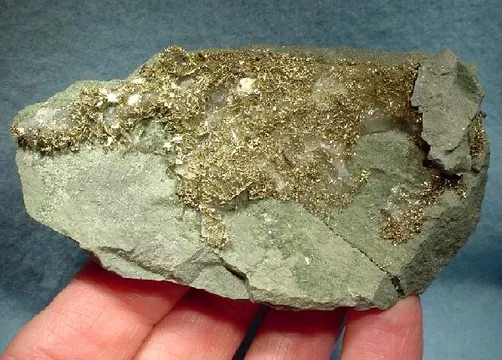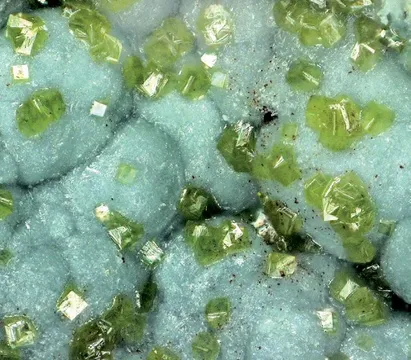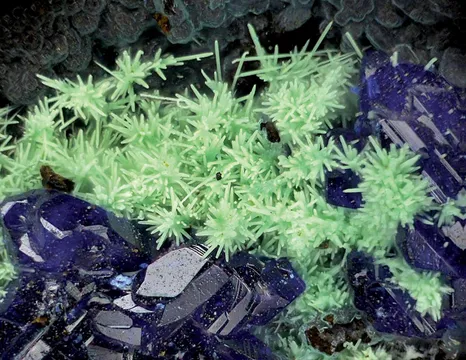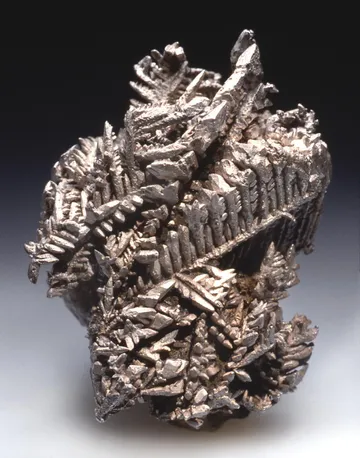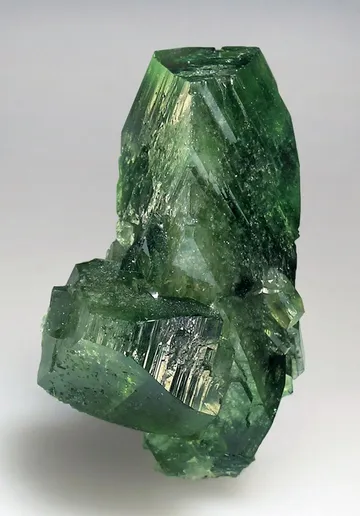
Copper Stope, USA, Gleeson, Arizona: a pocket locality yielding rosasite, smithsonite, hemimorphite, and malachite pseudomorphs, highly prized by collectors.
Key facts
Copper Stope is the collector name attached to a small but memorable oxidized zone in the Silver Bill mine of the Costello Mine group, near Gleeson in the Turquoise, or Courtland-Gleeson, mining district of Cochise County, Arizona. In specimen terms it is a compact locality, but a rich one: an underground pocket-and-stope environment where lead-zinc-copper mineralization in limestone near quartz monzonite produced pastel to saturated secondary minerals instead of the heavy sulfide ore that first drew miners into the district. Its best-known collector identity is rosasite—powder-blue to turquoise, commonly as velvet-like botryoids or spheroidal aggregates—set against white microcrystalline smithsonite, limonitic gossan, hemimorphite, or, in the most distinctive pieces, malachite pseudomorphs after azurite.
The setting matters. Silver Bill lies on the west slope of Gleeson Ridge, close to the better-known Defiance and Mystery mines, in a district where oxidized lead-zinc-copper ores formed along faults, fractures, contacts, and small replacement bodies in Pennsylvanian-Permian Naco Group limestone adjacent to intrusive rocks. The Copper Stope material is not large-scale “Arizona copper mine” ore in the Bisbee or Morenci sense; it is intimate pocket mineralogy from a small underground mine. That is exactly why serious collectors notice it. Fine pieces carry a strong micro- to miniature-scale architecture: blue-green rosasite hemispheres, drusy smithsonite, pale hemimorphite sparkle, earthy brown gossan, and occasional pseudomorphic forms preserving the blocky memory of azurite crystals.
Regional View
Country View
Historically, Silver Bill was one of several closely spaced workings in the Gleeson area. The mine is recorded as a former small underground Pb-Zn-Ag-Cu-Au-Mo-Mn-gemstone mine, discovered in 1890 and productive intermittently from 1893 into the twentieth century. For collectors, however, its name is tied less to tonnage than to late-stage oxidation: the conversion of primary galena, sphalerite, chalcopyrite, and pyrite-bearing ore into carbonates, sulfates, oxides, silicates, and molybdates. Copper Stope’s finest specimens sit at the intersection of that chemistry: copper enough for rosasite, malachite, and azurite; zinc enough for smithsonite, hemimorphite, sauconite, and aurichalcite; lead enough for cerussite, anglesite, plattnerite, and wulfenite; and enough open space for attractive crystal surfaces to survive.
Search for specimens: View all specimens from Copper Stope, USA
Copper Stope is best treated as a named collecting zone within the Silver Bill mine, not as a stand-alone mining district. The full locality context is the Silver Bill mine, Costello Mine group, Gleeson, Turquoise Mining District, Cochise County, Arizona, USA. Silver Bill sits roughly three-quarters of a mile northeast of Gleeson, about 25 kilometers east of Tombstone, on the west slope of Gleeson Ridge. The mine is immediately north of the Tom Scott mine and about 100 yards southeast of the Defiance mine, placing it in a tight cluster of oxidized base-metal workings that produced much more specimen diversity than their modest scale might suggest.
The deposit is an oxidized lead-zinc-copper-silver system developed near intrusive contacts and faults. Published locality descriptions place the Silver Bill mineralization as irregular small stringers, pockets, and replacement bodies of oxidized base-metal sulfides in Naco Group limestone adjacent to quartz monzonite porphyry. Ore control was structural: faults and fractures in the limestone, the limestone-intrusive contact, and dike-related zones perpendicular to bedding. The broader Turquoise or Courtland-Gleeson district contains several related mineralization styles, including copper carbonates and oxides in carbonate rocks, lead-zinc carbonates and silicates with silver chloride and minor copper, turquoise stringers in altered rocks, manganese oxides along fractures, and weak base-metal ores with gold and silver values in intrusive rocks.
The Silver Bill workings were not extensive by major-mine standards, but they were sufficiently developed to expose multiple oxidized zones. Records describe an inclined shaft, drifts, winzes, and stopes, with workings on the order of 160 meters long and roughly 53 meters deep; the bottom, or 200 level, connects with the Mystery adit. That underground connection is significant for collectors because old labels sometimes preserve the neighboring names—Silver Bill, Mystery, Mystery Tunnel, Costello Mine group—rather than a single tidy sublocality. A Copper Stope label should therefore be read within the Silver Bill-Mystery-Defiance cluster, not confused with unrelated “Copper Stope” localities elsewhere in the American West.
Mining began after discovery in 1890, with production recorded from 1893 onward and intermittent activity into the late twentieth century. The mine was associated with lead, zinc, silver, copper, gold, molybdenum, manganese, and gemstone commodities, but the specimen-producing oxidation zone is what gives Copper Stope its modern reputation. One summary notes 6,570 tons produced during the periods 1922-1930 and 1938-1941, while other collecting descriptions emphasize that the Silver Bill produced far fewer specimens than the nearby Defiance mine. The small scale is part of the appeal: good Copper Stope material is distinctive, but it is not abundant.
Collector accounts and specimen records point to Copper Stope as a source of especially good rosasite, some hemimorphite, malachite after azurite pseudomorphs, and light blue to deep blue smithsonite. The best-known specimen style is blue to blue-green rosasite on white smithsonite, sometimes forming small isolated balls, botryoidal crusts, or richer drapes over sculptural limonitic matrix. A few prized pieces preserve a replacement sequence in which azurite crystal forms were altered to malachite and then coated by pale sky-blue rosasite. Those pieces are important because they combine color, pseudomorph texture, and a clear supergene story in one specimen.
Collecting access today should be approached cautiously and legally. The Silver Bill is an old underground mine locality in a historic district, and the broader Gleeson workings include private claims, hazards, and unstable underground conditions typical of abandoned mines. Serious collectors should not attempt entry or surface collecting without confirming current land status and obtaining permission from the landowner or claim holder. Market specimens are overwhelmingly older collected material, dealer-circulated pieces, or specimens from documented Arizona collections rather than new casual-collecting finds.
Rosasite is the defining Copper Stope mineral. Here it appears as pale sky-blue, powder-blue, blue-green, turquoise-blue, and occasionally deeper green spheroidal to botryoidal aggregates, usually built from fine fibrous or bladed crystals with a velvety to matte surface. The strongest specimens show blue rosasite perched on sparkling white microcrystalline smithsonite, draped over brown limonitic or gossanous matrix, or coating malachite pseudomorphs after azurite, where the original blocky azurite form remains legible beneath the later copper-zinc carbonate. Documented Silver Bill examples range from micromount and thumbnail pieces to miniatures and cabinet-size specimens; notable described pieces include rosasite balls around 8 mm across, dominant spheroids near 1 cm, and rich specimens over 10 cm in overall size. Good Copper Stope rosasite is judged by saturated blue color, fresh velvety texture, undamaged botryoids, contrast with white smithsonite or pale hemimorphite, and clear locality provenance; ordinary examples are duller, thinner coatings on iron-stained matrix, or pieces whose labels do not distinguish Silver Bill/Copper Stope material from other Arizona rosasite localities.
Other documented Silver Bill minerals round out the Copper Stope story. Smithsonite is the most important visual partner, occurring as white to blue microcrystalline and botryoidal crusts that give many rosasite specimens their sparkling matrix. Hemimorphite occurs as a zinc silicate accessory and is specifically noted from the Copper Stope-producing area. Malachite and azurite record the copper-carbonate stage, with malachite after azurite pseudomorphs providing some of the locality’s most recognizable forms. The Silver Bill species list also includes anglesite, aurichalcite, cerussite, chalcopyrite, chlorargyrite, coronadite, galena, plattnerite, pyrite, sauconite, and wulfenite. No type-locality mineral is documented from Copper Stope or the Silver Bill mine in the sources consulted, but the occurrence is notable as a small, sharply localized Arizona rosasite source with unusually attractive association pieces.
Copper Stope specimens need careful locality reading. The name “Copper Stope” is not unique: there is also a well-known Copper Stope at the Majuba Hill mine in Nevada, famous for copper arsenates, parnauite, goudeyite, clinoclase, and arthurite. A Copper Stope label without “Silver Bill,” “Gleeson,” “Costello Mine group,” or “Cochise County, Arizona” can easily be misfiled. Conversely, genuine Silver Bill pieces may be labeled only “Silver Bill mine,” “Mystery Tunnel,” “Mystery mine,” or “Costello Mine group,” especially because the Silver Bill lower workings connected with the Mystery adit.
Species identification is the second concern. Rosasite, aurichalcite, hemimorphite, smithsonite, chrysocolla, and pale malachite can all appear in blue-green secondary assemblages, and older labels may be based on appearance rather than analysis. Rosasite from Copper Stope is commonly botryoidal or velvety; aurichalcite is more likely to form silky sprays or tufts; hemimorphite tends to be glassy, colorless to pale, and bladed; smithsonite forms drusy to botryoidal carbonate crusts. On high-value pieces, especially pseudomorphs after azurite or unusually rich blue botryoidal specimens, analytical confirmation or a strong provenance trail is desirable.
Condition is critical. The best rosasite surfaces are fine, fibrous, and exposed, so abrasion, rubbing, pocket clay removal, and overzealous cleaning can flatten the velvet and turn an excellent specimen into an ordinary one. Smithsonite crusts can sparkle beautifully but may undercut fragile rosasite balls. Hemimorphite can shed tiny glassy crystals, and malachite-after-azurite pseudomorphs should be examined for broken tips and rubbed edges. Avoid acid cleaning unless the mineral assemblage has been evaluated carefully; carbonate-rich specimens with smithsonite, rosasite, malachite, azurite, cerussite, or calcite can be damaged quickly by acid.
No widely documented fakery program is associated with Copper Stope rosasite, but mislabeling and optimistic identifications are realistic market risks. The most desirable examples are older Arizona-collection pieces with labels naming Silver Bill or Copper Stope, specimens traceable to collectors active in the district, or pieces matching the classic habit: powder-blue rosasite on white smithsonite or rosasite coating malachite after azurite. Market availability is limited. Fine examples appear sporadically through dealer archives and auctions rather than as steady production, and competition-quality, undamaged rosasite from Silver Bill commands a premium over common generic rosasite.
One of the best small stories from Copper Stope collecting is preserved not in a formal mine report but in the provenance of a single rosasite-smithsonite miniature. The specimen, 4.8 x 4.1 x 2.4 cm, was described as a rare and attractive rosasite on sparkling white microcrystalline smithsonite from the Silver Bill mine. Its most memorable detail was the old note accompanying it: Harold Urish had self-collected the piece in 1988, when he was “pushing 70 years old,” by going through the so-called Mystery Tunnel. That single label detail explains why Silver Bill specimens can carry overlapping locality names. The mine workings were physically connected underground, and a collector entering by the Mystery side could recover material that later moved through the market as Silver Bill rosasite.
Another specimen trail leads to H. Peter Knudsen, whose name is attached both to the important 1983 Mineralogical Record article on the Silver Bill mine and to Copper Stope material collected around 1978. Dealer-described examples from that material show a striking replacement sequence: blocky azurite crystals first replaced by malachite and then coated by pale sky-blue, velvety rosasite. In a cabinet, that is more than a pretty blue coating. It is a mineralogical palimpsest, with the geometry of the first copper carbonate still visible beneath two later alteration events.
The smallness of the Silver Bill mine sharpens these stories. Unlike great industrial Arizona localities where hundreds of tons of rock could expose many pockets, Copper Stope seems to have produced a narrow suite of recognizable specimens—rosasite, hemimorphite, malachite-after-azurite, and blue smithsonite—from a localized oxidized environment. That helps explain why old Arizona collections matter so much for this locality. A specimen label naming Copper Stope, Silver Bill, Mystery Tunnel, or a known collector can carry as much value as another millimeter of blue botryoids.
H. Peter Knudsen (1983), “The Silver Bill Mine, Gleeson, Arizona,” The Mineralogical Record, 14(2), 127-131 — The key collector-oriented publication specifically cited for Silver Bill mine mineralogy, including rosasite and the associated oxidized species.
John W. Anthony, Sidney A. Williams, Richard A. Bideaux and Raymond W. Grant (1995), Mineralogy of Arizona, 3rd edition, University of Arizona Press — Standard Arizona mineral reference cited by locality databases for Costello Mine group species and district mineralogy.
U.S. Geological Survey Open-File Report 84-830, table of Arizona wulfenite and related occurrences — Useful for the regional setting of Silver Bill as oxidized lead-zinc-copper mineralization at the quartz monzonite-limestone contact in the Turquoise district.
Mindat reference page for Knudsen’s Silver Bill article — Compact index of the species tied to the article, including anglesite, aurichalcite, azurite, cerussite, chalcopyrite, chlorargyrite, coronadite, galena, hemimorphite, malachite, plattnerite, pyrite, rosasite, sauconite, smithsonite, and wulfenite.
Silver Bill Mine, Costello Mine group — Mindat — Best single locality page for coordinates, mine description, geology, production notes, workings, and the documented mineral list.
Costello Mine group — Mindat — Places Silver Bill in context with the nearby Defiance and Mystery mines and their overlapping oxidized lead-zinc-copper mineral suites.
Turquoise Mining District — Mindat — Useful district-level geology, including the principal mineralization types around Gleeson and Courtland.
Rosasite and smithsonite from Silver Bill Mine — Wikimedia Commons — Photograph and provenance note for a Silver Bill rosasite-smithsonite specimen self-collected via the Mystery Tunnel.
Rosasite from Silver Bill Mine — Minfind archive — Market record describing a high-quality powder-blue rosasite specimen from the Ernie Schlichter collection.
Rosasite on smithsonite from Silver Bill Mine — Mineral Auctions archive — Dealer archive documenting an 8 mm blue rosasite botryoid on white smithsonite from the Steve Pullman and Bruce Murphy Arizona collections.
Rosasite from Silver Bill Mine — Mineral Auctions archive — Useful specimen description for cabinet-size turquoise-blue rosasite on limonitic matrix and notes on the rarity of Silver Bill material.
Rosasite on malachite after azurite from Copper Stope, Silver Bill mine — Weinrich Minerals archive — Documents the distinctive Copper Stope pseudomorph style and a Pete Knudsen collecting provenance around 1978.
Rosasite Mineral Data — WebMineral — General species data with a Silver Bill example illustrating rosasite on malachite after azurite.