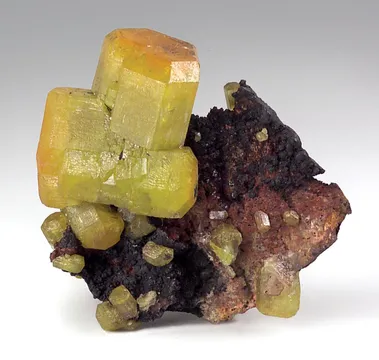
Niederschlema, Germany — premier European ore locality for ruby-red sulfosalts, native arsenic and bismuth, and a rare U–Se assemblage; a magnet for ore micros…
Key facts
Niederschlema is one of the great European localities for collectors who appreciate complex ore mineralogy rather than simply large, pretty crystals. The name belongs to a mining village in today’s Aue-Bad Schlema, Saxony, but in specimen literature it is inseparable from the Niederschlema-Alberoda part of the Schneeberg–Schlema–Alberoda uranium-polymetallic vein system of the western Erzgebirge. This was not a single tidy mine pocket, but a deep, densely veined hydrothermal ore field in contact-metamorphosed Paleozoic rocks above and near Variscan granite, cut by major fault and vein structures of the Gera–Jáchymov zone. Its collector importance rests on three overlapping reputations: ruby-red silver sulfosalts, native-element and arsenide specimens, and a scientifically exceptional U-Se-polymetallic assemblage rich in rare selenides.
The best Niederschlema pieces have a look that is immediately “old Saxony”: dark native arsenic or arsenide matrix, dull to bright metallic nickel-cobalt minerals, white to tan carbonate, and sudden windows of cherry-red proustite glowing from cavities. Native bismuth pieces from the better finds are another register entirely—silvery to brassy-grey skeletal or trigonal crystals, sometimes on skutterudite-group arsenides or quartz, sometimes with carbonate removed to reveal the metal. Even modest examples carry the aura of a district whose mineralization was repeatedly opened, overprinted, dissolved, and redeposited from the Permian into the Mesozoic.
Regional View
Country View
For collectors, Niederschlema sits at the intersection of cabinet-mineral history and ore microscopy. Proustite and native bismuth are the display minerals; calcite, dolomite, ankerite, quartz, arsenic, löllingite, safflorite, nickeline, nickelskutterudite, acanthite, native silver, and hematite supply the paragenetic architecture; and the rare selenides—clausthalite, berzelianite, tiemannite, naumannite, eucairite, mgriite, schlemaite, giraudite-hakite members, watkinsonite, nevskite, and bohdanowiczite—make the deposit a reference locality for specialists. Much Niederschlema material reached collections through Wismut-era mining and dump finds, often with older labels reading simply “Schlema,” “Niederschlema,” “Hartenstein,” “Shaft 38,” “Shaft 207,” “Shaft 309,” or “Shaft 371.”
Search for specimens: View all specimens from Niederschlema, Germany
Niederschlema represents the northern and central collecting face of the Niederschlema-Alberoda uranium ore field, a granite-related, perigranitic vein deposit classed in modern uranium-deposit compilations as a conventional vein deposit. The ore field lies in the western Erzgebirge, southwest of Chemnitz, within the Saxothuringian basement of the Bohemian Massif. The productive rocks are a contact-metamorphosed sequence including dark schists, mica-felses, metadiabase, amphibolite, quartzite, limestone/marble, skarn, and related lithologies in the thermal aureole of the Aue and Gleesberg granites. This setting matters to collectors because the best ore specimens are not random fracture fillings: they are products of a structurally focused, chemically varied vein system in which carbonates, quartz, uranium minerals, arsenides, native elements, silver sulfosalts, and selenides repeatedly overprinted one another.
The deposit was large and deep. Wismut-era descriptions record hundreds to more than a thousand mineralized hydrothermal veins, with individual uranium-bearing portions commonly only a small fraction of a vein’s area. Ore shoots and pockets were irregular rather than sheet-like. Important vein families followed several structural directions, including major WSW-ENE structures, NW-SE structures related to the Gera-Jáchymov fault zone, WNW “Spatgänge,” and other subsidiary sets. Some named structures reached kilometer scale; others were narrow veins or blind veins encountered only underground. The uranium mineralization was tested to more than 2,000 m depth, with the richest uranium concentrations chiefly between about 500 and 1,500 m.
The uranium ore assemblages are commonly described by the Erzgebirge formation names. The kku formation—the comb quartz-calcite-uraninite association—contains quartz, fluorite, calcite, pitchblende/uraninite, coffinite, hematite, sulfides, and associated arsenides; it is often treated as the primary uranium formation in the strict sense. The mgu formation—the magnesium-carbonate-pitchblende association—is characterized by dolomite and other Mg-Fe carbonates, with uraninite, coffinite, sulfides, and the important selenium mineralization. Carbonates are therefore not merely matrix minerals at Niederschlema; calcite, dolomite, ankerite, and siderite are central to the vein history and to the preservation, concealment, or later exposure of many collectible specimens.
The polymetallic mineralization that collectors prize belongs largely to younger and overprinted stages. The Bi-Co-Ni and Ag-S associations introduced or mobilized native bismuth, native silver, native arsenic, acanthite, Co-Ni-Fe arsenides such as skutterudite-group minerals, safflorite, rammelsbergite, löllingite, and nickeline, plus silver sulfosalts including proustite and pyrargyrite. In the scientific literature, Niederschlema-Alberoda is especially notable for selenide nests and fracture fillings in dolomite-ankerite-(calcite) veins, commonly only a few centimeters across, and for disseminated microscopic grains in Fe-Mg carbonate. These are the assemblages that yielded rare and type-locality species, but they also explain why many hand specimens look deceptively plain until sawn, polished, etched, or studied under magnification.
Mining history at Niederschlema is layered. The broader Schlema-Schneeberg region had late-medieval and early-modern mining for silver, cobalt, nickel, bismuth, copper, and iron ores long before uranium became the dominant target. Oberschlema later developed a radium spa culture based on radioactive waters connected with the old Markus-Semmler adit system. After the Second World War, the Soviet and later Soviet-German Wismut enterprise transformed the district into one of the most important uranium-producing mining fields in Europe. Object 09, the Niederschlema-Aue-Alberoda operation, became Wismut’s largest mining unit, worked by shafts, blind shafts, and a dense network of levels and roadways. Production records for the Niederschlema-Alberoda field and associated Schlema-Alberoda district consistently place total uranium output on the order of 73,000 to 80,000 tonnes, depending on the exact boundary and source used.
Shaft numbers are essential for specimen interpretation. Shaft 38, Shaft 207, Shaft 309, Shaft 371, Shaft 382, and related Alberoda shafts recur on old and modern labels. Shaft 371, near Hartenstein, was the principal late Wismut shaft for the Aue mining operation and is especially important historically, although the shaft collar itself was deliberately placed outside the richest ore area to avoid sterilizing reserves. It began sinking in the 1950s, entered production in 1959, and became the last major production shaft of the deposit after the upper levels had been largely exhausted. By the late 1980s the operation was enormously deep and technically demanding; the mine workings extended to levels far below the Markus-Semmler adit, with fresh air, haulage, pumping, and cooling all major engineering concerns.
Mining ceased at the end of 1990, with residual operations into early 1991. Flooding and remediation followed. Underground collecting is not a present-day collecting opportunity, and the old Wismut dumps and industrial areas are remediated, sealed, monitored, or otherwise controlled. For modern collectors, Niederschlema specimens therefore come from old collections, dealer stock, dispersed Wismut-era material, and occasional estate releases rather than from legal casual collecting. The most responsible way to encounter the locality on site today is through the mining heritage landscape, the Bad Schlema visitor-mine context, and especially the Wismut GmbH deposit collection at the secured Shaft 371 complex, which displays mineral and rock samples, maps, profiles, and documentation from the Saxon-Thuringian uranium deposits.
Notable finds are often tied to specific shafts and levels. Proustite specimens are especially associated in the trade and photo records with Shaft 207 and Shaft 309, commonly on native arsenic or with carbonate gangue. Some small but excellent proustite thumbnails from Shaft 207 show bright ruby-silver crystals with the saturation and transparency expected from classic Erzgebirge material. Bismuth specimens are especially linked with Shaft 38 and related deep-level occurrences; records and collector discussions refer to Opal Vein or Opal Lose material on the -855 m level, with native bismuth crystals to centimeter scale and, in exceptional cases, to around 2.5 cm. Some bismuth was recovered as massive carbonate-rich boulders from dumps and later etched to reveal crystals, while unetched or lightly cleaned specimens retaining matrix and paragenetic evidence are particularly desirable.
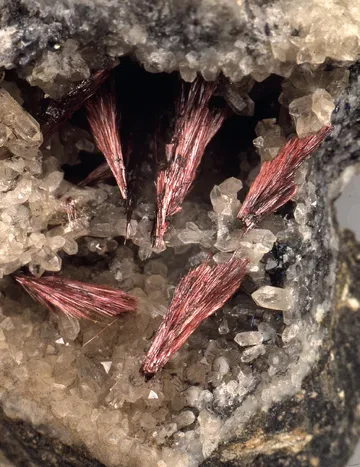
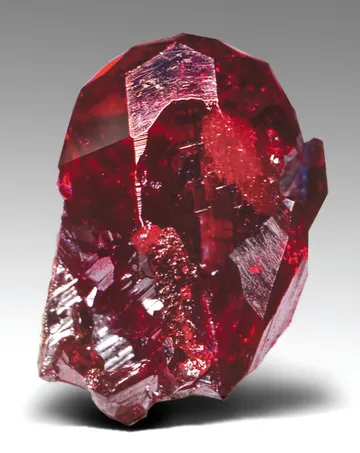
Niederschlema proustite is the classic “ruby silver” of the locality: typically small, brilliant, cherry-red to deep ruby-red prismatic crystals and crystal clusters in cavities of dark native arsenic or arsenide-rich matrix, sometimes with calcite or dolomite and other silver minerals such as stephanite, acanthite, pyrargyrite, or argentopyrite nearby. Documented specimens range from micromount fields of view only a few millimeters wide to thumbnails and miniatures, with individual crystals commonly in the 1–6 mm range; a fine Shaft 207 thumbnail measuring about 1.8 x 1.4 x 0.9 cm and richly covered with gemmy crystals is typical of the scale at which the locality excels. Good pieces here are judged by the same unforgiving standards as other classic proustites: sharp crystal form, transparency or internal red glow, minimal bruising, and an association that unmistakably reads Niederschlema—native arsenic, carbonate, and metallic Co-Ni-Ag ore minerals rather than anonymous black matrix.
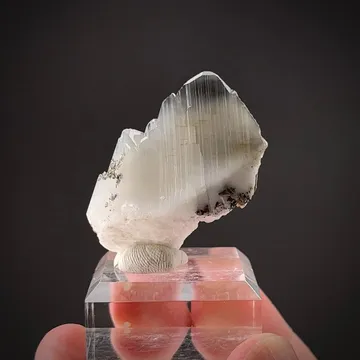
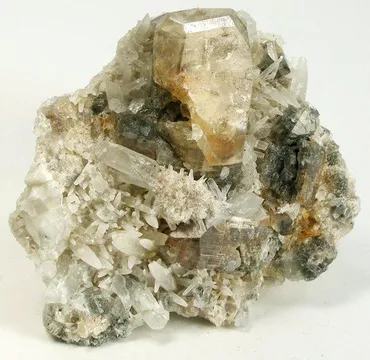
Calcite from Niederschlema is rarely pursued as an isolated show mineral in the way Alpine or Cumberland calcite is, but it is one of the key gangue and specimen-making minerals of the locality. In the kku assemblage it accompanies comb quartz, fluorite, uraninite, coffinite, hematite, and sulfides; in younger and telescoped veins it appears with arsenides, native bismuth, native silver, and silver sulfosalts. Specimen records show calcite from Shaft 207, Shaft 309, and Shaft 38, and district examples include white calcite matrix with nickeline, rammelsbergite, and löllingite, as well as scalenohedral calcite forms later coated or replaced by pearly ankerite on goethite. Better Niederschlema calcite specimens are therefore valued less for water-clear perfection than for paragenetic context: carbonate that frames proustite, records replacement by dolomite or ankerite, hosts arsenide seams, or still carries the original vein texture rather than having been over-cleaned into an attractive but geologically mute fragment.
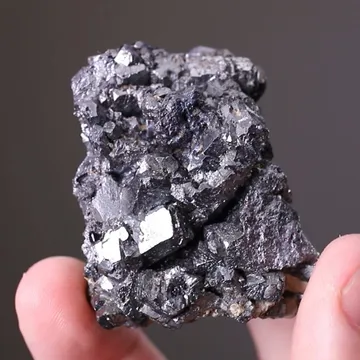
Native bismuth is one of Niederschlema’s finest metallic specimen species, especially from Shaft 38 and related deep-level workings, where it occurs as silvery-grey to brassy, trigonal, skeletal, dendritic, or sharply crystalline aggregates associated with skutterudite-group arsenides, safflorite, native arsenic, quartz, dolomite, calcite, chalcopyrite, and secondary bismuth alteration products. Published dealer and collector records describe Shaft 38 specimens with tiny brassy bismuth crystals to about 5 mm on quartz, high-end pieces with sharp crystals over 1 cm on skutterudite-group matrix, and an Opal Vein/-855 m level occurrence reported for crystals up to about 2.5 cm on dolomite. The best Niederschlema bismuths are not merely “metal in matrix”; they show crisp crystal geometry, skeletal growth, undamaged metallic luster, and enough original association to distinguish them from etched masses or from the far commoner artificial hopper bismuth sold as a curiosity.
Beyond these display species, Niederschlema-Alberoda is a heavyweight locality for rare ore minerals. Native arsenic, native silver, acanthite, pyrargyrite, miargyrite, nickeline, nickelskutterudite, safflorite, löllingite, rammelsbergite, chalcopyrite, hematite, fluorite, dolomite, siderite, ankerite, quartz, uranium minerals, and arsenates such as erythrite and annabergite are all documented from the Niederschlema shaft field. The selenide assemblage is the locality’s scientific jewel: clausthalite, berzelianite, tiemannite, naumannite, klockmannite, umangite, eucairite, crookesite, bukovite, permingeatite, giraudite-hakite members, watkinsonite, nevskite, bohdanowiczite, hessite, and related phases occur mostly as polished-section or micromineral material. Schlemaite, (Cu,□)6(Pb,Bi)Se4, was described as a new species from Niederschlema-Alberoda, and the district is also cited as the type locality and historically the only known occurrence for mgriite, Cu3AsSe3.
The most common Niederschlema problem is not deliberate fakery but imprecise or outdated labelling. “Schlema,” “Niederschlema,” “Bad Schlema,” “Schlema-Hartenstein,” “Hartenstein,” “Shaft 38,” “Shaft 207,” “Shaft 309,” and “Shaft 371” can all appear on labels for material from the same broader ore field or for adjacent parts of the district. Older English labels may misspell the locality as “Neiderschlema” or use “East Germany.” These labels are not automatically wrong, but serious collectors should preserve every old label and, where possible, distinguish village-level locality from shaft-level or vein-level provenance.
Proustite from Niederschlema requires the same light discipline as proustite from any classic locality. The red color is part of the mineral’s appeal, but prolonged strong light can darken and degrade surfaces. Keep specimens in closed drawers or low-light displays, avoid intense LED or sunlight exposure, and do not clean aggressively: many crystals are only millimeters long and sit in shallow cavities in brittle native arsenic or arsenide matrix. Good Niederschlema proustite is often contacted on edges or partly hidden in cavities; a specimen with a few undamaged, transparent, well-faced crystals may be superior to a larger but dull or bruised piece.
Native bismuth raises a different authenticity question. Artificial laboratory-grown bismuth is widespread, colorful, and hopper-shaped, but Niederschlema bismuth is natural, typically silvery-grey to brassy-grey, and geologically associated with arsenides, carbonates, quartz, chalcopyrite, or alteration products. The more subtle issue is preparation. Much bismuth from the district was reportedly found as massive material associated with calcite or carbonate gangue, and some specimens were etched or cleaned to reveal metallic crystals. Etching is not necessarily fraudulent, but heavy acid work can erase matrix evidence, soften context, and leave a specimen looking suspiciously isolated. Natural-looking matrix, retained carbonate, and old collection provenance are strong positives.
Radioactivity is another practical consideration. Not every Niederschlema specimen is meaningfully radioactive at collector scale, but the locality is a uranium ore field and specimens containing pitchblende/uraninite, coffinite, gummite-like alteration, or secondary uranium minerals should be handled with appropriate mineral-collector hygiene: store labelled and enclosed, avoid inhaling dust, wash hands after handling, and do not keep radioactive pieces in prolonged close living-space contact. Arsenic-bearing specimens also deserve respect. Native arsenic, löllingite, safflorite, nickeline, and related arsenides are stable enough for normal collection when left intact, but they should not be cut, ground, acid-treated, or stored in damp conditions by casual collectors.
Calcite and carbonate-rich pieces can show fluorescence; at least one documented Niederschlema specimen with calcite, nickeline, rammelsbergite, and löllingite has calcite described as red fluorescent under short-wave UV and brighter under mid-wave UV. This can be a useful supporting observation, but it is not a locality proof. By contrast, association, old labels, and shaft provenance carry far more weight.
Market availability is uneven. Small proustite specimens appear periodically and are prized by collectors of German classics and silver sulfosalts. Fine bismuth crystals from Shaft 38 or old deep-level finds are much scarcer and can command strong prices, especially when sharp, skeletal, matrix-supported, and accompanied by credible old labels. Calcite-only specimens from Niederschlema are less often marketed as major show pieces, but calcite in association with arsenides, proustite, bismuth, or replacement textures can be far more interesting than its price suggests.
Niederschlema’s collecting story is inseparable from the transformation of a spa and mining landscape into an industrial uranium district. The old Schlema villages had already lived with mining for centuries when uranium changed the scale of everything. Early mineral and metal working gave the region silver, cobalt, nickel, bismuth, copper, and iron ores; Oberschlema later became known for radioactive waters and radon bathing. Then, after 1945, the same ground became part of Wismut’s urgent postwar uranium program. In 1952, the old center of Oberschlema, including its church, was demolished as the landscape gave way to mining, subsidence, waste rock, shafts, and industrial infrastructure. For collectors looking at a delicate proustite thumbnail today, it is easy to forget that it came from a district where mineral beauty and Cold War extraction were physically intertwined.
Shaft 371 is the great monument of the later period. The shaft complex near Hartenstein was built from the mid-1950s and entered production in 1959 under the name “Jugendschacht 1. Mai.” It became the principal production shaft after shallower parts of the deposit were worked out. The shaft installation itself was planned outside the richest ore to avoid losing reserves to a shaft safety pillar, a telling detail in a deposit where geometry and resource accounting mattered at every level. Beneath it lay a mine reaching more than 1,800 m in working depth, with levels, blind shafts, haulage, pumping, and ventilation systems on a scale that dwarfs the tidy locality names found on mineral labels.
The numbers have the blunt force of industrial geology. Object 09 in the Niederschlema-Aue-Alberoda area covered about 22 square kilometers, was opened by adits, shafts, and blind shafts, and at times employed up to 13,000 workers. In the wider Niederschlema/Alberoda mine, modern summaries describe thousands of kilometers of roadways and floodable voids calculated in tens of millions of cubic meters. Shaft 371 alone had a high steel headframe, heavy hoisting equipment, radiometric ore sorting, rail haulage, and pumping stations that had to lift enormous volumes of water. In 1963, uranium production from the operation reached a recorded high point of 4,553 tonnes in a single year; by 1989, the last full year, the mine was still delivering about 1.4 million tonnes of ore with 442 tonnes of uranium content.
The end was not a clean closing of a mine gate. Planned uranium extraction stopped on December 31, 1990, and limited residual mining continued briefly into March 1991 to reduce the contact surface between ore and flooding water. Flooding officially began in January 1991 after the shutdown of the main pumping station on the -1710 level, though the deepest parts had already begun to flood after an auxiliary pump station was stopped in April 1990. By 1997, floodwater had reached the -540 m level, and work at Shaft 371 changed character. The shaft was no longer a production entrance to a uranium mine; it became part of a remediation landscape, with underground workings secured, contaminated materials removed, dumps reshaped and sealed, and mine water managed.
One of the more quietly dramatic details of the modern site is that the mine did not simply become “former.” Bergleute still work underground for remediation, not ore. Contemporary accounts from the Shaft 371 heritage project describe the complex as an authentic Wismut uranium-mining site that must also explain the darker side of the legacy: damage to people and landscape, the Cold War purpose of uranium production, and the long afterlife of radon and mine-water control. The mineral collector who visits the deposit collection at Shaft 371 is therefore standing not just before specimens but inside the unfinished history of the locality.
The specimen stories have their own underground geography. Bismuth collectors speak of the Opal Vein or Opal Lose material on the -855 m level, connected in accounts with Shaft 38 and the wider Shaft 371 workings. The best pieces were not the common massive bismuth-bearing lumps, but rare crystal specimens—skeletal, trigonal, sometimes on dolomite or quartz, sometimes later exposed from carbonate. A collector note records a comparable specimen with bismuth crystals up to 2.5 cm on dolomite from the -855 m level. That single figure explains why Niederschlema bismuth has a disproportionate reputation: most native bismuth localities yield dull masses, while the best material here can be unmistakably crystallized.
Proustite stories are smaller in scale but no less vivid. A typical old Niederschlema piece might be a 6 cm native arsenic specimen whose surface is dark grey and botryoidal, with translucent ruby-red crystals only 2 mm across scattered in shallow pockets. Another Shaft 207 thumbnail, under 2 cm across, has been described as richly crystallized with saturated cherry-red “ruby silver.” That is the charm of Niederschlema proustite: its finest specimens are often intimate objects, not great museum slabs, and the reward comes when light catches a tiny crystal at the right angle and the black Saxon ore matrix suddenly glows red.