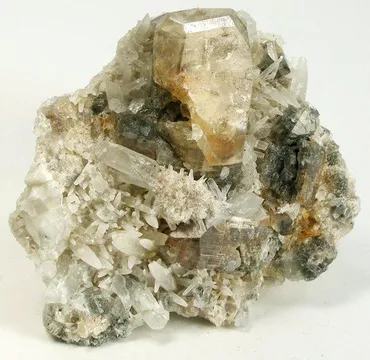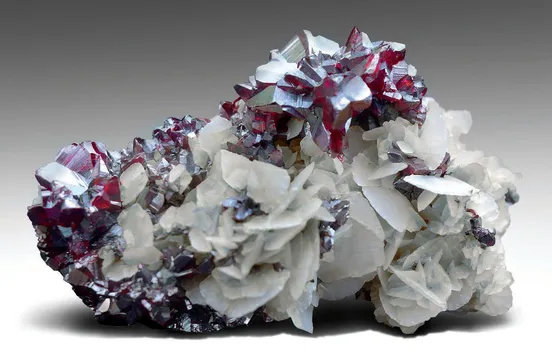
Bad Schlema, Germany - famed uranium and silver vein district in the Erzgebirge, prized for ruby-silver proustite and pyrargyrite crystals on calcite.
Key facts
Bad Schlema is one of the great deceptively small names in European mineral collecting: a spa town in the western Erzgebirge whose underground workings belonged to the enormous Schneeberg–Schlema–Alberoda ore field, a classic vein system where silver, cobalt, nickel, bismuth, arsenic, selenium, and uranium mineralization were repeatedly introduced into fractured Paleozoic rocks near the Aue granite. To collectors, the name immediately calls up “ruby silver” minerals—especially proustite and pyrargyrite—set against pale carbonate gangue, with the finest examples showing sharp, lustrous, deep-red crystals rather than the rubbed, sooty-looking relics so often encountered from old European mines. To ore geologists, Schlema-Alberoda is equally consequential as one of the major uranium vein deposits of the world, developed after the Second World War by SAG/SDAG Wismut and mined on an industrial scale to depths of more than 1,800 m.
The mineral suite is unusually broad because the district is not a single simple vein episode. Quartz-calcite pitchblende veins, dolomite-pitchblende veins, bismuth-cobalt-nickel-arsenide veins, sulphide-calcite veins, and selenium-rich assemblages are telescoped through the deposit. That history gave collectors a palette that ranges from pitchblende, native arsenic, nickeline, rammelsbergite, skutterudite, safflorite, native bismuth, native silver, proustite, pyrargyrite, miargyrite, stephanite, argentopyrite, realgar, and xanthoconite to a remarkable suite of microscopic selenides and bismuth minerals. The best display specimens, however, are usually judged by a very old-fashioned standard: sharp ruby-red silver sulfosalt crystals on contrasting calcite, dolomite, quartz, or ore matrix, preferably with transparency when backlit and with original luster intact.
Regional View
Country View

Photo: Wikimedia Commons

Photo: Wikimedia Commons
The physical landmark that helps explain the district is the Roter Kamm, a quartz-hematite mineralized fault zone exposed at Bad Schlema. It forms a boundary between the Schneeberg Ag-Co-Ni-U field to the southwest and the Schlema-Alberoda uranium deposit to the northeast. In specimen terms, that boundary matters because locality names on old labels can be imprecise: Schlema, Niederschlema, Oberschlema, Schlema-Hartenstein, Aue, Alberoda, Shaft 250, Shaft 38, Shaft 207, Shaft 309, Shaft 366, Shaft 371, and “Schneeberg-Schlema” may refer to closely related but distinct parts of the same historical mining landscape.
Search for specimens: View all specimens from Bad Schlema, Germany
Bad Schlema lies in the western Erzgebirge, now administratively part of Aue-Bad Schlema in Saxony. Mineralogically, the collecting name covers the Bad Schlema portion of the Schneeberg–Schlema–Alberoda district, especially Oberschlema and Niederschlema, with many specimen labels using older names such as Schlema, Schlema-Hartenstein, or Nieder Schlema. The district sits in the Lößnitz–Zwönitz syncline, where low-grade metamorphic Paleozoic rocks—schists, phyllites, amphibolites, diabases, quartzites, and related units—were cut by abundant faults and fissures in the vicinity of the Carboniferous Aue granite. These fractures became repeated pathways for hydrothermal fluids.
The ore bodies were steep hydrothermal veins and vein clusters rather than broad replacement masses. The uranium-bearing veins were commonly narrow but numerous, and the richest zones were concentrated in structural ore knots. Mining and exploration ultimately proved more than 1,000 uranium-bearing veins in the Aue-Bad Schlema dump landscape and an underground system extending to levels deeper than 1,800 m. The most productive uranium concentrations were reported between roughly the -390 m and -1125 m levels, while mineralization continued, though diminished, to the deepest workings.
The paragenesis is the key to understanding Bad Schlema specimens. The older quartz-calcite-pitchblende association, commonly abbreviated KKu in German literature, was followed and overprinted by dolomite-pitchblende and fluorite-bearing MgU assemblages and by later Bi-Co-Ni-Ag-As mineralization. The collectors’ minerals are concentrated in this complicated overprinting: pitchblende and coffinite with carbonates; native bismuth and bismuthinite; native arsenic; nickeline, rammelsbergite, skutterudite, safflorite, and löllingite; ruby silver minerals such as proustite and pyrargyrite; and a strong suite of selenium minerals in the Niederschlema-Alberoda part of the field. Carbonates are not merely background gangue here. Calcite, dolomite, ankerite, and siderite record the fluid history and provide the contrasting matrix for many of the finest silver sulfosalt and bismuth pieces.
Mining history at Schlema is unusually layered. Long before Wismut, the region had silver, cobalt, nickel, bismuth, iron, tin, and related Erzgebirge mining traditions. The Marx-Semmler-Stolln, driven from the Mulde side under the Schlema valley toward Schneeberg and Neustädtel, became both a major drainage adit and a lasting reference level for mining depths in the district. Radioactive waters discovered in the early 20th century gave Oberschlema fame as a radium spa. After 1945, however, the meaning of “Schlema” changed drastically: Soviet-led uranium exploration and then SAG/SDAG Wismut mining turned the valley into one of the central uranium-producing areas of East Germany. The Schlema-Alberoda deposit was discovered as a uranium orebody in 1946, exploited by Wismut, and nearly exhausted by the time uranium mining ended in 1990–1991.
Production was extraordinary. The Schlema-Alberoda deposit alone yielded about 80,000 metric tons of uranium, while the broader Schneeberg-Schlema-Alberoda district is regularly described as one of the world’s largest, and in some sources the largest, uranium vein deposit. Shaft 371, near Aue-Bad Schlema and Hartenstein, became the most important hoisting shaft of the Aue mining operation. Its shaft tube was about 1,000 m deep and 7 m in diameter; the shaft complex employed up to 3,000 people and produced more than 73,000 tons of uranium before closure. The last large Wismut shaft there was sealed in March 2011, and the preserved Shaft 371 complex is now part of the UNESCO World Heritage mining landscape of Erzgebirge/Krušnohoří.
For collectors, the named shafts and veins matter. Shaft 250 is one of the celebrated sources of Schlema proustite, including small but intensely colored crystals on calcite and carbonate matrix. Oberschlema specimens include proustite and pyrargyrite pieces preserved with old labels, some with bright ruby-red reflections under strong light. Niederschlema localities such as Shaft 207 and Shaft 309 are recorded for calcite, dolomite, native silver, proustite, uraninite, bismuth, nickel-cobalt arsenides, and secondary arsenates. Shaft 38 is important for native bismuth, including the “Opal” vein at the -855 m level. Alberoda’s Shaft 366 and the Brahmaputra vein are documented for silver sulfosalts such as pyrargyrite and stephanite, while the rare selenide research material from Niederschlema-Alberoda includes specimens from deep levels near the main shaft 371 area.
Collecting access today should be treated as historical, not recreational. Wismut mining ended more than three decades ago, the underground workings have been flooded or secured, and waste-rock piles and subsidence zones have been extensively remediated. Much of the former mining landscape is under long-term environmental control, heritage protection, or municipal redevelopment. The best legal field experience is educational: the Museum Uranbergbau in Bad Schlema, the Bergbau- und Sanierungslehrpfad around the former Wismut landscape, the Markus-Semmler visitor mine, and heritage sites such as Shaft 371. Specimen collecting from dumps or mine structures should not be assumed permissible; serious collectors should rely on old collections, documented dealer stock, museum exchanges where appropriate, and pieces with precise shaft or vein data.
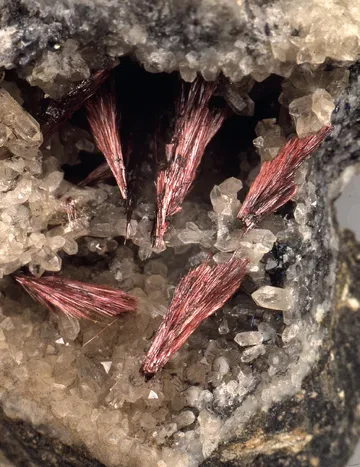
Proustite is the signature collector mineral of Bad Schlema: bright to dark ruby-red Ag3AsS3 occurring as striated prismatic crystals, blocky terminated individuals, sparkling crystal clusters, and small crystals richly scattered over calcite or dolomite. Shaft 250 is especially prized, and dealer and museum records show the classic habit as blood-red, lustrous, sharply terminated crystals on fissured carbonate matrix, commonly a few millimeters across but locally reaching centimeter scale; Oberschlema pieces include crystals around 2 cm, and older literature records exceptionally large Nieder Schlema material. The finest examples are transparent cherry-red when backlit, not merely dark red on the surface, and they retain crisp terminations without the dull blackened skin that ruby silvers develop from poor light exposure or handling. Associations with calcite, dolomite, native arsenic, acanthite, nickelskutterudite, and other silver-arsenide assemblage minerals give the best Bad Schlema proustites their distinctive old-Erzgebirge character.
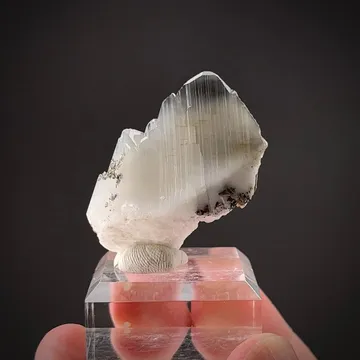
Calcite from Bad Schlema is important less as a stand-alone cabinet species than as the pale stage on which the district’s ore minerals crystallized. It occurs in the quartz-calcite uranium veins and later sulphide-calcite assemblages, and in specimen collections it appears as white to pale grey crystalline matrix, cleaved or fissured carbonate, and locally as modestly fluorescent calcite associated with ruby silver minerals and nickel arsenides. Shaft 250 proustite specimens are known on crystallized calcite, and Niederschlema material records calcite with nickeline, rammelsbergite, and löllingite; some documented pieces show red to pink fluorescence under ultraviolet light. The best calcite-associated specimens are valued for contrast, stability, and aesthetics: clean white or pale carbonate with sharply isolated proustite, pyrargyrite, bismuth, or arsenide crystals is far preferable to massive broken carbonate with rubbed ore blebs.
Pyrargyrite, Ag3SbS3, is the darker antimony-rich ruby silver of Bad Schlema and is generally less common in the marketplace than proustite from the locality, though some old specimens are exceptional. Oberschlema and Niederschlema pieces show short prismatic to stout hexagonal crystals, sharp terminations, metallic dark-red to grey surfaces, and red internal reflections where the crystals remain translucent; documented specimens include miniature groups with crystals to about 0.7 cm, a showy Oberschlema piece with a doubly terminated 1.7 cm crystal in calcite-pyrite matrix, and high-end Schlema examples with parallel or stout crystals reaching several centimeters. Associations include quartz, calcite, pyrite, miargyrite, stephanite, argentopyrite, and other silver sulfosalts, with Shaft 366’s Brahmaputra vein and old Schlema-Hartenstein labels especially worth noting. Good pieces have complete terminations, reflective faces, and visible ruby color under strong light; ordinary ones are black, worn, or massive.
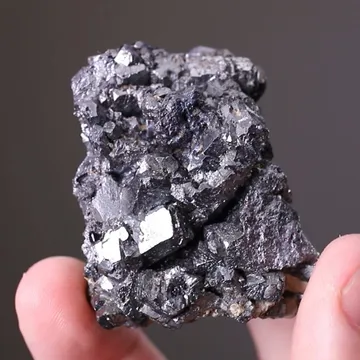
Native bismuth from Bad Schlema belongs to the Bi-Co-Ni-Ag-As part of the district’s mineralization and is best known as silvery metallic crystals, skeletal aggregates, and irregular masses in carbonate-arsenide ore. Niederschlema shafts 38, 207, 309, and 382 are documented for native bismuth, and one particularly notable record describes bismuth crystals to 2.5 cm on dolomite from the “Opal” vein at the -855 m level of Shaft 38, with other pieces showing minor native arsenic and late quartz. These are not the rainbow hopper crystals grown artificially from molten bismuth; natural Schlema bismuth is typically silver-white to grey, sometimes tarnished, and embedded in or perched on dolomite, calcite, quartz, arsenic, or nickel-cobalt arsenide matrix. The best specimens show distinct natural crystal form, clear locality data, and old-mining context rather than anonymous metallic blebs.
Beyond these four species, Bad Schlema and the immediately connected Niederschlema-Alberoda ore field are scientifically important for uraninite, pitchblende, coffinite, native arsenic, native silver, nickeline, rammelsbergite, nickelskutterudite, skutterudite, safflorite, löllingite, realgar, xanthoconite, miargyrite, stephanite, argentopyrite, baryte, fluorite, dolomite, ankerite, siderite, and secondary cobalt-nickel arsenates such as erythrite and annabergite. The locality’s rare-mineral fame rests especially on selenium chemistry: clausthalite, tiemannite, berzelianite, umangite, klockmannite, hessite, hakite-giraudite series minerals, Se-rich tennantite-tetrahedrite, and Bi selenides such as watkinsonite, nevskite, and bohdanowiczite have been studied from the deposit. Schlemaite, (Cu,□)6(Pb,Bi)Se4, is the name-bearing type-locality mineral of the Schlema-Alberoda ore field, described from a 1960 deep-level sample collected from the “Tiber” dike on the -855 m level near Shaft 371.
Bad Schlema specimens reward careful label reading. A precise label naming Bad Schlema alone is useful, but a serious collector should look for older or more exact data: Oberschlema, Niederschlema, Shaft 250, Shaft 38, Shaft 207, Shaft 309, Shaft 366, the Brahmaputra vein, the Opal vein, Schlema-Hartenstein, or a Wismut shaft number. Labels reading only “Schlema,” “Schneeberg-Schlema,” or “Erzgebirge” may still be genuine, but they should be handled as broader district labels unless supported by old collection documentation.
The main authenticity problem is not usually outright fabrication of Bad Schlema locality labels; it is over-broad attribution and species confusion within the ruby silvers. Proustite, pyrargyrite, xanthoconite, miargyrite, stephanite, and dark acanthite can be difficult to separate by casual inspection, especially on old, tarnished, or light-damaged pieces. Proustite should show the arsenic-rich ruby-silver character and commonly a brighter red internal response; pyrargyrite tends darker and more metallic, but color alone is not a reliable determination. For expensive specimens, especially loose ruby-silver crystals or old “Schlema” cabinet pieces without exact provenance, analysis or a highly trustworthy prior collection history is appropriate.
Ruby silver minerals are photosensitive. Proustite and pyrargyrite can darken with prolonged light exposure, and many old European specimens have suffered from decades of display in bright cases. Store the best pieces in darkness and view them briefly under controlled light. Avoid unnecessary washing, ultrasonic cleaning, and aggressive chemical treatment; delicate terminations, carbonate matrix, arsenic-rich associations, and old labels are often more valuable than a freshly cleaned appearance. Realgar, where present, requires even more care because it is light-sensitive and may alter.
Condition is a major value driver. The finest Bad Schlema proustite and pyrargyrite specimens are judged by intact terminations, original luster, visible translucency or red flashes, and attractive contrast with calcite or dolomite. Contacted crystals, rubbed edges, blackened faces, and matrix repairs reduce desirability sharply. Native bismuth requires a different eye: natural bismuth should not be confused with laboratory-grown rainbow hopper crystals. On authentic Bad Schlema pieces, bismuth is a natural silver-grey ore mineral in carbonate-arsenide matrix, commonly associated with dolomite, quartz, native arsenic, or Ni-Co arsenides.
Radioactivity is part of the locality’s identity. Many Bad Schlema specimens are not strongly radioactive if they consist mainly of silver sulfosalts, bismuth, arsenides, or carbonates, but uranium minerals and pitchblende-bearing pieces from the district can be significantly radioactive. Keep uranium specimens boxed, labeled, dust-controlled, and away from prolonged close contact; do not grind, saw, lick, or acid-clean them. Arsenic-bearing species such as native arsenic, löllingite, rammelsbergite, nickeline, realgar, and arsenates also call for basic hygiene: wash hands after handling, avoid creating dust, and keep fragile pieces away from children and food areas.
Current availability is limited and uneven. Small proustite thumbnails from Bad Schlema still appear on the market, but sharp, gemmy, well-labeled pieces from Shaft 250 or old Oberschlema/Niederschlema collections are increasingly difficult to replace. Pyrargyrite is scarcer in attractive collector quality and can command strong prices when crystals are large, lustrous, and well documented. Native bismuth is available mostly as older or specialist material, with good crystal form and exact shaft data being much rarer than simple metallic ore fragments. The end of mining, remediation of dumps, and closure or flooding of underground workings mean that meaningful new specimen production should not be expected.
Bad Schlema’s mineral story has a strange arc: from healing water to atomic ore, from spa architecture to spoil heaps, and finally back to a spa park layered over sealed workings. The same valley that collectors know for ruby silver and pitchblende became famous in the early 20th century for radium-bearing waters discovered in the Marx-Semmler-Stolln. Between 1908 and 1912 those waters were opened up; after 1918 Oberschlema developed into a major radium spa. The contradiction is striking to modern eyes: water enriched by the same uranium system that later drew Soviet mining geologists was first marketed as a cure.
That first spa world was still flourishing during the Second World War. In 1943, the Radiumbad Schlema reportedly reached 17,048 guests, a figure that captures how well established the place had become before the uranium rush. Within a decade the center of Oberschlema was gone. Wismut’s early mining drove near-surface workings through the town with little regard for the old spa district. Subsidence and ground damage became so severe that the spa quarter was abandoned and demolished in 1952. Later remediation literature describes central Oberschlema as a place where mine workings were driven so close to the surface, and without sufficient safety pillars, that subsidence reached up to about 10 m.
The scale of the postwar mining is hard to visualize from the quiet modern landscape. Wismut’s underground system around Schlema-Alberoda accumulated roughly 4,200 km of horizontal excavations and on the order of 40 million cubic meters of underground voids. At depth, rock temperatures around 65 °C created severe ventilation and cooling problems. Shaft 371, the great preserved industrial monument of the district, had a shaft tube roughly 1,000 m deep and 7 m across, employed as many as 3,000 people, and served one of Europe’s deepest uranium mines. This is the setting from which many of the classic collector specimens emerged: not from romantic candlelit silver workings alone, but from a huge Cold War industrial mine.
There is also a quieter scientific story hidden in polished sections. Schlemaite was not a glittering cabinet crystal pulled from a pocket; it was identified from a deep-level sample collected in 1960 from the “Tiber” dike on the -855 m level, block 5128, near Shaft 371. The grain that defined a new mineral species came from a polished section cut from sample S477. Around it lay the evidence of a complicated selenium-rich system—dolomite, ankerite, calcite, eucairite, berzelianite, clausthalite, and other microscopic ore minerals. In Bad Schlema, the same deposit that produced red proustite for collectors also produced tiny, research-grade grains that changed the species list of mineralogy.
The modern visitor walks a landscape made deliberately legible after devastation. Wismut’s Bergbau- und Sanierungslehrpfad begins at the Uranium Mining Museum in the Kulturhaus Aktivist and loops through stations at former shafts, waste-rock piles, viewpoints, the Hammerberg dump, the deformation area, and the Markus-Semmler visitor mine. The fact that the route exists at all is part of the story: a heavily damaged mining landscape was stabilized, covered, reshaped, monitored, and turned into a place where a collector can understand the geology without prying specimens from a dump.
Axel Hiller and Werner Schuppan, Geologie und Uranbergbau im Revier Schlema-Alberoda, Bergbau in Sachsen Band 14, Sächsisches Landesamt für Umwelt und Geologie, Dresden, 2008 — The essential locality monograph for geology, uranium mining, remediation, and historical context of the Schlema-Alberoda district.
Qucosa/SLUB record for Hiller and Schuppan, Geologie und Uranbergbau im Revier Schlema-Alberoda — Bibliographic record with stable citation data, ISBN, and abstract emphasizing the Lößnitz–Zwönitz syncline and the Gera-Jáchymov fault zone.
A. Hiller and W. Schuppan, “Geology and Uranium Mining in the Deposit of Schlema-Alberoda,” GeoScience Engineering, Vol. LVI, No. 3, 2010, pp. 7–9 — Concise English-language summary of the deposit’s structural geology, vein formations, mining levels, and uranium production.
Hans-Jürgen Förster, M. A. Cooper, A. C. Roberts, C. J. Stanley, A. J. Criddle, F. C. Hawthorne, J. H. G. Laflamme, and Gerhard Tischendorf, “Schlemaite, (Cu,□)6(Pb,Bi)Se4, a new mineral species from Niederschlema-Alberoda, Erzgebirge, Germany: description and crystal structure,” The Canadian Mineralogist, Vol. 41, 2003, pp. 1433–1444 — Type-mineral description of schlemaite from a 1960 sample from the “Tiber” dike on the -855 m level near Shaft 371.
Hans-Jürgen Förster, Dieter Rhede, and Gerhard Tischendorf, “Mineralogy of the Niederschlema–Alberoda U–Se–polymetallic deposit, Erzgebirge, Germany. I. Jolliffeite, NiAsSe, the rare Se-dominant analogue of gersdorffite,” The Canadian Mineralogist, Vol. 42, 2004, pp. 841–849 — First paper in the detailed rare-selenide series for the deposit, documenting jolliffeite and the broader Se-rich mineral assemblage.
Hans-Jürgen Förster, Dieter Rhede, and Gerhard Tischendorf, “Mineralogy of the Niederschlema–Alberoda U–Se–polymetallic deposit, Erzgebirge, Germany. III. First indication of complete miscibility between tennantite and giraudite,” The Canadian Mineralogist, Vol. 42, 2004, pp. 1719–1732 — Important paper on Se-rich tennantite-giraudite relations and the Jurassic selenide assemblage.
Hans-Jürgen Förster, Dieter Rhede, and Gerhard Tischendorf, “Mineralogy of the Niederschlema–Alberoda U–Se–polymetallic deposit, Erzgebirge, Germany. V. Watkinsonite, nevskite, bohdanowiczite and other Bi minerals,” The Canadian Mineralogist, Vol. 43, 2005, pp. 899–908 — Detailed treatment of Bi selenides, Bi sulfides, and native bismuth in the deposit.
Christian Wolkersdorfer, “Changes in mine water hydrology during the flooding of an abandoned uranium mine in the Erzgebirge/Saxonia/Germany,” IMWA Proceedings, 5th International Mine Water Congress, Nottingham, 1994 — Technical paper on the controlled flooding of the Niederschlema-Alberoda mine and the role of uraninite and löllingite in mine-water chemistry.
Mindat locality page for Bad Schlema, Aue-Bad Schlema, Erzgebirgskreis, Saxony, Germany — Broad locality page with species list, sublocalities, and photo links for the Bad Schlema collecting name.
Mindat locality page for Niederschlema, Bad Schlema — Useful sublocality page for Shaft 38, Shaft 207, Shaft 309, and other Niederschlema records.
Mindat locality page for Oberschlema, Bad Schlema — Useful sublocality page for Oberschlema ruby silver, arsenide, and secondary-mineral records.
Mindat locality page for Alberoda, Aue-Bad Schlema — Important for the Alberoda side of the Schlema-Alberoda field, including Shaft 366 and the Brahmaputra vein.
“Bad Schlema - Uranium Mining Museum - Valley of Death?” — Walking with heart - Pilgrims Via Francigena — A visitor-oriented video tour of the Museum Uranbergbau and the Bad Schlema uranium-mining story.
“Schacht 371 - Ein Wismut-Bergwerk erfindet sich neu” — MDR, Der Osten - Entdecke wo du lebst — Documentary segment on Shaft 371, its Wismut history, and its reinvention as a heritage site.
“WISMUT - Uranium mining - The vanished villages” — Ralf Sowieso — Historical video compilation on Wismut uranium mining and its impact on settlements.
Wismut GmbH: UNESCO World Heritage — Uranium Ore Mining Landscape — Authoritative overview of the Aue-Bad Schlema dump landscape, Shaft 371, mining depth, production, and remediation.
Wismut Stiftung: Projekt Schacht 371 — Details on the preserved Shaft 371 complex, its technical monument status, and its role in presenting the Wismut legacy.
Wismut GmbH: Sanierungslehrpfad Bad Schlema — Practical guide to the mining and remediation trail around Bad Schlema.
Museum Uranbergbau Bad Schlema — Official site of Germany’s uranium-mining museum, with visitor information and historical focus.
Kurort Bad Schlema: Museum Uranbergbau — Local tourism page noting the museum’s opening in 1996, exhibition size, and focus on Wismut miners’ work and life.
Kurort Bad Schlema: Besucherbergwerk Markus-Semmler — Visitor information for the Markus-Semmler mine and drainage-adit heritage.
Mindat: Bad Schlema locality — Best starting point for checking species, sublocalities, and specimen photos under the Bad Schlema name.
Mindat: Niederschlema locality — Essential sublocality page for many documented Bad Schlema collector minerals.
Mindat: Oberschlema locality — Useful for old ruby-silver and arsenide records from the Oberschlema side of the district.
Mindat: Alberoda locality — Important for Shaft 366, the Brahmaputra vein, and the Alberoda extension of the field.
Wikimedia Commons: Proustite from Schlema — Freely licensed specimen image showing the classic ruby-red character of Schlema proustite.
Wikimedia Commons: Roter Kamm fault at Bad Schlema — Geological image of the quartz-hematite fault zone separating the Schneeberg and Schlema-Alberoda systems.