






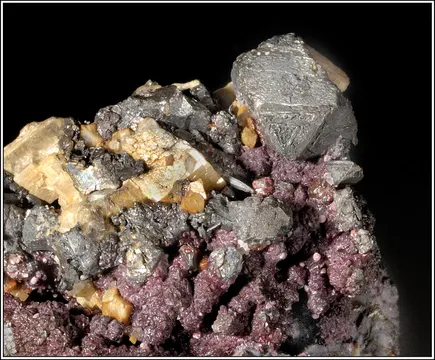
Bismuth — native crystals prized for iridescent patina and high density; rare provenance-driven pieces from Saxony and Jáchymov attract serious collectors.
Key facts
Native bismuth is a rare element species best known to collectors for its silvery-white to pinkish metallic hue, high heft, and distinctive iridescent patina that often develops naturally over time. It crystallizes in the trigonal system (rhombohedral), but natural crystals are usually tabular to wedge-like plates, skeletal laminae, or distorted rhombohedra embedded in quartz- or calcite-rich veins. Free-standing, sharp crystals do occur from classic European vein districts but are typically small. Most market “hopper crystals” with vivid rainbow colors are man-made from melted bismuth; natural specimens seldom show the large, stepped hopper form so familiar from synthetic material.
Bismuth forms in medium- to low-temperature hydrothermal veins with silver, cobalt-nickel arsenides, bismuthinite, and sulfides. In hand, it is soft (Mohs 2–2.5), brittle, extremely dense (≈9.8 g/cm³), and sectile—traits that make pristine terminations and undamaged edges desirable and uncommon. Aesthetically, collectors prize lustrous crystals, attractive iridescence, and context—bismuth perched on white quartz or contrasting with black arsenides can be especially striking. Because of the prevalence of synthetic specimens, provenance and locality confidence are major value drivers in this species.
Natural native bismuth occupies a niche in advanced element and European classics collections. Historic mining regions in Saxony (Germany) and Jáchymov (Czech Republic) yielded the quintessential specimens—small but elegant crystals, plates, and branching aggregates—often with aristocratic provenance and rich mining lore. In North America, the Cobalt camp in Ontario produced fine association pieces of native bismuth with silver and arsenides, which are avidly collected today.
Widespread availability of inexpensive man-made “rainbow hopper” crystals has raised awareness of bismuth, but collectors distinguish strongly between synthetic decorative pieces and natural, locality-documented specimens. Top native bismuth from classic veins is scarce and commands robust prices relative to size; fine, well-crystallized, matrix pieces from Schneeberg, Schlema-Hartenstein, Freiberg, and Jáchymov are especially sought-after, with competition high for undamaged crystals and distinctive patinas.
Below are renowned sources of natural native bismuth, all with documented specimen histories and distinct styles. Each links to a deeper, locality-focused guide.
Part of the famed Wismut uranium-silver vein system, Schlema-Hartenstein produced superb native bismuth during the mid-20th century. Specimens range from bright, laminar plates to neatly crystallized clusters associated with quartz, calcite, and cobalt-nickel arsenides. The most desirable pieces exhibit excellent luster, sharp edges (despite bismuth’s softness), and an appealing patina. With documented origins and recognizably Saxon associations, Schlema specimens hold an important place in modern collections of native elements.
Crystal form and habit:
Luster and patina:
Association and provenance:
Size and integrity:
Condition:
Synthetic vs. natural:
Polishing and surface alteration:
Assembly and glue:
Red flags:
When in doubt, consult literature examples from the same locality or seek input from experienced dealers and curators. Provenance is key.
Bismuth requires gentle handling due to its softness, brittleness, and low melting point.
Handling and environment:
Light and patina:
Cleaning:
Storage and display:
With careful handling, natural bismuth will retain its luster and charm indefinitely, standing as a quintessential piece in element suites and European vein collections alike.