Nevada, USA - a premier mineral locality with Carlin-type gold and Comstock history, featuring Meikle barite, Round Mountain gold, turquoise, cuprite, and more.
Key facts
Nevada is not a single mineral locality in the ordinary sense; for collectors it is a whole province of specimen-producing camps, trends, calderas, skarns, pegmatites, hot-spring systems, mercury districts, copper porphyries, turquoise mines, and Carlin-type gold deposits spread across the Basin and Range. Its best specimens carry the unmistakable look of desert geology: gemmy golden barite from deep gold-mine cavities, smoky quartz scepters from granitic pockets near the California line, turquoise with iron-rich spiderweb matrix, cinnabar in opalite and limestone, native gold leaves on white quartz, cuprite and copper from old copper camps, and skarn minerals from the margins of intrusions against carbonate rocks.
The state’s collecting importance rests on two intertwined histories. The first is mining: prehistoric turquoise workings, the Comstock Lode, 19th-century silver camps, copper at Ely and Yerington, mercury at Opalite and the Humboldt River basin, and the modern Carlin and Round Mountain gold systems. The second is specimen recovery: Nevada’s mines have repeatedly surprised miners and collectors with pockets whose value was mineralogical rather than metallurgical—Meikle barite, Murray stibnite and “sugar cube” barite, Zapot topaz, and Round Mountain crystallized gold among them.
Geologically, Nevada sits in an extraordinarily varied part of the Great Basin. Paleozoic carbonate and siliciclastic rocks were folded, faulted, intruded, mineralized, buried under volcanic fields, pulled apart by Basin-and-Range extension, and later overprinted by near-surface oxidation. That long history gave collectors a catalogue of deposit types: Carlin-type gold deposits in northeastern Nevada, low-sulfidation epithermal precious-metal veins at places such as Round Mountain and the Comstock, porphyry copper and skarn systems at Robinson and Yerington, fluorine-rich pegmatites at Zapot, mercury hot-spring systems at McDermitt and related districts, and secondary phosphate and copper mineral assemblages in oxidized zones.
Regional View
Country View
The finest Nevada specimens are seldom anonymous “state” pieces; their desirability usually depends on a tight mine or pocket attribution. A Meikle label suggests glassy honey-yellow tabular barite on calcite from hot underground voids in a Carlin-trend gold mine. A Murray label may mean black metallic stibnite with barite and drusy quartz, or blocky barite coated with sparkling quartz from the Sugarbowl Pocket. A Zapot label points to an unusual amazonite-topaz-zinnwaldite pegmatite in the Gillis Range, with blue to blue-green topaz and smoky quartz from miarolitic cavities. Round Mountain gold, by contrast, is prized when it keeps its natural crystalline fabric—leaves, wires, plates, herringbone growth, or dendritic forms—rather than merely showing visible metal in quartz.

Photo: Wikimedia Commons

Photo: Wikimedia Commons
Search for specimens: View all specimens from Nevada, USA
Nevada’s mineral-specimen story is best understood as a state-scale suite of deposits rather than a single ore body. Northeastern Nevada is dominated by Carlin-type gold systems in sedimentary rocks, especially along the Carlin and related trends. These deposits are not generally known for visible gold in ore—much of the mined gold is microscopic in arsenian pyrite—but they have produced exceptional specimen minerals from open spaces, faults, collapse breccias, and oxidized zones. The Meikle Mine yielded transparent golden barite and calcite from deep underground voids; the Murray Mine, geologically comparable in its Carlin-type setting, produced stibnite, barite, quartz-coated barite, and quartz casts after stibnite.
The Meikle deposit lies within the Goldstrike area of northeastern Nevada, where sediment-hosted gold mineralization was mined underground and in adjacent open pits. The famous barite pockets were encountered during mine development, not in a public collecting area. Their crystals formed in post-ore cavities and dissolution-collapse breccias, where late fluids deposited calcite and barite. In collector terms, Meikle is important because the barite is not just “from Nevada”; it is a distinctive modern American classic—transparent lemon-yellow to amber, tabular, lustrous, commonly perched on calcite, and often preserved only because mine personnel and collectors recognized the value of the pockets before blasting and mucking destroyed them.
The Murray Mine in the Independence Mountains district of Elko County is equally important but visually different. Its signature specimens are stibnite associated with barite and quartz, plus blocky barite crystals with a glittering coating of drusy quartz. The Sugarbowl Pocket, opened in 2000, produced the most recognizable Murray barite specimens: dark silicified limestone matrix supporting pseudocubic to blocky barite crystals dusted with white quartz, giving a frosted or sugar-coated appearance. Earlier and adjacent zones produced stibnite needles, thicker metallic crystals, and quartz casts where stibnite had apparently been coated and later removed or destroyed during silica deposition.
Western Nevada adds a very different specimen environment. Petersen Mountain and the Hallelujah Junction area near the California-Nevada border are famous for smoky quartz, amethystine quartz, scepters, phantoms, double terminations, and pocket quartz from granitic to pegmatitic systems. These are not ore-mine specimens in the Meikle sense; they are pocket minerals from quartz-bearing cavities in granitic terrain, many recovered by small-scale specimen miners and collectors. The best pieces show sharp sceptering, smoky-to-clear zoning, clean terminations, and strong sculptural form. Ordinary fragments are abundant enough, but intact scepters and large undamaged pocket groups are genuinely selective collector pieces.
The Zapot pegmatite in the Gillis Range of Mineral County is Nevada’s great topaz locality. It is a fluorine-rich amazonite-topaz-zinnwaldite pegmatite with miarolitic cavities, mined for mineral specimens, gem rough, and decorative amazonite-bearing rock. Its topaz is unusual for the state and prized when blue to blue-green, gemmy, well terminated, and still associated with feldspar or smoky quartz. The same locality is also a type locality for simmonsite, Na2LiAlF6, a rare alumino-fluoride mineral of pegmatitic-hydrothermal origin.
The copper camps provide another collecting thread. Robinson, near Ely in White Pine County, and Yerington in Lyon County are major copper districts with porphyry and skarn-related mineralization. Collectors encounter native copper, cuprite, malachite, chrysocolla, azurite, quartz, iron oxides, and locally skarn silicates. Much of the most attractive material is old-stock, dump-collected, or comes from historic high-grade zones rather than current mine faces. Robinson cuprite is often more massive to rich ore-textured than as fine isolated crystals, but polished or broken surfaces can show deep red cuprite with green malachite; Yerington-area material may show copper minerals in altered volcanic, intrusive, or skarn environments.
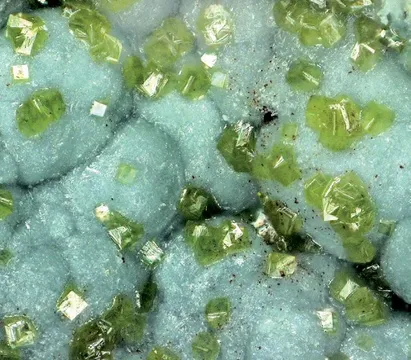
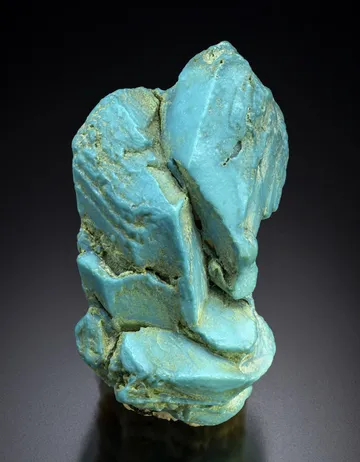
Nevada turquoise is a subject unto itself. Deposits occur in a broad north-northeasterly belt through the state, with famous names including Royston, Candelaria, Lone Mountain, Blue Gem, Number Eight, Carico Lake, Godber-Burnham, Orvil Jack, and Pilot Mountain. These are secondary phosphate deposits formed in oxidized, copper-bearing environments, and the collector market values them as much for mine identity and matrix pattern as for mineral species. Nevada is especially known for hard natural turquoise in blue, blue-green, apple-green, and lime-green hues, often with brown, black, or golden limonite-rich matrix.
Mercury districts add cinnabar, metacinnabar, native mercury, calomel, terlinguaite, corderoite, and other rare mercury minerals. The Opalite/McDermitt area in Humboldt County, the Cahill Mine, Red Bird Mine, Nevada Cinnabar Mine, and other quicksilver deposits produced cinnabar in opalite, limestone, tuffaceous rocks, and silica-rich breccias. These are scientifically interesting and historically important, but they require informed handling: cinnabar is a mercury sulfide, specimens may shed powder, and old mercury-mine dumps can be contaminated.
Access today varies sharply by locality. Some places, such as Garnet Hill near Ely, are managed as public rockhounding areas with clear visitor information, no fee, and surface collecting expectations. Many specimen-famous Nevada localities are not comparable: Meikle, Murray, Gold Quarry, Round Mountain, Robinson, Yerington, and many turquoise mines are active mines, patented ground, private property, tribal land, or valid mining claims. Abandoned workings are common across the state and are a serious hazard; entry into shafts, adits, stopes, and unstable dumps is both dangerous and often illegal. Serious collectors should assume that any mine locality requires current permission unless it is specifically designated for public collecting.
Nevada quartz ranges from vein quartz in precious-metal camps to highly collectible pocket crystals from western Nevada and quartz overgrowths in the Carlin-type gold mines; the most coveted crystallized pieces are smoky, clear, amethystine, sceptered, phantom-rich, or double-terminated crystals from Petersen Mountain and the Hallelujah Junction area, while another distinctive Nevada habit is the sugary drusy quartz coating barite and stibnite at the Murray Mine. Good Nevada quartz is judged less by mere size than by locality-specific character: sharp scepters with smoky stems and clear caps, undamaged terminations, balanced clusters from pocket clay, gold-bearing quartz from Round Mountain with visible crystalline metal, or sparkling quartz casts after stibnite from Murray. Ordinary white vein quartz is common across the mining districts, but display-grade Nevada quartz carries a pocket, mine, or association story.
Nevada barite is famous both as an industrial commodity and as a specimen mineral, but the collector peak is the Carlin-trend material: transparent lemon-yellow, honey, amber, and golden tabular crystals from the Meikle Mine, and blocky to pseudocubic barite with drusy quartz from the Murray Mine. Meikle crystals commonly sit on calcite and are prized when glassy, gemmy, damage-free, and three-dimensionally arranged rather than as flat cleaved fragments; Murray specimens are valued for contrast, with pale or translucent barite on dark silicified limestone, commonly “sugar-coated” by quartz and sometimes accompanied by stibnite. Fine examples are strongly locality-driven, and labels separating Meikle, Murray, Dee, Northumberland, Twin Creeks, and other Nevada occurrences matter to advanced collectors.
Native copper from Nevada is most closely associated with the state’s copper districts, especially Robinson near Ely and Yerington in Lyon County, where copper mineralization belongs to large porphyry, skarn, and related oxidized systems rather than the basalt-native-copper style familiar from Michigan. Collectible Nevada copper is usually found as small sheets, grains, wires, arborescent patches, or rich metallic areas with cuprite, malachite, chrysocolla, quartz, and iron oxides; cabinet specimens with sharp isolated crystals are uncommon. The best pieces show honest metallic copper, attractive green or red copper-mineral contrast, and old locality provenance, while ordinary ore chunks or heavily coated masses have less specimen appeal unless the association or label is exceptional.
“Baryte” is the same mineral species more often spelled “barite” in American mining literature, and Nevada’s finest baryte specimens are the same classic Carlin-trend pieces: Meikle’s golden transparent blades and Murray’s quartz-frosted blocky crystals. In European-style labels the spelling “baryte” often appears on high-end Meikle specimens, especially those distributed through international dealers, and the best examples combine saturated yellow to amber color, high transparency, undamaged thin edges, and a calcite or dark matrix that gives the crystal visual lift. Murray baryte is more sculptural and textural, with sugar-like quartz sparkle, and top pieces preserve full blocky crystal form rather than broken cleavages or overgrown masses.
Nevada stibnite has two collector identities: older material from the Manhattan district and modern Carlin-type gold-mine specimens from northeastern Nevada, especially the Murray Mine, where metallic black to lead-gray striated crystals occur with barite, quartz, stibiconite, and silicified limestone. Murray pockets yielded mostly small needles but also larger crystals and groups, with documented crystals to impressive sizes; the finest specimens show bright metallic luster, sharp terminations, open jackstraw arrangement, and clean contrast against white drusy quartz or pale barite. Because stibnite is soft, easily bruised, and prone to edge damage, undamaged Nevada pieces with good three-dimensional form and reliable mine attribution are far scarcer than simple massive antimony ore.
Nevada topaz is dominated by the Zapot pegmatite near Hawthorne in Mineral County, a fluorine-rich amazonite-topaz-zinnwaldite pegmatite that produced blue to blue-green gemmy topaz, smoky quartz, and amazonite from miarolitic cavities. The best Zapot specimens are not loose waterworn grains but sharp, lustrous, well-terminated crystals, commonly a few centimeters and rarely larger, ideally perched on feldspar or associated with smoky quartz; blue-green color, transparency, and an undamaged termination are what separate major pieces from ordinary broken crystals. The 1999–2000 period is especially associated with memorable Zapot topaz specimens, including display pieces with multiple steely-blue crystals and larger terminal individuals.
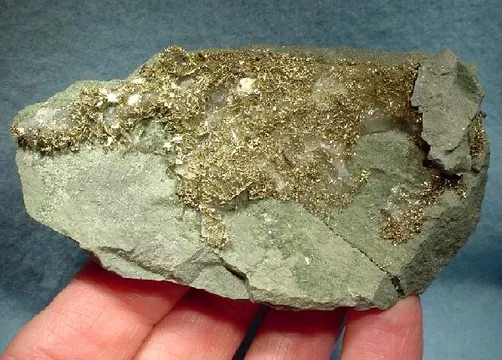
Nevada gold specimens span the 19th-century silver-gold camps, Carlin-type deposits where the gold is usually microscopic, and modern specimen-producing occurrences such as Round Mountain, where visible native gold occurs in quartz-rich low-sulfidation epithermal material. The most desirable Round Mountain pieces show crystallized leaves, wires, dendritic mats, herringbone growth, plates, or hoppery cubic textures on or in white quartz rather than simply massive yellow metal; some pieces are pale because of silver-rich gold to electrum compositions. Fine crystallized Nevada gold is far rarer than the state’s enormous gold production might suggest, and strong pieces require both aesthetic metal exposure and credible provenance because modern preparation, etching, and relabeling can blur the line between attractive ore and true specimen gold.
Nevada cuprite is best known from oxidized copper districts such as Robinson near Ely and Yerington, where it appears with native copper, malachite, chrysocolla, tenorite, azurite, quartz, and iron oxides. Much of the material is massive, granular, or richly disseminated in ore rather than as the brilliant freestanding crystals seen at world-class cuprite localities, but deep red cuprite with malachite-green contrast can make handsome historic Nevada specimens, particularly when old labels tie them to Robinson district mines. The strongest collector pieces show visible red cuprite rather than merely brown oxidized copper rock, and polished faces should be distinguished from natural display surfaces when judging mineral-specimen value.
Nevada turquoise is among the state’s defining collector minerals, with named mines and districts—Royston, Candelaria, Lone Mountain, Blue Gem, Number Eight, Carico Lake, Godber-Burnham, Orvil Jack, Pilot Mountain, and others—producing colors from robin’s-egg blue through blue-green to bright apple and lime green. It forms as a secondary copper-aluminum phosphate in oxidized, fracture-controlled zones, commonly with limonite-rich brown, golden, or black matrix that creates the spiderweb patterns prized by lapidary collectors. The best specimens and rough are hard, naturally colored, well documented by mine, and visually distinctive enough to support the locality attribution; ordinary chalky turquoise, stabilized cutting rough, dyed material, or vague “Nevada turquoise” labels are much less meaningful to serious collectors.
Nevada cinnabar comes from quicksilver districts including the Opalite/McDermitt area, Cahill Mine, Red Bird Mine, Nevada Cinnabar Mine, and other mercury deposits in Humboldt, Pershing, Nye, Storey, and adjacent counties. It occurs as red earthy coatings, impregnations, grains, and local crystals in opalite, tuffaceous sedimentary rocks, limestone, silica-rich breccia, and fault zones, sometimes with native mercury, metacinnabar, calomel, terlinguaite, corderoite, and other rare mercury minerals. The most collectible Nevada cinnabar is vivid red, well localized in contrasting matrix, and preferably crystalline rather than powdery; because cinnabar can darken in light and mercury-mine material may be contaminated or friable, careful storage and handling are part of owning good Nevada examples.
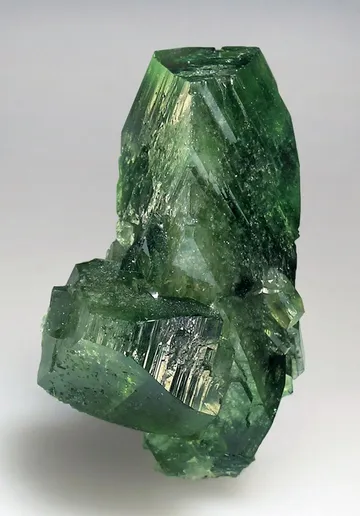
Nevada epidote is most characteristic of skarn, contact-metamorphic, and hydrothermally altered intrusive settings rather than the state’s famous precious-metal veins, occurring with garnet, quartz, actinolite, diopside, wollastonite, fluorite, scheelite, pyrrhotite, and related calc-silicate minerals in districts such as Tem Piute, Mason Pass, Disaster Peak, and skarn-altered zones around older mines. Collectible pieces tend to be green prismatic to bladed crystals, radiating sprays, or massive epidote-rich skarn with contrasting quartz or garnet; the best Nevada examples show saturated pistachio to dark green color, identifiable crystal habit, and an attractive matrix rather than dull granular skarn. Because epidote is widely developed as an alteration mineral, precise locality and specimen aesthetics are what distinguish a collectible Nevada epidote from a common field rock.
Beyond these headline species, Nevada is important for rare and type-locality minerals. The Gold Quarry Mine produced nevadaite and goldquarryite from a remarkable supergene phosphate-vanadate-arsenate-uranate assemblage in altered carbonate rocks. The Zapot pegmatite is the type locality for simmonsite. The Buena Vista Mine is the type locality for coulsonite. The McDermitt mercury deposit produced rare mercury sulfohalides including kenhsuite, and the Red Bird Mine area is tied to rare lead-antimony-mercury and sulfate minerals such as dadsonite, robinsonite, and schuetteite. Other Nevada rarities include galkhaite, orpiment, realgar, wakabayashilite, ammonioalunite, and specialized skarn, pegmatite, zeolite, uranium, and mercury minerals that rarely appear in ordinary specimen commerce.
Nevada specimens reward precise labeling. “Nevada” alone is acceptable only for inexpensive decorative material; serious specimens should carry mine, district, county, and ideally pocket or level information where known. Meikle barite, Murray stibnite and sugar-coated barite, Zapot topaz, Round Mountain gold, and named turquoise mines all lose significant collector value when reduced to a state label.
Turquoise needs the most caution. Nevada mine names are heavily used in the jewelry and lapidary trade, and some names—especially old, rare, or famous mines—are overapplied to material that cannot be proven. Stabilization is common for softer turquoise and is not automatically fraudulent when disclosed, but dyed, reconstituted, backed, waxed, or resin-impregnated material should not be sold as untreated natural turquoise. For collectible rough or specimen-grade turquoise, ask whether the material is natural, stabilized, dyed, backed, or reconstituted, and whether the mine attribution comes from the miner, an old parcel, or merely visual comparison.
Round Mountain gold should be judged for both natural form and preparation. Some specimens are naturally exposed on quartz; others have been acid-prepared or mechanically trimmed to reveal gold. Preparation is not inherently improper, but the price should reflect the quality of the crystallized gold, the amount of metal, the aesthetics of the quartz matrix, and whether the piece has been over-etched into an unnatural-looking sponge. Be skeptical of generic “Nevada gold in quartz” sold without locality, especially if the specimen could be Californian, Australian, or assembled lapidary material.
Meikle and Murray barite are fragile. Thin tabular Meikle crystals chip along edges and corners, and even very fine specimens often have tiny contacts from mining recovery. Murray “sugar cube” barites can shed drusy quartz grains, and the black silicified limestone matrix may hide old repairs or sawed bases. Stibnite from Nevada is soft and brittle; bright crystal edges bruise easily, and long needles are vulnerable to vibration. Store stibnite away from harder specimens and do not clean it aggressively.
Cinnabar and mercury minerals require conservative handling. Do not grind, tumble, saw, or ultrasonic-clean cinnabar specimens, and avoid inhaling dust from old mercury-mine matrix. Wash hands after handling, keep powdery specimens boxed, and store cinnabar out of strong sunlight because some cinnabar can darken on exposure. Native mercury droplets, if present, should be treated as a hazardous feature rather than a curiosity to touch.
Topaz from Zapot has perfect basal cleavage, so crystals can snap or cleave even though topaz is hard. Avoid pressure mounts, tight thumbnail boxes, and careless washing if crystals are attached to friable pegmatite matrix. Blue to blue-green color, sharp terminations, and matrix association drive value; loose broken crystals are much more common on the market than top display specimens.
Availability varies by species. Nevada turquoise and inexpensive barite are continuously available in the trade, but top natural turquoise from depleted or tightly held mines is not. Meikle barite appears regularly from old stocks but true best-of-pocket pieces are finite. Murray stibnite and Sugarbowl barite are increasingly old-collection material. Zapot topaz is limited and often small. Round Mountain gold remains one of the more available modern American crystallized gold localities, but fine pieces with attractive quartz association and strong crystal form are expensive and competitive.
In January 1999, the Murray Mine gave collectors the kind of opportunity that almost never happens twice. Greg Struble, the mine operations manager, took Casey and Jane Jones underground by mine tractor to a working heading known as Z5-100 in the Roberts Mountains Formation. The previous shift had just blasted, and a 5-cubic-yard loader was mucking the broken ore. Between loader passes, the collectors moved in, wet down the muck pile with a hose, and searched quickly before the next scoop erased the evidence. After about an hour, clear pseudocubic barite appeared on the right-hand rib of the drift. Struble told them that voids of that size were rare, and instead of ending the visit he invited them to stay into the night shift so ground support could be installed and the pocket could be reached safely.
That first Murray experience was memorable for another reason: only days earlier, specimen recovery at Meikle had taken place in underground heat close to 110 °F, while the Murray workings hovered around 65 °F. The contrast says much about Nevada collecting in active mines. These specimens did not come from leisurely surface digging. They came from narrow windows between blasting, mucking, ground support, heat, mine schedules, and the constant priority of ore production. A collector could be standing before world-class barite one hour and see the same cavity gone in the next round.
The Murray stibnite pockets were usually modest—fist-sized to football-sized cavities with needles up to about 2 inches—but even the small pockets mattered because the crystals were sharp, metallic, and associated with barite and quartz. In April 1999, after a blast, broken crystals, a few groups, and a couple of undamaged exceptional specimens came off the muck pile. The find hinted that better stibnite existed nearby, but the great in-place stibnite cavern never appeared. Instead, in March 2000 the mine opened something stranger: a large void packed with blocky barite on jet-black silicified limestone, much of it glittering with micro-quartz. The collectors named it the Sugarbowl Pocket. It took several days to recover, produced hundreds of specimens, and became one of the signature Nevada specimen finds of the modern era.
The Zapot pegmatite story has a different rhythm: remote desert, fluorine-rich pegmatite, and a small number of spectacular topaz pockets rather than an industrial gold-mine drift. Harvey Gordon’s operation near Hawthorne worked an amazonite-topaz-zinnwaldite pegmatite for specimens, gemstones, and decorative rock. The best late-1990s and 1999–2000 topaz pieces were not plentiful. One well-known photographed specimen from the locality shows a procession of gemmy steely-blue topaz crystals rising to a sharp 5 cm crystal, a miniature-sized object with the impact of a much larger piece. That is the essential Zapot appeal: Nevada is not expected to produce great topaz, and then a pocket appears that forces American topaz collectors to make room for a new locality.
Nevada turquoise carries the oldest field story in the state’s mineral record. At several deposits, modern prospectors found evidence that they were not the first miners: stone tools, fragments, rubbing stones, and ancient workings. The Crescent area in southern Nevada is especially evocative, with accounts of prehistoric mining and later rediscovery by modern prospectors in the late 19th century. The repeated pattern is striking: a remote desert hill, copper-stained rock, old pits or debris, and turquoise valued first by Indigenous miners long before the state’s silver and gold booms.
Round Mountain shows the gap between metal production and specimen survival. The mine is a large open-pit gold operation, and its purpose is not to preserve aesthetic gold. Yet some ore zones produced crystallized native gold in quartz—leaves, wires, plates, and mossy or dendritic growths—that survived well enough to enter collections. Early geologic descriptions of Round Mountain noted specimen ore with gold plates in fine quartz and even gold on adularia from rich veinlets on top of Round Mountain. Modern collectors prize the same phenomenon in a newer mining context: visible crystalline gold that escaped the crusher.