Mohawk Mine, California — a classic Mojave micromount locality famed for tiny arsenate and carbonate crystals (mimetite, beudantite, adamite, smithsonite) priz…
Key facts
The collector assemblage represented by this Mohawk mine entry is the Mohawk Mine on Mohawk Hill in the Clark Mountain District, San Bernardino County, California, a compact but exceptionally rich oxidized Pb-Zn-Cu-Ag-Au occurrence developed in carbonate rocks along the southern Clark Mountains near the California–Nevada line. It is not a Canadian mineral locality in the geological literature; Canadian “Mohawk mine” usage most commonly points instead to a small silver-cobalt occurrence in the Cobalt area of Ontario, while the species suite below belongs to the Mohawk Hill locality of the eastern Mojave. For specimen purposes, that distinction matters: the Mohawk Hill mine is a classic micromount locality for secondary arsenates and carbonates, especially mimetite, beudantite, adamite, conichalcite, smithsonite, hetaerolite, chalcophanite, wulfenite, hemimorphite, aurichalcite, rosasite, malachite, cuprite, and related lead-zinc-copper oxidation minerals.
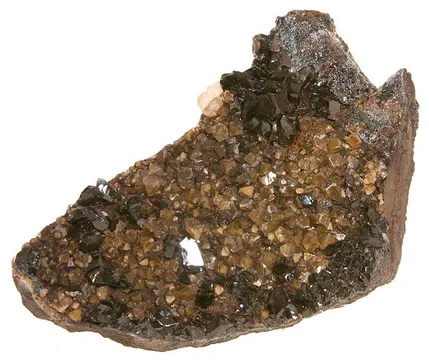
The mine sits in a limestone and dolomite host cut by quartz monzonite and by fracture-controlled, brecciated ore zones. Its best specimens are not large showpieces; they are precise, high-magnification pieces from limonitic boxwork, gossan cavities, and oxidized vein material. The appeal is in miniature architecture: lustrous yellow-brown beudantite plates, orange to yellow mimetite, pale blue-green cuprian adamite, green conichalcite tufts and botryoids, bright malachite in vugs, clear to white smithsonite scalenohedrons, and black manganese-zinc oxides sparkling against ocherous iron oxides. The mine’s fame rests on variety, crystal perfection at microscopic scale, and the unusual arsenate chemistry generated by oxidation of a polymetallic ore body whose primary sulfides were only sparsely preserved.
Regional View
Country View
The mine’s collecting story has two lives. Economically, it was a modest lead-zinc-silver-copper producer, with early work tied to the Copper World and Ivanpah operations and a later 1940s–1950s phase under Mohawk Mines Inc. As a specimen locality, it became important later, especially to Southern California micromounters, because nearly every pocket of gossan seemed to contain a different chemical variation on lead, zinc, copper, manganese, iron, arsenic, sulfur, and carbonate. Mohawk specimens are therefore best judged less by cabinet size than by cleanliness, verified identity, fresh crystal surfaces, and locality precision down to the adit or pocket where known.

Photo: Wikimedia Commons
Search for specimens: View all specimens from Mohawk mine, Canada
The Mohawk Mine of the Clark Mountain District is a former Pb-Cu-Au-Ag-Zn-Mn mine complex on and around Mohawk Hill, north of Interstate 15 and north of Cima in northeastern San Bernardino County. Historical names attached to the same mine complex include Clark Station Mine, Pactolus Mine, and Wilshire prospect. The principal workings were driven into Mohawk Hill as three adits at different levels, with drifts, stopes, winzes, and raises amounting to more than 2,500 feet of underground development. The mine was never a large tonnage producer, but it exposed an unusually reactive oxidized ore environment, and that is what made it important to collectors.
The deposit is fracture- and breccia-controlled mineralization in carbonate rocks near quartz monzonite. Published descriptions place the ore in limestone and dolomite, especially within a zone of silicified and recrystallized carbonate where fractures cross contact zones. The ore bodies are irregular veins and breccia reservoirs rather than a single simple tabular lode. In the Upper East Adit, one of the clearest examples followed a vein only a few feet wide, and other ore shoots varied in thickness and attitude. Quartz, calcite, ankerite, iron oxides, and manganese oxides form much of the gangue and alteration matrix. The oxidized character of the workings is critical: none of the mine workings reached substantial unoxidized ore, so the collector assemblage is overwhelmingly secondary.
The primary ore was probably a Pb-Zn-Cu-Ag-Au sulfide assemblage. Galena, sphalerite, chalcopyrite, pyrite, arsenopyrite, and traces of native gold and native silver have been reported or inferred from preserved material and from the secondary chemistry. Oxidation transformed that sparse primary sulfide record into the mine’s real mineralogical signature: lead arsenates and sulfates such as mimetite and beudantite; zinc and copper arsenates such as adamite, austinite, conichalcite, duftite, and olivenite; zinc carbonates and silicates such as smithsonite and hemimorphite; copper carbonates and oxides such as malachite, azurite, cuprite, and chrysocolla; and manganese-zinc oxides such as hetaerolite and chalcophanite.
Mining began early in the twentieth century. The Mohawk property was probably first worked with the nearby Copper World Mine under Ivanpah Smelting Company control, and it had already accumulated several hundred feet of underground workings by the time it was surveyed for patent in 1900. By 1908 it was associated with L. D. Godshall and the Cocopah Mining Company. During the World War I period, the mine produced lead-copper-silver-zinc ore, with ore hauled to the railroad at Cima; high-grade shipping requirements meant that only lead-rich ore was worth sending out. The property was idle for a period, then leased in the early 1940s and operated more continuously from 1944 to 1952 for lead and zinc under Mohawk Mines Inc. and associated lessees.
Collectors know the mine from a later chapter. From the 1970s through the 1990s, Mohawk became a prized micromount locality, especially among Southern California collectors. Material from the western adits, the Upper East Adit, the dumps, and stoped areas yielded sharply crystallized secondary minerals in limonitic cavities. Many of the best pieces are microscope specimens rather than hand specimens: a 1 mm beudantite cluster, a 750 micrometer green conichalcite aggregate with yellow-brown beudantite plates, a 3 mm patch of pale blue-green cuprian adamite, or a 6 mm vug containing goethite replacing cuprite needles with malachite.
Collecting access today should be regarded as closed unless current written permission is obtained from the land and mineral-rights holder. The mine has been posted against trespass, roads to the adits have been chained, and underground workings in this terrain present serious physical hazards. The best modern route to collecting Mohawk specimens is therefore the secondary market, older micromount collections, club dispersals, and pieces traceable to named collectors who worked the locality before access tightened.
Domeykite is the one species in this EarthWonders Mohawk grouping that demands special label scrutiny: the verified Mohawk Hill, San Bernardino County assemblage is an oxidized lead-zinc-copper arsenate/carbonate suite and does not stand in the literature as a domeykite locality, while “Mohawk” domeykite and “mohawkite” labels classically refer to the Mohawk Mine at Mohawk, Keweenaw County, Michigan, where brassy copper-nickel arsenide masses, commonly described under the historical mohawkite name, are associated with algodonite, nickeline, rammelsbergite, quartz, calcite, and native copper or silver. A good Mohawk-labeled domeykite specimen should therefore be treated as a label problem first and a mineral problem second: the desirable pieces are heavy metallic masses or polished/sawn arsenide ore with fresh brassy to bronze surfaces and clear Keweenaw provenance, whereas Mohawk Hill labels attached to domeykite require analytical and historical support before being accepted.
Mimetite is one of the signature collector minerals of the Mohawk Hill mine, occurring as small yellow to orange lead arsenate crystals on limonitic gossan, commonly with beudantite, hemimorphite, goethite, and other secondary Pb-Zn-Cu minerals. The best pieces are micromounts with isolated, lustrous crystals or bright crystalline coatings that stand cleanly against dark brown iron oxide; ordinary material is merely yellowish crust on boxwork and can be difficult to separate visually from neighboring beudantite, segnitite-group minerals, or other lead arsenates without magnification and, for ambiguous pieces, analysis. Mohawk mimetite is especially attractive when it keeps sharp form and color in small cavities rather than forming dull, powdery coatings.
Smithsonite from Mohawk Hill is documented as both typical steep scalenohedrons and more unusual forms combining scalenohedron and pinacoid faces, generally as white, clear, gray-white, or pale aggregates in the zinc-rich parts of the oxidized ore. Good specimens are microscope pieces showing discrete radiating clusters or clear individual scalenohedrons, often associated with hetaerolite, chalcophanite, hemimorphite, quartz, or limonitic matrix; less desirable pieces are massive or sugary carbonate coatings with little crystal definition. The finest Mohawk smithsonite has the crisp geometry and contrast that make the mine’s microminerals so satisfying: pale zinc carbonate set against black Mn-Zn oxides or ocher gossan.
Beudantite is abundant and varied at Mohawk Hill, forming brown to yellow-brown lustrous coatings, pseudocubic rhombohedral crystals, hexagonal-looking plates, rosettes, irregular wafer-like clusters, and massive crusts on limonitic boxwork. Crystal size is generally microscopic, but exceptional individuals and clusters approach about 1 mm across; darker crystals tend to be larger, while smaller plates grade toward yellow-brown or yellow. The best pieces show bright, well-separated plates or blocky pseudocubes with mimetite, conichalcite, hemimorphite, carminite, anglesite, or goethite as associates, and the ordinary ones are hard-to-read brown coatings that disappear visually into the gossan unless lit and magnified well.
Malachite at Mohawk Hill is a secondary copper mineral of the oxidized workings, most valued as small green sprays, needles, and vug linings rather than large botryoidal masses. Documented specimen material includes green malachite in a vug in massive cuprite, with goethite replacing cuprite needles in the middle stoped area of the western adits; other pieces occur with goethite, cuprite, calcite, and the mine’s broader arsenate suite. Strong pieces have bright saturated green color, open acicular texture, and sharp contrast with red-brown cuprite or dark goethite, while common material is thin green stain on limonite or carbonate matrix.
Adamite from Mohawk Hill is best known as pale blue-green to light green cuprian adamite in small crystals and crystal clusters, typically in the same oxidized zinc-copper arsenate environment that produced conichalcite and austinite. It can occur as transparent pale blue-green crystals with green botryoidal conichalcite, or as small blue-green crystal groups in fields of view only a few millimeters wide; material from the Mohawk Mine Annex workings is also represented in collector photographs. Top pieces show clean, lustrous, discrete crystals with blue-green color and verifiable cuprian character, while ordinary examples grade into ambiguous green arsenate crusts that can be confused visually with conichalcite or cuprian austinite.
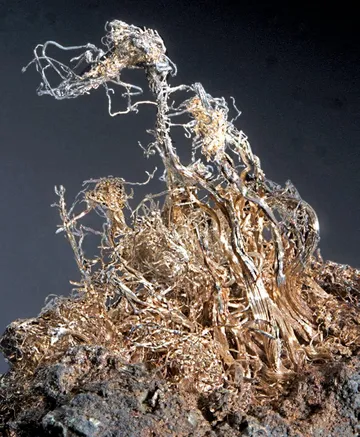
Native silver is a minor but historically important species at Mohawk Hill, reflecting the silver component of the Pb-Cu-Zn ore and the mine’s record as a lead-copper-silver-zinc producer. It is not the showy wire-silver style of Cobalt, Ontario or the Keweenaw copper district; Mohawk Hill silver should be expected as small native grains, blebs, or inconspicuous metallic occurrences in oxidized or partly oxidized ore, with chlorargyrite also part of the secondary silver story. The best pieces are those with convincing metallic silver in context and old, specific labels; mediocre or doubtful specimens are easy to overcall because gray manganese oxides, galena remnants, and dark limonite can mimic metallic flecks under casual inspection.
Conichalcite is a characteristic green copper-calcium arsenate at Mohawk Hill, appearing as radiating crystals, botryoidal aggregates, and crystalline green coatings in close association with adamite, austinite, beudantite, hemimorphite, and chlorargyrite. The best documented pieces show green radiating conichalcite crystals with yellow-brown beudantite plates in submillimeter fields, or pale blue-green adamite resting with greener conichalcite; such associations are visually superb but analytically tricky because conichalcite and cuprian austinite form a compositional continuum in the mine. Good specimens have clear green color, radial texture, and distinct boundaries from neighboring arsenates, while ordinary pieces are simply green crusts on gossan.
Goethite is both a major visual component of Mohawk Hill gossan and a collectible species when it forms distinct textures rather than anonymous brown iron oxide. It occurs with malachite, cuprite, sauconite, mimetite, rosasite, and beudantite, and one especially instructive style shows goethite replacing cuprite needles, with malachite in a vug in massive cuprite from the middle stoped area of the western adits. The best goethite specimens preserve pseudomorphic form, botryoidal or acicular detail, or strong association with bright copper minerals; ordinary pieces are abundant limonitic boxwork and should not command much attention unless they host sharper arsenates or carbonates.
Beyond the species highlighted above, the Mohawk Hill mine is especially important for its broader oxidized Pb-Zn-Cu-As-Mn suite. Documented minerals include agardite-(Y), anglesite, ankerite, aragonite, arsenbrackebuschite, arseniosiderite, arsenopyrite, aurichalcite, austinite, azurite, beaverite-(Cu), brochantite, calcite, carminite, cerussite, chalcanthite, chalcophyllite, chalcopyrite, chalcosiderite, chlorargyrite, chrysocolla, cuprite, delafossite, dioptase, duftite, epsomite, fluorite, fraipontite, galena, hematite, hemimorphite, hetaerolite, hidalgoite, jarosite, massicot, mixite, native copper, native gold, native sulphur, olivenite, plumbojarosite, pyrolusite, quartz, rhodochrosite, rosasite, sauconite, scorodite, sphalerite, tsumebite, and wulfenite. Among these, hetaerolite with smithsonite and chalcophanite is particularly prized by micromounters; chalcophanite occurs as brownish-black platy or rose-like aggregates to several millimeters; and massicot pseudomorphs after cerussite, chlorargyrite on conichalcite, and rare arsenate-suite combinations give the locality unusual depth for systematic collectors.
The largest authenticity issue is locality confusion. “Mohawk Mine” is a repeated mine name across North America, and three different traditions can collide on labels: Mohawk Hill in San Bernardino County, California; the Mohawk Mine in Keweenaw County, Michigan, famous for mohawkite and domeykite-bearing arsenide ore; and the Mohawk mine in the Cobalt area of Ontario, Canada, associated with silver-cobalt district mineralization. The species suite in this guide—mimetite, beudantite, adamite, conichalcite, smithsonite, hetaerolite, chalcophanite, malachite, and related arsenates—is the Mohawk Hill, California suite. Domeykite or “mohawkite” attached to this same locality should be questioned unless the specimen has unusually strong documentation.
Most Mohawk Hill specimens are micromounts. Hand specimens may be visually unpromising until magnified, and the best value lies in sharply crystallized cavities. Labels that mention an adit, “western adits,” “Upper East Adit,” “middle stoped area,” a Paul Adams or Southern California micromount provenance, or a club giveaway connected with documented Mohawk collecting are more informative than vague “Mohawk mine” labels. Because several visually similar arsenates occur together, analytical confirmation is desirable for beudantite-segnitite group minerals, conichalcite versus cuprian austinite, adamite-conichalcite mixtures, and less common species.
Condition issues are typical of oxidized gossan micromounts: delicate crystals can be crushed by careless trimming, limonitic matrix can shed grains, and blue-green arsenates may be hidden in friable cavities. Avoid washing specimens aggressively. Use air bulb cleaning and careful mechanical removal under magnification if necessary. Some sulfates and salts reported from the assemblage are more moisture-sensitive than the main arsenates and carbonates, so stable storage in a dry microbox is prudent. Because arsenates and lead minerals are common, handle broken material sensibly, avoid generating dust, and wash hands after working with specimens.
Mohawk Hill material is not common on the broad cabinet market, but it appears with some regularity in micromount circles, older Southern California collections, and online offerings of small boxed specimens. Prices tend to reflect identification confidence and aesthetics rather than size: a small but sharp, verified beudantite, mimetite, adamite, conichalcite, hetaerolite-smithsonite, or malachite-cuprite association can be more desirable than a much larger but featureless gossan fragment. The most collectible pieces combine color contrast, open crystal growth, analytical or expert identification, and an old, locality-specific label.
On October 27, 1917, D. G. Thompson photographed one of the most evocative scenes from the mine’s working life: an ore-loading platform, a burro ore train, and ore wagons at the Mohawk mine. The image belongs to the World War I chapter of the southern Clark Mountains, when high metal prices briefly made remote desert ore worth moving. Ore from the related Copper World operation was being hauled by tractor to the Rosalie smelter at Valley Wells, and copper matte then had to travel about 25 miles to the Salt Lake Railroad at Cima before shipment to the smelter at Garfield, Utah. The Mohawk’s own ore followed the same desert logic: only material rich enough to justify transport could leave the hill, and lead content determined whether rock was ore or merely a colorful burden.
The Mohawk’s early production was selective and hard-earned. During the World War I period, the mine produced 2,893 tons of lead-copper-silver-zinc ore valued at $70,000. The ore was hauled to the railroad at Cima, and only ore running more than 16 percent lead was shipped. Those numbers explain the mine’s personality underground: a small, selective operation chasing narrow, irregular, oxidized shoots rather than a vast industrial system. For collectors, that selectivity left behind the kind of broken limonitic cavities and oxidized seams that later yielded microcrystals.
A different Mohawk emerged decades after commercial mining. By the 1970s, the mine had become a micromounter’s place: not a destination for glittering cabinet pieces pulled from cavernous pockets, but a locality where patient collectors broke gossan and found entire mineral associations in fields of view measured in millimeters. Later photographs of Mohawk specimens read almost like tiny stage directions: green radiating conichalcite with yellow-brown beudantite plates in a 750 micrometer view; pale blue-green transparent adamite with green botryoidal conichalcite in a 1.5 mm field; goethite replacing cuprite needles with malachite in a 6 mm vug. That is the mine’s real collector romance—the Mojave reduced to miniature chemistry.
The mine also became a lesson in generosity and circulation. At the 2019 Leidy Micromineral Symposium and the Pacific Micromount Conference in Fallbrook, specimens collected by Paul Adams moved onto giveaway tables and into many private micromount collections. Some of the most carefully photographed modern Mohawk pieces trace to those distributions. In that sense, Mohawk specimens traveled farther through microscopes than the ore ever traveled by wagon: from a posted desert hill to small perky boxes, stacked photographs, and specialist collections around the world.