Madoc Township, Ontario - premier fluorspar locality known for green, amber, and purple fluorite in banded vuggy veins; old Canadian pedigree and Bailey mine f…
Key facts
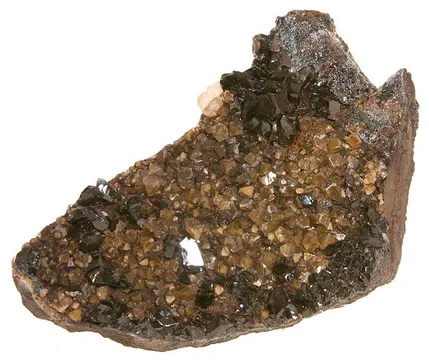
Madoc Township sits in the old mineral belt of Hastings County, eastern Ontario, where fluorite was not a picturesque accessory but an ore mineral worked seriously enough to make the district the dominant Ontario fluorspar producer. The collector’s Madoc is built around a set of low-temperature fluorite veins occupying northwest-trending fractures tied to the Moira fault system and its subsidiary breaks. The veins cut Grenville marble, Paleozoic Black River limestone, granite, and locally andesite; their typical fabric is banded, vuggy, crustiform fluorite-calcite-baryte vein matter rather than the open, cathedral-like pockets of a classic alpine fissure. That geology gives Madoc specimens their particular look: green, colorless, amber, yellowish, smoky, and rarer purple fluorite in cubes and modified cubes, commonly with creamy to pinkish baryte and white to pink calcite, and often with the slightly weathered iron staining that marks old dump pieces.
Regional View
Country View
The best Madoc fluorites are not usually judged by sheer crystal size alone. They are prized for old Canadian pedigree, sharpness, translucency, color zoning or phantom-like internal architecture, and the association with the district’s characteristic baryte. Specimens labelled simply “Madoc” may come from several closely spaced mines in the Madoc–Moira Lake fluorspar camp, particularly Bailey, Keene, Rogers, Kilpatrick, and related properties. Within Madoc Township proper, Bailey is the flagship collector name: discovered in the 1890s, reopened several times, and famous as the first fluorite mine to operate in the Madoc area. The wider Madoc district also carries a second, quite different mineralogical fame through the Taylor Pit sulfosalt occurrence, a small marble-hosted locality at Madoc that became one of Canada’s great type-locality stories for microscopic lead-antimony-arsenic sulfosalts.
Search for specimens: View all specimens from Madoc Township, Canada
The fluorspar deposits at Madoc are classic fault-vein deposits. They occur as lenticular fracture fillings along the Moira fault and in parallel subsidiary fractures west of the main break. Older descriptions divide the district into the Moira Lake group, lying on the principal fault zone, and the Lee-Miller group, occupying narrower subsidiary fissures. Although the EarthWonders locality name is Madoc Township, collectors should understand the label historically: “Madoc” on an old fluorite specimen often refers to the mining camp around Madoc village and Moira Lake, including workings that modern administrative geography may place in Centre Hastings or former Huntingdon Township as well as Madoc Township.
The bedrock setting is unusually important for recognizing the material. The veins cut Grenville-series marble, pink granite related to the local batholiths, Paleozoic Black River limestone and dolomitic limestone, and locally volcanic rocks. In the main fluorspar veins, the essential minerals are fluorite, calcite, and baryte. Celestine, quartz, marcasite, pyrite, sphalerite, and scattered sulphide minerals occur in lesser amounts. Banded fluorite-baryte-calcite ore is common, and in some places the banding is so fine that it was a metallurgical nuisance: hand-cobbing could not cleanly separate the fluorspar from baryte and calcite. The collector’s equivalent is a very recognizable texture—greenish fluorite in rhythmic bands or blocky crystals against creamy baryte, with pockets lined by small cubes or modified cubes.
The individual ore lenses were modest but locally rich. In the Moira Lake group, lenses reached widths of roughly 18 feet and lengths of several hundred feet. In the Lee-Miller group, individual lenses were usually much narrower, commonly under 3 feet, though one breccia zone was recorded at about 7 feet maximum width over several hundred feet. Run-of-mine material varied widely, but historic descriptions give fluorite contents commonly in the 50 to 75 percent range, with calcite and baryte forming most of the remainder. Baryte tends to become especially important toward the southern part of the district, and this is reflected in many specimens: attractive fluorite-only pieces occur, but highly characteristic Madoc cabinet specimens often show fluorite with baryte rather than isolated, matrix-free crystals.
Bailey is the principal Madoc Township name attached to collector fluorite. The deposit was reportedly first noticed in the 1890s by Nicholas Fleming while excavating a cellar. Stephen Wellington optioned the property in 1905 and worked it again in 1907, then H. B. Hungerford recovered ore in 1916 and 1917. The major producing period came from 1944 to 1950, when Millwood Fluorspar Mines Limited recovered about 25,000 tons of ore from surface and underground workings. The workings included an open cut about 80 feet long, 15 feet wide, and 44 feet deep, and later underground levels at about 100 and 179 feet connected to a shaft east of the open cut. The vein strikes northwest and is continuous with the Keene deposit across the township boundary; at Bailey it was recorded as reaching widths up to 12 feet, with 1- to 2-foot bands of nearly pure fluorite reported along either wall on the 100-foot level for lengths as great as 80 feet. The wallrock is grey-black argillite and banded Grenville marble, a setting that helps distinguish Bailey pieces from the limestone-hosted material of some neighboring mines.
Other Madoc Township fluorite workings include the Lee Senior, McIlroy, Wallbridge and Herrington, and William Reynolds mines. Wallbridge and Herrington was discovered in 1918 by G. M. Wallbridge as a continuation of the Lee Senior main vein and produced fluorspar from open cuts and shafts during the early 1920s, then again under Dominion Fluorspar Company Limited from 1941 to 1943; historic shipments are estimated at about 6,600 tons. William Reynolds was much smaller, with 88 tons shipped in 1941–1942, but it is a useful collector reference point because documented specimens show colorless fluorite cubes to about 1 cm with colorless calcite and white baryte aggregates; some fluorite portions from the occurrence fluoresce white under longwave ultraviolet light. Lee Senior and McIlroy are smaller names on labels but belong to the same narrow-vein fluorspar story and carry the usual fluorite-calcite-baryte assemblage.
Water shaped the mining history as much as geology did. Mines north of Moira Lake, especially Rogers, Kilpatrick, and Perry Lake, struggled with heavy inflow along the fault zone. Historic accounts record pumping capacity reaching 2,000 gallons per minute at some operations, yet ore was still left in lower workings when inflow exceeded what could be managed. The source was from the north along the fault system rather than directly from Moira Lake, a point that led to the practical trick of one operator waiting for a neighbor to pump out before restarting after winter shutdown. South of Moira Lake and in much of the Lee-Miller group, water was less troublesome, and some narrow open cuts could be worked without elaborate pumping.
The district’s production rhythm followed demand. The most active periods were during and just after the two World Wars. From the beginning of recorded fluorspar mining in Ontario in 1905 to the last recorded Ontario activity in the early 1960s, the Madoc district supplied the bulk of Ontario’s fluorspar output. During the Second World War, concern over metallurgical-grade fluorspar shortages led to Canadian government support through loans, diamond drilling, geophysical work, and consideration of a custom flotation plant. In 1943, a systematic drilling campaign put more than 18,000 feet of holes into the Moira fault system, searching for near-surface ore lenses and offsets. The proposed custom mill was ultimately not built because reserves were considered insufficient for the scheme.
Collecting access today must be treated conservatively. The old mines are abandoned industrial sites, many on private land, with fenced shafts, collapsed collars, open cuts, water-filled workings, and crown-pillar hazards documented in provincial abandoned-mine records. Bailey, for example, has had fenced and posted features, a collapsed shaft collar, concrete foundations, an open cut, backfilled raises, and underground workings extending beneath an active road allowance. Collectors should not assume that an old guidebook locality is open; permission, current safety status, and land ownership have to be confirmed before any visit. Much of the collector market is supplied by older material from mine dumps, estate collections, and Canadian show circulation rather than fresh collecting.
Madoc Township fluorite is best known from the fluorspar veins of the Bailey and allied Lee-Miller deposits, where it occurs in green, colorless, amber to yellowish, reddish, smoky, and less commonly purple tones as massive bands, translucent vein sections, cubes, modified cubes, and locally sharp vug crystals. Bailey material is typically associated with calcite and baryte, with minor marcasite and sulphides, and the better specimens show clean luster, undamaged cube faces, good translucency, attractive green or yellow color, and enough baryte or calcite matrix to prove the locality without overwhelming the fluorite. Ordinary pieces are massive or granular “gravel spar,” heavily iron-stained, or bruised from ore handling; the more desirable collector pieces preserve vuggy crystal faces, zoning, phantom-like internal growth, or pale green cubes on contrasting creamy baryte. Size ranges from small thumbnail fragments to cabinet specimens, but the important distinction at Madoc is aesthetic survival from a working fluorspar camp: pieces that escaped crushing, hand-cobbing, and decades of dump weathering are the ones collectors compete for.
Madoc Township itself has a broader mineral record than fluorite. Baryte, calcite, marcasite, pyrite, sphalerite, tetrahedrite-subgroup minerals, celestine, and quartz belong to the fluorspar-vein assemblage, while other township localities add iron, sulphide, and gold occurrences: the Eldorado Copper Mine is associated with chalcocite, chalcopyrite, hematite, magnetite, and pyrite; the Richardson and Sophia mines are among the Madoc Township gold localities; and marble and skarn-related occurrences add tremolite, serpentine-group minerals, magnetite, tourmaline, and related species. The nearby Taylor Pit at Madoc is the systematic-mineral collector’s great prize: a small marble-hosted sulfosalt occurrence famous as the type locality for madocite, veenite, twinnite, playfairite, launayite, sorbyite, guettardite, sterryite, dadsonite, morleyite, and, more recently, lopatkaite. These are not showy hand specimens in the fluorspar sense; they are mostly microscopic metallic grains and intergrowths in carbonate matrix, often requiring X-ray, electron-microprobe, or polished-section work for reliable identification.
The chief authenticity issue with Madoc fluorite is locality precision. Many older labels say only “Madoc,” “Madoc Township,” or “Madoc, Ontario,” even when the specimen may have come from Bailey, Rogers, Keene, Kilpatrick, or another mine in the broader camp. This is not necessarily deception; it reflects how material circulated during and after the mining years. For high-value pieces, an old Canadian label, mine-specific provenance, or a collection history back to a known Ontario collector adds real value. A specimen labelled “Bailey Mine” should make mineralogical sense: fluorite with baryte and calcite, often in greenish to yellowish tones, is plausible; a dramatic habit alien to the district should invite closer scrutiny.
No well-known commercial treatment tradition is associated with Madoc fluorite. The market problem is not irradiation or dyeing so much as misattribution, overconfident mine assignment, and occasionally cleaning that strips away useful locality clues. Iron staining is common on dump-collected pieces; careful cleaning may improve appearance, but aggressive acid work can undercut calcite associations, loosen baryte crusts, or erase the very patina that helps support an old-field origin. Calcite-rich matrix also means specimens should be kept away from acidic cleaners unless the intention is deliberate matrix reduction.
Condition is central. Fluorite is brittle and cleaves perfectly, and Madoc material from ore workings often shows bruised corners, cleaved faces, chatter marks, or missing cubes. Baryte crusts can be friable, and marcasite-bearing pieces should be monitored for sulphide decay, especially if stored in damp conditions. Keep suspect marcasite-bearing specimens dry and away from other labels and boxes that could be damaged by acidic alteration products. Pieces with old mine grime but intact fluorite faces are often better left only lightly cleaned.
Fluorescence is variable rather than a defining market feature. Some documented William Reynolds fluorite fluoresces white under longwave ultraviolet light, but collectors should not assume a strong, uniform response across the district. Test gently, record the response with wavelength if it matters to the specimen, and avoid using fluorescence alone to authenticate a Madoc label.
Taylor Pit sulfosalts require a different collector mindset. Apart from a few visually distinctive metallic grains, these are analytical minerals. Many look like black to lead-grey blebs in marble; without polished-section work or reliable analytical provenance, names such as madocite, veenite, twinnite, sterryite, and playfairite should be treated cautiously. In the systematic market, a tiny verified type-locality grain can be more important than a larger but unanalyzed metallic patch.
Madoc fluorite is available but not abundant in fine condition. Small to moderate specimens still appear from old Ontario collections and regional shows, and massive or iron-stained pieces are not especially rare. Sharp, aesthetic cabinet specimens with strong color, bright luster, baryte association, and an old label are much scarcer. Mine-specific Bailey pieces carry extra interest because Bailey was the first operating fluorite mine in the Madoc area and one of the township’s principal producers.
The Madoc fluorspar story begins, appropriately, underground before anyone had sunk a mine. Nicholas Fleming was excavating a cellar on what became the Bailey property when he encountered the fluorite vein. That domestic accident—an orebody found in the making of a house—became the seed of the first operating fluorite mine in the Madoc area. Stephen Wellington optioned the ground in 1905, came back to it in 1907, and recovered early ore from shallow workings. By the time Millwood Fluorspar Mines Limited was operating Bailey in the 1940s, the humble cellar find had grown into an open cut 80 feet long, 15 feet wide, and 44 feet deep, with underground levels at 100 and 179 feet and roughly 25,000 tons of ore taken during the last major producing period.
The miners who chased the Moira fault north of Moira Lake fought a different adversary: water. The district’s ore lenses were not just narrow and discontinuous; they were cut by open channels that could turn a working stope into a shower room. Rogers and Kilpatrick each had two 1,000-gallon-per-minute deep-well pumps, yet the pumps were not always enough. In one account, broken ore was left in the bottom stopes of the Kilpatrick mine in 1959 after a routine blast opened a sudden increase in inflow. Attempts to seal it failed, and the water rose to waist depth. The ore stayed behind. In a wonderfully practical bit of mine-camp strategy, operators learned that the water came from the north along the fault, not directly from Moira Lake. After winter shutdown, a northern operator could wait for a neighbor to pump out first, letting that effort lower the water in his own mine as well.
The Second World War brought Madoc into a national industrial story. Fluorspar was needed as a metallurgical flux, and a shortage was feared badly enough that the Canadian government stepped in. In 1942, more than $100,000 in loans went to four Madoc-area producers, to be repaid from earnings. In 1943, the district received the kind of systematic attention small mines rarely saw: 110 drill holes totalling 18,608 feet, laid out mostly at about 100-foot intervals, probing the upper 250 feet of the Moira fault over an aggregate 10,000 feet of strike. The fault itself showed as a broad conductive zone in geophysical work, while the fluorite lenses tended to sit along one margin or the other. The same program considered whether a custom flotation plant could treat the awkwardly banded fluorite-baryte-calcite ore. Laboratory tests showed that a concentrate could be made, but the reserve picture did not justify the mill.
The Taylor Pit story is smaller in scale and larger in mineralogical consequence. The locality was once described as an antimony-rich counterpart to the legendary Lengenbach Quarry, but that comparison flatters the eye more than the hand. Taylor Pit did not yield elegant centimetric sulfosalt crystals in open vugs; its treasures were tiny metallic grains locked in marble. In 1966, L. Moyd of the National Museum of Canada and H. Steacy of the Geological Survey of Canada removed about 2,000 pounds of material. That haul was broken into several hundred pieces. The first sorting produced roughly 200 pieces with visible sulphide grains, and X-ray work on those pieces yielded only 18 useful hits—16 of them veenite. From that stubborn, unshowy rock came a suite of type minerals that made the Madoc name permanent in systematic mineralogy.