A collector's guide to Black Rapids Mine, Canada: its geology, mining history and notable minerals, illustrated with the 101 specimens documented from this locality on EarthWonders.
Key facts
Black Rapids Mine is one of those Canadian locality names that demands a careful label reading. The documented mine at Black Rapids is the old Black Rapids Quartz Mine near the Lyndhurst area of Lansdowne Township, Leeds and Grenville Counties, southeastern Ontario: a Grenville-age quartz-crystal occurrence in brecciated gneiss, worked chiefly for clear and milky quartz crystals rather than for metallic ore. In the strict geological literature, this is a quartz locality—rock crystal, doubly terminated crystals, milky-to-clear prisms, hematite-stained crystals, chlorite or hematite phantoms, and pockets lined with specular hematite are the historically described collector material.
For serious collectors, its significance is twofold. First, it is a classic southeastern Ontario wartime quartz locality, part of the small group of Leeds County deposits mined when clear quartz crystal had strategic value for radio-frequency control and optical equipment. Second, it now carries an important modern marketplace caution: some specimens catalogued under “Black Rapids Mine, Canada” show a phosphate assemblage of lazulite, siderite, quartz, wardite and augelite—an assemblage much more characteristic of the famous Rapid Creek–Big Fish River phosphate district in Yukon than of the documented Ontario Black Rapids Quartz Mine. The best such pieces are visually superb: inky blue to nearly black lazulite crystals on white quartz with honey-brown siderite, and, on some phosphate-suite material, pale to greenish wardite or augelite. But the locality name should be handled as a label problem unless a specimen’s chain of custody is unusually strong.
Regional View
Country View
The Ontario mine proper is set in the Central Metasedimentary Belt of the Grenville Province. Its quartz occurs in large vugs and cavities cementing brecciated rock, with paragneiss as the principal host and quartzite recorded nearby. Collectors should picture a small hard-rock quartz operation rather than a broad ore mine: pits, open workings and later underground work following the breccia zone, producing crystals that range from small clear points to much larger milky doubly terminated individuals.
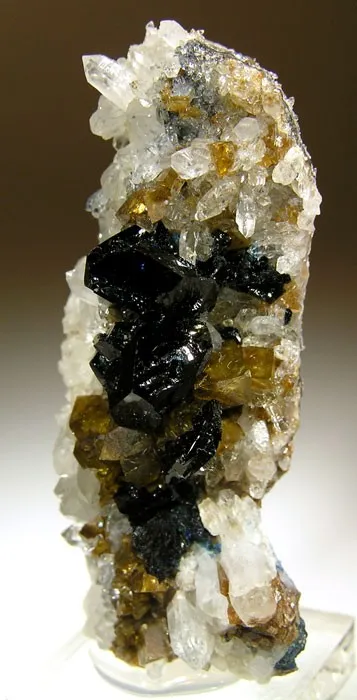
Photo: EarthWonders
The photographed specimen illustrates the modern label issue beautifully: it is a fine lazulite-siderite-quartz association entered as Black Rapids Mine, Ontario, yet the assemblage and style are the kind collectors usually associate with Yukon phosphate material. That does not make the specimen unattractive—quite the opposite—but it does mean the locality attribution deserves scrutiny before the piece is represented as documented Ontario Black Rapids material.
Search for specimens: View all specimens from Black Rapids Mine, Canada
The documented Black Rapids Mine is the Black Rapids Quartz Mine of Lansdowne Township, in the Lyndhurst or Black Rapids area of Leeds and Grenville Counties, Ontario. Government inventory records place it in the Grenville Province, Central Metasedimentary Belt, with Mesoproterozoic host rocks. The principal host is paragneiss, and quartzite is recorded as adjacent lithology. The economic commodity was quartz, with mineral-specimen quartz also recognized in the modern inventory record.
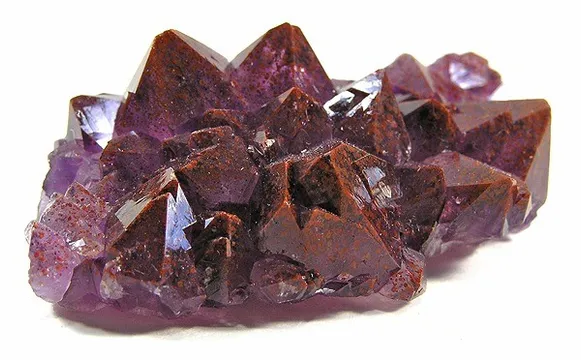
The deposit is best understood as a quartz-crystal occurrence in brecciated Grenville rocks. The quartz filled vugs, open spaces and cavities in the breccia; the collectible material consisted of individual crystals and clusters rather than massive vein quartz alone. Ann P. Sabina described clear and milky quartz crystals in vugs in quartz veins, with clusters and individual doubly terminated crystals up to about 5 inches long. Most crystals were slender and up to about 2 inches long, with the larger examples commonly milky and clearer toward the terminations, while the smaller crystals were generally clearer and better quality. Hematite and chlorite films could create phantom crystals, and reddish-brown hematite coatings and micaceous specularite between crystals were part of the classic look.
The mining history begins earlier than the wartime rush. Ontario’s mineral inventory records quartz mining by A. Sherman in 1897, acquisition by J. Moorhead in 1901, production by the Red Horse Lake Mining Syndicate in 1942–43, and production by Quartz Crystals Mining Corporation of Canada Limited from 1951 to 1954. Geological sources also record work beginning in the World War II period, when clear quartz had strategic value for radio and radar equipment. Later, Quartz Crystals Mines Limited mined crystals from both open pit and underground workings. By 1958, the pit was described as roughly 70 feet long, 50 feet wide and 40 feet deep; later work deepened the opening and added underground development.
The mine had an unusual afterlife as a specimen source. In 1963 it was operated by J. B. “Jim” Steele, apparently for the mineral trade, and quartz crystals could reportedly be purchased from him by the pound regardless of quality. Sabina’s collecting guide made a point of saying that collecting at the mine itself was not allowed, though specimens could be purchased from Steele; nearby Higley Lake prospect pits in the broader Lyndhurst–Black Rapids quartz area were noted as places where quartz crystals could be collected.
For collectors today, the most important practical fact is the divide between the mine proper and the broader label. The Black Rapids Mine in the Ontario geological literature is a quartz locality with calcite, hematite/specularite, chlorite, biotite, cordierite, garnet and pyroxene-group minerals documented. The celebrated lazulite–siderite–wardite–augelite phosphate suite belongs, in the published mineralogical literature, to the Rapid Creek–Big Fish River district of Yukon. When a specimen labelled “Black Rapids Mine” carries that phosphate assemblage, it should be treated as a locality-sensitive piece until the label history is resolved.
Lazulite specimens currently grouped under Black Rapids Mine on EarthWonders show the highly attractive collector style of deep blue to nearly black, lustrous, twinned or wedge-like crystals on contrasting quartz with brown siderite; one documented marketplace example has a larger lazulite crystal about 1 cm across on a 6.0 x 2.5 x 2.2 cm specimen. The strongest pieces are those with isolated, sharp, undamaged blue crystals standing proud of the quartz-siderite matrix, rather than dark crowded aggregates lost among quartz points. As locality evidence, however, lazulite is the warning species here: published records for the Ontario Black Rapids Mine proper do not include lazulite, while the same lazulite-siderite-quartz association is famous from the Rapid Creek phosphate district in Yukon.
On the lazulite-bearing specimens catalogued under Black Rapids Mine, siderite appears as transparent to translucent honey, amber or brown rhombohedral crystals nestled among quartz points and blue lazulite, providing the warm colour contrast that makes these pieces so displayable. Good examples show clean, glassy rhombs separated enough to read individually, especially where they form a row or partial crust around the lazulite; ordinary examples are dull, iron-stained or so crowded that the siderite serves only as brown matrix. Siderite is not part of the published Ontario Black Rapids Mine mineral list, so its presence with lazulite and phosphate species should prompt a provenance check rather than be accepted casually as an Ontario Black Rapids association.
Quartz is the true historically documented collector mineral of Black Rapids Mine. The mine produced clear and milky crystals from vugs in quartz veins cutting brecciated Grenville rocks, including clusters and individual doubly terminated crystals; reported crystals ranged from very small clear points to larger milky crystals, with some examples exceeding 30 cm in later mining accounts and many smaller examples prized for clarity. The best Ontario Black Rapids quartz specimens show sharp terminations, transparency near the tips, attractive hematite or chlorite phantoms, reddish-brown hematite coatings, or sparkling specularite in the interstices; damaged milky fragments and iron-stained massive pieces are far less desirable. In the phosphate-style specimens grouped here, quartz plays a different aesthetic role as a white, clear or drusy matrix for lazulite and siderite, and those mixed-species pieces need the same locality scrutiny as the lazulite material.
Wardite associated with material catalogued under Black Rapids Mine should be approached as part of the same label-sensitive phosphate suite: pale greenish, bluish, white or colourless tetragonal crystals with quartz and lazulite are characteristic of the celebrated Yukon phosphate assemblage, not of the documented Ontario Black Rapids quartz mine. In this context, the most desirable wardite pieces would be those with distinct, lustrous, well-formed crystals visible as a separate species rather than tiny pale crusts hidden in matrix, and the best associations would show clear textural relationships with lazulite, siderite and quartz. Because wardite is absent from the published Black Rapids Mine mineral list, any “Black Rapids” wardite specimen deserves a hard look at old labels, dealer history and whether “Rapid Creek” may have been confused, abbreviated or mistranscribed.
Augelite in the Black Rapids Mine grouping is best treated as a rare accessory in the labelled phosphate-suite material rather than as a verified mineral from the Ontario mine proper. Where present on such specimens, it should appear as small, lustrous, thick tabular crystals or microcrystalline patches, commonly pale, white, yellow-green or greenish, adding mineralogical interest to lazulite-siderite-quartz plates. The highest-quality examples would show abundant, identifiable augelite in good contrast with lazulite and quartz; ordinary pieces may require magnification and confirmation because pale phosphate coatings can be easy to overcall. As with wardite, augelite is a strong signal that a specimen may belong to the Rapid Creek–Big Fish River phosphate suite rather than to the documented Black Rapids quartz mine in Ontario.
Other minerals documented from the Ontario Black Rapids Mine proper include calcite, hematite and specularite, chlorite-group minerals, biotite, cordierite, garnet-group minerals and pyroxene-group minerals. The broader Lyndhurst–Black Rapids area also has quartz varieties such as rock crystal, sceptre quartz and smoky quartz at nearby occurrences, plus additional minerals recorded from neighbouring workings. No type-locality mineral is documented from the Ontario Black Rapids Mine. By contrast, the Rapid Creek–Big Fish River phosphate district—often implicated when lazulite, wardite, augelite and siderite appear together—has a remarkable type-locality record including minerals such as arrojadite-(KNa), barićite, garyansellite, gormanite, kulanite, marićite, nahpoite, penikisite, rapidcreekite, satterlyite and wicksite.
The first collector note for Black Rapids Mine is provenance, provenance, provenance. There is a real, documented Black Rapids Quartz Mine in Ontario, and there is a world-famous Rapid Creek phosphate district in Yukon. A label reading “Black Rapids” on a lazulite-siderite-quartz specimen can easily sit in the danger zone between the two. If the piece contains lazulite, wardite, augelite or the familiar Yukon phosphate suite, do not assume Ontario Black Rapids unless the label trail is explicit, old and internally consistent. A specimen with old Rapid Creek, Kulan Camp, Crosscut Creek, Big Fish River or Yukon wording may have been mis-entered into a database or marketplace category; conversely, a quartz-only specimen from Lyndhurst or Black Rapids, Ontario may be perfectly legitimate Black Rapids Mine material.
Condition issues differ by assemblage. For Ontario quartz, check for bruised terminations, chips along prism edges, iron-stained contacts and rehealed or phantom zones that may be attractive rather than damaging. Smaller clear crystals are often more appealing than larger milky crystals, unless the larger crystal is doubly terminated, undamaged and has good form. Hematite coatings and specularite are part of the locality’s character and should not automatically be cleaned away.
For lazulite-suite pieces in this locality grouping, inspect the blue crystals carefully under strong light. Lazulite can appear almost black in thick crystals, so luster, sharpness and transparency at thin edges matter. The most desirable specimens show discrete blue crystals with minimal edge abrasion, not just dark masses embedded in quartz. Siderite rhombs should be checked for cleaved corners and dulled faces. Wardite and augelite may be small and pale; confirmation may require magnification, comparison with old labels, or analytical documentation on high-value pieces.
No well-documented treatment tradition is known for Black Rapids quartz beyond ordinary cleaning, but any quartz locality can produce acid-cleaned specimens. Overcleaning can strip iron oxides that define phantoms and pocket character. For phosphate-suite material, avoid aggressive cleaning: associated carbonates and hydrated phosphate minerals can be more delicate than quartz, and labels are often as valuable as the minerals themselves. Keep original labels, dealer cards and collection notes with the specimen.
Market availability is uneven. True Ontario Black Rapids quartz appears as an older locality specimen rather than a steady mine-run product. Lazulite-siderite-quartz pieces under the Black Rapids name are available in the marketplace grouping, but the buyer should treat them as attractive phosphate-suite specimens with a locality question unless the supporting provenance is unusually strong. In general, sharp lazulite on quartz with bright siderite will sell on aesthetics; fully documented Rapid Creek provenance will usually be more valuable and more defensible than a vague or contradictory “Black Rapids” label.
During World War II, the Black Rapids quartz deposit was not just a rural Ontario collecting spot—it was part of a strategic mineral hunt. Clear quartz was sought for radio-frequency control and optical equipment, and government records later noted that Black Rapids crystals were mined for radio-frequency control and bomb sights. The numbers are striking for a locality collectors now think of in hand specimens: 5,610 tons of rock were removed, yet only some quartz crystals were recovered. Most of the crystals were small, many no more than a quarter inch in diameter; the best clear pieces were the exception that justified the work.
The place then shifted from wartime material source to collector locality. By the early 1960s, J. B. “Jim” Steele was operating the property, and the story has the pleasing directness of an older mineral-trade era: quartz crystals could be bought from Steele for $1.00 per pound, with no premium for quality. That detail is worth remembering when evaluating old labels. A superb, clear, doubly terminated Black Rapids quartz crystal may once have left the mine as part of a by-the-pound lot, not as a curated cabinet specimen.
Ann Sabina’s collecting description gives the locality its field texture. The mine lay about 1.5 miles northeast of Black Rapids, on the north side of the road to La Rose Bay on Charleston Lake, with the turnoff from the Lyndhurst–Lansdowne road near the bridge at Black Rapids. She was clear that collectors were not to collect at the mine itself, but could purchase specimens from Steele. Nearby, around the west side of Higley Lake, old prospect pits offered quartz collecting in the same broader Lyndhurst–Black Rapids district. That distinction—mine property versus nearby pits—is another reason old “Black Rapids” labels can be imprecise.