A collector's guide to Thunder Bay District, Canada: its geology, mining history and notable minerals, illustrated with the 66 specimens documented from this locality on EarthWonders.
Key facts
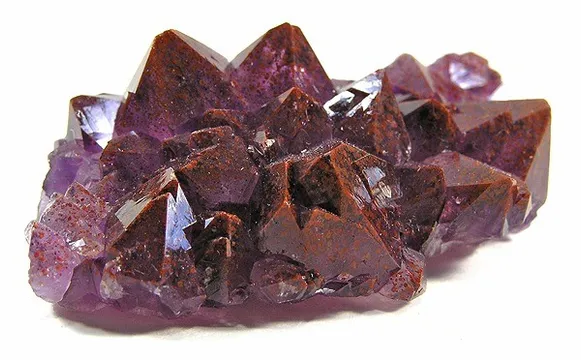
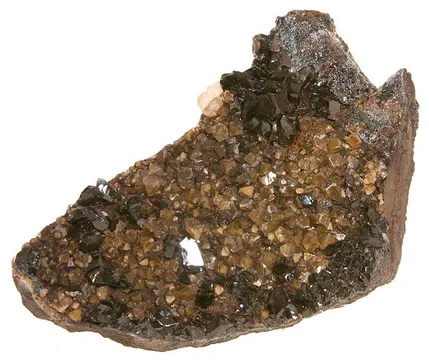
Thunder Bay District is one of the great North American names in collector quartz, but it is not a single mine or a single style. It is a broad, rugged Lake Superior district whose best-known specimen production comes from the amethyst-bearing fault and breccia systems east and northeast of the city of Thunder Bay, especially in McTavish Township around Loon Lake, Pearl, and Big Pearl Lake. The classic pieces are unmistakable: low, glittering plates and knobs of quartz crystals in violet, smoky purple, lilac, reddish brown, and nearly black tones, often dusted or internally freckled with hematite so that the crystal faces appear wine-red, brick-red, or “rust capped” over purple interiors.
The geological setting is part of the reason Thunder Bay amethyst looks so different from the basalt-geode amethyst of Brazil, Uruguay, or the Paraná Basin. The Ontario material grew in veins and open cavities along faults and breccia zones near the unconformity between Archean crystalline basement and Proterozoic sedimentary rocks of the Sibley and Animikie successions, with later Midcontinent Rift tectonism providing the fractures, fluid pathways, and open spaces that quartz needed. In the best pockets the crystals are not towering prismatic individuals; they are typically pyramidal, lustrous, tightly grouped, and dramatically zoned. Fine pieces reward close looking: hematite may be present as red coatings, red growth layers, or tiny spherical to discoidal inclusions suspended in quartz.
Regional View
Country View
Collectors should also remember that Thunder Bay District is much larger than the amethyst belt. It includes the famous flooded Silver Islet mine on Lake Superior, one of Canada’s legendary native-silver localities; the Hemlo gold deposit near Marathon, a scientifically important gold-tellurium-antimony-thallium-mercury mineral province and type-locality area; and important mafic-ultramafic, alkaline, pegmatitic, and base-metal occurrences scattered through the Canadian Shield. Yet on the specimen market the name “Thunder Bay” most often means amethyst, quartz, and hematite from the McTavish-area mines and prospects.

Photo: Wikimedia Commons
Search for specimens: View all specimens from Thunder Bay District, Canada
The specimen-producing amethyst district lies mostly east to northeast of Thunder Bay, along and near Highway 11/17 in McTavish Township and adjacent parts of Shuniah. The important amethyst deposits are hydrothermal vein and breccia occurrences rather than geodes in basalt. Quartz, amethyst, smoky quartz, red hematite-rich quartz, barite, calcite, fluorite, sphalerite, chalcopyrite, pyrite, goethite, and other minor species occur in variable proportions from mine to mine. The veins are closely tied to faults and fractured rock near the Archean-Proterozoic unconformity; the most productive openings formed where fault systems intersected or where brecciation created interconnected vugs.
At Amethyst Mine Panorama, the commercial history traces back to a discovery made during road construction for access to the McTavish fire tower area. The Thunder Bay Amethyst Mining Company was incorporated in 1960 with Rudy Hartviksen as president, and the operation evolved from quarry production and lapidary stone into a public collecting and tourist mine. Modern Amethyst Mine Panorama is an open surface quarry with a public dig area; the operation has long supplied rough, landscape stone, lapidary material, and specimens, and its “pick your own” stock is replenished from active mining.
Diamond Willow Mine, near Pearl and Big Pearl Lake, is one of the most important specimen names for serious collectors. It works an amethyst-bearing vein in McTavish Township and is associated historically with Gunnard Noyes and later family operators. A particularly important chapter in its collector output came from careful seasonal work by David and Ian Nicklin on a leased part of the vein. Their approach—slow drilling, light blasting, wedges where possible, and careful extraction from clay-filled pockets—helped preserve some of the most admired lustrous plates and red-capped groups from the district. Many older labels simply say “Thunder Bay,” but the best modern labels should specify Diamond Willow, Amethyst Mine Panorama, Blue Point/Blue Points, Loon Lake, Pearl, McTavish Township, or another exact property.
Blue Point Amethyst Mine, also in the Pearl area, is important both for public collecting and for its mineralogical contrast. It is reported from an east-west fault-contact setting between crystalline granitic rocks and sedimentary mudstones, and it has produced classic hematite-included amethyst as well as associated barite, calcite, sphalerite, chalcopyrite, and other vein minerals. Diamond Willow and Blue Point are close enough that their geology and collecting experience are naturally compared, but good labels should not merge them.
The pockets that produce collector specimens are irregular. Some are no more than small crystal-lined cavities; others are large enough to yield plates, knobs, and sizeable masses. A famous published account from the district records cavities from a few centimeters across up to a chamber measured in meters, and a very large amethyst crystal reported at 61 cm across. The best pieces, however, are not merely large. Quality is determined by lustre, depth and richness of purple, sharpness of crystal faces, attractive hematite zoning, freedom from blasting damage, and whether the cluster has enough natural form to read as a mineral specimen rather than decorative garden stone.
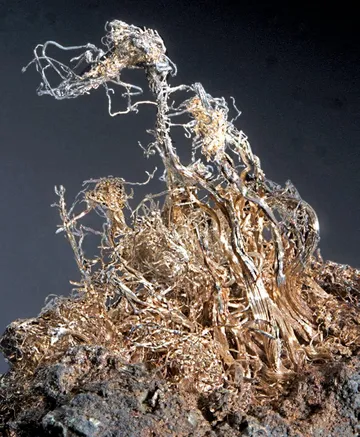
Silver Islet belongs to a different chapter of Thunder Bay District mineral history. Discovered in 1868 on a tiny rock in Lake Superior near the Sibley Peninsula, it became one of the most dramatic native-silver mines in Canada. The ore was worked below lake level from an artificial island built up with cribbing, fill, and breakwaters, and the mine produced native silver in carbonate-quartz gangue with acanthite, nickel-cobalt-arsenic-bismuth minerals, and sulphides. The mine closed after flooding in the 1880s, and specimens from the original workings are historical pieces rather than contemporary collecting material.
Farther east in the district, the Hemlo gold deposit near Marathon is not a typical cabinet-specimen locality, but it is mineralogically important. Hemlo ore is hosted in highly deformed Archean rocks and is enriched in gold together with elements such as molybdenum, antimony, mercury, thallium, vanadium, and tungsten. The deposit and its mines—Williams, David Bell, and Golden Giant—have yielded microscopic and polished-section rarities that matter greatly to systematic mineralogy, including several type-locality species.
Collecting access today is practical only at operating public amethyst sites or by explicit permission on private claims. Amethyst Mine Panorama, Diamond Willow, and Blue Point have advertised public or seasonal dig-your-own collecting in recent seasons, with site-specific rules, fees, tool limits, safety requirements, and opening dates. Old silver mines, flooded shafts, industrial mine sites, highway cuts, and active or claimed prospects are not open collecting grounds simply because they are famous on labels. Thunder Bay District is vast, much of it is private, claimed, park, municipal, or industrial land, and serious collectors should treat permission as part of the specimen’s provenance.
Thunder Bay amethyst is most prized as lustrous, compact groups of pyramidal quartz crystals ranging from pale lavender to deep purple, smoky violet, red-purple, and nearly black, with hematite commonly present as red caps, red growth zones, or tiny internal disks and spherules that give the crystals their unmistakable Lake Superior character. Crystals are commonly around 1–2 cm on plates and knobs, though larger individuals occur, and doubly terminated crystals are rare; the finest pieces from Diamond Willow, Amethyst Mine Panorama, Blue Point, and related McTavish Township deposits combine strong wet-looking lustre, saturated colour, intact terminations, and attractive hematite zoning rather than the dull, broken, clay-stained surfaces common in ordinary mine-run material.
Quartz from Thunder Bay District includes colorless, milky, smoky, amethystine, red hematite-rich, and locally citrine- or prasiolite-toned material in veins, breccias, and vugs, and it is best understood as a continuum rather than as separate specimen styles. Good quartz pieces may show clean glassy points, smoky-purple zoning, white-to-clear-to-purple layered growth, or red hematite phantoms; at the amethyst mines, the most collectible quartz is not plain massive vein quartz but sharply crystallized vug material with balanced form, strong lustre, and district-specific colour contrasts, especially where clear or smoky quartz grades into amethyst with hematite-rich growth layers.
Hematite is the signature accessory mineral of Thunder Bay amethyst, most often seen not as separate bladed crystals but as red to brown coatings, caps, late growth layers, and microscopic to submillimetric inclusions inside quartz. In the best Diamond Willow and related McTavish Township pieces, hematite forms red speckles, disks, spherules, and dense reddish zones that float within or lie just beneath the quartz surface; collectors prize pieces where the hematite enhances rather than muddies the amethyst, producing crisp red-on-purple contrast without excessive iron staining, dull crusts, or damage from clay-filled pocket collapse.
Millerite is a much rarer and less visually familiar Thunder Bay District species than amethyst, recorded from multiple district localities associated with nickel-bearing sulphide, mafic-ultramafic, and metalliferous vein settings rather than the public amethyst dig piles. Collector examples should be approached as locality-specific specimens: the desirable habit is the classic brassy acicular to hairlike NiS crystal form, ideally in protected cavities or carbonate/sulphide gangue, but Thunder Bay District labels without a precise mine or occurrence are weak because the district includes many unrelated geological environments and “Thunder Bay” alone does not tell a collector whether the specimen comes from an amethyst vein, a silver vein, a PGE-Ni-Cu occurrence, or another setting entirely.
Other documented minerals from Thunder Bay District give the locality far more depth than its amethyst fame suggests. Silver Islet produced native silver, acanthite, calcite, dolomite, quartz, graphite, sphalerite, chalcopyrite, galena, nickeline, breithauptite, cobaltite, skutterudite-series arsenides, and related five-element vein minerals. Hemlo has yielded a remarkable suite of gold-, thallium-, mercury-, antimony-, arsenic-, vanadium-, and tellurium-bearing minerals, including type-locality species such as criddleite, hemloite, thunderbayite, and vaughanite. Elsewhere in the district, the Coldwell complex, Lac des Iles area, Georgia Lake pegmatites, Prairie Lake carbonatite, and numerous Archean greenstone and Proterozoic vein occurrences add platinum-group minerals, rare-element pegmatite minerals, barite-fluorite-base-metal assemblages, uranium occurrences, iron formation minerals, and carbonatite species to the district record.
The most common authenticity problem is not fake Thunder Bay amethyst; it is weak or overconfident labelling. “Thunder Bay” on an older specimen label may mean the district in general, not the present city, and most contemporary market pieces are from McTavish Township mines and prospects northeast of the city rather than from within Thunder Bay itself. For high-value examples, a precise label—Diamond Willow Mine, Amethyst Mine Panorama, Blue Point/Blue Points Mine, Loon Lake, Pearl, McTavish Township, or another exact source—adds real value.
Condition is the critical grading issue. The same geological history that makes Thunder Bay amethyst attractive also makes it vulnerable: many crystal plates broke loose naturally in the pocket before mining, then sat in stiff red clay with sharp quartz shards, and later endured drilling, blasting, washing, trimming, and handling. Expect bruised points, broken edges, bruised hematite caps, iron staining, and dull areas. Premium pieces have bright glassy faces, intact terminations, strong but not muddy hematite, and pleasing natural backs or contact surfaces.
Colour should be judged under neutral light. Some pieces are truly deep purple; others are mainly smoky quartz, red hematite-coated quartz, or purple quartz partly masked by iron oxides. The trade names “red cap,” “hematite capped,” “red amethyst,” and similar descriptions can be useful shorthand, but they should not replace the actual mineral description: quartz var. amethyst with hematite inclusions or coatings. Metaphysical and marketing names used for some Thunder Bay-area quartz should be treated as commercial names, not mineral species.
Cleaning requires restraint. Clay can hide excellent surfaces, but aggressive acids, prolonged soaking, wire brushing, or ultrasonic treatment can remove delicate iron-oxide aesthetics, expose bruises, or loosen already fractured plates. Hematite is often part of the specimen’s identity, not dirt. Before cleaning a red-capped piece, decide whether the red material is unattractive surface stain or desirable hematite growth and inclusion texture.
Market availability is two-tiered. Decorative and self-collected Thunder Bay amethyst remains available because public mines continue to operate seasonally and a large amount of rough enters the local tourist and lapidary trade. Fine collector specimens—especially lustrous, undamaged Diamond Willow plates with vivid purple and hematite zoning—are far less common and are increasingly competed for by collectors who recognize the district’s best material as a North American classic. Native silver from Silver Islet, well-provenanced historic silver specimens, and Hemlo type-mineral material are in a different category: they are historical, institutional, microscopic, or highly specialized and should be bought only with strong provenance.
The Silver Islet story still feels improbable even by 19th-century mining standards. The deposit began as a tiny rock in Lake Superior, barely an island at all, about 25 metres across and low enough that rough weather could wash straight over it. After silver was found in 1868, the challenge was not simply to mine ore; it was to create a workable island around the ore. Engineers and miners built cribbing, filled and armored the outcrop, and fought Lake Superior with breakwaters while the shaft descended below the level of the lake. The mine’s richest years made Silver Islet famous, and contemporary accounts describe a venture that in one year alone produced ore valued at $1,300,000. By 1884 the shaft had reached roughly 1,300 feet below lake level. Then the pumps lost their fight. A shortage of coal stopped the machinery that held the water back, the mine flooded, and one of Canada’s legendary silver mines was effectively finished while encouraging ore was still reported underground.
Diamond Willow’s collector history has a different scale: not a company town and lake-engineering epic, but a handful of stubborn people in the bush, trying to remove fragile crystal plates from fractured rock without shattering them. Ian Nicklin’s account of his first visit with his father Dave has become part of Thunder Bay amethyst lore. They met Gunnard Noyes after a suggestion from the Ontario Geological Survey regional geologist, then canoed an old Atlas Copco Cobra plugger drill up Pearl Lake because the claims were not yet easily reached by road. Nicklin was 16 and remembered struggling under the weight of the drill; Noyes, already well into his 60s, laughed, took it from him, and carried it on his shoulder.
That first day at Diamond Willow also introduced the Nicklins to the practical side of specimen mining. Noyes had brought Forcite 40, fuse, and blasting caps. The caps had to be crimped onto the fuse with pliers, and once the charges were set the warning was simple and old-fashioned: “Fire!” The fuse burned for about 30 seconds, long enough for everyone to walk—never run—to cover and long enough for a young collector to learn how slowly half a minute can pass when a blast is coming. When the shots went off, smoke drifted through the trees, cordite hung in the air, and the first amethyst specimens lay in the broken rock. They collected about 100 pounds that day and carried it back by canoe.
The later work was patient and punishing. The Nicklins returned summer after summer. Feather-and-wedge work was preferred where it could protect pockets, but blasting was often unavoidable; a full day on the plugger could leave hands so sore they would not open properly. The pockets were a paradox. Because plates had often collapsed naturally from the walls, miners could sometimes recover them without chiselling them directly from the vein; but because they had collapsed, almost every plate had suffered some damage before a collector ever saw it. The red clay that filled many pockets made recovery messier still, and it was laced with tiny razor-sharp quartz fragments that punished bare or careless hands.