Sudbury District, Canada - premier locality famed for sperrylite, cobaltite, and millerite; rich mining history and micro-crystal riches prized by collectors.
Key facts
Sudbury District is one of the few mineral localities where a collector can hold, in one small specimen, a piece of planetary violence, industrial history, and classic species mineralogy. The celebrated ore field lies around the Sudbury Igneous Complex, the deeply eroded and deformed remnant of a 1.85-billion-year-old impact-melt system in northern Ontario. The impact melted and shattered crustal rocks; dense sulphide liquids segregated, pooled against the basin floor and walls, and later invaded offset dikes and footwall structures. The result is one of the world’s great Ni-Cu-PGE camps, famous economically for pyrrhotite, pentlandite and chalcopyrite ores, and famous to collectors for sperrylite, cobaltite, cubanite, millerite, native silver, native gold, and an extraordinary suite of microscopic palladium, platinum, bismuth, tellurium, arsenic and antimony minerals.
For collectors, Sudbury is above all a sperrylite locality. The Vermilion Mine in Denison Township is the type locality of sperrylite, and its old specimens—bright, steel-white to tin-white isometric crystals set in brassy chalcopyrite or quartz-sulphide vein material—are among the canonical Canadian platinum-mineral specimens. Later, the Frood Mine and especially the Broken Hammer deposit added further character: Frood with scarce crystals preserved from precious-metal-rich mine material, and Broken Hammer with sharp, lustrous sperrylite crystals occurring not only in sulphides but also with epidote and quartz in low-sulphide, high-PGE zones. The best Sudbury pieces are not showy in the manner of large pegmatite or carbonate-pocket specimens; they reward the connoisseur with brilliant millimetre crystals, rich ore textures, and labels from mines whose names are written into the history of Canadian mining.
Regional View
Country View
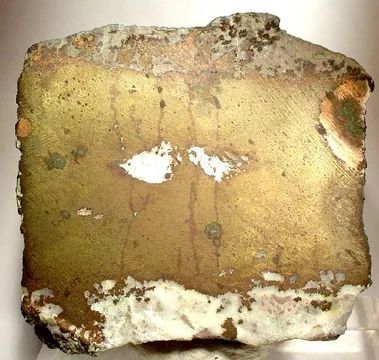
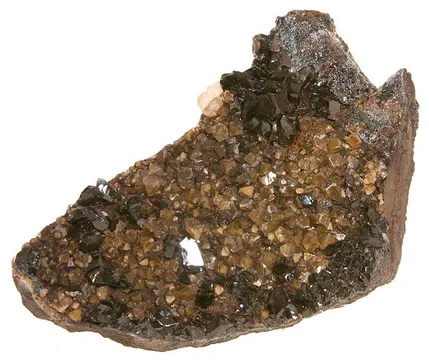
The district also matters because it changed how geologists think about ore deposits. Sudbury is not a simple layered intrusion in the textbook sense; it is an impact-melt sheet and associated sublayer, breccia, footwall and offset-dike system, later folded, faulted, metamorphosed and mined from many distinct ore settings. This complexity is why Sudbury specimens are so varied: massive bronzy pyrrhotite with pentlandite “eyes,” brassy chalcopyrite masses, cobaltite crystals in sulphide ore, late calcite-sulphide vein specimens, Strathcona cubanite and silver, and micromount-scale rarities that can require polished section work to appreciate fully.

Photo: Wikimedia Commons
The visual language of the district is unmistakably that of ore. Sudbury specimens tend to be compact, heavy, metallic, and best examined under strong light and magnification. A fine Vermilion sperrylite is usually a sharp, mirror-bright cube or cubo-octahedron standing out against chalcopyrite; a good Frood cobaltite is a small, crisp silvery crystal embedded in massive sulphides; an important Strathcona piece may preserve cubanite, pyrrhotite, calcite or native silver textures that would otherwise have gone straight through the mill. Labels matter here as much as aesthetics, because many of the best specimens came from operating mines, rehabilitated old workings, or short-lived access windows that cannot simply be revisited.
Search for specimens: View all specimens from Sudbury District, Canada
In collector usage, “Sudbury District” gathers a constellation of mines, townships and deposits around the Sudbury Basin in Ontario: Vermilion, Frood, Creighton, Copper Cliff, Strathcona, Falconbridge, Garson, Coleman, Levack, McCreedy, Broken Hammer, Murray, Totten and many others. The ore field is centered on the Sudbury Igneous Complex, commonly abbreviated SIC, a differentiated impact-melt body associated with the great Sudbury impact structure. The modern oval outcrop pattern is the tectonically compressed and eroded remnant of a much larger original crater. Around the margins and in footwall structures, sulphide liquids rich in Ni, Cu, Co, Pt, Pd, Au, Ag and related chalcophile elements collected into economic deposits.
The classic ore assemblage is dominated by pyrrhotite, pentlandite and chalcopyrite, with variable pyrite, magnetite, cubanite, bornite, millerite and a fine-grained platinum-group mineral suite. The mining geologist’s vocabulary divides much of the camp into contact-style ore along or near the base of the SIC; offset-dike mineralization in quartz diorite bodies such as the Frood-Stobie and Vermilion systems; and footwall Cu-Ni-PGE zones that may be relatively sulphide-rich or, in special cases, low-sulphide and PGE-enriched. These distinctions matter to collectors. Massive contact ore may give handsome ore textures but few open crystals. Footwall and late structural zones can produce the unusual mineralogy: sperrylite in quartz-epidote at Broken Hammer, cubanite and calcite in cavities at Strathcona, silver plates in bornite-rich footwall material, and cobaltite or gersdorffite in arsenic-rich sulphide zones.
The district’s mining story is inseparable from the Canadian Pacific Railway. In 1856, surveyor W.A. Salter noticed an extreme compass disturbance while running lines west of Lake Nipissing; the anomaly lay close to what would later become the Creighton open pit, but at the time the region was remote and the report drew little practical attention. The decisive event came in 1883, when CPR blacksmith Tom Flanagan noticed rusty mineralized rock in a fresh railway cut northwest of present-day Sudbury. The property was soon tied to the Murray Mine, and further discoveries followed rapidly. Within a generation Sudbury had become the dominant nickel camp in the world, and its ores helped define the industrial importance of nickel alloys.
Early operators and mine names still seen on labels include the Canadian Copper Company, Mond Nickel Company, International Nickel Company and Falconbridge. Their successors and modern operators include Vale Base Metals, Glencore’s Sudbury Integrated Nickel Operations, and Magna Mining at McCreedy West after its acquisition of assets formerly held by KGHM International. Vale’s Sudbury complex includes long-lived mines and plants such as Creighton, Copper Cliff, Garson, Coleman, Totten, Stobie, the Clarabelle Mill, the Copper Cliff smelter complex and the Copper Cliff nickel refinery. Glencore’s present Sudbury footprint includes Fraser, the Strathcona mill, the Sudbury smelter, and the Onaping Depth project at Craig Mine. Magna has been operating McCreedy West as a copper-precious metals-nickel mine, shipping ore to Vale’s Clarabelle mill.
Production has occurred in waves. Murray was the birthplace of the camp; Copper Cliff began operations in the 1880s; Creighton started in 1901 and remains one of the district’s landmark mines; Copper Cliff, Garson, Frood-Stobie, Falconbridge, Levack, Strathcona, Coleman, Totten and many smaller deposits represent more than a century of continuous discovery, depletion, re-entry, modernization and deeper mining. In recent years the emphasis has included deeper deposits, footwall copper-PGE resources, renewed open-pit work at Stobie, and battery-electric and automation programs at depth.
Collecting access today is extremely limited. Active mines, mills, smelters, tailings areas, rehabilitated mine sites and old dumps are private or industrial lands, and Sudbury is not a casual collecting district in the way a public quarry or fee-dig site might be. The old Vermilion dumps, historically important for sperrylite, have been reworked and the mine site has been largely rehabilitated. The collector’s realistic route to Sudbury material is the secondary market, old collections, dealer stock, museum deaccessions where legitimate, and specimens saved by geologists, miners and local collectors during periods of authorized access. The Discovery Site of the Sudbury Mining Camp, near the former Murray Mine, is valuable as a public geotour stop, but it is a geological and historical locality rather than a source of specimen-grade platinum minerals.
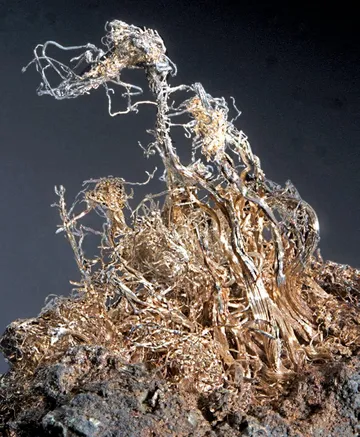
The notable specimen finds are therefore tied to short windows and specific mine environments. Vermilion produced many of the classic sperrylite crystals, mostly as tiny to several-millimetre metallic crystals in chalcopyrite-rich or quartz-sulphide material. Frood yielded scarce sperrylite and cobaltite specimens preserved from precious-metal-rich and arsenic-bearing sulphide zones. Broken Hammer, discovered in 2003 and mined briefly as a small precious-metal-rich copper-nickel operation, produced unusually handsome sperrylite crystals in sulphide and in epidote-quartz-silicate matrix. Strathcona is remembered by collectors for remarkable cubanite from cavities on the 2500–2600 levels near an olivine-diabase dyke, and for native silver plates in bornite-rich footwall ore. Falconbridge, Garson, Hardy, McLennan, McCreedy, Levack and other mines contributed calcite, galena, marcasite, sphalerite, millerite, gersdorffite, pyrite and pyrrhotite specimens, but the recurring Sudbury rule holds: fine crystallized pieces are uncommon compared with the enormous tonnages of ore mined.
Sudbury sperrylite is the locality’s signature collector mineral: tin-white to steel-white, opaque, highly lustrous PtAs2 crystals, most characteristically sharp cubes and cubo-octahedra embedded in or perched on chalcopyrite-rich sulphide matrix. The Vermilion Mine is the type locality and supplied many classic pieces, usually with crystals from submillimetre size to a few millimetres; 3–6 mm crystals are already significant for old Vermilion material, and well-exposed, undamaged crystals on contrasting brassy chalcopyrite are far superior to the many ordinary pieces where only a tiny metallic face is visible in ore. Frood specimens are generally scarcer and prized for provenance from a great historic mine, while Broken Hammer produced a distinct modern style: sharp, bright sperrylite, locally reported to roughly centimetre scale in exceptional material, associated not only with sulphides but also with epidote and quartz in a low-sulphide, high-PGE zone. The best Sudbury sperrylites combine confirmed mine provenance, a complete reflective crystal, clear separation from look-alike metallic minerals, and matrix that tells the Sudbury story rather than hiding the crystal in a massive sulphide lump.
Chalcopyrite is one of the principal ore minerals of Sudbury and the major copper carrier across many deposit styles, but collectible crystals are far less common than the sheer production tonnage might suggest. In hand specimens it is most often brassy yellow, massive to granular, intergrown with pyrrhotite, pentlandite, cubanite, magnetite, pyrite, bornite, millerite and platinum-group minerals; at Vermilion it is the classic matrix for sperrylite, native gold and several rare precious-metal phases. Crystal specimens are usually small—millimetre-scale crystals from localities such as Falconbridge and Errington are notable because they escaped the usual massive ore habit. For collectors, Sudbury chalcopyrite is most desirable when it serves as an attractive metallic matrix for sperrylite or other rarities, when it shows rich ore textures with cubanite or bornite, or when a genuine crystallized face is documented from a specific mine rather than offered merely as anonymous “Sudbury ore.”
Cobaltite from Sudbury is a collector’s mineral of arsenic-rich sulphide zones rather than a bulk ore mineral, even though cobalt has long been recovered from the camp as a by-product of nickel processing. The finest documented specimens are sharp, silvery metallic crystals, commonly embedded in massive chalcopyrite and pyrrhotite, with Frood Mine examples especially admired; crystals to about 13 mm have been reported from the district, and 6–11 mm Frood crystals already make excellent representative pieces. Cobaltite may occur with gersdorffite and related cobalt-nickel arsenides or sulfarsenides, and its bright cubic to pyritohedral forms can resemble sperrylite to the unaided eye, making mine provenance and, for important specimens, analytical confirmation especially important. A good Sudbury cobaltite should show crisp form, bright lustre, minimal bruising on the exposed faces, and a label tying it to a known arsenide-bearing mine such as Frood rather than simply to “Sudbury.”
Beyond these three species, Sudbury is a type-locality and research locality for a remarkable group of rare minerals. Vermilion is tied to sperrylite, violarite and arsenohauchecornite, while Frood and Copper Cliff South are central to the history of froodite, michenerite and sudburyite. The district has also yielded parkerite, gersdorffite, maucherite, nickeline, breithauptite, hessite, altaite, tetradymite, tellurobismuthite, electrum, native bismuth, native gold, native silver, cubanite, millerite, bornite, pyrite, pyrrhotite, pentlandite, sphalerite, galena, marcasite, calcite, quartz and many microscopic platinum-group phases including kotulskite, merenskyite, moncheite, niggliite and palladian melonite. Many of these are not display minerals in the usual cabinet sense, but in polished section and micromount work Sudbury is one of the classic world laboratories for PGE mineralogy.
The chief authenticity issue with Sudbury specimens is not artificial treatment but identification and provenance. Sperrylite, cobaltite, gersdorffite, galena, pyrite and bright broken sulphide faces can all deceive the eye at millimetre scale. A genuine sperrylite should be a dense, brittle, high-lustre Pt-As mineral with isometric form, but visual identification alone is risky unless the specimen comes with strong provenance from a classic source such as Vermilion, Frood or Broken Hammer. Important loose crystals, anonymous “platinum ore,” and unusually large crystals without a credible chain of ownership deserve skepticism and, ideally, SEM-EDS, microprobe or other analytical support.
Condition is another major factor. Sudbury ore specimens are commonly massive sulphides and can show bruised crystal faces, saw marks, cleaved or broken metallic grains, oxidation, rusty goethitic coatings, and friable alteration along pyrrhotite-rich areas. Pyrrhotite-rich specimens should be kept dry and stable; prolonged humidity can encourage deterioration, staining, and sulphide odor. Chalcopyrite is generally robust, though surface iridescence may be natural tarnish, handling wear, or the result of cleaning history. Avoid aggressive chemical cleaning unless the target species and matrix are well understood; on sperrylite specimens, it is easy to make a small rare crystal less attractive by overcleaning the surrounding sulphides.
The most marketable Sudbury pieces fall into several categories: classic Vermilion sperrylite with an old label; modern Broken Hammer sperrylite with bright crystals in epidote-quartz or sulphide matrix; Frood cobaltite; well-documented Strathcona cubanite or native silver; and polished or ore specimens that clearly show important PGE or sulphide textures. Sperrylite is the most widely encountered collector species from the district, but truly aesthetic examples remain scarce. Cobaltite from Sudbury is much less frequently available than the EarthWonders specimen count alone might suggest. Chalcopyrite as a standalone species is common geologically but uncommon as a fine crystallized specimen; it is far more often purchased because it hosts something rarer.
Labels should be read closely. “Sudbury” may mean the city, the mining camp, the administrative district, Greater Sudbury, or simply a dealer’s shorthand for any mine in the basin. Whenever possible, prefer specimens labeled to a mine, township and association: Vermilion Mine, Denison Township; Frood Mine, McKim Township; Broken Hammer deposit, Wisner Township; Strathcona Mine; Copper Cliff South; Creighton; Falconbridge; Garson; McCreedy West; Levack. Mine-level locality is not a nicety here—it is part of the specimen’s mineralogical meaning and much of its value.
Most Sudbury sulphide and PGE specimens show no useful fluorescence. Handling concerns are instead those of heavy-metal sulphide and arsenide minerals: do not grind, inhale dust, or lick specimens; wash hands after handling; store friable pieces in boxes; and keep labels with the specimen, not merely in a separate database. Sperrylite and cobaltite are arsenic-bearing minerals, stable as intact specimens but inappropriate for careless abrasion or jewelry use.
The Sudbury story begins with a compass needle that would not behave. In 1856, W.A. Salter was running a meridian north from his baseline near Whitefish Lake when he noticed a powerful local attraction: the needle varied by four to fourteen degrees west. The line was only a few hundred yards from what would later become the Creighton open pit, but the observation landed in a world not yet ready for it. The area was remote, the mining industry in Ontario was barely developed, and even assays showing copper and nickel did not trigger a rush.
The discovery that did change everything came not from a trained mining man but from a railway blacksmith. In August 1883, while the Canadian Pacific Railway was being blasted through hard Precambrian rock northwest of present-day Sudbury, Tom Flanagan noticed a rusty patch in a fresh rock cut. The rust mattered. In Sudbury ore, iron sulphides weather to orange-brown oxides and hydroxides, the surface clue that prospectors learned to follow around the basin. Further exposure and sampling led to the Murray Mine, and the district’s geography quickly filled with names that would become mine names: Creighton, Frood, Stobie, Totten, Copper Cliff, Garson.
Vermilion tells a different, more collector-focused story. It began as a gold discovery in 1887, and for a time it drew the sort of attention that follows any precious-metal rumor. The gold boom did not remake the region the way nickel did, but Vermilion became far more important mineralogically than its size suggested. Material from the mine supplied the new platinum arsenide later named sperrylite, honoring Francis L. Sperry of the Canadian Copper Company. What collectors now see as a few bright millimetre crystals in chalcopyrite was, at the time, part of a broader revelation: Sudbury ores were not merely nickel and copper, but hosts to platinum, palladium, gold, silver, tin and a suite of rare minerals that would keep mineralogists busy for generations.
The district even trained moonwalkers. In July 1971, Apollo 16 astronauts John Young and Charlie Duke trained in Sudbury, wearing electric Hasselblad cameras like those they would later use on the Moon. The attraction was not nickel ore but impact geology—breccias, shattered rocks, and structures produced by a giant collision. Sudbury’s scar was ancient, deformed and mined; the Moon’s craters were airless and fresh by comparison. But the field discipline was the same: learn to recognize rocks made or modified by impact, then make fast decisions with gloved hands and limited time.
Broken Hammer is the modern specimen story collectors still talk about. Discovered in 2003, it became a small, short-lived operation rather than a century-long giant. Yet in that brief life it yielded some of the most attractive modern Sudbury sperrylite specimens. Unlike the classic Vermilion habit of tiny metallic crystals in chalcopyrite-rich ore, Broken Hammer produced sharp crystals in a low-sulphide, high-grade sperrylite-epidote-quartz setting. For collectors accustomed to Sudbury as dark ore and brassy sulphides, the contrast of mirror-bright sperrylite with green epidote and pale quartz made the locality feel unexpectedly fresh.