A collector's guide to Mashamba West Mine, DR Congo: its geology, mining history and notable minerals, illustrated with the 432 specimens documented from this locality on EarthWonders.
Key facts
Mashamba West is one of the essential post-1970s localities of the Central African Copperbelt: an open-cast copper-cobalt mine near Kolwezi, in Lualaba Province, where an industrial oxide-and-sulfide orebody also happened to open some of the most colorful specimen pockets known from the Katanga Copper Crescent. Collectors value the locality for its unusually complete supergene suite—primary-style malachite, bright red cuprite, honey-yellow baryte, hot pink cobalt-bearing calcite and dolomite, powder-blue chrysocolla, rare vanadates and uranium vanadates, and the copper-cobalt carbonate kolwezite. The best pieces have a distinctly Mashamba look: green malachite as sculptural rosettes, ridges, fibrous sprays, and sharp “primary” crystal groups; red to nearly black cuprite octahedra rising from chrysocolla or malachite; orange-yellow baryte blades; and shocking pink cobaltian carbonates that made the mine a modern classic almost as soon as specimens reached the international market.
Regional View
Country View
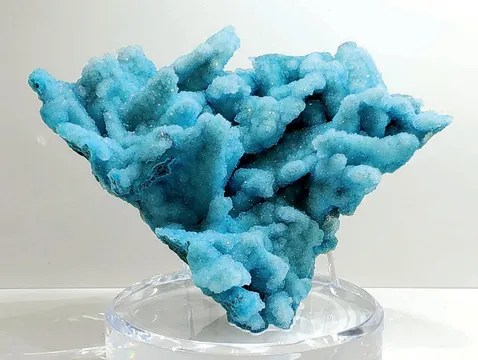
Geologically, Mashamba West belongs to the DIMA group of deposits with Dikuluwe and Mashamba East. These pits exploit folded and faulted Mines Subgroup rocks of the Roan succession, the classic host package of the Kolwezi copper-cobalt ores. The mine’s collector fame rests less on one single species than on how the oxidation zone stacked color and texture: carbonate, oxide, silicate, sulfate, and vanadate minerals grew together in open cavities, replacements, and crusts that can be read almost like a paragenetic sequence.

Photo: Wikimedia Commons
On the specimen market, Mashamba West is sometimes treated as a “malachite locality,” but that understates it. It is equally a cuprite locality, a cobaltian-calcite locality, a baryte locality, and a locality for uncommon species that many collectors first encountered in the 1990s through Mashamba labels: metatyuyamunite, carnotite, vésigniéite, kolwezite, spherocobaltite, and related cobalt-copper minerals.

Photo: Wikimedia Commons
Search for specimens: View all specimens from Mashamba West Mine, DR Congo
Mashamba West lies in the Kolwezi mining district of Lualaba Province, roughly 10 km from Kolwezi, within the great Central African Copperbelt. The mine is part of the Sicomines copper-cobalt project and is associated with the DIMA deposit group—Dikuluwe, Mashamba West, and Mashamba East—three closely related open pits developed along a semi-continuous mineralized trend. Mashamba West is the western Mashamba open cut; Mashamba East lies farther east and has never had the same mineralogical reputation among collectors.
The ore is sediment-hosted stratiform copper-cobalt mineralization in Mines Subgroup rocks of the Roan Supergroup. In the DIMA area, the ore-bearing succession occurs as folded and faulted blocks, with upper and lower ore horizons separated by a subeconomic interval. Technical descriptions of the DIMA resource area emphasize a northward-plunging anticline through the Mashamba West–Mashamba East sector and a syncline toward Dikuluwe, with transverse and longitudinal faults especially developed along fold crests and troughs. Earlier work in the Mashamba West pit concentrated on the apex of the anticlinal structure, where deformation and oxidation helped expose the complex cavity assemblages now so familiar on specimen labels.
The collector minerals come overwhelmingly from the oxidized and supergene parts of the orebody. Copper sulfides such as chalcocite belong to the ore assemblage, while the specimen suite is dominated by secondary copper, cobalt, barium, silica, vanadium, and uranium minerals. Malachite, chrysocolla, cuprite, baryte, calcite, cobalt-bearing calcite, dolomite, cobalt-bearing dolomite, heterogenite, native copper, kolwezite, plancheite, metatyuyamunite, carnotite, and vésigniéite all reflect the chemical richness of the weathered ore zones. The pocket minerals are not random decorations on the ore; they record oxidation of Cu-Co sulfides, mobilization of carbonate and silica, barium sulfate precipitation, and later replacement events that produced the mine’s famous pseudomorphs.
Mining at Mashamba West began in the late 1970s, and the deposit became a celebrated specimen source very quickly. The principal modern mineralogical write-up appeared in the January–February 1991 issue of The Mineralogical Record, only a little more than a decade after the open pit began operating. That article fixed Mashamba West in the literature as a famous locality for high-end secondary copper and cobalt minerals from what was then Shaba, Zaire. In the early 2000s and after, the industrial mining rights history became more complicated, involving Gécamines, Katanga Mining and Nikanor transactions, and ultimately the Sicomines joint venture. Today the name is best understood as both a classic specimen locality and an operating industrial copper-cobalt asset within the Sicomines project.
Collector access should be regarded as closed. Mashamba West is not a recreational collecting site; it is an industrial open-pit mine within an active mining project. Specimens reach collectors through recovered mine material, old stocks, dealer holdings, and documented collections. Older pieces with 1980s and early 1990s labels remain important because they often correspond to the great classic period of cuprite, baryte, malachite, cobaltian carbonate, vanadate, and uranium-vanadate finds. Later production and occasional new finds have added superb material—especially cobalt-bearing carbonates, baryte with malachite, and complex pseudomorphs—but the best historical pieces retain a particular prestige.
The most memorable Mashamba West finds include primary-style malachite druses and sharp crystal groups, malachite and chrysocolla replacing baryte in rosette-like blade clusters, red cuprite octahedra on chrysocolla or malachite, bright pink cobalt-bearing calcite scalenohedra and lenticular groups, cobalt-bearing dolomite druses, rare kolwezite sprays, and yellow to orange uranium vanadates such as metatyuyamunite and carnotite. Some baryte specimens consist of honey-yellow prismatic or tabular crystals; others survive only as the ghost of baryte form, replaced by green malachite, pale-blue chrysocolla, or both.
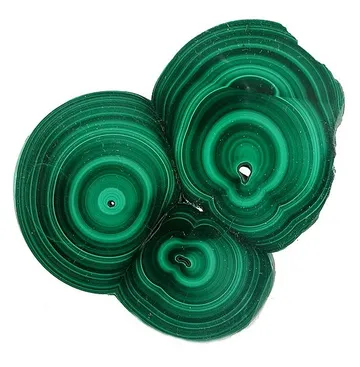
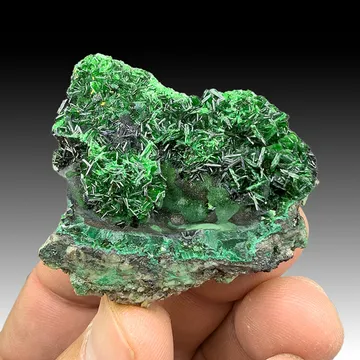
Mashamba West malachite is not just ordinary botryoidal copper carbonate; the locality is prized for “primary” style crystal groups, fibrous and chatoyant forest-green aggregates, botryoidal velvet crusts, rosettes, and pseudomorphs after baryte. Fine pieces range from thumbnail and miniature sprays to cabinet specimens with sharp, three-dimensional crystals or sculptural botryoids, commonly associated with chrysocolla, cuprite, calcite, baryte, cobalt-bearing calcite, metatyuyamunite, dolomite, and rare kolwezite. The best malachites here show crisp form and saturated color rather than merely massive green coverage: sparkling needles in preserved pseudomorphs, undamaged crests of primary crystal growth, contrasting pink cobaltian carbonate or pale-blue chrysocolla, and complete edges that prove the specimen is more than a broken patch of ore.
Calcite at Mashamba West occurs both as clear to white gangue and as cobalt-bearing pink calcite, with the latter giving the locality much of its modern fame. The collector pieces commonly show translucent to lustrous scalenohedral, lenticular, rhombohedral, or drusy calcite in association with malachite, cuprite, kolwezite, native copper, heterogenite, quartz, dolomite, plancheite, and chrysocolla. Ordinary pieces are simple pink crusts or sawed plates, but top Mashamba calcites have intense color, fresh luster, open crystal form, and strong contrast—especially hot pink cobaltian calcite rising from green malachite, or pink calcite intergrown with older white calcite and later copper minerals in visibly staged growth.
Mashamba West is a world-class cuprite locality, best known for bright red to deep blood-red octahedra and modified octahedral groups on contrasting chrysocolla, malachite, calcite, baryte, quartz, plancheite, and occasional native copper. Many crystals are small, but the locality produced showy crystals large enough to dominate thumbnails and miniatures, with some cabinet specimens carrying multiple lustrous octahedra against blue-green copper silicates. Quality depends on crystal sharpness, luster, translucency in strong light, and composition: a single undamaged ruby-red octahedron on velvety malachite or pale chrysocolla is far more desirable than scattered dull grains on massive ore.
Mashamba West chrysocolla is typically light blue to blue-green, botryoidal, massive, or pseudomorphic, and its greatest collector role is as a vivid partner to malachite, cuprite, baryte, carnotite, metatyuyamunite, quartz, dolomite, and rare plancheite. The finest chrysocolla specimens from the mine are not plain blue coatings; they are sculptural replacements after baryte blades, powder-blue crusts on malachite pseudomorphs, or glossy botryoidal fields carrying red cuprite crystals. Good pieces show color contrast, recognizable replaced crystal forms, and a stable, attractive surface, while lesser pieces are indistinct blue-green earthy coatings with little relief or mineralogical story.
Dolomite from Mashamba West includes clear to tan dolomite and the much more sought-after cobalt-bearing pink variety, commonly as rhombohedral to saddle-shaped druses and small crystals on matrix with calcite, cobalt-bearing calcite, native copper, quartz, heterogenite, chalcocite, malachite, and occasional cuprite. The pink dolomite material can be confused with cobalt-bearing calcite, but good Mashamba dolomite tends to show tighter rhombohedral habits, different luster, and a more mauve or purplish cast. Top specimens have saturated color, three-dimensional crystal coverage, and pleasing associations, especially dark heterogenite or green malachite accents on pink drusy carbonate.
At Mashamba West, “cobalt” on collector labels should be understood primarily as a chemical and mineralogical theme rather than as confirmed native cobalt metal: the locality’s cobalt expression is in heterogenite, cobalt-bearing calcite, cobalt-bearing dolomite, kolwezite, spherocobaltite, and cobalt-bearing ore minerals. Specimens sold under broad cobalt labels are usually black heterogenite, pink cobaltian carbonate, or mixed Cu-Co secondary assemblages with malachite, chrysocolla, calcite, dolomite, and kolwezite. The best cobalt-themed pieces are those where the cobalt mineral is visually legible—black botryoidal heterogenite on colorful copper silicates, saturated pink cobaltian carbonate, or brown kolwezite sprays—not ambiguous dark ore fragments requiring a label to be interesting.
Barite, more commonly written baryte in current mineralogical usage, is one of the signature Mashamba West species: transparent yellow to honey-colored crystals reached about 2.4 cm in classic descriptions, while later material includes reddish to orange-yellow tabular crystals and prismatic groups, commonly associated with malachite, cuprite, chrysocolla, and cobalt-bearing calcite. Many of the most famous “barite” specimens are actually replacements after barite, where bright green malachite and pale-blue chrysocolla preserve rosettes or jackstraw clusters of blades 3–5 cm long and up to about 1 cm thick. The best pieces retain recognizable baryte geometry, clean blade outlines, and color contrast; dull caramel masses or incomplete broken blades are much less compelling.
Cobaltocalcite, in collector usage for Mashamba West, refers to the vivid cobalt-bearing calcite that made the mine famous: light to dark pink calcite in scalenohedral, lenticular, rhombohedral, and sparkling drusy habits, often on or with malachite, cuprite, kolwezite, native copper, heterogenite, quartz, dolomite, and plancheite. The finest Mashamba examples can be neon pink, lustrous, and sculptural, with individual crystals from small druse crystals to large display scalenohedra; important recent pieces include crystals several centimeters tall and cabinet specimens where pink calcite contrasts dramatically with green malachite. Strong color saturation, undamaged crystal terminations, matrix contrast, and correct distinction from cobalt-bearing dolomite separate top pieces from ordinary pink carbonate plates.
Baryte from Mashamba West occurs as colorless, light yellow, honey, orange, reddish, and butterscotch to caramel crystals, generally simple prismatic or tabular in habit, with some colorless transparent crystals under 1 cm found on malachite and better yellow crystals historically reaching around 2.4 cm. It is especially important because it provided forms later replaced by malachite and chrysocolla, producing rosettes and bladed pseudomorph clusters that are among the most recognizable specimens from the mine. For collectors, a fine Mashamba baryte should be either transparent and lustrous enough to stand as baryte in its own right, or so cleanly replaced that the former baryte blades remain crisp, sculptural, and aesthetically arranged.
Plancheite is a rare but legitimate Mashamba West species, appearing as pale blue acicular crystals and urchin-like clusters, sometimes with quartz, calcite, cuprite, malachite, kolwezite, shattuckite, and chrysocolla. It is not a bulk display mineral here in the way malachite or cobaltian calcite can be; its appeal is in delicate sprays, blue inclusions or tufts, and the association with the mine’s Cu-Si supergene assemblage. The best specimens show identifiable plancheite habit rather than vague blue staining, and they are strongest when the pale blue needles sit in open cavities or against contrasting green malachite, red cuprite, or clear quartz.
Kolwezite is one of the locality’s important rarities: a copper-cobalt carbonate hydroxide occurring at Mashamba West as light to dark brown needles that cluster in urchin-like aggregates, commonly associated with calcite, cobalt-bearing calcite, chrysocolla, malachite, plancheite, quartz, heterogenite, spherocobaltite, baryte, and cobalt-bearing dolomite. The species is visually subtle compared with malachite or cobaltian calcite, so superior Mashamba West examples need obvious radiating needles, fresh surfaces, and a supportive association—especially pink cobalt-bearing calcite or green malachite—to make the kolwezite readable. Fine pieces are important not because they are large in the usual display sense, but because they preserve a rare Cu-Co species in attractive, recognizable crystal habit.
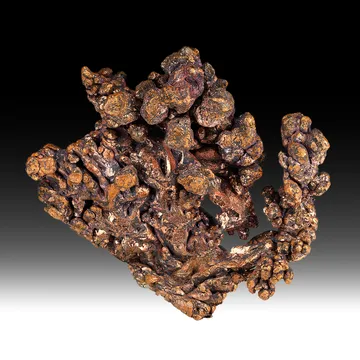
Native copper is documented from Mashamba West as copper-red massive material and distorted crystals, most often associated on specimens with calcite, cobalt-bearing calcite, dolomite, cobalt-bearing dolomite, cuprite, and chrysocolla. It is a minor collector species at the mine compared with cuprite or malachite, but it can add an important paragenetic step in mixed specimens where copper, cuprite, and cobaltian carbonates appear together. Better pieces show visible metallic copper rather than merely a reddish stain, and they are especially desirable when the copper is cleanly contrasted with pink carbonate or red cuprite.
Quartz is a minor but useful Mashamba West accessory, recorded as transparent to clear prismatic crystals and, in very small crystals, as almost black smoky quartz on specimens with metatyuyamunite, carnotite, and chrysocolla. Its collector value is usually associative: quartz can frame plancheite inclusions, sit with malachite or cobalt-bearing calcite, or provide sparkle on copper minerals. Good Mashamba quartz pieces are not judged like alpine quartz; they matter when the quartz is sharp, transparent, and clearly integrated with the mine’s colorful Cu-Co supergene assemblage rather than appearing as anonymous vein quartz.
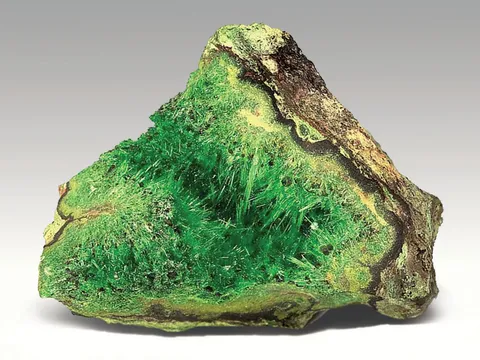
Carnotite is one of the significant uranium-vanadium minerals from Mashamba West, occurring as yellow to orange tablets and scale-like crystals, rare but considered very important for the species from this locality. It is associated with dolomite and metatyuyamunite in the classic descriptions, and specimen-photo associations also include chrysocolla, malachite, heterogenite, quartz, baryte, goethite, and breccia. The best pieces show discrete yellow-orange crystals or rich crusts with unmistakable color and contrasting matrix; because carnotite is radioactive and commonly delicate, collector quality also depends on stability, proper labeling, and careful handling history.
Other documented Mashamba West minerals include brochantite, chalcocite, conichalcite, dioptase, goethite, heterogenite, khorixasite, metatyuyamunite, neotocite, shattuckite, spherocobaltite, tyuyamunite, and vésigniéite. Several are important rarities: metatyuyamunite from Mashamba West has been regarded among the finest for the species, carnotite is world-class here despite its rarity, and vésigniéite is a notable barium copper vanadate in the same chemically rich supergene system. Kolwezite is not a Mashamba West type mineral—the type locality is in the Kolwezi area at Musonoi—but Mashamba West produced important collectable examples. Some names historically linked to Mashamba West should be treated cautiously: carrollite, cuprosklodowskite, metatorbernite, mottramite or “duhamelite,” rutherfordine, schoepite, and uranophane appear in erroneous or doubtful records rather than as reliable collector species from the mine.
The main authenticity issue with Mashamba West material is not a well-documented industry of manufactured fakes, but mislabeling, over-broad labeling, and confusion among visually similar cobalt and copper minerals. Pink cobalt-bearing dolomite has repeatedly been sold or labeled as cobalt-bearing calcite or “cobaltocalcite,” and the distinction matters: dolomite typically shows different rhombohedral or saddle-like habits and a somewhat different luster and color tone. Conversely, true cobalt-bearing calcite from Mashamba West is one of the locality’s great claims to fame, so high-value pink carbonate specimens deserve careful examination, especially when they are unusually large, unusually perfect, or lack older provenance.
Locality labels also require care. Mashamba West, Dikuluwe, Mashamba East, Kolwezi, Musonoi, KOV, and other Lualaba localities can produce superficially similar copper-cobalt minerals. A vague “Kolwezi” label may be honest but less precise; a precise “Mashamba West” label should ideally be supported by older dealer, collection, or mine-source provenance. The spelling “Mashamba,” “Mashamba West,” “Mashamba Ouest,” and older “Shaba, Zaire” labels all occur, and older Shaba/Zaire labels can be desirable when the specimen style matches classic material.
For condition, the principal risks are bruised malachite crests, abraded cuprite faces, rubbed chrysocolla botryoids, broken baryte blades, and edge damage on sawed cobaltian-carbonate plates. Malachite from this mine can be fibrous, sparkly, and deceptively delicate; even small pressure points can flatten luster. Cuprite is dense but brittle, and its best crystals show clean faces and sharp octahedral edges. Baryte and baryte pseudomorphs need careful inspection because replaced blade clusters may have old breaks hidden among rosette forms. Chrysocolla can be softer and more porous than it looks, so avoid aggressive washing.
Radioactive species are a real consideration at Mashamba West. Carnotite, metatyuyamunite, tyuyamunite, and related uranium minerals should be handled with standard radioactive-mineral precautions: keep specimens labeled, avoid inhaling dust, wash hands after handling, do not grind or trim indoors, and store them away from prolonged close personal exposure. Many ordinary Mashamba West malachite, cuprite, calcite, chrysocolla, and dolomite specimens are not radioactive in any practical collector sense, but mixed yellow-orange vanadate specimens should be treated as radioactive until checked.
Fluorescence is not a major selling point for the classic Mashamba suite. Many principal listed species from the locality are reported as not fluorescent, including malachite, cuprite, chrysocolla, baryte, kolwezite, carnotite, and cobalt-bearing calcite. Buy these for daylight color, crystal form, paragenesis, and contrast—not for ultraviolet response.
Market availability remains fairly good for small to medium malachite, cuprite-on-chrysocolla, cobalt-bearing calcite, and mixed secondary copper specimens, but truly fine classic pieces are not common. Top material is usually priced according to aesthetics first and rarity second: an undamaged red cuprite crystal on blue-green chrysocolla, a richly colored pink cobaltian calcite with malachite, a clean malachite-after-baryte pseudomorph, or a verified kolwezite specimen will command much more attention than a larger but visually muddy ore specimen. Old collection labels from the 1980s and 1990s add value, especially for rare vanadates and pseudomorphs.
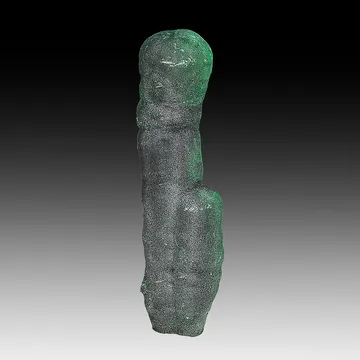
One of the most evocative specimen names tied to Mashamba West is the Mudinge Hole, remembered through a small but remarkable malachite collected before 2010. The specimen measured only 8.5 x 5.4 x 1.8 cm, yet it carried two different personalities on opposite faces. One side showed banded light-green malachite clusters with raised peaks in their centers; the other displayed the more familiar forest-green, botryoidal, velvety malachite for which the locality is loved. In the contact areas between the botryoids, a third texture appeared: lighter green, glassy needles. It is exactly the sort of pocket specimen that explains why Mashamba West malachite is collected as a crystal mineral, not merely as green copper ore.
Another famous cabinet specimen, once in the Jack Halpern collection, shows why the mine’s best malachite-on-calcite pieces have such power in a case. The specimen measured 11 x 10 x 4.5 cm and was described as primary malachite built into a stack of sharp three-dimensional crystals, “like a green tidal wave” over amber-colored calcites. That comparison is more than dealer poetry; it captures the Mashamba West look at its best—dark green, chatoyant crystal growth that crests and overlaps, with pale carbonate acting as both matrix and color foil. Halpern, a San Francisco collector, was described as still going strong near the age of 90, with about 2,500 specimens to consider; pieces leaving such collections often carry more than mineralogical data, preserving the taste and collecting history of the era when Mashamba West first became famous.
The mine has also continued to surprise collectors long after its classic early period. Reports of finds from March to September 2020 described decimeter-scale geodes with pinkish-red cobalt-bearing dolomite, distorted cuprite cuboctahedra to about 1 cm that had been completely altered to dark olive-green kolwezite, and occasional light-green malachite crusts. The same period yielded distinctive reddish, thin-tabular baryte crystals reaching about 5 cm across, partly overgrown with globular malachite, along with large cobalt-bearing calcite scalenohedra exceeding 7 cm in height. For a locality already famous for old-stock classics, that was an important reminder: Mashamba West is not a static name from the 1991 literature, but a living industrial mine whose oxidation zone can still produce mineralogical surprises when the right cavities are opened.