






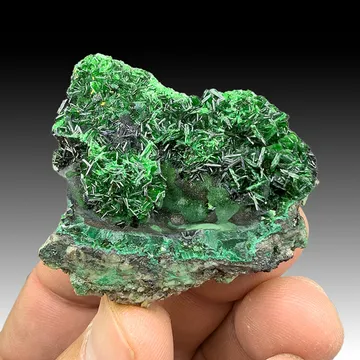
Musonoi Mine, DR Congo - renowned Katangan locality yielding cuprosklodowskite, torbernite, sklodowskite, and malachite; a type locality prized by collectors.
Key facts
Musonoi is one of the great mineralogical localities of the Central African Copperbelt: an industrial copper-cobalt-uranium mine near Kolwezi that happened to expose a compact, chemically extravagant uranium-selenium zone. For specimen collectors, its name immediately evokes emerald-green torbernite, radiating sprays and “puffballs” of cuprosklodowskite, yellow sklodowskite and guilleminite, malachite-lined cavities, dark digenite, and a suite of uranyl selenites and palladium selenides unmatched by ordinary copper mines. It is a locality where specimen beauty and serious mineralogical pedigree overlap unusually well.
Geologically, Musonoi sits in the Kolwezi klippe of the Katanga Supergroup, in folded and faulted Roan rocks of the Lufilian Arc. The economically important ores are sediment-hosted stratiform copper-cobalt bodies, but the collector fame belongs especially to the faulted lower orebody and the Musonoi Extension, where metasomatic enrichment introduced uranium, selenium, vanadium, lead, chromium, molybdenum, and palladium into an already copper-rich system. That small chemical anomaly was large enough for a mine geologist, and immense enough for mineralogy: Musonoi became a type locality for seven minerals and a world-class source of several more.
The best specimens have a look that is immediately Katangan but specifically Musonoi. Vugs in altered siliceous dolostone or dark ore are lined with malachite, then sparked by tabular torbernite, orange-yellow kasolite, lemon-yellow sklodowskite or guilleminite, and sprays of intense grass-green cuprosklodowskite. Classic cuprosklodowskite can form radial tufts and hemispherical aggregates with a vivid electric-green color; fine torbernite shows glassy to almost metallic square plates; uranium-selenium pieces may combine drab ore with micromount-level rarity. Even small Musonoi specimens can carry a complex paragenesis that rewards magnification.
Regional View
Country View
Musonoi’s reputation rests on contrast. It was not a small romantic specimen dig, but a major mining complex of open cuts and later redevelopment, tied to Kolwezi’s long copper-cobalt history. Specimens were rescued from ore zones, dumps, and development work rather than collected from a protected show pocket. The old material therefore carries the character of hard mining: broken but mineral-rich matrix, compact cavities, mixed associations, and occasionally spectacular pockets that were never repeated once that part of the orebody was gone.

Photo: Wikimedia Commons
Search for specimens: View all specimens from Musonoi Mine, DR Congo
Musonoi lies just northwest of Kolwezi in Lualaba Province, within the western part of the Katangan Copperbelt. The name originally referred to a nearby river, but in mineral collecting it has come to mean the Musonoi open cuts and their associated extensions, particularly Musonoi Principal, Musonoi Extension, and Musonoi Extension II. The district belongs to the Kolwezi ore field, a highly productive copper-cobalt region that also includes Kamoto, KOV, Mashamba, Mupine, and related operations.
The deposit is a sediment-hosted stratiform copper-cobalt system in the Roan succession of the Katanga Supergroup. The host rocks are dolomitic and clastic units that have been intensely affected by folding, faulting, and thrusting in the Lufilian Arc. Musonoi is commonly described in terms of two principal orebodies, each on the order of about ten meters thick; the famous uranium mineralization is concentrated in the faulted lower orebody. The Musonoi Extension exposed the celebrated “Ecaille 2400” or “Thrust Slice 2400,” a uranium- and selenium-rich block in dolomitic sandstone and associated copper sulfide ore.
The primary ore assemblage includes copper sulfides such as chalcocite-group minerals, digenite, covellite, bornite, and cobalt-bearing phases such as carrollite; supergene alteration produced abundant malachite and heterogenite/kolwezite in the oxidized zone. What makes Musonoi exceptional is the overprint: uranium and selenium enrichment produced uranyl selenites, uranium silicates, phosphates, vanadates, carbonates, and oxides, while palladium entered the selenide assemblage as rare species such as oosterboschite and verbeekite. In polished-section mineralogy, Musonoi is as important for seleniferous digenite, berzelianite, trogtalite, and Pd-Se phases as it is for the display-case cuprosklodowskite and torbernite.
Commercial mining at Musonoi developed through the twentieth century under the broader Katangan copper industry. Musonoi Principal, the oldest major open cut, was begun in the 1940s; Musonoi Extension followed in the 1950s; and Musonoi Extension II was opened during the 1970s. The cuts were eventually joined into the larger Kolwezi-Kamoto mining landscape. Historic operators and controlling interests changed with the region’s political and mining history, from Union Minière du Haut-Katanga through Gécamines and later joint-venture redevelopment.
Modern Musonoi-related mining remains an industrial matter rather than a collector locality. Current operations in the Kolwezi/Musonoi area are tied to large-scale copper-cobalt production by corporate operators and state partners, with open-pit, hydrometallurgical, flotation, and underground-development projects depending on the specific asset. Access for collectors should be regarded as closed unless formal permission is granted by the landholder and mine operator. The old specimen story is overwhelmingly one of historic production and dump recovery, not present-day field collecting.
The most important collector finds came from the Musonoi Extension uranium-selenium zone. Sources describe a restricted uranium-rich block roughly tens of meters thick and about 50 by 100 meters in surface expression, known to mine workers as Ecaille 2400. That block was not simply another copper ore lens; it contained an extraordinary secondary mineral assemblage in cavities, fractures, and altered ore. The best classic torbernite and cuprosklodowskite are tied to this setting, and many of the locality’s famous uranyl selenites were recovered from the same broader mineralizing environment.
One important caution is the uranium dump known as remblay 269, also called dump 500 in some publications. It received uranium-rich material from more than one locality, including material connected with Kamoto East, and was later processed through the Kolwezi concentrator. As a result, “Musonoi” on an old label is not always as precise as collectors would like. Some specimens are genuinely Musonoi Mine material; others may be dump-derived, mixed-origin, or from nearby operations in the Kolwezi district. For high-value pieces, the distinction matters.
Cuprosklodowskite is the signature display mineral of Musonoi: bright lime- to emerald-green acicular crystals, bladed sprays, radial hemispheres, and dense vug linings on altered siliceous dolostone, malachite, digenite-rich matrix, and other uranium-bearing ore. Individual needles are commonly millimetric, but old-stock pieces show sprays approaching centimeter scale, and classic 1970s material includes rounded “puffball” aggregates dusted or intergrown with yellow guilleminite, sklodowskite, kasolite, schoepite, rutherfordine, vandenbrandeite, and dark green torbernite or metatorbernite. The best Musonoi cuprosklodowskite is open, lustrous, vividly colored, and three-dimensional, with undamaged radial sprays in a protected pocket; ordinary examples tend to be thin crusts, crushed fibers, or green coatings without the sharp acicular architecture that made the locality world-famous.
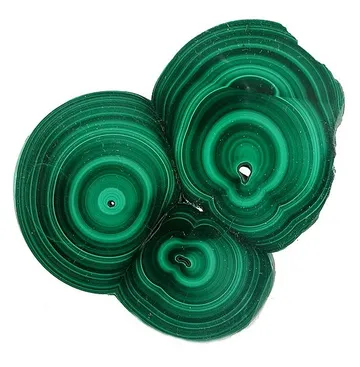
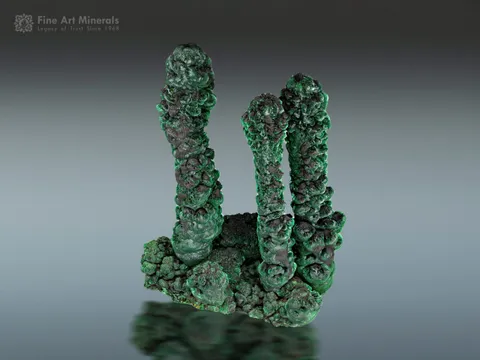
Malachite at Musonoi is both a major oxidized copper mineral and the visual stage on which many of the uranium species appear. It occurs as botryoidal crusts, fibrous linings, acicular fans, dark to bright green coatings, and banded masses associated with heterogenite, kolwezite, cuprosklodowskite, torbernite, kasolite, calcite, dolomite, and quartz. Some Musonoi malachite specimens are collectible as malachite in their own right, particularly hollow botryoids lined with crystals or richly banded pieces, but its highest importance to serious collectors is as a locality matrix: deep green malachite can make the yellow uranyl minerals, orange-red wulfenite or kasolite, and square torbernite plates read with exceptional contrast. Fine pieces show sharp secondary minerals perched on fresh, undulled malachite; lesser pieces are massive green copper ore with little definition or ambiguous associated species.
Torbernite from Musonoi is the classic African standard for the species: square to rectangular tabular crystals, emerald to dark bottle-green, often lustrous enough to look wet or faintly metallic. The finest historic crystals from Musonoi Extension reached about 2 cm on edge, though most market pieces show smaller plates in the 2–8 mm range, scattered or stacked in pockets on malachitic, quartzitic, or uranium-rich matrix. Associations include malachite, cuprosklodowskite, metatorbernite, kasolite, guilleminite, sklodowskite, uranophane, and wulfenite. The premium Musonoi look is a sharp, translucent, undamaged square plate or cluster with saturated green color and old provenance; routine examples are thin crusts of edge-worn plates, darkened aggregates, or material better described as metatorbernite after dehydration.
Uranophane from Musonoi is a yellow secondary uranyl silicate that typically appears as fine acicular crystals, powdery to silky coatings, and compact yellow sprays on altered dolostone and uranium-bearing matrix. It is recorded in association with cuprosklodowskite, schoepite, rutherfordine, malachite, vandenbrandeite, digenite, and torbernite, and it can form part of the late-stage alteration sequence from uraninite and uranyl oxyhydroxides into uranyl silicates. Musonoi uranophane is most desirable when it is not merely a yellow smear but an identifiable crystalline layer or spray that contrasts with green cuprosklodowskite, dark malachite, or tan rutherfordine; ordinary pieces are common-looking yellow alteration without crystal definition or with uncertain distinction from sklodowskite and other yellow uranium species.
Sklodowskite at Musonoi is the yellow to yellow-green magnesium uranyl silicate counterpart to the more famous copper-bearing cuprosklodowskite, and the two often occur together in the same cavities. It forms acicular crystals, fibrous tufts, silky yellow sprays, and coatings on altered siliceous dolostone, commonly associated with cuprosklodowskite, malachite, heterogenite, uranophane, schoepite, torbernite, rutherfordine, and digenite. Good Musonoi sklodowskite specimens show obvious yellow acicular crystals rather than powder, and the best are compositionally and visually clear enough that the yellow sklodowskite can be separated from green cuprosklodowskite in the same vug. Because the former uranium dump also received material from nearby localities, specimens labelled simply as Musonoi sklodowskite deserve closer provenance scrutiny than the more typical cuprosklodowskite-rich pieces.
Schoepite from Musonoi is a yellow uranyl oxyhydroxide of the oxidized uranium assemblage, found as crusts, earthy to crystalline coatings, and notably as pseudomorphs after rutherfordine. Its most characteristic associations at Musonoi include rutherfordine, cuprosklodowskite, malachite, digenite, vandenbrandeite, uranophane, metatorbernite, torbernite, and minor sklodowskite. Specimen-quality schoepite is seldom the showiest mineral in a Musonoi piece, but it is important paragenetically: it marks the alteration pathway from uranium oxides and carbonates toward the silicate-rich assemblages that collectors prize. Desirable pieces show crisp yellow schoepite retaining form or sitting in a readable sequence with tan rutherfordine and green cuprosklodowskite; poor examples are friable yellow alteration products that may be difficult to identify without analysis.
Calcite at Musonoi is best known to collectors in its cobalt-bearing, pink to fuchsia expression, though ordinary calcite also occurs as gangue and late cavity mineralization. Musonoi cobalt-bearing calcite specimens may form prismatic, twinned, or vuggy crystals and are documented with kolwezite, malachite, dolomite, cobalt-bearing dolomite, heterogenite, spherocobaltite, chrysocolla, native copper, and locally uranium minerals. The best examples have saturated magenta color, sharp crystal form, and contrasting green or black cobalt-copper associations; ordinary material can be pale, massive, or confused with other pink cobalt carbonates unless the specimen context and identification are solid. Fluorescent calcite has also been noted in Musonoi combination specimens, adding appeal when associated with malachite and rare copper oxides.
Dolomite is central to Musonoi both as host rock and as a collectible carbonate, especially where cobalt colors it pink as cobalt-bearing dolomite. Specimen material may show hot-pink dolomite crystals with quartz, cobalt-bearing calcite, kolwezite, malachite, heterogenite, and spherocobaltite, while the broader deposit sits in dolomitic Roan strata and altered siliceous dolostone that host many of the uranium-copper cavities. The finest collector pieces are not plain gray host fragments but sharp, lustrous pink cobalt-bearing dolomite crystals with contrasting green copper-cobalt minerals or clear quartz; average pieces are valuable mainly as matrix for cuprosklodowskite, torbernite, or the uranium-selenium assemblage.
Native gold is an unusual but documented component of Musonoi’s chemically complex ore system, occurring as small grains, blebs, or rare wire-like collector features rather than as the dominant specimen mineral. It is reported with uranium-copper associations including vandenbrandeite and malachite, and collector pieces have circulated showing tiny native gold wires or grains on uranium- and malachite-bearing matrix. At Musonoi, gold is most interesting because it belongs to the same exceptional polymetallic environment that produced Pd-Se minerals and rare uranyl species; the best pieces need visible native gold, credible provenance, and ideally analytical or collection documentation, because tiny metallic grains on dark copper-uranium ore can be misread easily. Ordinary “gold from Musonoi” claims without magnification, provenance, or context should be treated cautiously.
Beyond those major collector species, Musonoi is famous for its rarities. It is the type locality for demesmaekerite, derriksite, guilleminite, kolwezite, marthozite, oosterboschite, and verbeekite. The uranium-selenium suite includes guilleminite, demesmaekerite, derriksite, marthozite, chalcomenite, cobaltomenite, and related rare phases; the uranium suite also includes kasolite, vandenbrandeite, rutherfordine, soddyite, studtite, billietite, becquerelite, curite, sengierite, mottramite, and other secondary species. On the sulfide-selenide side, Musonoi is significant for seleniferous digenite and covellite, berzelianite, trogtalite, athabascaite, yarrowite, spionkopite, oosterboschite, verbeekite, merenskyite, palladseite, native palladium, and other tiny but mineralogically important phases. Many of these are micromount or analytical species rather than cabinet minerals, but together they make Musonoi one of the most chemically distinctive copper-cobalt mines on Earth.
Musonoi specimens require more than normal mineral-cabinet caution because many of the desirable species contain uranium. Cuprosklodowskite, torbernite, metatorbernite, uranophane, sklodowskite, schoepite, kasolite, vandenbrandeite, rutherfordine, guilleminite, demesmaekerite, marthozite, and derriksite are radioactive. They should be stored in closed, labeled boxes; handled briefly; kept away from food-preparation areas; and never cut, ground, brushed aggressively, blown clean, or displayed where dust can accumulate. Wash hands after handling, and avoid keeping large or highly active specimens in occupied rooms for long periods without understanding the radiation and radon implications.
Condition is a major issue. Musonoi torbernite plates are thin, brittle, and easily chipped along the square edges; old pieces may have cleaved plates, crushed corners, or loose crystals hidden by intense color. Cuprosklodowskite and sklodowskite sprays are fibrous and vulnerable to compression; attractive vugs can lose their sparkle if even a few tufts are flattened. Schoepite, rutherfordine, and some yellow uranium alteration minerals can be powdery or friable. Malachite and heterogenite matrices may shed particles. The safest cleaning is generally no cleaning beyond gentle air-free inspection and stable storage.
Torbernite also presents a mineralogical complication: it dehydrates readily toward metatorbernite. Many historic “torbernite” specimens in collections are technically partly or wholly metatorbernite, especially if stored in dry or warm conditions. That does not automatically destroy collector value, since Musonoi “torbernite” is often traded under the traditional name, but serious labels should be careful. Avoid heat, direct sun, and very dry display cases; do not attempt home “rehydration,” which can damage crystals and does not reliably restore the original phase.
Mislabelling is a known Musonoi problem. The remblay 269 or dump 500 uranium stockpile received material from multiple sources, and some specimens from Kamoto East and other nearby occurrences entered the market under a Musonoi label. The problem is not merely academic: Musonoi commands a premium for torbernite, cuprosklodowskite, and uranium-selenium rarities. For expensive purchases, favor old labels, collection history, dealer documentation, visual consistency with Musonoi matrix, and, for rarities, analytical confirmation. Be especially cautious with rare names attached to mixed yellow-green crusts; many Musonoi uranyl species are visually similar in small grains.
There are no widely accepted “factory fakes” for Musonoi comparable to dyed agates or manufactured geodes, but there are recurrent practical hazards: locality inflation, optimistic species names, mixed-dump provenance, glued or stabilized fragile fibers, and undislosed radioactive material sold as ordinary malachite. Deep green bladed crystals sold as “malachite” can be torbernite or metatorbernite; yellow sprays may be sklodowskite, uranophane, kasolite, guilleminite, or another uranyl species; black coatings may be heterogenite, digenite, uraninite, manganese oxides, or mixed alteration. A Geiger counter is useful for triage but not for identification.
Fluorescence is not the main collecting feature of Musonoi’s famous minerals. Calcite may fluoresce in some specimens, and certain uranium minerals can show fluorescence under appropriate UV, but Musonoi pieces should be bought for crystal habit, association, provenance, and paragenesis rather than UV response. For uranium minerals, bright visible fluorescence is also not a substitute for analysis: many important Musonoi species are dull, weak, or variable under UV.
Market availability is uneven. Cuprosklodowskite and torbernite appear regularly enough that collectors can be selective, but fine old pieces with sharp, undamaged crystals and secure Musonoi Extension provenance are scarce and expensive. Malachite and mixed uranium-copper specimens are more available. Sklodowskite, uranophane, schoepite, and rutherfordine combinations appear intermittently. Type-locality uranyl selenites and Pd-Se species are rare to extremely rare as aesthetic specimens and should be treated as micromount or analytical material unless proven otherwise. The best Musonoi specimens are no longer a matter of going to the dump; they are old-stock, collection-cycled, or carefully sourced dealer pieces.
The most consequential Musonoi story is the discovery of a small, stubbornly mineralized block inside a vast industrial mine. In the Musonoi Extension, miners cut into a uranium- and selenium-rich zone known locally as Ecaille 2400 or Thrust Slice 2400. It was not a huge body by the standards of copper mining, but it was chemically extraordinary: a compact uranium-selenium anomaly in the lower orebody, surrounded by folded and broken Roan rocks. The mine worked around it, left part of it in place, and later moved material to the uranium dump. From that restricted zone came a list of minerals that reads less like an ore ledger than a catalogue of mineralogical improbabilities.
The torbernite find became the legend most cabinet collectors remember. Musonoi Extension yielded square emerald-green crystals of a size and quality that made dealers compare them to “green wulfenite.” Some old descriptions place the best plates near 2 cm on edge, with transparency depending on crystal thickness. The finest miniatures are still startling: shiny, sharply outlined green tablets stacked in pockets, or scattered over malachite like panes of colored glass. Many have partly dehydrated, but well-kept pieces preserve the visual force of the original discovery.
Cuprosklodowskite added a different kind of spectacle. Instead of flat plates, Musonoi produced sprays, tufts, and radial “puffballs” of vivid green needles. A classic old specimen could be a rough brown-green cavity in altered dolostone, the interior lined with brilliant acicular growth, sometimes dusted with yellow guilleminite. Under magnification those cavities become miniature landscapes: green fibers, yellow needles, dark malachite, tan carbonate, black ore, and occasional rare species tucked into the same square centimeter.
The dump story is less romantic but just as important to collectors. The uranium dump called remblay 269, or dump 500, became a temporary archive of uranium-rich material from Musonoi and nearby operations. It was productive enough that specimens entered collections from it, but mixed enough that locality labels became blurred. When the dump was processed through the Kolwezi concentrator, its loose specimen potential largely vanished. What survived was already in drawers, flats, and old collections—and sometimes with labels that now need interpretation rather than blind trust.
Rock Currier’s 1997 collecting account gives a vivid picture of how specimens moved through Kolwezi after the classic mining era. In one evening visit to a geologist’s small home, he was shown a table of mostly low-grade study specimens, including poor secondary uranium minerals said to be from Musonoi Extension. The surprise was a small group of dark green libethenite pieces. He bought them cheaply; two days later the same geologist appeared at the hotel with about 200 more. Most were under two inches, with the largest a hand-sized sandstone fragment carrying isolated 2–3 mm crystals. The negotiation opened at “seven dollars each,” followed by raised voices, indignation, and the practical lesson every field collector eventually learns: agree on the price before the specimens start moving.
Another Musonoi field memory from the same Congo trip is less about rarity than scale. The old mine, already famous for torbernite, was described as mostly backfilled with waste from other operations, while one wall of the pit carried large boulders coated with small pink crystals of cobaltian dolomite. It is easy to imagine the collector’s frustration: a mine name that promised uranium classics, a working landscape altered by industrial waste, and yet still, on the wall, enough cobalt-colored carbonate to make the place unmistakably Katangan.
Wendell E. Wilson (2018), “The Musonoi mine, Kolwezi District, Lualaba Province, Democratic Republic of the Congo,” The Mineralogical Record, 49(2), 236–304 — The major modern locality treatment, with specimen history, mineralogy, and extensive illustrations.
Cassian Pirard and Frédéric Hatert (2008), “The sulfides and selenides of the Musonoï Mine, Kolwezi, Katanga, Democratic Republic of Congo,” The Canadian Mineralogist, 46(1), 219–231 — Essential technical study of the Cu-Se-Pd sulfide and selenide assemblage, including Ecaille 2400.
Mindat Type Locality Report for Musonoi Mine — Summary of the Musonoi type-locality species: demesmaekerite, derriksite, guilleminite, kolwezite, marthozite, oosterboschite, and verbeekite.
Fabien Cesbron, Bernard Bachet and Robert Oosterbosch (1965), “La demesmaekerite, sélénite hydraté d’uranium, cuivre et plomb,” Bulletin de Minéralogie, 88(3) — Original description of demesmaekerite from the lower oxidation zone of the Musonoi copper deposit.
Michel Deliens and Paul Piret (1980), “La kolwésite, un hydrocarbonate de cuivre et de cobalt analogue à la glaukosphaérite et à la rosasite,” Bulletin de Minéralogie, 103(2) — Original description of kolwezite, a Musonoi-related Cu-Co hydroxycarbonate.
Zdeněk Johan, Paul Picot, Roland Pierrot and Théodore Verbeek (1970), “L’oosterboschite (Pd,Cu)7Se5, une nouvelle espèce minérale et la trogtalite cupro-palladifère de Musonoï (Katanga),” Bulletin de Minéralogie, 93(4), 476–481 — Original description of oosterboschite and the associated cupro-palladian trogtalite.
Andrew C. Roberts, Werner H. Paar, Mark A. Cooper, Dan Topa, Alan J. Criddle and J. Jedwab (2002), “Verbeekite, monoclinic PdSe2, a new mineral from the Musonoi Cu-Co-Mn-U mine, near Kolwezi, Shaba Province, Democratic Republic of Congo,” Mineralogical Magazine, 66(1), 173–179 — New-mineral description documenting the Pd-Se complexity of Musonoi.
“Mineral species first described from Zaïre and their type mineral specimens,” Royal Belgian Institute of Natural Sciences working document — Useful reference on type specimens and Zaire/DR Congo type-mineral history, including Musonoi species.
Brugger, Wallwork, Meisser, Pring, Ondruš and Čejka (2006), “Pseudojohannite from Jáchymov, Musonoi, and La Creusaz: A new member of the zippeite-group,” American Mineralogist, 91, 929–936 — Includes Musonoi material in the study of pseudojohannite.
USGS country minerals information: Congo (Kinshasa) — Current national production context for copper, cobalt, gold, and other commodities, including COMMUS/Kolwezi data.
“Torbernite, Musonoi Mine $120” — Ryan Paul — Short Vimeo specimen video showing Musonoi torbernite.
“Cobalt-bearing Calcite from Musonoi Mine, DR Congo” — Heritage 1971 — Dealer video tied to a Musonoi cobalt-bearing calcite specimen with gemmy pink crystals.
USGS “Torbernite” image — Carlin J. Green, U.S. Geological Survey — Public-domain photograph of a 5.0 cm torbernite specimen from Musonoi Mine.
Wikimedia Commons category: Musonoi Mine — Open media category with photographs of Musonoi cuprosklodowskite, torbernite, uranium combinations, and rare species.
Mindat: Musonoi Mine, Kolwezi, Mutshatsha, Lualaba, DR Congo — Core locality entry with mineral list, maps, references, sublocalities, and locality cautions.
Mindat: Type Locality Report for Musonoi Mine — Fast reference for the seven Musonoi type-locality minerals.
Mindat: Cuprosklodowskite from Musonoi Mine — Species-locality entry with associations and photo statistics for the mine’s most famous green uranium silicate.
Mindat: Schoepite from Musonoi Mine — Useful entry for schoepite associations, including pseudomorphs after rutherfordine.
The Mineralogical Record: “Musonoi!” back issue — Publisher page for the dedicated 2018 Musonoi issue.
Pirard and Hatert (2008), The Canadian Mineralogist: “The sulfides and selenides of the Musonoï Mine” — Technical article on Musonoi’s sulfide-selenide paragenesis.
Metorex: Musonoi Project — Current corporate project summary for modern Musonoi underground and processing development.
Zijin Mining: Kolwezi Copper Mine — Corporate overview of the COMMUS/Kolwezi operation, ownership, resources, production capacity, and development history.
USGS: Congo (Kinshasa) minerals information — Current national minerals-production context, including copper-cobalt data for the Kolwezi/Musonoi area.
Amnesty International: forced evictions at industrial cobalt mines in DR Congo — Human-rights context for modern industrial mining expansion around Kolwezi and COMMUS.
Wikimedia Commons: Musonoi Mine — Open image repository for Musonoi specimen photographs.
_1.jpg)