






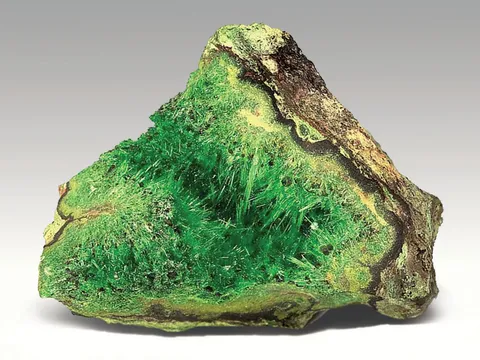
Musonoi torbernite from Kolwezi, DR Congo - emerald-green, square tabular crystals with sharp outlines; prized for its classic locality and strong provenance.
Key facts
Musonoi torbernite is the classic African expression of the species: deep emerald to blackish green, square tabular crystals with a wet vitreous to almost metallic luster, often stacked in tight bladed aggregates across quartzitic or malachite-stained matrix. The best pieces have a quality that is immediately recognizable—transparent green panes with sharp tetragonal outlines, bright edges, and enough thickness to show color without becoming opaque. Fine examples from Musonoi are not merely “good for Congo”; they belong in the front rank of world torbernite localities.

Photo: U.S. Geological Survey
The locality’s importance rests on a particular geological accident within the Kolwezi district of the Central African Copperbelt. Musonoi is a Cu-Co-U deposit in the Roan strata of the Katanga Supergroup, deformed by folding, faulting, and thrusting. In the Musonoi Extension, uranium and selenium were concentrated in a restricted, highly tectonized zone; that small anomaly produced an outsized mineralogical legacy. The same system that yielded large, aesthetic torbernite also made Musonoi famous for uranyl selenites, copper-uranium silicates, palladium selenides, and several rare or type-locality species.
For collectors, Musonoi torbernite is attractive because the locality supplies both specimen beauty and mineralogical pedigree. The crystals can be cabinet-showy, with plates reported up to about 2 cm on edge in the best material, yet the mine also produced rich miniatures and thumbnails with dense carpets of lustrous blades. The most desirable specimens combine sharp square tablets, translucency, saturated green color, minimal edge chipping, and a secure old provenance—especially labels tied to Musonoi Extension or to the well-known classic production of the 1960s and 1970s.

Photo: Wikimedia Commons
Search for specimens: View all torbernite specimens from Musonoi Mine, DR Congo
Musonoi Mine lies near Kolwezi in Lualaba Province, in the western part of the Katanguian Copperbelt. The historic workings are a group of open cuts: Musonoi Principal began during the 1940s, Musonoi Extension followed in the 1950s, and Musonoi Extension II was opened during the 1970s. These pits were eventually combined and are linked historically and geographically to the broader Kolwezi-Kamoto mining complex.
The deposit is a sediment-hosted copper-cobalt-uranium system in the Roan rocks of the Katanga Supergroup. Musonoi’s ore is hosted in dolomitic and clastic sequences that were strongly folded and faulted; two principal orebodies of roughly 10 m scale are recorded, with the uranium mineralization concentrated in the faulted lower orebody. That lower orebody, especially in the Musonoi Extension, is the context that matters most to specimen collectors. It supplied the exceptional secondary uranium minerals—torbernite, cuprosklodowskite, kasolite, sklodowskite, sengierite, vandenbrandeite, uranophane, soddyite, and others—along with the unusual selenium and palladium mineralogy for which the mine is also famous.
Musonoi was not a specimen mine in the modern sense. It was a major industrial copper-cobalt operation, and mineral specimens were recovered incidentally from blasting, development, ore handling, and dumps. The best torbernite is historically tied to Musonoi Extension, where the uranium-selenium anomaly was limited in size but exceptionally rich in collectible minerals. A main torbernite discovery was reported in 1966, and classic dealer descriptions often place the finest torbernite specimens in the 1960s–1970s production window.
Collecting access today should be treated as closed industrial ground unless explicit permission is obtained from the land and mineral-rights holders. Historic dump collecting is also not a dependable option: the uranium-rich dump known as “remblay 269” or “dump 500” was processed, with sources recording removal or processing dates in the late 1980s and early 1990s. Because that dump received uranium minerals from multiple mines, it also created a real locality-label problem: some specimens connected with Kamoto East and related material have been wrongly reported as Musonoi. For high-end torbernite, old labels are valuable, but old labels still need to be read critically.

Photo: Wikimedia Commons
Torbernite from Musonoi is most admired as square to rectangular tabular crystals, generally thin but sometimes thick enough to appear dark bottle-green or black-green face-on. Individual crystals in good material may be gemmy on the edges, with strong internal green fire when backlit. Fine old descriptions report square plates up to about 2 cm on edge, though most specimens seen on today’s market carry much smaller crystals, commonly in the 2–8 mm range, either as scattered plates or dense bladed carpets.
The habit is unmistakably autunite-group: flat tetragonal tablets, bladed aggregates, overlapping stacks, rosettes, and compact crusts of intergrown square plates. Musonoi specimens often show a particularly lustrous, almost metallic sheen on dark green crystal faces. This submetallic look, coupled with deep color and tabular geometry, is one of the easiest visual clues for classic material from the locality.
Color ranges from bright emerald green through forest green to nearly blackish green in thicker clusters. Thin exposed plates may be translucent to transparent; tightly intergrown masses can appear opaque. Fresh-looking, high-quality plates have a glassy to pearly surface, while partly dehydrated or bruised crystals may look duller, powdery, or matte. Many old labels say “torbernite,” but specimens may include metatorbernite, Cu(UO2)2(PO4)2·8H2O, formed by dehydration of torbernite, Cu(UO2)2(PO4)2·12H2O.
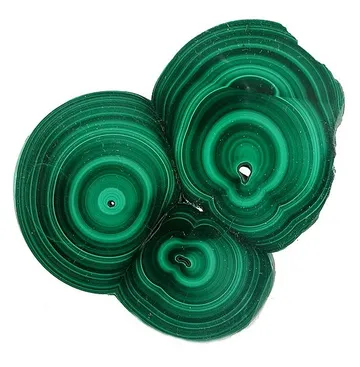
The most typical matrix is quartzitic or dolomitic rock with secondary copper staining. Malachite is a frequent visual companion and may form green velvet coatings beneath or beside the torbernite. Important associated minerals include cuprosklodowskite, kasolite, metatorbernite, sklodowskite, uranophane, soddyite, sengierite, vandenbrandeite, wulfenite, and guilleminite. Combination pieces with yellow kasolite, orange to red wulfenite, green torbernite, and malachite are especially distinctive to the Musonoi collector aesthetic, even when the torbernite crystals are only millimetric.
Quality is judged by crystal size, crystal completeness, luster, color saturation, transparency, and visual separation from the matrix. A specimen with fewer but sharp, isolated, glassy square plates may be more desirable than a larger rock with abundant crushed crusts. For advanced collectors, provenance matters nearly as much as appearance: labels naming Musonoi Extension, old Shaba or Zaïre labels, and pre-1990s collection history all add credibility and market strength.
Musonoi torbernite is radioactive and should be handled with the same discipline applied to all uranium minerals. Display it in a closed case, avoid generating dust, wash hands after handling, keep it away from children and food-preparation areas, and do not saw, grind, or aggressively clean it. Strong specimens should be stored where radon accumulation and loose radioactive particles are considered; a sealed display box with sensible ventilation practices is preferable to leaving friable material exposed.
The main authenticity issue is not usually artificial enhancement, but accurate identity and locality. Many old specimens labeled torbernite are partly or wholly metatorbernite at the surface. That is not unusual and does not automatically make the specimen undesirable, but it should be understood. Phase precision requires analysis; visually, torbernite and metatorbernite can be difficult to separate, especially on old material. A cautious label such as “torbernite / metatorbernite” is often more scientifically honest than a confident species name based on appearance alone.
Locality precision is another concern. Musonoi is famous, and “Musonoi” labels have sometimes been applied broadly to uranium minerals from the Kolwezi district. The former uranium dump at Musonoi received material from other mines, and some specimens historically attributed to Musonoi are better understood as dump-derived or from nearby operations. For important purchases, favor pieces with old labels, collection history, dealer documentation, or a visual association consistent with known Musonoi material: dark lustrous plates on quartzitic or malachitic matrix, sometimes with kasolite, cuprosklodowskite, guilleminite, or wulfenite.
Condition is critical. Torbernite plates are brittle and cleave easily; exposed edges chip, and dense crusts can be crushed without obvious matrix damage. Examine crystals under magnification for broken square edges, powdered surfaces, loose flakes, and post-collection bruising. Avoid specimens that were oiled, lacquered, glued, or stabilized without disclosure; coatings can change luster and may trap loose radioactive dust rather than solve the underlying problem.
Storage environment matters. Classic Musonoi material is noted for relatively slow dehydration when well preserved, but heat, direct sun, and very dry display conditions are poor practice. Keep specimens out of strong light and away from heat sources. Do not attempt to “rehydrate” torbernite; such experiments risk damaging the specimen and do not reliably reverse mineralogical alteration.
On the market, Musonoi torbernite appears regularly enough that patient collectors can choose carefully, but fine pieces are scarce. Common offerings are small plates or crusts on matrix, often damaged but attractive. Better miniatures with bright, sharp, glassy plates are strongly sought. Cabinet specimens with large, undamaged, transparent plates and old Musonoi Extension provenance are modern classics and should be expected to command a premium.
The best Musonoi story begins not with a large mine, but with a small geological target inside it. In the highly tectonized west side of the mine, the Musonoi Extension cut through a uranium-selenium anomaly with an approximate radius of 100 m and a thickness of about 50 m. The uranium reserves in that pocket were not enormous by mining standards—described as several thousand tons of uranium metal “at the utmost”—yet that limited zone produced some of the most celebrated uranium mineral specimens of the Shaba-Zaire collecting era.
The torbernite discovery reported in 1966 is the episode collectors still repeat. The best crystals were square plates up to about 2 cm on edge, emerald-green to dark green, and transparent according to thickness. Their setting was just as specific: fractures in a quartzitic rock separating the two copper-cobalt orebodies. Once blasted into air, torbernite began its slow conversion toward metatorbernite, but the high-quality crystals resisted collapse. Contemporary accounts noted that even after twenty years, well-preserved crystals could remain gemmy if kept away from heat and sun.
Musonoi’s uranium dump added a second, messier chapter. The dump known as remblay 269, also called dump 500 in some publications, became a repository for uranium-rich material from more than one locality. It yielded collectible minerals, but it also blurred specimen labels. Material from Kamoto East and sklodowskite from Kamoto were recovered there, which explains why some “Musonoi” attributions need a second look. When the dump was removed and sent for processing, a window closed: specimens that once might have been rescued from loose uranium-bearing rock were gone into the concentrator stream.
One surviving miniature from that late dump-removal period captures the Musonoi combination aesthetic perfectly. The specimen measured 5.0 x 4.4 x 4.1 cm and carried five named minerals: wulfenite, kasolite, torbernite, guilleminite, and malachite. The wulfenite was not the usual thin yellow style collectors expect from many localities, but tiny blood-red prismatic crystals up to 1 mm set on green velvet malachite. Bright yellow kasolite reached 2 mm, with some crystals showing phantom growth. The torbernite plates reached 4 mm on edge, and the crystal edges themselves hosted minute guilleminite clusters. That is Musonoi in miniature: a copper-cobalt mine that, in a few oxidized seams and cavities, behaved like a uranium-selenium jewelry box.


.jpg)