A collector's guide to Tenke-Fungurume area, DR Congo: its geology, mining history and notable minerals, illustrated with the 242 specimens documented from this locality on EarthWonders.
Key facts
Tenke-Fungurume is one of the essential modern names in Central African copper-cobalt mineral collecting: not a small romantic mine, but a vast active industrial district whose oxidized ore zones have delivered some of the most recognizable recent Congolese secondary copper specimens. The district lies in Lualaba Province in the Katanga Copper Crescent, at the northern apex of the Lufilian Arc, where Neoproterozoic Roan Group carbonate and shale units have been folded, thrusted, broken into fault-bounded slices, and later deeply weathered. To the mining geologist, Tenke-Fungurume is a giant stratabound copper-cobalt system. To the collector, it is the source of bright blue chrysocolla, velvet and crystalline malachite, quartz-drused pseudomorphs, cobalt-bearing carbonates, rare copper nitrates and chlorides, and the kind of paragenetic puzzles that make a specimen more than a splash of color.
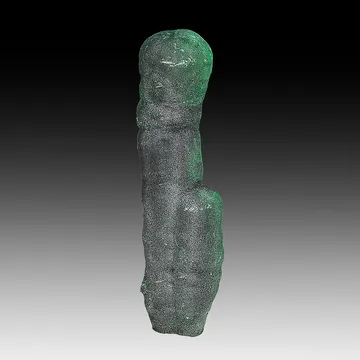
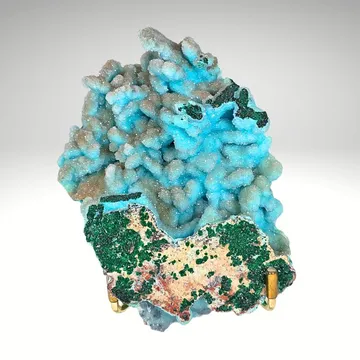
The most distinctive collector style is the quartz-sparkled blue pseudomorph: pale sky-blue to saturated turquoise chrysocolla, commonly over malachite and earlier bladed or tabular precursor forms, then dusted with clear microcrystalline quartz so the surface looks frosted or sugared. Many specimens are compact miniatures and small cabinets, but the best cabinet pieces have real architecture—ridges, blades, cockscomb forms, botryoidal rolls, and open pockets where green malachite, black heterogenite, pink cobalt-bearing carbonate, brown goethite, or pale dolomite matrix shows through. The locality’s best specimens are therefore judged not just by color, but by readable history: a sequence of carbonate, sulfate, copper oxide, copper carbonate, copper silicate, and silica events preserved on a hand specimen.
Regional View
Country View
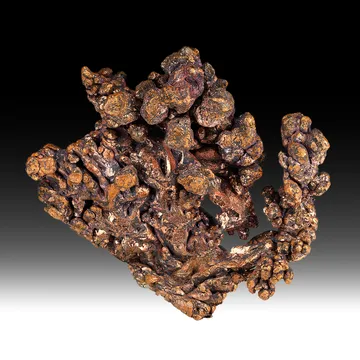
Modern Tenke-Fungurume collecting is inseparable from geology. The same layered ore architecture that made the district a world-class copper-cobalt producer also produced a strong near-surface oxidized suite: malachite, chrysocolla, heterogenite, pseudomalachite, brochantite, cuprite, native copper, cobaltoan dolomite, and other species replacing and coating earlier sulfides and gangue. The productive Mines Series rocks include dolomitic shale horizons and cellular silicified dolomite, so quartz and dolomite are not mere background minerals here; they are part of the mineralizing and alteration system itself. That is why Tenke-Fungurume specimens so often combine green copper carbonate, blue copper silicate, sparkling silica, pale carbonate, and black cobalt oxide in one compact object.
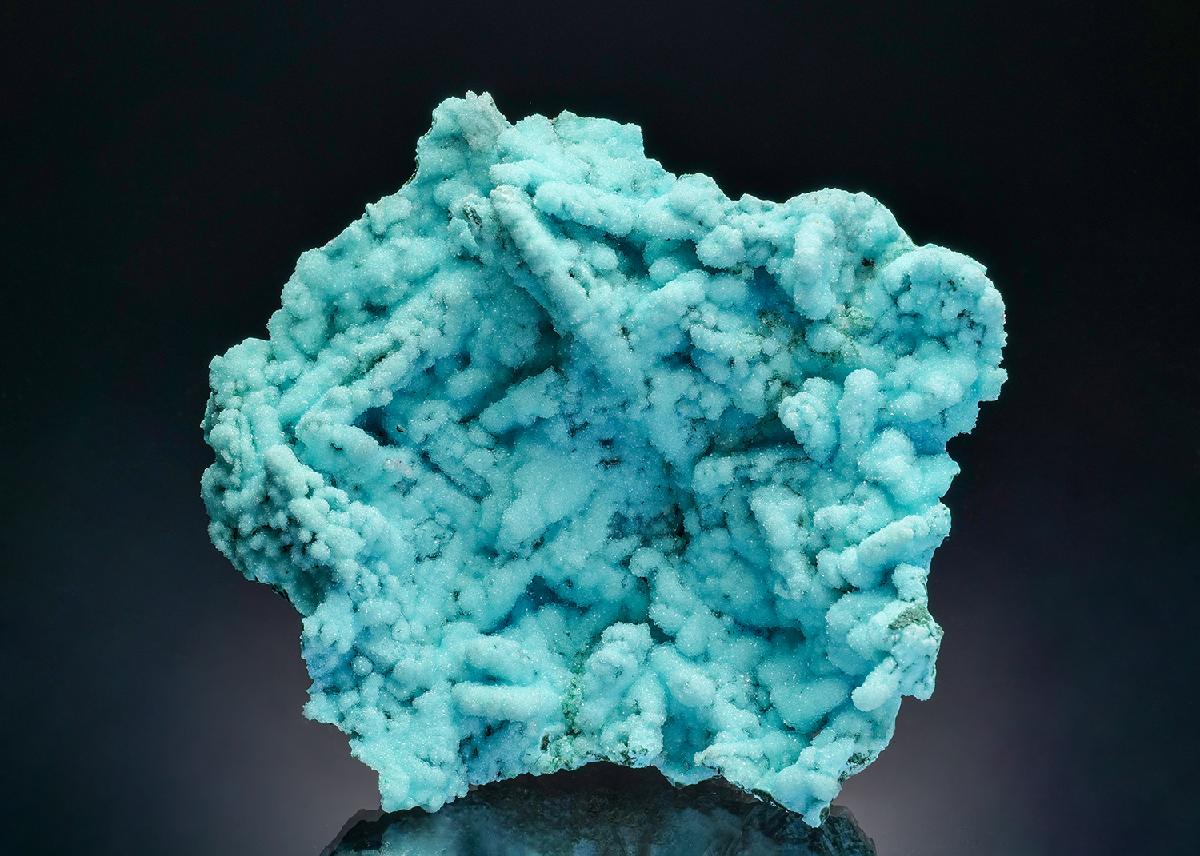
Photo: Crystal Classics
Search for specimens: View all specimens from Tenke-Fungurume area, DR Congo
Tenke-Fungurume is a broad mining area rather than a single pocket or shaft locality. The name is used for a group of deposits and open pits around Tenke and Fungurume in Lualaba Province, in the southeastern Democratic Republic of the Congo, within the Central African Copperbelt. Published technical descriptions place the deposits near latitude 10°S and longitude 26°E, northwest of Lubumbashi and east of Kolwezi, within contiguous concessions historically reported at about 1,437 square kilometers and more recently described by the operator as covering more than 1,500 square kilometers. Important named deposits and pit areas include Tenke, Fungurume, Kwatebala, Fwaulu, Kansalawile, Mambilima, Mwadinkomba, Pumpi, Kazinyanga, Kato, Zikule, Shinkusu, Mudilandima, and Fungurume VI.
The deposit type is sediment-hosted, stratabound copper-cobalt mineralization of the Central African Copperbelt. The productive rocks belong principally to the lower Mines Series of the Roan Group within the Katanga Supergroup. Mine terminology commonly refers to two key ore-bearing dolomitic shale horizons, RSF and SDB, each about 5 to 15 m thick, separated by roughly 20 m of cellular silicified dolomite known as RSC. Primary copper-cobalt mineralization is dominated by chalcocite, digenite, bornite, carrollite, and lesser chalcopyrite; near the surface, oxidation and supergene redistribution produced the collector suite of malachite, chrysocolla, pseudomalachite, heterogenite, cuprite, native copper, brochantite, cobalt-bearing carbonates, and associated quartz and dolomite.
Structurally, Tenke-Fungurume is complex even by Katangan standards. The Lufilian Arc compressed the Roan rocks into folds and thrust slices, while earlier evaporite-bearing units helped create salt-related brecciation, collapse, and detached blocks of Mines Series rocks. Published mine reports describe the productive package as occurring in fault-bounded tectonic slices, or écailles, in places “floating” in a sea of RAT and Dipeta units. For collectors, this helps explain why one specimen may carry dolomite, quartz, malachite, and chrysocolla in a tidy pocket assemblage while another from the same broad district shows cuprite, rare nitrate minerals, or cobalt-rich carbonate: mineralogy changes sharply with stratigraphic position, oxidation depth, and the particular slice of ore-bearing rock exposed.
Mining history reaches back to early twentieth-century work. The deposits were known by at least 1917, with historical drilling beginning as early as 1919. Later campaigns involved Union Minière du Haut-Katanga, Gécamines, Société Minière de Tenke Fungurume, Tenke Mining, Phelps Dodge, Freeport-McMoRan, Lundin Mining, and eventually CMOC. The 1971–1976 Société Minière de Tenke Fungurume program was ambitious and expensive, but the project was halted amid political and social instability, falling copper prices, and infrastructure delays. The modern project was revived through agreements in the 1990s and 2000s; Phelps Dodge made the positive construction decision in December 2006, Freeport-McMoRan became operator after acquiring Phelps Dodge in 2007, open-pit stripping began in March 2008, and first copper production was achieved on March 31, 2009.
Ownership has changed significantly since the first production period. Under the Freeport-Lundin-Gécamines structure, Tenke-Fungurume became a major SX-EW copper cathode and cobalt hydroxide producer. CMOC later acquired Freeport’s effective interest, and today CMOC reports an 80% stake in TFM, with Gécamines holding 20%. CMOC describes TFM as an active producer with five production lines and annual copper production capacity of more than 450,000 tonnes as of 2025. This matters for collectors because Tenke-Fungurume is not an abandoned specimen locality; it is an operating high-security copper-cobalt mining complex. There is no public collecting access, and any specimen collecting is incidental to mining, artisanal activity around the district, or movement through Congolese mineral trading networks.
Precise pocket information is often absent. Many trade labels say “Tenke-Fungurume area” or “Tenke-Fungurume Mine,” while better labels may specify Tenke Mine, Kansalawile open pit, Fungurume, or another sublocality. Dealer and collector records show particularly attractive waves of blue chrysocolla-malachite-quartz pseudomorphs in the early 2020s, including 2020–2021 and 2024 material described as chrysocolla after malachite after azurite, barite, gypsum, or anhydrite. Kansalawile has also become important for rarer material, including cobalt-bearing dolomite, kolwezite with heterogenite, hermannroseite, baryte on goethite with malachite, quartz with malachite, and cobalt-bearing calcite-quartz combinations. As always with Congolese copper specimens, provenance should be preserved carefully: the district name is real and important, but it is also broad enough that a good old label, dealer invoice, analysis note, or photographic archive can add lasting value.
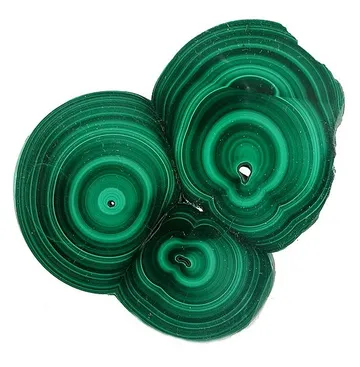
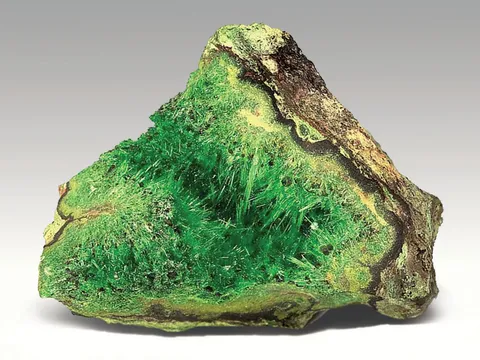
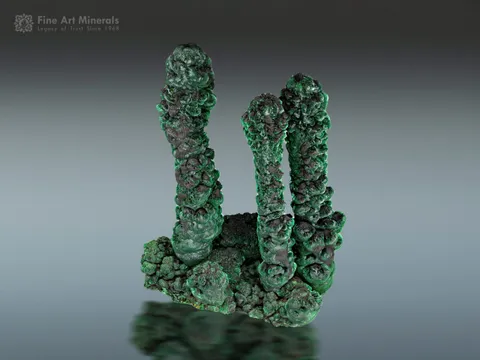
Malachite is the dominant collector mineral of the Tenke-Fungurume oxidized copper zone and appears in several distinct habits: green microcrystals on dark oxides, velvet coatings on dolomite or quartz-rich matrix, cavity linings beneath clear druzy quartz, and especially pseudomorphic stages in which earlier blades or plates were first converted to malachite before being partly or wholly overgrown by chrysocolla. Fine pieces show saturated green color, crisp surface texture, and attractive contrast with sky-blue chrysocolla, clear quartz druse, black heterogenite, or pale dolomite; ordinary examples are more massive, chalky, bruised, or visually confused. Documented Tenke material includes malachite with cuprite, buttgenbachite, chrysocolla, rouaite, gerhardtite, azurite, and quartz, so advanced collectors should look closely at small associated crystals rather than treating every green surface as simple malachite.
Chrysocolla from Tenke-Fungurume is the district’s most market-recognizable modern specimen style: pale robin’s-egg blue, sky-blue, turquoise, or blue-green copper silicate occurring as botryoidal crusts, seams, epimorphs, and pseudomorphs after earlier copper and gangue minerals. The finest specimens preserve bladed, tabular, elongated, or cockscomb-like architecture, often interpreted as chrysocolla after malachite after azurite, though gypsum, anhydrite, and barite have also been proposed for some broader or more evaporite-like forms; late quartz druse can add a bright sugar-like sparkle and makes the blue surface more durable. The best pieces combine strong color, complete form, intact quartz, visible green malachite relics, and enough matrix to make the paragenesis legible, while lower-grade pieces are chalky, massive, poorly defined, or have abraded projecting ridges.
Quartz at Tenke-Fungurume is both a major gangue mineral of the Mines Series and a crucial aesthetic mineral on collector pieces. In the ore system it is common in the cellular silicified dolomite and adjacent strata, appears in veins, replaces dolomite in places, and forms late microcrystalline coatings; in specimens it commonly appears as sparkling druse over malachite, chrysocolla, calcite, or cobalt-bearing carbonate, sometimes with one generation of clear quartz followed by orange or iron-stained quartz. Good collector pieces show uninterrupted, lively druse over blue or green copper minerals, transparent to translucent crystals that allow the color below to show through, and minimal bruising on high points; dull, dirty, broken druse quickly reduces the visual strength of otherwise colorful Tenke material.
Dolomite is one of the defining minerals of Tenke-Fungurume because the ore is hosted largely by dolomitic rocks and has undergone multiple dolomitization events, not merely because dolomite occurs as a specimen accessory. On the collector market it appears as pale carbonate matrix, rhombohedral crystals, cobalt-bearing pink to purple dolomite, and narrow dolomite bands beneath malachite, chrysocolla, baryte, quartz, calcite, and heterogenite. The strongest Tenke dolomite specimens are not plain carbonate pieces but associations: cobalt-bearing dolomite with malachite from Kansalawile, dolomite carrying kolwezite and black heterogenite, or dolomite forming a readable matrix beneath baryte-malachite-chrysocolla pseudomorphs; damage is common where softer carbonate supports harder drusy quartz or protruding copper minerals.
Kolwezite from the Tenke-Fungurume area is a collector rarity, especially from the Kansalawile Mine, where documented specimens show brown-green to olive or pale green botryoidal kolwezite on cobalt-bearing dolomite with black heterogenite, and in some trade examples with malachite or pseudomorphic carbonate-rich assemblages. It is a copper-cobalt hydroxyl carbonate, visually modest compared with electric chrysocolla but mineralogically far more specialized; look for verified labels, analysis where possible, and natural association with pink to purple cobalt-bearing carbonate and dark heterogenite rather than bright, showy but untested green coatings. The best pieces are small but well composed, with clear botryoidal kolwezite coverage, strong cobalt-carbonate contrast, and specific sublocality provenance, especially Kansalawile.
Barite at Tenke-Fungurume is most significant to collectors as a form-maker and paragenetic precursor, not as the classic golden or colorless freestanding crystal mineral familiar from other districts. Published paragenetic work records barite with later diagenetic dolomite and magnesite, while specimen records describe thin platy or cockscomb barite crystals on dolomite-calcite-quartz matrix that were later replaced by malachite and partly by chrysocolla, then coated by drusy quartz. A good Tenke barite-related specimen preserves the barytic habit clearly—platy, ridged, or cockscomb forms—so the replacement story can be read; if the form is rounded beyond recognition, the piece may still be attractive chrysocolla-malachite but is less convincing as a barite pseudomorph.
Azurite is much rarer than malachite or chrysocolla in the Tenke-Fungurume collector suite, and confirmed Tenke Mine records note it as a very rare species associated with gerhardtite, cuprite, malachite, brochantite, and quartz. Its broader importance is as the likely ancestor of many bladed pseudomorphs: tabular azurite crystals are frequently proposed as the first stage in the famous azurite-to-malachite-to-chrysocolla-to-quartz sequence, especially where green malachite cores show in bruised tips or broken edges. Actual azurite specimens from Tenke should be treated as uncommon and should be distinguished from blue chrysocolla replacements; good pieces require sharp crystal form, deep color, and credible analytical or provenance support.
Anhydrite is important in Tenke-Fungurume geology as an early evaporitic mineral and sulfur source, with published alteration studies describing early anhydrite nodules and laths, gypsum and anhydrite pseudomorphs, and evaporite textures in the Roan succession. In the specimen trade, anhydrite is most often invoked as a possible precursor for elongated “surfboard-shaped” or broader bladed pseudomorphs now composed of malachite, chrysocolla, and quartz; direct collectible anhydrite crystals from the district are far less familiar than the replaced forms. The best anhydrite-related Tenke pieces are therefore judged by preserved evaporite-like shape, continuity of replacement, late quartz sparkle, and honest labeling that acknowledges uncertainty between gypsum, anhydrite, barite, or azurite where no analysis or pocket evidence exists.
Baryte is the same mineral species as barite, and the Tenke-Fungurume material is best understood through the specimen habit: flat plates, platy crusts, and cockscomb aggregates, sometimes preserved only as malachite-chrysocolla pseudomorphs with quartz. Kansalawile has also produced newer baryte-associated material, including large flat baryte crystals on brown to black goethite with green malachite, a style that differs from the blue chrysocolla pseudomorphs and is of special interest because it anchors baryte as a real mineral in the district rather than only a guessed precursor. Top baryte-labeled specimens should show crisp plates or a convincing replaced cockscomb form, clean association with malachite or goethite, and preferably sublocality detail such as Kansalawile.
Beyond the headline species, Tenke-Fungurume rewards close inspection for rarities. The Tenke Mine and broader area have documented cuprite, native copper, tenorite, paramelaconite, brochantite, pseudomalachite, heterogenite, cobaltoan calcite, cobalt-bearing dolomite, spherocobaltite, carrollite, chalcocite, bornite, chalcopyrite, digenite, covellite, connellite, claringbullite, buttgenbachite, gerhardtite, rouaite, and riebeckite-group material. Kansalawile has added a particularly interesting modern rare-species suite, including hermannroseite, asbolane, kolwezite, cobalt-bearing dolomite, baryte, quartz, cobalt-bearing calcite, and heterogenite. Tenke-Fungurume is not chiefly famous as a type-locality district in the way Shinkolobwe, Musonoi, or Likasi are, but it is now an important occurrence for rare secondary copper and cobalt minerals, especially specimens that combine copper nitrates, copper chlorides, cobalt oxides, and cobalt-bearing carbonates on the same small matrix.
The first authenticity issue is locality precision. “Tenke-Fungurume area” is a valid locality name, but it covers a large active district with many deposits and sublocalities. A label that says only “Tenke-Fungurume” may be entirely honest at the district level while still being too broad for advanced cataloguing. Better labels specify Tenke Mine, Kansalawile Mine or open pit, Fungurume, Mambilima, or another deposit. Preserve every old label, invoice, dealer description, analysis note, minID record, and photograph; in this district, documentation can be as important as aesthetics.
The second issue is pseudomorph interpretation. Chrysocolla does not form sharp freestanding blades, so blue bladed “chrysocolla crystals” should be understood as replacements, coatings, or epimorphs. Many are described as chrysocolla after malachite after azurite, and that interpretation is plausible where the form is tabular, copper-carbonate-like, and green malachite remains visible inside. But not all Tenke-style pieces should be forced into an azurite story. Barite, gypsum, and anhydrite are all reasonable possibilities for some broader, cockscomb, or evaporite-like forms. The strongest labels acknowledge the sequence and the uncertainty when no analytical or pocket evidence exists.
Condition is a major value factor. Quartz-coated chrysocolla is more durable than bare earthy chrysocolla, but projecting blades and ridges chip easily. Micro-chipping is common on the highest points; it may expose green malachite cores, pale blue chrysocolla, or dark matrix. Examine the tips under magnification for bruises, missing druse, glue lines, reattached blades, filled fractures, and mismatched quartz sparkle. On malachite-rich pieces, crushed velvet surfaces and fibrous sprays are easily rubbed. On cobalt-bearing carbonate specimens, dolomite or calcite matrix can be cleaved, bruised, or etched, and botryoidal heterogenite can be naturally rough but should not look freshly broken across display faces.
Treatments are possible but not always obvious. Porous chrysocolla from any locality can be stabilized or impregnated; suspicious signs include plastic luster, glossy pooling in recesses, unusually darkened fractures, chemical odor, or an artificial-looking uniform blue in areas where natural zoning should be expected. Quartz-drused pseudomorphs with complex green-blue-brown zoning are less likely to be dyed than massive lapidary chrysocolla, but they should still be examined carefully. Rare species such as kolwezite, rouaite, gerhardtite, claringbullite, buttgenbachite, and hermannroseite deserve analysis or provenance from a reliable collector, dealer, or institution.
Rarity varies sharply by style. Attractive chrysocolla-malachite-quartz pieces have been available in waves and can still be found in miniature to cabinet sizes. Truly excellent examples—complete, architectural, bright blue, evenly quartz-coated, unrepaired, and clearly pseudomorphic—are much scarcer. Malachite on its own is common in the ore system but less often exceptional as a specimen unless it is crystalline, unusually aesthetic, or well associated. Kolwezite, hermannroseite, good copper nitrate specimens, confirmed azurite, and sublocality-specific Kansalawile rarities are much more specialized and should be treated as advanced collector material rather than decorative stock.
The first Tenke-Fungurume story is a stop-start mining saga. The deposits were known early, drilled as far back as 1919, and then repeatedly studied by companies with the scale to imagine a major copper-cobalt operation. In the 1970s, Société Minière de Tenke Fungurume spent about $280 million on exploration, studies, equipment, and site infrastructure. Then the project stalled in 1976. The reasons read like a compressed history of mining risk in central Africa: deteriorating political and social conditions, falling copper prices, and delays in building a power line through the region. Control reverted to Gécamines, and the giant orebody waited.
The 1990s revival was no simple reopening. Lundin entered discussions with Gécamines in 1994, was selected after a tender process in 1996, and saw the Tenke Fungurume Mining Convention finalized under DRC law on May 28, 1997. Then came more delay: BHP entered an option agreement, feasibility work was halted in February 1999 under force majeure, Phelps Dodge later stepped in, and the project agreements were renegotiated after the DRC’s 2002 mining code. The decisive modern sequence came fast only at the end: amended agreements in 2005, a positive construction decision in December 2006, civil work in February 2007, open-pit stripping in March 2008, plant startup in March 2009, and first copper production on March 31, 2009.
The collector story has its own uncertainty, and it begins with the blue blades. When the best chrysocolla pieces appeared on the market, they looked like crystals—upright blades, tabular forms, ridges, cockscombs—yet the mineral on the surface was chrysocolla, which should not crystallize that way. The explanation became part of their appeal. A Crystal Classics cabinet specimen measuring 117 x 137 x 56 mm was described as pale blue bladed chrysocolla coated with fine colorless quartz, but the description immediately confronted the paradox: chrysocolla does not make freestanding blades, and malachite does not normally explain that shape either. The proposed solution was a multi-stage replacement: azurite first, malachite next, chrysocolla after that, and quartz last.
A large recorded Mindat minID specimen sharpened the same problem in a memorable way. It measured 170 x 140 x 65 mm and was described from a late-2020 Congo find, with sparkling blue chrysocolla replacing earlier bladed crystals “of what were likely azurite or barite, even possibly gypsum.” Some blades reached at least 5.0 cm. The note also observed that slight micro-chipping was present and typical for the material. That small condition detail is useful: on these specimens, damage is not only damage. A bruised edge can reveal green malachite beneath the blue skin and help confirm the replacement sequence.
The locality label became a story too. In a Mindat discussion from October 2024, Sue Marcus asked the collector’s question directly: dealers were offering chrysocolla after gypsum, anhydrite, or barite from the DRC, “usually the Tenke area,” but could the locality be pinned down more precisely? Paul De Bondt’s reply was candid: Congolese diggers keep sources secret because they are afraid other diggers will dig there too. He added a warning familiar to anyone buying recent Congolese copper minerals: “almost everything coming out of the Congo these days” was being labeled Tenke-Fungurume area. The lesson is not cynicism; it is discipline. The district produces real and remarkable specimens, but the best catalogues distinguish a secure sublocality from a broad trade label.
A 2024 find described by Persson Rare Minerals brought another vivid form into the story: sharp elongated “surfboard-shaped” crystals interpreted as original gypsum or anhydrite, then replaced by malachite, then chrysocolla, then overgrown by druzy quartz and a final generation of malachite. One specimen measured 14.5 x 5.5 x 6.5 cm. The description is a reminder that Tenke-Fungurume pseudomorphs are not all azurite stories. In an evaporite-influenced copper-cobalt system with anhydrite and gypsum textures documented in the rocks, sulfate precursors can make just as much sense for certain shapes.
Kansalawile has become a quieter but more mineralogically sophisticated chapter. Museum and collector records document cobalt-bearing dolomite with malachite, dark purple dolomite crystals, hermannroseite as a green coating, asbolane plates, kolwezite on cobaltian dolomite with black heterogenite, flat baryte on goethite with malachite, and quartz with malachite. These are not always showier than the blue chrysocolla pseudomorphs, but they are the kind of specimens that make a locality mature in collections: first come the bright cabinet pieces, then the rare associated species, then the sublocality-level labels that separate one pocket style from another.
The human landscape around the mine has changed as dramatically as the mineral market. CMOC’s human-rights due-diligence reporting describes a large concession with active mining pits, many communities, and major population growth. TFM managers estimated that Fungurume grew from about 40,000 to 200,000 people and Tenke from about 8,000 to 90,000 over a decade, with roughly 10,000 artisanal and small-scale miners operating illegally around the concession and making incursions into active mining and stockpile areas. For collectors, that reality sits behind many recent Congolese specimens: the mineral beauty is real, but so are the access, safety, provenance, and supply-chain complications.