A collector's guide to Kolwezi, DR Congo: its geology, mining history and notable minerals, illustrated with the 156 specimens documented from this locality on EarthWonders.
Key facts
Kolwezi is one of the great names of the Central African Copperbelt: a mining city and district whose specimens carry the visual grammar of copper oxidation at its richest—velvet malachite, turquoise chrysocolla, pale blue plancheite, cobalt-pink calcite, emerald dioptase, glossy black heterogenite, and, from Musonoi especially, a rare uranium-selenium-palladium suite of unusual scientific importance. For collectors, “Kolwezi” is both a practical label and a mineralogical landscape: the old Kolwezi Mine, Musonoi, Kamoto, KOV, Mashamba, Dikuluwe, Mutoshi, and related deposits form a tightly connected Cu-Co mining field in folded and thrust-faulted Roan Group rocks of the Katanga Supergroup.
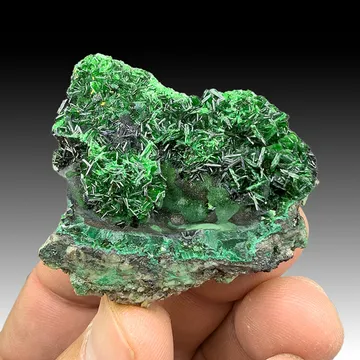
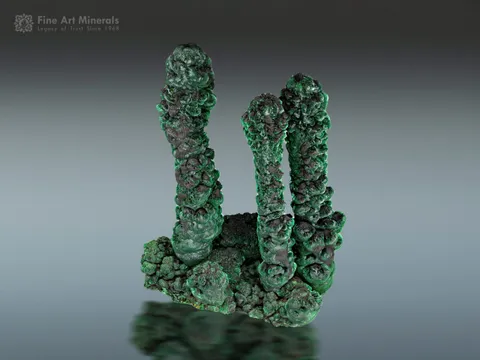
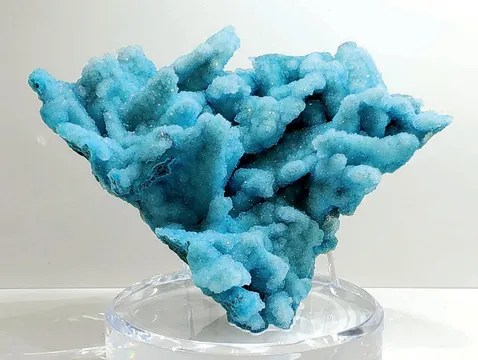
The specimens that made the district famous are not subtle. The best Kolwezi malachites have rolling botryoidal surfaces, stalactitic forms, or sparkling fibrous crusts with a deep green, almost velvet-black body color. Chrysocolla from the district can be hard, bright, and saturated blue to blue-green, often in botryoidal masses or lining cavities beneath malachite. Mashamba West and nearby workings are well known for airy pale-blue plancheite sprays and tufts, while Musonoi is legendary among systematic collectors for uranyl selenites and other rare secondary minerals in oxidized uranium-bearing ore. The district is therefore unusual in spanning both decorator-scale copper classics and micromount-to-thumbnail rarities that belong in advanced reference collections.
Regional View
Country View
Geologically, Kolwezi sits toward the western end of the Congolese Copperbelt, where copper-cobalt mineralization is hosted in the Mines Subgroup and associated units of the Roan Group. The ore-bearing blocks in the Kolwezi klippe are structurally complicated: folded, faulted, and locally dismembered into rafts and thrust slices. That deformation helped bring mineralized rocks into near-surface positions, where deep weathering produced the specimen minerals collectors know so well. In the lower, faulted orebody at Musonoi, uranium and selenium added an extra dimension, producing species that are rarely encountered elsewhere and giving Musonoi a reputation out of proportion to the physical size of many specimens.

Photo: Wikimedia Commons

Photo: Wikimedia Commons
Search for specimens: View all specimens from Kolwezi, DR Congo
Kolwezi is best understood as a district label centered on a group of major sediment-hosted copper-cobalt deposits: Kolwezi Mine, Musonoi, Kamoto, KOV, T17, Mashamba East and West, Dikuluwe, Mutoshi, Kananga, Dilala East, and related open cuts and underground workings. These deposits lie in the Lualaba Province of the Democratic Republic of the Congo, within the western part of the Katanguian Copperbelt. The ore system is hosted mainly by Neoproterozoic Roan Group rocks of the Katanga Supergroup, especially the Mines Subgroup, historically called the Série des Mines. Host lithologies include dolomites, dolomitic shales, siltstones, carbonaceous horizons, stromatolitic carbonate rocks, and associated argillaceous units.
The Kolwezi klippe is a structural package rather than a simple flat-lying orebody. At Kamoto, DIMA, and Musonoi-T17, the mineralized Mines Subgroup occurs within the Kolwezi Nappe, a northeast-trending synclinal basin roughly 20 km by 10 km. The Roan rocks are folded, faulted, and thrust-disrupted, with mineralized rafts preserving fragments of the original stratigraphy. That structural complexity matters directly to collectors: the same district can produce large, massive malachite from oxide zones, delicate late-stage cavity minerals, cobalt-bearing carbonates, and uranium-selenium species from very specific faulted or oxidized portions of the ore system.
The primary economic mineralization is copper-cobalt, with carrollite and other sulfides in hypogene ore and a spectacular secondary suite developed during oxidation. Musonoi is usually described as a Cu-Co-U deposit and is particularly noted for uranyl selenites and palladium minerals. Two principal orebodies, each on the order of about 10 meters, are recorded at Musonoi, with the uranium mineralization concentrated in the faulted lower orebody. The collector assemblage from Musonoi includes malachite, torbernite/metatorbernite, cuprosklodowskite, uranophane, kasolite, vandenbrandeite, guilleminite, demesmaekerite, derriksite, marthozite, oosterboschite, verbeekite, and related minerals. In contrast, Mashamba West and neighboring workings are especially important for copper silicates such as plancheite, chrysocolla, and shattuckite, often with cuprite, calcite, malachite, and quartz.
Mining at Kolwezi has a long arc. Early workings and open cuts in the broader area date to the beginning of the twentieth century, with the old Kolwezi Mine recorded as worked from an open cut since 1903. Musonoi Principal began during the 1940s, Musonoi Extension during the 1950s, and Musonoi Extension 2 during the 1970s. The Musonoi pits were eventually combined and connected with the Kamoto group of mines. KOV—named for Kamoto East, Oliveira, and Virgule, with Variante and FNSR also part of the pit group—became one of the great open-pit copper-cobalt mines of the district. Kamoto and KOV suffered flooding and operational interruptions around the turn of the twenty-first century, followed by large-scale redevelopment.
Modern Kolwezi is not an abandoned specimen field. It is an active industrial copper-cobalt province. Kamoto Copper Company, a joint venture of Glencore, Gécamines, and the DRC state, operates KOV, T17, Mashamba East, KTO underground, the Kamoto concentrator, and the Luilu refinery. Mashamba West and Dikuluwe are tied to the Sicomines copper-cobalt project. Musonoi has also been redeveloped as an underground copper-cobalt project under Metorex/Jinchuan interests, with construction beginning in December 2019 and first copper cathodes reported in 2025. These operations are controlled mine sites, and casual collecting is not a realistic or lawful expectation without explicit permission.
For collectors, one historical detail is crucial: Musonoi once had a uranium-mineral dump known as remblai 269, also referred to in some publications as dump 500. It received uranium-bearing material not only from Musonoi but also from other localities, including Kamoto East. As a result, some specimens historically labelled “Musonoi” may actually have originated elsewhere in the Kolwezi system. The dump was reportedly sent to the Kolwezi concentrator for processing in the early 1990s, removing a once-important source of old uranium specimens and complicating the provenance of material already in circulation.
The most collectible Kolwezi pockets fall into several recognizable groups. The large green malachites, including botryoidal, stalactitic, and carving-grade masses, came from oxide copper zones and are still the public face of the district. The bright chrysocolla-malachite material is especially attractive when the chrysocolla is hard, saturated, and not chalky. Musonoi’s uranium assemblages are usually smaller and more specialized: vugs, crusts, and microcrystalline associations on digenite- or dolostone-rich matrix. Mashamba West plancheite specimens, often pale blue and acicular, are judged by how free the sprays are from abrasion and how strong the contrast is against darker matrix or associated malachite, cuprite, calcite, and quartz.

Photo: Wikimedia Commons
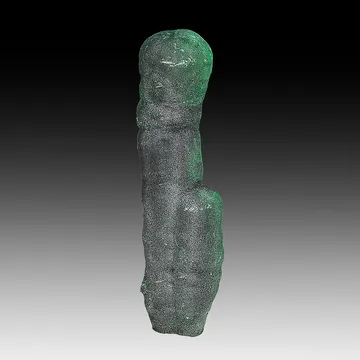
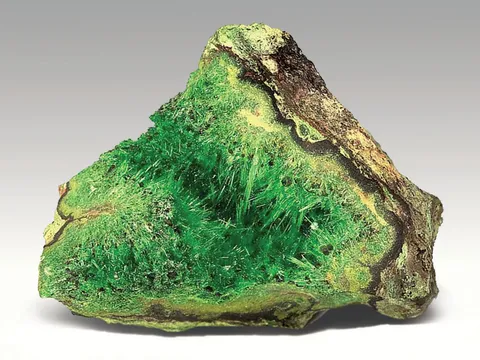
Kolwezi malachite is the district’s emblem: botryoidal, stalactitic, fibrous, massive, and locally sparkling, with colors from deep bottle-green to velvety black-green and bright emerald highlights on fresh fibrous surfaces. The old Kolwezi Mine is especially associated with carving-grade malachite, but fine collector pieces also come from Musonoi, Mashamba, and other oxidized copper zones around the district. The best examples are sculptural rather than merely massive—complete stalactites, undamaged botryoidal mounds, satiny radial cross sections, or sparkling “velvet” crusts on contrasting chrysocolla, dolomite, heterogenite, or cobalt-bearing carbonate matrix. Ordinary pieces are simply green copper carbonate; superior Kolwezi pieces have depth of color, crisp surface texture, three-dimensional form, and no obvious bruising on high points.
Kolwezi chrysocolla is valued for saturated blue to blue-green color in massive, botryoidal, and cavity-lining forms, commonly intergrown with or overgrown by malachite in the oxidized copper zones. Dikuluwe, Mutoshi, Kolwezi Mine, Musonoi, KOV, and Mashamba West all sit within the broader Kolwezi collector orbit for this material, with some Dikuluwe specimens recorded as bright blue massive and botryoidal chrysocolla associated with cuprite and, less commonly, malachite. Good pieces are hard, richly colored, and visually clean, showing smooth botryoidal surfaces or strong color contrast with green malachite and dark oxide matrix; lesser pieces are chalky, fractured, or too massive to show the intense turquoise character for which the district is admired.
Calcite at Kolwezi is most collectible when it is cobalt-bearing, producing the pink to rose “cobaltoan calcite” that gives strong contrast against green malachite, pale kolwezite, black heterogenite, or dolomitic matrix. Musonoi has documented cobalt-bearing calcite associated with kolwezite, malachite, dolomite, heterogenite, spherocobaltite, chrysocolla, native copper, and cuprosklodowskite, placing it firmly within the cobalt-rich oxidized and carbonate-altered portions of the deposit. The best specimens show lively color, discrete crystal faces or attractive drusy coverage, and balanced association rather than a flat pink crust; cabinet pieces can be showy, but small specimens with sharp calcite and well-identified kolwezite or heterogenite are often more interesting to serious locality collectors.
Kolwezi dioptase is not the common decorative face of the district, but it is a prize when sharp emerald-green crystals occur on pale carbonate or with blue copper silicates. Musonoi is a documented dioptase locality, and Mashamba West material is known in association with plancheite, making the species part of the district’s silica-rich secondary copper suite rather than the massive malachite-chrysocolla trade alone. Fine specimens depend on intensity and isolation: bright glassy crystals, preferably perched on calcite or light matrix, are far more desirable than thin green crusts lost in dark oxide ore. Damage is easy to spot on dioptase, so intact terminations and clean contrast are decisive, even when the crystals are only small.
Quartz from Kolwezi is typically an accessory rather than a headline species, but in this district that accessory role can be mineralogically useful: quartz is recorded in Musonoi uranium assemblages and with Mashamba West plancheite, helping frame the silica-rich environments that also produced chrysocolla, plancheite, shattuckite, and dioptase. Collector-quality pieces are usually drusy linings, small clear crystals, or quartz-bearing cavities carrying more important associated minerals such as cuprosklodowskite, uranophane, plancheite, malachite, or vandenbrandeite. The best quartz-bearing Kolwezi specimens are therefore association pieces, not pure quartz specimens; value rests on freshness, attractive cavity architecture, and a secure label tying the quartz to a meaningful copper or uranium assemblage.
Kolwezi plancheite is most strongly associated with Mashamba West, where it occurs as pale blue acicular needles and clustered sprays, sometimes described as urchin-like aggregates, in association with cuprite, calcite, cobalt-bearing calcite, quartz, malachite, kolwezite, shattuckite, and chrysocolla. It belongs to the district’s refined copper-silicate suite: softer in color than chrysocolla, more fibrous and structured than massive blue coatings, and most appealing when the sprays stand free on contrasting matrix. Superior specimens have undamaged tufts, good separation, and clear pale-blue color; ordinary pieces are simply blue crusts or abraded fibers that lose the delicate architecture that makes Mashamba West plancheite worth collecting.
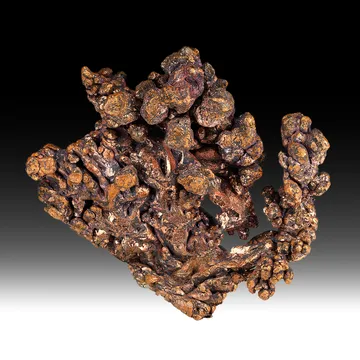
Kolwezi’s wider mineral list is one of the most important in Africa for type-locality and rarity collectors. Musonoi is the type locality for demesmaekerite, derriksite, guilleminite, kolwezite, marthozite, oosterboschite, and verbeekite, while the nearby Kamoto area has yielded type-locality rare-earth uranyl carbonates and phosphates including astrocyanite-(Ce), françoisite-(Nd), kamotoite-(Y), pendevilleite-(Y), and shabaite-(Nd). Other notable district minerals include carrollite, heterogenite, spherocobaltite, cobalt-bearing dolomite, cuprite, native copper, chalcocite, torbernite and metatorbernite, cuprosklodowskite, uranophane, kasolite, vandenbrandeite, rutherfordine, schoepite, curite, soddyite, chalcomenite, cobaltomenite, trogtalite, and rare Pd-Se phases. For the advanced collector, Kolwezi is not just a malachite locality; it is a reference district for copper-cobalt oxidation complicated by uranium, selenium, palladium, and rare earth elements.
Kolwezi labels deserve careful reading. A specimen labelled only “Kolwezi, Congo” may refer to the city, the old Kolwezi Mine, the Kolwezi mining district, Musonoi, Mashamba West, KOV, Kamoto, or another mine in the district. That is not a small distinction: a massive polished malachite slice, a pale-blue plancheite tuft from Mashamba West, and a rare uranyl selenite from Musonoi all carry different locality significance even though dealers may compress them to “Kolwezi.” Whenever possible, keep the full mine name, historic province name, and any old collection label together.
The most specific provenance problem concerns Musonoi’s uranium-mineral dump, remblai 269, also known in some references as dump 500. Because this dump received uranium-bearing material from more than one source in the Kolwezi system, some specimens long sold as Musonoi may actually have originated at Kamoto East or another associated locality. This is especially relevant for rare uranium species and for old specimens acquired from bulk lots. In high-value systematic material, species confirmation and provenance are both important; a beautiful label is not a chemical analysis.
Malachite from Kolwezi is abundant on the market, but quality varies dramatically. Polished malachite is common and may be stabilized, waxed, or repaired; that is not necessarily deceptive if disclosed, but it should be priced as lapidary material rather than as an undisturbed mineral specimen. Natural stalactitic or botryoidal pieces should be checked for rubbed high points, resin shine in fractures, sawed bases, and glued repairs. Velvet malachite is particularly vulnerable to bruising and dusting; avoid repeated handling of fibrous surfaces.
Chrysocolla should be examined for hardness and stability. Fine Kolwezi chrysocolla can be attractive and compact, but low-grade material may be porous, chalky, or prone to edge chipping. Bright blue-green chrysocolla with malachite is widely imitated in the mineral trade by dyed, stabilized, or composite lapidary goods from various regions, so serious buyers should favor specimens with credible mine attribution and natural matrix relationships.
Cobalt-bearing calcite from Kolwezi and Musonoi can be excellent, but pink carbonate labels are often loose. “Cobaltoan calcite,” “cobalt calcite,” “spherocobaltite,” and “kolwezite” are sometimes confused in commerce, especially when the specimen is simply pink carbonate plus green coatings. Kolwezite, in particular, is a rare Cu-Co hydroxycarbonate and should not be assumed from color alone. On important specimens, analytical confirmation is preferable.
Radioactive minerals from Musonoi require informed handling. Cuprosklodowskite, torbernite/metatorbernite, uranophane, kasolite, vandenbrandeite, guilleminite, demesmaekerite, derriksite, marthozite, and related species should be stored in closed containers, handled minimally, kept away from food-preparation and sleeping areas, and clearly labelled. Dust is the practical concern; do not trim, grind, polish, or ultrasonically clean radioactive material. Torbernite-labelled specimens from Musonoi are often best considered metatorbernite unless confirmed otherwise, because dehydration is common and historically many “torbernites” in collections have been relabelled after closer scrutiny.
Current availability divides into two markets. Decorative malachite and chrysocolla from the broader Congo copperbelt remain available, though precise Kolwezi attribution can be vague. Fine old Musonoi uranium pieces, type-locality rarities, and older labelled specimens from the 1960s through 1980s are much scarcer and increasingly collection-bound. Mashamba West plancheite and associated copper-silicate pieces appear periodically, but delicate, undamaged sprays with good aesthetics are not common.
In the old specimen world, Musonoi has the feel of a mine that kept producing surprises long after the obvious copper minerals had been named. The ore itself was never merely “green copper rock.” In the lower oxidized zones it carried uranium and selenium, and in tiny grains and crusts those elements built a mineralogical vocabulary almost no casual visitor would have predicted: guilleminite in yellow, demesmaekerite, derriksite, marthozite, palladium-bearing oosterboschite, and later verbeekite. Some of these species are best appreciated under magnification rather than from across a room, but they made Musonoi one of the essential localities for collectors who care about the chemistry of oxidation zones.
One of the more telling stories concerns the dump called remblai 269. It was not just an ordinary waste pile beside a mine; it became a collecting source for uranium minerals, but it also muddied locality history because material from other mines was dumped there. Kamoto East specimens were recovered from it, and so was sklodowskite attributed to Kamoto. By the early 1990s the dump was reportedly sent to the Kolwezi concentrator, turning what had been a source of specimens into processed ore. For collectors today, that vanished pile lives on as a provenance problem: a specimen can be genuinely old, genuinely from the Kolwezi mining complex, and still not be cleanly attributable to the exact mine printed on its label.
A field-trip memory preserved by the Geological Society of South Africa captures Kolwezi during an earlier era of African mine visits. The party had already seen the Broken Hill lead-zinc mine at Kabwe, where underground stopes were described as “veritable Aladdin’s caves” lined with calcite crystals nearly a metre in size. They then moved through the Copperbelt mines of Zambia and the Belgian Congo and went underground at Musonoi near Kolwezi. The writer came away with “a large box full of interesting minerals,” only to lose it years later during moves—a small collector tragedy, but a familiar one. The same account notes that the group sampled where uranium minerals from other localities had been dumped, a detail that now reads like a warning label for every old Musonoi specimen without careful documentation.
Another vivid pocket story survives through a Wikimedia-hosted iRocks specimen description: a Musonoi barite included by malachite, 6.4 x 5.7 x 4.8 cm, came from a late-1990s pocket that produced many such pieces. Most were described as jumbled crystals, but the pictured specimen stood out for gemmy, pristine barite crystals to almost 4 cm perched dramatically on matrix, with the barite included by green malachite. It is a perfect example of why Kolwezi cannot be reduced to “malachite masses.” Even in a district famous for copper carbonates, a pocket could combine transparency, inclusion, and sculptural architecture in a way that looks closer to a classic cabinet specimen than to ore.