Lake George, Colorado — classic miarolitic pegmatite district yielding blue-green amazonite and smoky quartz; prized for its status and rare intact crystals.
Key facts
For mineral collectors, “Lake George” means the Lake George–Crystal Peak–Florissant pegmatite country of central Colorado: a classic miarolitic-cavity district in and around the Pikes Peak batholith, north of Florissant and near the town of Lake George in Park and Teller Counties. Its fame rests on one of the most visually arresting American mineral combinations—blue-green amazonite, the colored variety of microcline, with lustrous brown to black smoky quartz—formed in pockets within pegmatite dikes and lenses of the Lake George intrusive center. The finest specimens have the unmistakable Colorado look: blocky feldspar crystals in saturated turquoise-blue to blue-green color, black or root-beer smoky quartz set at architectural angles, snowy albite accents, and sometimes bronze to golden goethite sprays.
The geology gives Lake George its character. The district lies on the western side of the Pikes Peak batholith, a Proterozoic A-type granitic complex cut by later textural variants, syenitic bodies, ring-dike structures, and pegmatites. The collectable specimens came not from conventional ore shoots but from miarolitic cavities—gas- and fluid-formed voids in pegmatite—where feldspar, quartz, albite, fluorite, goethite, hematite, micas, and rarer accessory minerals had room to crystallize freely. Most pockets were later fractured, collapsed, clay-filled, or invaded by roots and groundwater, which is why complete unrepaired plates from Lake George are vastly scarcer than loose single crystals or repaired groups.
Regional View
Country View
Historically, Lake George belongs among the defining American pegmatite localities. Collecting in the Crystal Peak–Lake George region began by the 1860s and 1870s, when smoky quartz, topaz, and “green microcline” were already being gathered as curiosities. Amazonite later became the signature prize, especially after late-19th-century displays brought Colorado’s blue-green feldspar to wider attention. In the modern market, Lake George specimens are judged not simply as pretty amazonite, but as pocket specimens with pedigree: Two Point, Yucca Hill, Kosnar, Clarence Coil, Goethite Hill, 2nd Mesabi, Smoky Hawk, and related claims each carry their own mineralogical and aesthetic expectations.

Photo: Wikimedia Commons

Photo: Wikimedia Commons
The best Lake George pieces are cabinet specimens in the old American tradition: balanced, sculptural, and immediately legible from across a room. A great one does not need a label to announce itself. The feldspar supplies color; the smoky quartz supplies contrast and drama; the pocket geometry supplies the composition. That is why a top Lake George amazonite-smoky quartz group can stand comfortably beside the great American classics from Sweet Home, Mount Antero, Franklin, Bisbee, and Elmwood.
Search for specimens: View all specimens from Lake George, USA
Lake George is not a single shaft or quarry but a collector’s locality name applied to a cluster of pegmatite prospects, claims, and historic diggings around the town of Lake George and the Crystal Peak district in the Pikes Peak batholith. In strict locality language, many important pieces are better described by their claim or sublocality—Two Point Mine, NC No. 1 or Clarence Coil claim, R. A. Kosnar claims on Yucca Hill, Goethite Hill, 2nd Mesabi Claim, Quartz Hill, Lakeview Lode II, Smoky Hawk, Godsend, and others—but in commerce they are often grouped under “Lake George,” “Crystal Peak,” “Florissant,” or “Pikes Peak batholith.” That imprecision is common, but for high-end specimens the exact pocket and claim history matter.
The mineralization is classic NYF-type granitic pegmatite mineralization: niobium-, yttrium-, and fluorine-influenced accessory chemistry in a granitic environment, though most collectable Lake George specimens are dominated by simple feldspar-quartz-albite assemblages rather than rare-element showpieces. Productive pegmatites occur as dikes and lensoid bodies in Pikes Peak Granite and related rocks of the Lake George intrusive center. The pocket zone commonly lies near the median line of a dike or lens, with graphic granite above and below. A favorable pegmatite lens may be only tens of centimeters thick but laterally persistent, and a pocket may be a low, clay-filled cavity rather than a romantic open cave.
The “ore body,” from a collector’s viewpoint, is the pocket. The best pockets are localized where pegmatite lenses intersect fractures or small faults, especially north-south structures noted during mechanized work at Two Point. Within those cavities, microcline and quartz grew as primary display minerals, with albite, fluorite, goethite, hematite, siderite, micas, cassiterite, columbite-group minerals, zircon, xenotime, and other accessories varying from pocket to pocket. Many pockets contain ordinary white or tan feldspar and smoky quartz; fewer contain true amazonite; fewer still contain saturated blue-green amazonite with undamaged smoky quartz attached.
Mining history is a mixture of prospecting, specimen mining, and occasional small-scale gem and rare-mineral work. Early visitors and prospectors collected crystals from the hills around Lake George and Crystal Peak during the 19th century. Foote Mineral Company is associated with early efforts in the Crystal Peak area, when topaz and quartz were the more obvious gem targets and amazonite was not always prized. Albert Whitmore’s late-19th- and early-20th-century work at the Gem Mines helped turn Colorado amazonite into an internationally admired collector mineral. In the 20th century, well-known local collectors and miners—including John O. Buckner, Clarence Coil, Richard Kosnar, Jerry and Thelma Hurianek, Ray Berry, Rock Currier, Bob Bartsch, Al Ordway, and later Collector’s Edge and the Dorris family—gave the district its modern specimen-mining history.
The Two Point Mine is one of the best-documented modern Lake George operations. John O. Buckner named and claimed the Two Point in 1956, and Collector’s Edge Minerals worked it under lease in 1996–1997 using mechanized equipment. The 1996 season produced several small but important pockets, including a Pit A amazonite pocket and Pit C amazonite-smoky quartz pockets at a fault-pegmatite intersection. In June 1997, Pit D yielded the Tree Root Pocket, one of the legendary Colorado amazonite-smoky quartz finds. It lay only about 2 meters below the surface, was collapsed and clay-filled, and produced more than 100 cataloged amazonite-smoky quartz groups plus hundreds of lesser pieces and singles.
Other finds form the folklore of the district. The Key Hole Pocket on the 10 Percenter claim, mined in 1985, was famous for its size—large enough when empty to be compared with a space into which a small car could fit—and for large amazonite pieces with white albite. The Hurianek property near Crystal Peak became a fee-digging destination in the 1970s and early 1980s; Thelma Hurianek is tied to the discovery of the Museum Pocket, later reconstructed and displayed at the Denver Museum of Natural History. The Kosnar and Clarence Coil claims produced classic old-time Lake George material, including amazonite-smoky quartz groups, goethite, and onegite. More recently, the Smoky Hawk trend and related claims became famous for large, carefully mined amazonite-smoky quartz pockets, including the Icon Pocket and the Smoky Hawk King.
Collecting access today is complex and should be approached conservatively. Much of the famous ground is private, patented, under active unpatented mining claim, or otherwise controlled; some claims lie within public land, but the mineral rights still belong to the claimant. Casual collecting on unclaimed public land may be legal in limited, noncommercial circumstances, but digging on an active claim without permission is claim jumping and is taken seriously in this district. The best practical access for visitors is through established clubs, invited field trips, claim-owner events, or reputable fee-dig opportunities when offered. Serious collectors buying specimens should value precise labels, claim names, pocket names, and repair documentation as part of the specimen itself.
At Lake George, microcline is both the ordinary feldspar of the pegmatites and, when colored blue-green, the mineralogical identity behind amazonite; uncolored or weakly colored microcline occurs as blocky white, tan, pink, pale green, or cream crystals in pocket zones, graphic granite, and feldspar-rich matrices. Good non-amazonite microcline specimens from this district are usually valued for sharp feldspar form, clean pocket surfaces, association with smoky quartz, fluorite, albite, or goethite, and honest matrix context rather than color alone. The finest pieces show the same crisp Colorado blocky habit as the amazonite, with well-defined faces, minimal etching, and a natural composition rather than a loose feldspar single from pocket rubble.
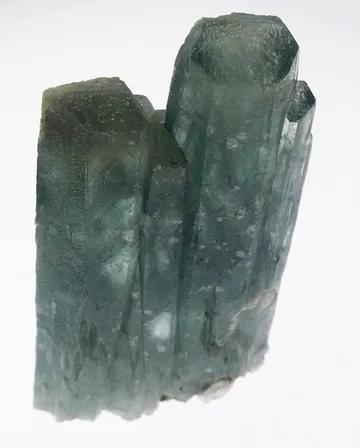
Lake George amazonite is the district’s signature mineral: blue-green microcline in sharp, blocky crystals and groups, commonly associated with smoky quartz and locally with white albite, cleavelandite, fluorite, goethite, hematite, or cassiterite. Color varies dramatically from pale green to medium blue-green to the coveted deep blue-green; at Two Point, even within one pocket, subtle shifts toward bluer or greener hues were recorded, while the best crystals showed color penetrating to the core rather than merely coating the surface. Ordinary Lake George amazonite may be a single dinged feldspar crystal or a pale block from a collapsed pocket; fine pieces combine saturated color, glossy faces, sharp edges, balanced smoky quartz, intact matrix or plate structure, and clear documentation of any repair.
Quartz at Lake George ranges from massive milky quartz cores and pale pocket quartz to clear, smoky, amethystine, and goethite-included varieties, and it is fundamental to the structure of the pegmatites. In many pockets, quartz appears first as ordinary core or wall material, then as euhedral pocket crystals with microcline, albite, and fluorite, and finally as late-stage quartz overgrowths or goethite-included onegite in selected cavities. The collector value of non-smoky quartz from Lake George depends on context: a loose milky crystal is common, but quartz that records the pocket sequence—clear or amethystine crystals with goethite, quartz molds around goethite groups, or quartz aesthetically integrated with amazonite and albite—is far more interesting.
Lake George is one of the important American sources of crystallized goethite in pegmatite pockets, where it occurs as late-stage dark brown, golden-brown, bronze, bladed, acicular, and spray-like growths, often attached to or surrounding smoky quartz. Its most distinctive local expression is “onegite,” a collector term for quartz—commonly smoky, citrine-tinted, or amethystine—penetrated by goethite needles or blades; this association is especially noted from claims such as the 2nd Mesabi, Goethite Hill, NC No. 1, Lakeview Lode II, and related Lake George-area workings. Good goethite from here is judged by crystal definition, metallic-to-silky luster, golden-brown translucency at edges, sculptural spray habit, and clean association with quartz rather than massive iron staining.
Lake George smoky quartz provides the dark counterpoint that makes the district’s amazonite famous: crystals range from pale smoky brown through root-beer and deep black, with the best examples glassy, gemmy, sharply terminated, and naturally seated among blue-green microcline. In the Tree Root Pocket, quartz crystals were described as gemmy to nearly flawless, grading from medium to deep root-beer brown, reaching 17 cm in length but averaging about 6 cm; pocket collapse and root damage, however, meant that only a small proportion were completely damage-free. Excellent smoky quartz singles exist from claims such as Dreamtime and Hill Top, but the premium specimens are balanced combinations where the smoky quartz is sharp, lustrous, undamaged at the termination, and compositionally locked into amazonite or albite rather than merely glued onto a feldspar base.
Albite at Lake George is usually a supporting mineral, but in fine pockets it can transform a specimen by adding a white textural accent against blue-green amazonite and dark smoky quartz. It occurs as cleavelandite-like platy feldspar, small white crystals, and rounded “balls” or aggregates; the Tree Root Pocket produced snow-white albite balls to about 4 cm on several amazonite plates, and the Key Hole Pocket was especially admired for large amazonite specimens carrying white albite. Ordinary albite-coated material can look chalky or distracting, but the best Lake George albite is clean, bright, well placed, and clearly part of the pocket paragenesis, giving contrast without burying the feldspar or quartz.
Other documented Lake George minerals include fluorite, hematite, siderite, cassiterite, topaz, beryl, bertrandite, euclase, muscovite, molybdenite, pyrite, chalcopyrite, galena, sphalerite, uraninite, wolframite-group minerals, xenotime-(Y), zircon including cyrtolite, and stibiocolumbite. Cassiterite is especially notable as a rare accessory in some amazonite-smoky quartz pockets, including pieces from the Tree Root Pocket carrying crystals around 1.5 cm. Stibiocolumbite from the NC No. 1 or Clarence Coil claim is a particularly interesting rare oxide record for the locality, though Lake George’s fame is not as a type-locality district; its importance lies in the extraordinary preservation, documentation, and aesthetics of pegmatite-pocket specimens.
The main authenticity issue with Lake George specimens is not rampant outright fakery; it is disclosure. Many important amazonite-smoky quartz groups were recovered from collapsed, clay-filled pockets and later cleaned, repaired, or reassembled. That is not automatically a defect—some of the district’s finest specimens would not exist as coherent display pieces without expert repair—but the repair history should be clearly stated. A repaired Tree Root Pocket specimen, for example, can be highly desirable when the work is honest, documented, and confined to reattaching original pocket components. Undisclosed reconstruction, added crystals, artificial matrixing, or vague “Colorado” labeling should reduce confidence and price.
Condition is the great dividing line in this locality. Amazonite edges bruise easily, smoky quartz terminations are commonly chipped, and many pocket specimens show natural etching, limonite staining, clay seams, feldspar cleaving, or contact damage from collapse. Root damage is not folklore; roots can enter shallow pegmatite pockets and physically disrupt plates over long periods. The phrase “no repairs” carries real premium value for Lake George combinations, especially on older pieces from the 1970s and early 1980s, but it should be believable under magnification. Look for glue lines at quartz bases, mismatched luster across joins, suspiciously convenient contact points, and color or matrix inconsistencies.
Cleaning is normal. Many pieces emerge coated with iron-stained clay, limonite, and decomposed granite. Proper cleaning may reveal exceptional color; over-cleaning can bleach the visual warmth of associated iron oxides, undercut fragile albite, or expose repaired joins. Avoid harsh handling of albite-rich pieces, onegite sprays, and goethite clusters, which can be brittle. Goethite and onegite specimens should be protected from abrasion; the fine blades and included quartz points are far less forgiving than blocky amazonite.
Mislabelling is common at several levels. “Lake George,” “Crystal Peak,” “Florissant,” “Teller County,” and “Pikes Peak batholith” may all be used for specimens from the broader pegmatite belt, but they are not interchangeable for provenance. A specimen labeled simply “Lake George” may be from Park County sublocalities near the town, from Crystal Peak-area Teller County claims, or from the broader commercial Lake George district. For ordinary miniatures, the broad label may be acceptable; for four- and five-figure specimens, claim and pocket names are part of the specimen’s value.
Rarity is strongly tiered. Loose smoky quartz and feldspar fragments remain obtainable; modest amazonite singles and repaired small groups appear regularly. Attractive miniature to cabinet combinations with good color, sharp smoky quartz, and honest condition are much less common. Old, unrepaired, well-balanced combinations from named claims are scarce. Major pocket plates with saturated amazonite, large smoky quartz, albite contrast, and strong documentation are genuinely elite American pegmatite specimens and are priced accordingly.
The Tree Root Pocket at Two Point is the story every Lake George collector should know. In June 1997, Collector’s Edge returned to a small Teller County claim near Lake George after a 1996 season that had produced useful geological clues but no great bonanza. The first day of renewed digging at Pit D began with a few exposed fragments of deep blue-green amazonite on the dump of an older hole—what local diggers call “color.” The crew followed the pegmatite down about 2 meters, watched it flatten and widen into a lens, and then saw thousands of quartz and blue-green amazonite fragments pour out. Within 30 minutes, a pocket opening appeared.
At first the pocket seemed disappointing. The first amazonite crystals were mostly damaged, and every piece was masked by limonite and clay. Then the groups started coming. By the end of the first day, four “killer specimens” had been removed. By the second day, the crew realized the pocket was large—already more than 1 meter deep—and badly collapsed. The cavity was sandwiched between hard graphic-granite layers above and below, with its open space compressed to a low, clay-filled seam only about 16 to 20 cm high. Roof plates had fallen onto floor plates, making an amazonite “sandwich” with clay filling every void.
The pocket’s name was literal. A tree root had followed the pegmatite down into the cavity and wound through it to the end, slowly wedging and breaking plates apart. Groundwater moving through the shallow pocket added more trouble, destabilizing feldspar and staining everything. Each day the crew pulled four or five superb specimens, but for every good group, about 50 broken pieces came out. After roughly eight days, the cavity had been opened to more than 2 meters wide and about 1.7 meters deep, still no more than about 20 cm high. It was kidney-bean shaped, nearly horizontal, and finally empty by the end of June.
The work did not end at the dig. In Golden, Colorado, the Tree Root Pocket became a mineralogical jigsaw puzzle. The material was washed, sorted, photographed, fitted, repaired where appropriate, cataloged, and labeled. The cleaning revealed the surprise: the amazonite color was exceptional, deep blue-green and penetrating through the crystals. The smoky quartz was gemmy, glassy, and root-beer brown to deep smoky. It took weeks of careful work to reassemble the best plates; about half of the final fine specimens were repaired, many with only one repair. The pocket debuted at the Denver Gem and Mineral Show in September 1997 and immediately entered Colorado collecting legend.
The older Key Hole Pocket had already shown what the district could do on a grand scale. Mined in 1985 on the 10 Percenter claim northeast of Two Point, the empty pocket was famously described as large enough to drive a small car into. It yielded hundreds of excellent amazonite specimens, many with white albite balls. Some pieces reached about 75 cm across and weighed more than 100 kg. The color was not always the deepest Lake George blue-green, but the size, abundance, and albite association made the find unforgettable.
The Hurianek diggings near Crystal Peak gave another kind of story: the era when a collector could pay to dig into pockets opened by backhoe. In the 1970s and early 1980s, Jerry and Thelma Hurianek owned property where visitors could work newly opened pegmatite zones. If an exceptional specimen came out, it could require an additional purchase. Thelma Hurianek is credited with discovering the Museum Pocket, later reconstructed for display at the Denver Museum of Natural History. That pocket reconstruction is a reminder that Lake George’s greatest specimens are not merely objects; they are three-dimensional records of cavities that no longer exist.
The Godsend claim story belongs to the post-fire, early-2000s chapter of the district. Richard Fretterd staked the claim in 2001 in the Crystal Creek area west of Crystal Peak, within the broader Lake George pegmatite district. On February 2, 2002, while working a quartz-feldspar contact beside a 0.5 m quartz vein, he dug down about 1 m and opened a pocket. While removing crystals from the first cavity, he encountered a large milky-quartz core; breaking through it revealed another large pocket beyond. By September 6, 2002, six close-spaced pockets had been opened and named the Holy Moses group. The interpretation offered for the find was a pulsating, vapor-rich system that pinched and swelled into en echelon cavities—a “string of pearls” structure in pocket form.
The Smoky Hawk chapter brought Lake George-style collecting into the age of television and museum-scale specimen mining. In summer 2012, the Dorris family opened a pegmatite on the Smoky Hawk claim in the Crystal Peak mining district and encountered several large miarolitic cavities. The largest yielded the Smoky Hawk King, described in club and museum accounts as Colorado’s largest high-quality amazonite-smoky quartz combination specimen. The discovery began at the end of June, and excavation continued into late July while High Noon Productions filmed for the television series Prospectors. Over the next two years, Tim Dorris cleaned and restored the massive ceiling plate: more than 85 pounds, nearly three feet long, almost two feet wide, and dominated by huge amazonite, smoky quartz, and cleavelandite crystals. Displayed at major shows, it won “Best in Show” at Denver for its size, color, completeness, and sheer visual force.