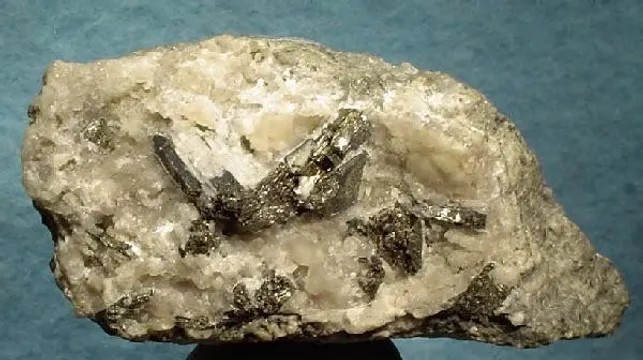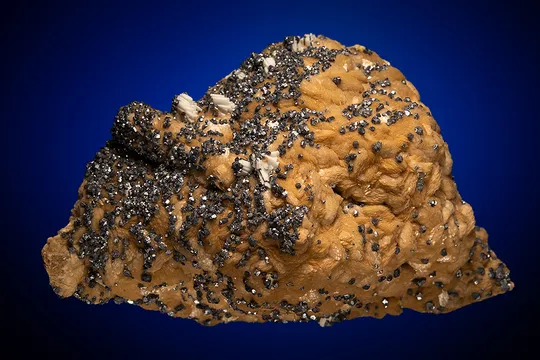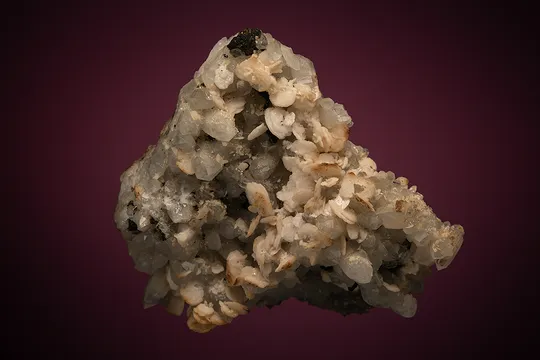
Cash Mine, Gold Hill, Colorado — a renowned collector locality yielding native gold with tellurides (hessite, petzite, sylvanite) in compact, dense miniatures.
Key facts
The Cash Mine is a collector’s locality with the peculiar gravity that only a true telluride mine can have: small specimens, dark ore, and exceptional mineralogical density. It sits in the Gold Hill district west of Boulder, at the northeastern end of the Colorado Mineral Belt, where Precambrian crystalline rocks were cut by steep fissure veins and later mineralized by gold-silver-telluride fluids. For collectors, Cash is not merely “a Colorado gold mine.” Its better specimens are compact pieces of horn-gray quartz and sulfide-rich vein matter carrying native gold, hessite, petzite, sylvanite, pyrite, and other tellurides in associations that reward both hand-lens work and ore microscopy.
Gold Hill itself is one of Colorado’s foundational mining camps. Placer gold at Gold Run began the rush in 1859, lode discoveries followed, and telluride ores revived the district in the 1870s. The Cash lode was staked during that telluride era, and the mine remained important enough to reappear in modern exploration and small-mine production records in the early 2000s. Its collectible material reflects that long life: historic matrix wire gold, modern high-grade telluride ore, polished-looking vuggy quartz fragments, and small metallic patches that are easily underestimated until magnified.
The finest Cash specimens are not broad museum plates of showy crystallization; they are concentrated, information-rich miniatures and thumbnails. Native gold may appear as fine leaves, striated little wires, curled horn-like forms, rounded aggregates, inclusions in tellurides, or fracture fillings cutting hessite. Hessite and petzite are typically dark lead-gray to black metallic tellurides, sometimes forming rich seams or patches with brassy pyrite and quartz. The best pieces preserve visible gold in direct association with recognizable telluride minerals, rather than anonymous dark ore with only an assay story behind it.
Regional View
Country View
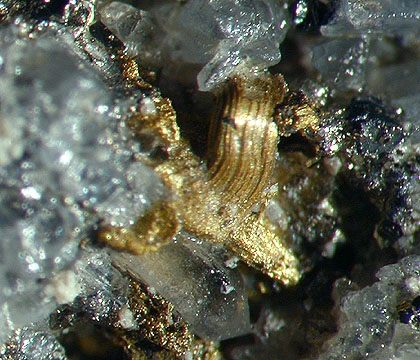
Photo: Rob Lavinsky, iRocks.com via Wikimedia Commons
This is a locality where labels matter. “Gold Hill, Boulder County” appears on old specimens from several nearby mines, and telluride ore from the district can look deceptively similar from mine to mine. A strong Cash Mine specimen should have more than a broad district attribution: ideally it should carry an old collection label, a dealer record, a known modern production association, or mineralogical evidence consistent with the Cash assemblage—hessite, petzite, pyrite, quartz, and native gold in a narrow-vein, gold-silver-telluride context.
Search for specimens: View all specimens from Cash Mine, Gold Hill, Gold Hill District, Boulder County, USA
The Cash Mine is best understood as an alkaline gold-telluride vein deposit: a narrow, steep, structurally controlled Au-Ag-Te vein system in the Gold Hill district. The country rocks are Proterozoic crystalline units, including gneissic and granitic rocks of the Boulder Creek terrane, and the district sits within the broader northeastern Colorado Mineral Belt. Regional studies treat the Boulder County gold district as a set of gold-telluride and pyritic-gold vein camps spatially related to Tertiary alkalic intrusive activity and older Precambrian structural grain. At Cash, the collector sees the end result in miniature—dark, fine-grained quartz gangue, sulfides, and a suite of gold and silver tellurides rather than large open-pocket crystal growth.
The vein material is narrow but high grade. Modern summaries describe the district veins as fissure veins, commonly only a few feet wide and associated with breccia zones and sericitic or argillic alteration. Cash-specific work on the third level emphasized the role of a pre-vein fault: open spaces developed where the fault geometry changed, and ore localized where the structure created room for quartz, sulfides, tellurides, and gold. The Cash shaft followed a steep northwest-dipping vein downward to the ninth level; a modern adit entered on the third level, where later work explored and mined parts of the old system.
The ore assemblage is classic Boulder County telluride mineralogy, but with its own Cash flavor. Fine-grained, dull to dark gray chalcedonic quartz—locally called horn quartz—is the common gangue. Early sulfides include pyrite, galena, sphalerite, and chalcopyrite. Hessite is abundant in the documented third-level material, with petzite, sylvanite, altaite, native gold, electrum, and other tellurides recorded from the locality. Very late scheelite has also been noted in the Cash ore microscope work, an important reminder that the Boulder tungsten belt and the telluride districts overlap in this part of the Front Range.
Historically, the Cash lode belongs to the second, telluride-driven phase of Gold Hill mining. The claim was located in November 1872 by Robinson, Hoik, and Sanford, surveyed for patent in early 1873, and patented in February 1875. A Colorado Supreme Court case from the 1880s preserves unusually vivid technical details: the lode was prominent on the surface, cropped out for hundreds of feet, had multiple early workings along the vein, and was considered one of the best-known mining properties near Gold Hill. The legal record is unusually useful for collectors because it confirms that Cash was not a vague neighborhood name but a defined patented lode with recognized workings.
Modern records show renewed exploration and small-scale production in the 2000s under Mount Royale Ventures, a Colorado subsidiary of Global Minerals. In 2004–2005, rock-chip samples from the 125 level were reported to average 1.59 ounces of gold per ton and 7.92 ounces of silver per ton, and work was underway on a third-level crosscut and the local flotation mill. By 2006–2007, the Cash and Rex project encompassed more than 100 patented and unpatented claims in a roughly 480-acre land position, and production permission had been granted for MRV Adit No. 1 on the Cash third level. Published accounts describe a refurbished mill rated at 50 tons per day, with planned upgrades, and a measured Cash-Rex resource of 15,948 tons at 1.71 ounces gold and 14.8 ounces silver per ton.
Collector pieces from the mine reflect both historical and modern sources. A famous documented miniature of matrix wire gold with sylvanite, collected by Russ McClellen in 1961 and later in Rich Kosnar’s Colorado gold suite, shows that attractive hand specimens came from earlier work. Modern specimens on the market tend to be high-grade telluride ore miniatures and thumbnails: gold with hessite, petzite, and pyrite; hessite with petzite and pyrite; and petzite-hessite patches on quartz-rich matrix. Because many of the richest mineral relationships are microscopic, a “good” Cash specimen may be modest in size but unusually important if it carries visible gold and identifiable tellurides in the same piece.
Access today should be treated as private, non-collecting mine property unless explicit permission has been obtained from the owner or operator. The old workings are also not safe casual collecting sites: Gold Hill is riddled with historic shafts and stopes, and Cash itself includes old unmapped workings in addition to rehabilitated modern mine development. For collectors, the practical route is through documented specimens from old collections, specialist dealers, and modern mine-related material, not field collecting.
Gold from the Cash Mine is prized when it escapes the usual fate of being microscopic metal in telluride ore and appears as visible native gold on matrix. Cash gold is documented as fine leaves in vugs, rare striated curled horn-like forms, inclusions in hessite, fracture fillings in telluride masses, small stout wires on quartz, and rounded aggregates with petzite. The most desirable pieces show gold in direct association with the Cash telluride assemblage—especially hessite, petzite, sylvanite, pyrite, and quartz—rather than isolated specks in dark ore. Size ranges from microscopic grains and leaves to visible millimetric wires and aggregates; one documented specimen carries an 8 mm rounded gold aggregate with petzite, while the noted 1961 Russ McClellen/Rich Kosnar miniature is a 4.1 x 3.8 x 2.4 cm matrix specimen with small striated gold wires, pyritohedral pyrite, bladed sylvanite, and quartz. The collector premium here goes to bright, sharply exposed gold on a verified Cash label, particularly when the specimen preserves the intimate gold-telluride relationships rather than merely suggesting them by assay.
Hessite is one of the defining Cash Mine species, not for large freestanding crystals but for its role as the common silver telluride in the ore. In third-level material it is documented with petzite and native gold, commonly as metallic gray to dark gray masses, seams, patches, and microscopic intergrowths in horn quartz with pyrite, galena, sphalerite, and chalcopyrite. Ore microscopy from Cash shows hessite late in the paragenesis of one narrow quartz-vein association; in another sample, gray hessite followed euhedral quartz and was cut by curvilinear fractures later occupied by coarser gold. Hand specimens sold and illustrated from the mine are typically thumbnails to miniatures, with hessite-bearing pieces around 3 cm to 5 cm and larger slabs carrying gold, hessite, petzite, and pyrite to roughly 8–10 cm. The best Cash hessite specimens are those in which the hessite is not merely a name on an assay label: it should be visually present as metallic telluride, associated with petzite and gold, and preferably supported by an old label, analytical confirmation, or a documented dealer or collection history.
Pyrite at Cash is both an ore mineral and a specimen enhancer. In the paragenesis described from Cash ore microscopy it belongs to the earlier sulfide assemblage with galena, sphalerite, and chalcopyrite, later joined or overprinted by tellurides and native gold. In hand specimens, Cash pyrite is most attractive as sharp, lustrous brassy pyritohedra sprinkled through quartz-telluride matrix; the classic 1961 wire-gold specimen is specifically noted for razor-sharp, highly lustrous pyritohedral pyrite crystals associated with striated gold wires and bladed sylvanite. In reflected-light views, pyrite is seen as pale yellow to cream-brown fractured crystals with altaite, galena, sphalerite, chalcopyrite, and quartz, making it an important anchor for identifying the ore textures. Collectors should prize crisp, bright pyrite that provides contrast and context for gold and tellurides, while ordinary massive pyritic ore without visible telluride or gold associations remains much less compelling.
Other documented Cash Mine minerals include petzite, sylvanite, altaite, electrum, galena, sphalerite, covellite, melonite, nagyágite, stützite, tellurite, scheelite, muscovite or sericite, chlorite-group minerals, and quartz. Petzite is especially important because Cash specimens show dark gray to black petzite with native gold, including microscopic crystals and aggregates. Altaite is a notable rarity in the assemblage, recorded as rich metallic patches and as bright grains in polished-section associations with galena, sphalerite, pyrite, chalcopyrite, and quartz. Sylvanite gives the locality some of its most attractive classic gold specimens, appearing as bright metallic white bladed crystals with wire gold and pyrite. Tellurite is a particularly interesting late Te oxide record from the mine, while melonite, nagyágite, and stützite add depth to the locality’s telluride suite even when they are unlikely to be recognizable without analysis.
Cash Mine specimens require more scrutiny than many Colorado gold pieces because the collectible material often consists of small metallic telluride grains in dark quartz-sulfide matrix. A casual “gold in quartz” label is not enough. Good documentation should name Cash Mine specifically, not only Gold Hill or Boulder County, and the best labels identify the associated tellurides or come from known collections, modern mine-related material, or dealers who have handled analyzed ore.
Mislabelling is the main risk. Gold Hill district material from Cash, Rex, Red Cloud, Slide, and other nearby mines can be visually similar, and broad “Gold Hill” labels may have been tightened by later owners without evidence. Conversely, unattractive but genuine telluride ore may be under-described because the valuable minerals are microscopic. If a specimen is sold as hessite, petzite, altaite, or sylvanite from Cash, ask whether the identification is based on visual habit, ore microscopy, analytical work, or an inherited label. Hessite and petzite can be difficult to distinguish by eye, especially as dark metallic patches.
No well-documented specimen-faking tradition appears to be attached specifically to Cash Mine, but the usual native-gold cautions apply. Added gold leaf, glued gold fragments, and vague “telluride ore” claims should be viewed skeptically if the gold sits unnaturally on broken surfaces or lacks coherent mineral context. The most convincing Cash pieces show gold integrated into vugs, fractures, wires, or telluride masses, with pyrite and quartz relationships that make geological sense.
Condition is usually a matter of aesthetics rather than fragility. Native gold is soft and can be flattened or brightened by handling; hessite and other tellurides are comparatively soft, metallic, and easily rubbed; pyrite may tarnish, but Cash specimens are generally judged by freshness of metallic surfaces, contrast, and visible relationships rather than perfection. Many pieces are thin vein slabs or broken ore fragments, so edge chipping is common and not necessarily a defect unless it interrupts the main gold-telluride display.
Fluorescence is not a selling point for Cash material. Scheelite is documented from the mine and may fluoresce under shortwave ultraviolet light, but it is a late, rare accessory in the telluride ore rather than the feature for which collectors pursue the locality. Handle specimens as metallic ore: avoid unnecessary cleaning, acids, or abrasive brushing, and keep labels with the piece. For hessite-rich and petzite-rich specimens, a small box, stable humidity, and minimal finger contact are sensible.
Market availability is intermittent but real. Cash is not a locality that floods the market with cabinet specimens; rather, it appears in small runs from modern mine material, specialist dealer inventories, and older Colorado collections. Modest hessite-petzite-pyrite pieces can be affordable, while pieces with visible native gold—especially gold with hessite and petzite—move into a substantially higher tier. The strongest specimens combine a specific Cash label, visible gold, identifiable tellurides, and enough matrix to preserve the locality’s geological story.
The Cash Mine has an unusually vivid paper trail for a small hard-rock gold mine. In an 1884 Colorado Supreme Court case, the lode appears almost as a character in the landscape: located in November 1872 by Robinson, Hoik, and Sanford, surveyed for patent in early 1873, and ultimately patented on February 4, 1875, as a 1,500-foot-long by 50-foot-wide claim. The court record says the vein cropped out for 500 to 1,000 feet, that a shaft house covered the discovery shaft, and that five or six other openings had already been made along the vein. By the time rival locators attempted to place the Queen of May lode over the same ground in 1880, the Cash was already “one of the best known mining properties” near Gold Hill—visible, worked, monumented, and familiar enough that other claimants used it as a point of reference.
More than a century later, the mine still had the feel of a living 19th-century problem being solved with 21st-century tools. A 2008 Colorado School of Mines account opens not with gold but with a phone ringing on the office wall—a dedicated line from the underground mine. Mine engineer Branden Burden jumped for it, not because there had been an emergency, but because the possibility was always present. His line was memorable: “I hate it when that phone rings.” The mine then employed 33 people, seven of them Colorado School of Mines alumni, with Matt Collins as mine manager, Lina Collins as environmental engineer, Chris Emanuel as mill engineer, Jim Paschis as geologist, Donovan Smith as associate mine engineer, Murray Watts on core drilling, and Burden as mine engineer.
The physical mine described in that account was no simple adit. The old Cash workings formed a treacherous maze of vertical shafts and horizontal drifts, many not fully mapped. The original mine was said to have nine levels and to reach about 750 feet deep; Mount Royale Ventures entered from the side of the mountain at the third level and was mining upward, intending to clean out higher levels before going deeper. The company was relearning selective narrow-vein mining—working vertically upward through a narrow vein—with a 1918 manual as one of its best guides. Burden joked that only a handful of people were still alive who knew the method well, and the mine was employing most of them.
The modern operation was small enough to feel personal and old enough to feel haunted by earlier work. Engineers sometimes filled in as miners or welders. New engineers rotated through the mine before settling into their roles. Smith’s morning job included lighting the wood stove in the miners’ dry room at 5:30. The crew placed new timber and track as they advanced, built ore chutes where productive veins appeared, and worked carefully around old unmapped openings because breaking into a watercourse could flood the mine. At the face they still used compressed-air jackleg drills, a 1930s technology, while the primary and secondary crushers dated to the 1920s. Fuses were preferred over electronic blasting systems because lightning on Gold Hill made wiring a risk the crew did not want.
The numbers from that modern period give collectors a useful sense of scale. The mine was pulling about 50 tons of ore a day—tiny by industrial standards—and processing it at the on-site mill before shipping concentrate to Mexico for smelting. Grades improved from roughly a tenth to half an ounce of gold per ton in the early stages to about three-quarters of an ounce per ton. The richest ore was described as a one-foot-thick, nearly vertical vein. Each blast was sampled and assayed, and Collins fed the results into a three-dimensional model. When his algorithms pointed to a new target, it turned out to lie directly beneath an old stope that had been mined decades earlier with considerable success. Collins called that discovery an “aha” moment.
There is also a quieter story in the ore microscope. Jim Paschis, senior mine geologist at Cash, described a vein world where the collector’s familiar hand specimen becomes a landscape of tiny events: early pyrite, galena, sphalerite, and chalcopyrite; later tellurides; gold leaves in vugs; rare curled gold horns; hessite in quartz vugs; and gold filling fractures within hessite after cooling and structural change. One Cash sample suggested hessite deposition above 155º C and later gold below that temperature, consistent with the remarkably low temperatures long proposed for Boulder County telluride deposits. In a hand specimen, those relationships may look like little more than a golden flash in dark gray ore. Under the microscope, they become the chronology of a vein closing, cooling, cracking, and admitting one more pulse of gold.
Mindat.org — Cash Mine, Gold Hill, Gold Hill Mining District, Boulder County, Colorado, USA — Locality database entry for the Cash Mine, including coordinates, commodity, mineral list, photo links, and cited occurrence records for native gold, hessite, petzite, pyrite, altaite, and other species.
Mindat.org — Cash Mine photo gallery — Useful specimen-photo record showing Cash petzite, native gold, sylvanite, altaite, pyrite, galena, sphalerite, and quartz associations, including microscope-scale ore images and notable collection pieces.
Paschis, Jim A. “Cash Mine: 3rd level Mining, Milling and Ore Microscopy.” In Gold and Silver Deposits in Colorado Symposium Abstracts, Posters & Program, Friends of Mineralogy Colorado Chapter, 2017. — The most Cash-specific modern mineralogical source located, with details on the third-level workings, ore microscopy, paragenesis, hessite, gold in vugs, horn quartz, scheelite, milling, and MRV production.
Saunders, James A. “Gold Deposits of the Boulder County Gold District, Colorado.” In Geology and Resources of Gold in the United States, U.S. Geological Survey Bulletin 1857-I, 1991. — Regional geologic framework for Boulder County gold-telluride and pyritic-gold veins, including the relationship to Precambrian terrane, Tertiary intrusive activity, and gold-telluride mineralization.
Lovering, T. S., and E. N. Goddard. Geology and Ore Deposits of the Front Range, Colorado. U.S. Geological Survey Professional Paper 223, 1950. — Classic Front Range ore-deposit reference cited in later Cash and Gold Hill records.
Gable, Dolores J. Geologic Map of the Gold Hill Quadrangle, Boulder County, Colorado. U.S. Geological Survey Geologic Quadrangle Map GQ-1525, 1980. — Bedrock geologic map for the Gold Hill quadrangle, important for understanding the local Proterozoic crystalline setting.
Vanderwilt, John W., W. S. Burbank, and W. M. Traver Jr. Mineral Resources of Colorado. Colorado Mineral Resources Board, 1947. — Foundational Colorado mining-district reference used in later Gold Hill production summaries.
Cappa, James A., et al. Colorado Mineral and Mineral Fuel Activity, 2004. Colorado Geological Survey Information Series 70. — Documents early 2000s exploration at Cash, including 125-level sampling, third-level crosscut work, the 50-ton-per-day flotation mill, and the 480-acre claim position.
Cappa, James A., Genevieve Young, James R. Burnell, Christopher J. Carroll, and Beth Widmann. Colorado Mineral and Energy Industry Activities, 2006. Colorado Geological Survey Information Series 75. — Documents Cash and Rex development, measured resources, production permission for the third-level adit, early concentrate and doré production, and reclamation recognition.
Cullacott v. Cash Gold & Silver Mining Co., 8 Colo. 179, Colorado Supreme Court, 1884. — Primary legal source for the Cash lode’s 1872 location, 1875 patent, surface exposure, early workings, and claim dispute.
Gold with Sylvanite from the Cash Mine, ex Rich Kosnar Collection — Wikimedia Commons file record. — Documented 4.1 x 3.8 x 2.4 cm matrix wire-gold specimen collected by Russ McClellen in 1961 and later in Rich Kosnar’s Colorado gold suite.
Weinrich Minerals — Petzite with Hessite, Pyrite, Quartz, specimen 3773074. — Dealer record for an identified Cash Mine thumbnail formerly in the Hal Miller collection and later Martin Jensen collection.
Cash Mine — Western Mining History — MRDS-derived mine record with location, commodity, private land status, underground past-producer classification, and alkaline Au-Te vein model.
Cash Mine, Gold Hill — Mindat locality page — Best single mineral-list starting point for the locality, especially for telluride species and specimen-photo links.
Cash Mine photo gallery — Mindat — Essential visual reference for what real Cash gold, petzite, altaite, pyrite, and polished-section ore textures look like.
Cash Mine: 3rd level Mining, Milling and Ore Microscopy — Friends of Mineralogy Colorado Symposium PDF — Cash-specific technical account by Jim Paschis, with ore microscopy and modern production context.
Gold Deposits of the Boulder County Gold District, Colorado — USGS Bulletin 1857-I — Regional geologic model for the Boulder County gold-telluride system.
Geologic Map of the Gold Hill Quadrangle — USGS GQ-1525 — Bedrock map reference for the geology around Cash and Gold Hill.
Colorado Mineral and Mineral Fuel Activity, 2004 — Colorado Geological Survey IS-70 — Documents renewed Cash exploration, sampling, and mill work in 2004–2005.
Colorado Mineral and Energy Industry Activities, 2006 — Colorado Geological Survey IS-75 — Documents the Cash-Rex modern project, third-level production permission, and early concentrate production.
Hard Rock Gold Mining — Mines Magazine — Readable account of the 2008 Cash operation, its people, equipment, mining methods, and day-to-day hazards.
Cullacott v. Cash Gold & Silver Mining Co. — OpenJurist — Legal record preserving early Cash lode history, patent details, and claim-dispute context.
Gold-Sylvanite-282521.jpg — Wikimedia Commons — Image and documentation for the classic Russ McClellen/Rich Kosnar matrix wire-gold specimen.
Petzite with Hessite, Pyrite, Quartz — Weinrich Minerals — Example of a confirmed modern market specimen from Cash with collection provenance.