Sterling Mine, USA — Colorado’s classic blue barite locality, with aquamarine-blue prisms on calcite, noted for beauty, rarity, and collector history.
Key facts
Sterling Mine, better known among Colorado collectors as the Stoneham blue-barite locality, is one of the classic sulfate occurrences of the American High Plains. The name can mislead: the celebrated specimens do not come from a metal mine in the mountain West, but from shallow pockets in Oligocene sedimentary beds northeast of Stoneham, Weld County, Colorado. Older labels often say “Sterling,” because Sterling, in nearby Logan County, was the better-known railroad and supply town; the collector locality itself is in the Stoneham area.
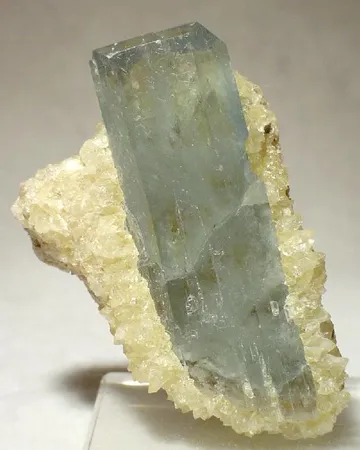
The deposit is famous for blue barite, BaSO4, occurring as flattened orthorhombic prisms, blades, single crystals, and clusters, commonly on pale yellow to honey calcite. The setting is a tan to cream claystone in the lower Chadron Formation of the White River Group, a tuffaceous unit rich in altered volcanic glass. The best crystals formed in open cavities along low-angle segments of fault planes, where groundwater moved through brittle claystone and left barite and calcite in pockets rather than in ordinary vein fillings.
Collectors prize Sterling Mine specimens for a look that is unmistakably Colorado: cool aquamarine to gray-blue barite blades standing free from sugary calcite, sometimes sharply doubly terminated, sometimes grouped into open “forests” across thin plates. The finest pieces combine translucency or true gemminess, undamaged chisel-like terminations, pleasing spacing, and a contrasting calcite matrix. Single crystals are common enough that modest examples still circulate, but balanced, transparent, damage-free clusters from the best 1980s pockets have become genuinely difficult to replace.
Regional View
Country View
The locality’s importance rests on a rare combination: handsome cabinet aesthetics, a tight and well-documented geological control, and more than a century of collector history. By the late nineteenth century, pale blue “Sterling” barite was already noted in mineralogical literature; by the mid- and late twentieth century, the Stoneham pockets had become a reference point for American barite. The 1985 and 1989 digs, especially the Leeson Pocket material, fixed the locality’s modern reputation and supplied the market with the classic blue clusters still sought today.

Photo: Wikimedia Commons

Photo: Wikimedia Commons
Search for specimens: View all specimens from Sterling Mine, USA
Sterling Mine is a specimen locality rather than an ore mine in the usual sense. The collecting ground lies on the high plains of northeastern Colorado, about 150 kilometers northeast of Denver and roughly 10 kilometers north-northeast of Stoneham. The productive ground is associated with a bright, pale, flat-topped promontory whose eroded north flank forms a small horseshoe-shaped basin long called the Blowout. The surrounding landscape is open ranch country and badland topography near the Chalk Bluffs and the Pawnee National Grassland region.
The geological host is the lower part of the Chadron Formation in the White River Group, early Oligocene sedimentary rocks resting unconformably on the Cretaceous Pierre Shale. In the productive zones the critical layer is a 15- to 20-foot tan-to-cream claystone rich in altered volcanic ash and montmorillonite. That claystone was brittle enough to preserve open fractures and cavities, while the underlying Pierre Shale and overlying softer beds tended not to hold the same clean pocket spaces. The barium is generally interpreted as having been leached from altered volcanic glass in the tuffaceous sediments; sulfate may have come from earlier sulfate minerals in the sedimentary pile, with groundwater doing the concentrating and depositing.
The specimen pockets are structurally controlled. In the 1989 excavation, a major fault zone striking northwest-southeast and dipping on average northeast was exposed in a long trench. The fault was not a simple planar crack: its dip varied from nearly horizontal to steep. Where it steepened, slickensides and brecciation were common but good pockets were scarce. Where the fault flattened, small openings could be pulled apart and lined with barite, calcite, or both. That is why the best pockets had flat floors and ceilings, with free-standing blue barite crystals rising from the bottom like a miniature forest. Some cavities were no more than seams; others reached several meters across.
The collecting history extends back at least to the late nineteenth century under the broad “Sterling” label. The locality entered mineral literature as blue barite “near Sterling,” but later work clarified that the classic collecting area is near Stoneham in Weld County, about 25 miles west of Sterling. Early collecting produced loose crystals, rosettes, sheaf-like groups, earthy concretions, and small crystal-lined geodes. In 1953 Clarence Coil and O. Art Reese reportedly made a successful dig; Ed Over collected a 12.7 cm cluster around 1952 that later entered the Denver Museum of Natural History collection. Through the twentieth century, the locality was visited by individuals and mineral clubs when landowner permission could be obtained.
The first modern pocket that collectors still speak of with reverence was the 1985 find by Luke and Cathy Westervelt and Norman Bennett. Working for eight days, they followed a dipping seam or joint in the clay and found pockets associated with pale yellow calcite. One large plate from that find, later acquired for the Denver Museum, measures 43 by 23 cm and carries roughly seventy-five exposed barite crystals, the largest about 14 by 3.8 cm. That find helped define the look collectors still mean when they say “Stoneham blue barite”: blue blades partly set in pale calcite, with enough matrix to give the piece presence rather than just mineral identity.
In 1989 Dennis Wilson and Jim Smerglia found another fine pocket along the same general seam or fault zone, excavating through about 3.7 meters of clay overburden and recovering fine barite with calcite. The danger and labor of hand digging at that depth led to the best-documented specimen-mining campaign at the locality. Bryan Lees of Collector’s Edge Minerals and Dennis Wilson formed the Leeson Partnership, leased mineral rights from the Niklas Ranch Company, and in July 1989 brought in heavy equipment to follow the structure. A 955 Caterpillar crawler-loader was used to remove overburden, and USGS geologist Peter Modreski documented the excavation.
That 1989 work cut a trench ultimately about 45 meters long, at least 9 meters wide, and as much as 15 meters deep. Two major pockets and several smaller openings were mined. The two large pockets were measured at roughly 3 by 2 by 1.5 meters and 3.6 by 1.2 by 0.25 meters. The final yield was about 3,000 specimens: around 2,100 single crystals or small groups and about 890 cleaned, numbered crystal clusters. Specimens from the Leeson pockets were marked with an “L” number. Many of the most desirable market pieces today trace to that operation, particularly those with gemmy aquamarine-blue blades on pale calcite.
Later specimen mining did occur. In July 2002, Michael R. Sanders and Frank Bendrick conducted a one-week operation on a state-land lease in the Stoneham area. They used a backhoe to uncover pockets as large as about 6 inches high, 6 feet long, and 3 feet deep. The best cavities contained loose, pale to sky-blue crystals as long as 10 cm, often with only thin clay coatings. Quality reportedly declined where pockets approached the underlying Pierre Shale, because cream-colored sticky clay filled cavities and the barite became cloudy and broken.
Collecting access today must be treated conservatively. The famous Niklas Ranch collecting areas are private land and are no longer open; the owners have asked that collectors not come to the ranch, and permission is not granted. Other barite occurrences exist over a broad area of Weld and Logan Counties wherever favorable White River Group beds are exposed, but land status varies among private, state, and federal holdings. Serious collectors should not rely on old guidebook directions or historic trip reports as permission. A Sterling/Stoneham label is best understood as a locality and specimen-mining name, not an invitation to dig.
Barite from Sterling Mine is the locality’s signature species, occurring as pale to medium aquamarine-blue, gray-blue, and greenish-blue crystals in flattened prismatic to tabular habits, elongated along the b-axis and commonly showing chisel-like terminations; 1989 Leeson Pocket crystals commonly ranged from about 1.27 to 5.1 cm, with larger examples to around 10 cm and historic crystals reaching roughly 10–15 cm. The best specimens are transparent to translucent, lustrous, sharp, and either free-standing as singles or set as balanced clusters on pale yellow to honey calcite; ordinary examples are cloudy, isolated, cleaved, sun-bleached, or merely loose crystals without matrix. Particularly desirable pieces come from the mid-1980s and 1989 pockets, where blue blades stood from flat pocket floors and, in some seams, were sprinkled or partly supported by small distorted calcite rhombs.
Baryte is the same BaSO4 mineral under the IMA-preferred spelling, and Sterling Mine examples should be judged by the same locality-specific standards: cool blue color, glassy luster, intact terminations, and elegant spacing of blades on calcite. The classic baryte specimens are not massive vein pieces but cavity-grown crystals from the Chadron Formation claystone, often loose in pockets or lightly coated with clay when found; the most coveted examples preserve the pocket architecture as plates or clusters rather than single separated blades. Good baryte here may show aquamarine-like clarity, but many crystals are translucent or cloudy, and the most valuable pieces are those in which the blue crystals contrast cleanly with pale yellow, cream, or honey calcite while retaining the delicate, damage-prone edges that make Stoneham material so recognizable.
The documented Sterling Mine assemblage is narrow but interesting: barite/baryte dominates, calcite is the principal associated mineral, and opal occurs as thin coatings on some barite and calcite. The locality is also known for sand-calcite from the broader Stoneham area, and some specimens carry bright green fluorescence where uraniferous opal coats crystal faces or tips. It is not a type-locality suite and should not be represented as one; its significance lies instead in producing one of North America’s most distinctive blue-barite habits. Faceted Stoneham material also appears in gemological records, including barite and a celestite-labeled stone, but the classic collectible identity of the Sterling Mine remains blue barite with calcite.
The first authenticity issue is locality precision. “Sterling,” “Sterling Mine,” “Stoneham,” and “near Sterling” have all been used on labels, but the great classics are from the Stoneham area of Weld County, not from the town of Sterling in Logan County. A vague “Sterling, Colorado” label may be historically legitimate, especially on older pieces, but it should be read carefully. Conversely, not every Colorado blue barite is Stoneham: Hartsel, Two Creeks, the Book Cliffs, Muddy Creek, and other Colorado localities have their own habits and color behavior.
Stoneham barite is frequently encountered as single loose crystals, small intergrown groups, or clusters on calcite. Top market specimens are not simply blue; they are damage-free, transparent to gemmy, sharply terminated, and well composed. Matrix pieces with multiple upright crystals on pale calcite are far scarcer than singles. Clean, old Leeson Pocket numbers, provenance to Collector’s Edge, or association with named collections can add confidence and value, particularly because the 1989 material was cleaned, sorted, and numbered after the dig.
Condition matters greatly. Barite has perfect cleavage, relatively low hardness, and brittle edges; Sterling Mine crystals often show bruised terminations, chipped side faces, repaired cleaves, and abraded contact points. Many examples were recovered loose or from clay-filled cavities, so clay staining and calcite encrustation are normal, but harsh cleaning can leave dulled faces or broken edges. Dealers have sometimes noted that tiny bruises on glossy blue crystals can be hidden with oil; collectors should inspect under magnification and strong oblique light, because oiled abrasions and old repairs can be difficult to see in photographs.
Color requires special care. The blue in Stoneham barite is a color-center phenomenon whose cause has been debated, and published work records both fading with prolonged sunlight and collector reports of post-excavation intensification. Surface float is commonly bleached or paler than freshly recovered pocket crystals. The safest conservation practice is to keep fine specimens out of direct sunlight and away from heat. Do not place a prized Stoneham barite in a sunny window to “improve” the color; unlike some other blue barites, the Stoneham response is not simple enough to justify the risk.
Fluorescence should be interpreted correctly. The barite itself is generally nonfluorescent under ultraviolet light. Bright green fluorescence on some specimens belongs to uraniferous opal coatings on barite or calcite. This coating is one of the small accessory pleasures of the locality, but it should not be sold as fluorescent barite. As with any uraniferous coating, avoid grinding, acid-cleaning, or generating dust; ordinary intact display specimens present no unusual handling issue beyond sensible hygiene.
Market availability is two-tiered. Small singles and lesser clusters still appear regularly from old collections, club material, dealer back stock, and field-collected lots. Fine clusters from the 1985 and 1989 discoveries, especially deep blue gemmy crystals on attractive calcite matrix, are far less common and command a premium. The famous ranch collecting ground is closed, and modern production is sporadic at best, so high-grade Sterling Mine specimens are increasingly collection-to-collection pieces rather than fresh-mine commodities.
The Stoneham story begins with a cartographic ghost. For decades, collectors repeated “Sterling” because Sterling was the bigger town and the name that found its way onto labels, catalogues, and old references. The crystals themselves were not coming from an ore shoot under a mining camp, but from pale clay hills near Stoneham, in country better known for grass, wind, ranch roads, and badlands. That mismatch is part of the charm: one of Colorado’s best-known display minerals came not from the San Juans or the Front Range pegmatites, but from a quiet High Plains clay bed laid down by Oligocene ash and crossed by small faults.
In May 1985, Luke and Cathy Westervelt and Norman Bennett spent eight days digging by hand into that clay. They followed a sloping seam, the sort of subtle structural clue that looks unimpressive until it opens. The pockets they described could be meters across, and the best zones were where the seam approached a flatter attitude. Out came large blue crystals and clusters with pale yellow calcite, including a plate now in the Denver Museum collection measuring 43 by 23 cm. About seventy-five crystals are exposed on that plate, with the largest around 14 by 3.8 cm. For a locality often represented on the market by singles, that plate is a reminder of what the pockets looked like before trimming, cleaning, and dispersal.
The 1989 season had the drama of a small expedition. Bryan Lees and Dennis Wilson formed the Leeson Partnership, leased mineral rights from the Niklas Ranch Company, and moved into the field with heavy equipment. They brought in a 955 Caterpillar crawler-loader because hand digging had become too dangerous and inefficient under meters of hard clay. The dig started on July 14, 1989. Thunderstorms and tornado weather moved across the county, punishing tents and tarps, while the crew camped on site so someone was always present. Old hand-dug holes, only about 0.6 to 0.9 meters wide, were exposed as the earlier tailings were stripped away. It took three days just to get below the level of the old tunnels.
Then the structure seemed to die. The trench had exposed more than 45 meters of the barite-bearing seam, but the steep parts of the fault were barren or nearly so. Calcite veinlets pinched out. By the sixth day, the expected deepening of calcite had not happened. It is easy, in hindsight, to see the pattern—steep fault, little open space; flat fault, pocket—but in the dust of an expensive excavation that realization had not yet delivered specimens. On the seventh day, a 0.3-meter brecciated clay zone appeared. The loader stopped. Someone probed the clay. A small dark opening appeared.
A flashlight went in first. The phrase that survived was “Barite wasteland!”—followed at once by the practical collector’s question, “How far does it go?” What the light revealed was a low, broad cavity about 3 meters wide, 1.8 meters deep, and only about 0.15 meter high, its floor coated with a forest of upright blue barite. That pocket changed the dig from a costly geological exercise into one of the classic American specimen-mining stories. The best pockets had flat roofs and floors, and the crystals were often free-standing from the bottom, connected by smaller barite or crusts of calcite. It was less a vein than a preserved crystal floor.
The work after discovery was almost as telling as the discovery itself. Seven people were involved in collecting, but five people then worked full time for six weeks cleaning the crystals and preparing them for the Denver mineral show. The final count was about 3,000 specimens: roughly 2,100 singles and small groups, plus about 890 cleaned and numbered clusters. Each Leeson Pocket specimen received an “L” number. This is why good provenance matters at Stoneham: the best pieces did not merely “come from Colorado”; they were part of a documented operation in a particular trench, along a particular fault, during two weeks of July 1989.
The 2002 operation showed that Stoneham was not just a one-pocket legend. Michael R. Sanders and Frank Bendrick worked for a week in July on a state-land lease and used a backhoe to open new cavities. Some pockets were as much as 6 inches high, 6 feet long, and 3 feet deep. The crystals were commonly loose, pale to sky-blue, and lightly clay-coated, with individuals as long as 10 cm. The most instructive observation was negative: as the faults approached the Pierre Shale, the pockets began to hold sticky cream-colored clay, and the barite became cloudy and broken. The clay and shale contact acted like a hydrologic boundary as well as a collecting boundary, turning the science of pocket prediction into something a collector could see on the floor of an excavation.