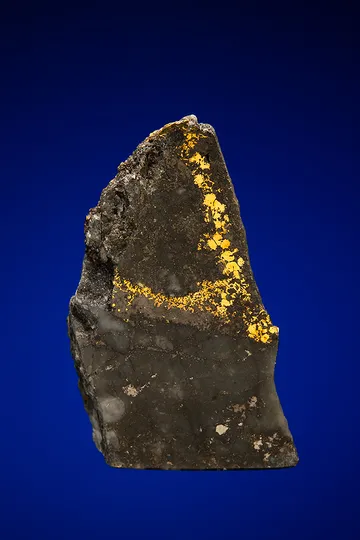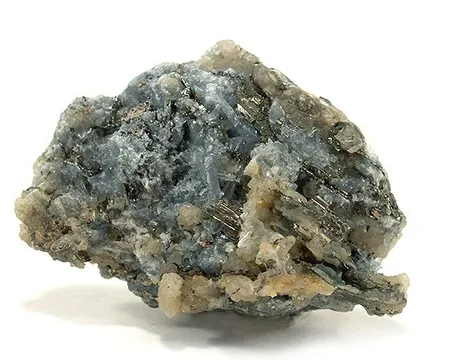
Cripple Creek, USA - world-class locality for gold tellurides like calaverite and sylvanite, with bright metallic blades in quartz and historical specimens.
Key facts
Cripple Creek is the American classic for gold tellurides: not a pretty side-note to Colorado gold history, but one of the world’s defining examples of an alkaline igneous rock-related Au-Te district. The mines lie in Teller County, west of Pikes Peak, where Oligocene phonolitic, tephriphonolitic, trachyandesitic, mafic, and ultramafic intrusive and breccia bodies punched into older Proterozoic crystalline rocks. For collectors, the important point is that the district’s gold did not merely occur as yellow metal in white quartz. Much of the fame rests on metallic gold tellurides—especially calaverite, with sylvanite and krennerite also central to the story—set in quartz, fluorite, pyrite, altered phonolite, breccia, and locally celestine, dolomite, rhodochrosite, creedite, and other distinctive gangue minerals.
The best Cripple Creek specimens have a very particular look: bright, silvery to brass-bronze metallic telluride blades, plates, striated laths, or granular seams in pale gray to white quartz, commonly touched by purple fluorite. Some are handsome cabinet pieces, but many of the great locality specimens are deceptively small—ore minerals of extremely high value preserved as thumbnail- to miniature-scale survivors from a district where most rich material went straight to the mill or smelter. In old collections, a well-crystallized Cripple Creek calaverite or sylvanite with unquestionable mine provenance is as much a historical object as a mineral specimen.
Regional View
Country View
The district also matters because it bridges two collecting eras. The underground bonanza mines of the 1890s and early twentieth century produced the old-time telluride specimens that built Cripple Creek’s reputation. The modern Cripple Creek & Victor operation, centered on the Cresson area, has exposed enormous volumes of altered breccia and disseminated ore, while occasional pockets and unusual mineral assemblages—most famously the Cresson vug historically, and later Cresson open-pit finds of creedite, celestine, rhodochrosite, and gearksutite—keep the locality alive in the collector imagination.

Photo: James St. John / Wikimedia Commons

Search for specimens: View all specimens from Cripple Creek, USA
Cripple Creek is an alkaline Au-Te district developed in and around a complex volcanic-intrusive center between the towns of Cripple Creek and Victor. The dominant host environment is a nested diatreme-intrusive complex: breccias, phonolitic and related alkaline rocks, dikes, and intrusive bodies emplaced into older crystalline basement. Hydrothermal alteration and mineralization followed the magmatic activity, with fissures, sheeted vein zones, breccias, and permeable fragmental rocks acting as the principal sites for ore deposition.
The district contains two broad ore styles that collectors should keep separate in their minds. The old high-grade ores occurred as narrow veins, fractures, and open-space fillings carrying gold-silver tellurides in quartz-pyrite-fluorite gangue. These are the sources of the classic hand specimens: metallic calaverite, sylvanite, krennerite, petzite, hessite, altaite, coloradoite, melonite, and associated minerals in quartz, fluorite, and altered wall rock. The second style is low-grade disseminated gold, commonly microscopic native gold associated with pyrite and adularia-rich alteration in breccia and wall rock. That disseminated ore is crucial economically, especially for modern open-pit mining, but it is far less obvious to the naked-eye collector.
The major ore minerals are not distributed as a single simple vein. Cripple Creek mineralization is structurally and lithologically controlled, with northeast- and northwest-trending structures, dikes, breccia bodies, and zones of permeability helping channel hydrothermal fluids. The Cresson area is especially important because of the Cresson pipe or “blowout,” a pipe-like basaltic breccia mass around which mineralization developed. In the Cresson open pit, ore is documented as broad zones of low-grade disseminated native gold with pyrite and potassium alteration, hydrous iron and manganese oxides, and gold-silver tellurides in narrow quartz-fluorite fractures. For specimen collectors, that distinction explains why a large piece of Cripple Creek ore may show little visible metal, while a tiny fracture filling can carry a meaningful amount of gold in telluride minerals.
Mining history began with the late nineteenth-century discoveries that made Cripple Creek the last great Colorado gold camp. Robert Womack’s early finds and the rush that followed transformed a high, ranching landscape into a dense mining district of towns, shafts, mills, railroads, exchanges, and speculative fortunes. Among the classic names are the Independence, Portland, Cresson, Last Dollar, Gold Dollar, Doctor or Jackpot, El Paso, Ajax, Vindicator, Isabella, Golden Cycle, Victor, and Mollie Kathleen mines. The district’s most productive years straddled the 1890s and early 1900s, with underground mining continuing through cycles of boom, labor conflict, drainage-tunnel development, declining grades, and later revivals tied to higher gold prices and improved metallurgy.
Modern production belongs to the Cripple Creek & Victor Gold Mine, now operated by SSR Mining after its acquisition from Newmont was completed in 2025. The present operation is an open-pit, heap-leach gold mine centered on the historic Cresson ground and adjacent deposits. It is a large industrial mine, not a collecting locality in the casual sense. Access to active pits, benches, dumps, leach facilities, and mine roads is controlled, and collecting should be assumed prohibited unless explicit permission is granted by the operator or landholder. Historic dumps and mine sites around the district are also complicated by private ownership, patented claims, hazards, reclamation, and protected historic resources. Serious collectors generally obtain Cripple Creek specimens through old collections, dealer inventories, deaccessioned material, and rare pieces with credible mine or collection provenance.
The great specimen story is the Cresson vug, opened in 1914 on the deep underground levels of the Cresson Mine. Contemporary and later accounts describe a large open cavity, pear- or room-shaped, lined with rich gold tellurides including calaverite and sylvanite, with quartz and other gangue minerals. Vast quantities of extremely high-grade ore were removed, guarded, sacked, sampled, and shipped; only a small fraction survived as specimens. Modern collectors should treat any “Cresson vug” attribution with caution unless it is backed by old labels or a chain of custody, but the event remains the touchstone for Cripple Creek telluride mineralogy.
Important specimen-producing material also came from mines such as the Cresson, Portland, Last Dollar, Gold Dollar, Doctor or Jackpot, and Ajax. The Last Dollar is well known for sylvanite with purple fluorite; the Portland and Cresson have yielded crystallized calaverite on quartz and fluorite; and the Gold Dollar is historically tied to the short-lived “goldschmidtite” episode, in which a supposed new telluride was later shown to be crystallographically identical with sylvanite. More recent Cresson open-pit collecting history is notable for the 2001 occurrence of rhodochrosite, creedite, celestine, and gearksutite—an assemblage very different in appearance from the classic metallic telluride ores, but unmistakably part of Cripple Creek’s unusually fluorine-rich, tellurium-rich mineral system.
Cripple Creek sylvanite is most prized when it shows distinct metallic crystals rather than merely dark seams in ore: platy to bladed, silvery gray to steel-white or slightly yellowish metallic crystals, commonly only a few millimeters across, on quartz-rich matrix and locally with purple fluorite, pyrite, or altered phonolite. The Last Dollar, Cresson, Portland, Gold Dollar, Blue Bird, and other district mines have all been tied to sylvanite occurrences, but labels must be handled carefully because much older “sylvanite” from Cripple Creek was later suspected or shown to be krennerite or other Au-Ag tellurides. A good Cripple Creek sylvanite specimen has exposed, lustrous, identifiable crystals or rich vein material, an undamaged quartz-fluorite association, and credible provenance; an ordinary piece is simply dark telluride ore with no crystal definition and no mine history.
Calaverite is the signature Cripple Creek ore mineral and, at its best, occurs as sharp metallic tabular or lath-like monoclinic crystals, often striated lengthwise, with a brass-yellow, bronze, tin-white, or silvery metallic sheen on frosted gray quartz and purple fluorite. Cresson and Portland specimens are especially familiar to collectors: crystals of a few millimeters are typical, while crystals approaching 6 to 9 mm are substantial for the district and highly desirable. The richest old vug and fracture material was commonly mined for value rather than saved, so the best pieces are those in which the calaverite stands proud from the matrix, sparkles as the specimen is turned, and remains associated with the classic Cripple Creek quartz-fluorite gangue rather than being an indistinct metallic smear in broken ore.
Quartz at Cripple Creek is important less as a standalone crystal species than as the stage on which the district’s tellurides are displayed: white, gray, frosted, chalcedonic, vuggy, brecciated, or vein quartz carrying calaverite, sylvanite, krennerite, pyrite, fluorite, and locally carbonate minerals. Specimens may show etched or sinter-like quartz surfaces, crusts of small quartz points, or narrow quartz-fluorite veinlets cutting altered phonolite and breccia; showier collector pieces are those where the pale quartz provides clean contrast for bright metallic telluride crystals. Ordinary Cripple Creek quartz without visible tellurides, fluorite, ore texture, or mine provenance is usually of limited interest, but quartz with exposed Au-Te minerals from Cresson, Portland, Last Dollar, or related mines is central to the locality’s visual identity.
Beyond sylvanite, calaverite, and quartz, Cripple Creek’s mineral list is a compact lesson in telluride and fluorine-rich epithermal mineralogy. Krennerite is especially important and may account for some historical material once labelled sylvanite. Petzite, hessite, altaite, coloradoite, melonite, native tellurium, native gold, pyrite, marcasite, galena, sphalerite, stibnite, acanthite, tetrahedrite-tennantite group minerals, fluorite, kaolinite or dickite-like clay minerals, opal, calcite, dolomite, celestine, rhodochrosite, creedite, and gearksutite are among the species documented from the district or its major mines. The brief “goldschmidtite” story from the Gold Dollar Mine is historically interesting: it was proposed as a new telluride near the turn of the twentieth century, then dropped after comparison showed it to be sylvanite. The district is not famous primarily as a valid type-locality suite; its significance is instead the richness, variety, and collecting history of its Au-Ag-Te mineralization.
Cripple Creek is a locality where labels matter as much as sparkle. “Sylvanite” is the most treacherous name on old labels: much material historically called sylvanite has been reassessed as krennerite or other closely related tellurides, and hand-specimen identification can be unreliable without analytical work. Calaverite, krennerite, sylvanite, and petzite may all appear as small metallic grains, blades, seams, or laths in similar quartz-fluorite matrix. For high-value pieces, especially loose fragments or unlabeled old ore, collectors should prefer specimens with old collection labels, mine-specific provenance, published comparison material, or modern analytical confirmation.
Mislabelling is also a locality problem. Cripple Creek produced many visually similar telluride ores from many mines, and later dealers or owners often attached famous mine names—Cresson, Portland, Last Dollar, Gold Dollar—without documentation. The Cresson vug attribution is particularly vulnerable to wishful labeling. A specimen may be genuinely from the Cripple Creek district and still have an invented or unprovable mine attribution. Treat specific “Cresson vug” claims as exceptional, not routine.
Condition issues are predictable for the species involved. Sylvanite is soft and brittle; exposed crystals can be abraded, rubbed, or crushed by careless wrapping. Calaverite crystals are more robust than sylvanite but still small, high-relief, and vulnerable at edges and terminations. Many specimens were trimmed from ore and show broken quartz, sawed backs, or bruised metallic surfaces. Purple fluorite can be chipped or cleaved, and old matrix may shed crumbly clay or oxidized material. Avoid ultrasonic cleaning, aggressive acids, or prolonged soaking unless the specimen has been evaluated carefully; these are historic ore specimens, not durable quartz clusters.
Treat bright Cripple Creek tellurides as light-sensitive display pieces. Sylvanite in particular is known to darken or tarnish with excessive exposure, and even when the species identification is uncertain, conservative storage is wise: low light, dry conditions, acid-free labels, no sulfur-bearing storage materials, and minimal handling. Fluorite should not be left in strong sunlight. Specimens are dense for their size because of their precious-metal telluride content, but density alone does not prove identity.
On the market, Cripple Creek material ranges from modest ore fragments to expensive classic crystallized tellurides. Small ore pieces with visible metallic seams remain available, but fine, sharp crystals on attractive quartz-fluorite matrix are scarce and increasingly dependent on old collections. Large cabinet specimens with rich crystallized calaverite or sylvanite, strong aesthetics, and credible mine provenance are genuinely uncommon. The best examples compete not merely as Colorado minerals, but as world-class gold-telluride specimens.
The story every Cripple Creek collector eventually hears is the Cresson vug, and it deserves its reputation. In late 1914, deep in the Cresson Mine, miners broke into a cavity unlike anything the district had seen. State reporting placed it 1,265 feet below the surface and described a pear-shaped open space 33½ feet long, 14½ feet wide, and 36 feet high. Other later summaries give slightly different measurements, but all agree on the essential picture: a cavernous pocket, large enough to stand in, with walls lined by rich gold tellurides.
The words used at the time were not restrained. Newspapers called the discovery a strike that “staggers the imagination” and “the most important strike ever made in the Cripple Creek District.” That was not ordinary camp exaggeration. The best ore from the vug was reported at more than $5,000 per ton in 1914 dollars, with second-grade ore at $1,000 to $1,500 per ton. At the then-standard gold price of roughly $20 per ounce, that meant first-class material running on the order of 250 ounces of gold per ton and second-class material still carrying about 75 ounces per ton.
Richard “Dick” Roelofs, manager of the Cresson, understood the problem immediately: the rock itself was treasure. The ore could not be treated as ordinary broken material tossed into cars and moved through the mine. He ordered an underground storehouse built into an old drift on the same level as the vug and secured it with solid steel doors. Bags of high-grade ore were stacked by hand inside. Contemporary descriptions put 80 to 100 tons of phenomenally rich ore in storage at one point, and later accounts estimate that as much as $500,000 in 1914 value could be locked underground at a time.
The anti-theft measures became part of the legend. Two or three armed guards worked each shift underground, and guards followed the ore through mining, movement, and processing. Roelofs reportedly allowed only two of the most trusted senior miners to work the vug at a time, and then only under close supervision. This was not paranoia. In a mining camp built on high-grade ore, a pocket-sized specimen could be a week’s wages or more, and the Cresson vug produced material that invited high grading simply by existing.
A February 1915 Congressional Record excerpt preserves the scale in almost bookkeeping form. Five carloads of Cresson vug ore were sampled at the Copeland sampler in Cripple Creek: two cars of first-grade ore and three cars of second-grade ore, about 25 tons to the car. Control assays estimated the first-grade material at about 205 ounces of gold per ton and the second-grade at about 104 ounces per ton. The projected return for that single shipment was approximately $361,000, not including silver values.
For specimen collectors, the tragedy is that this incomparable pocket was an ore event first and a mineral event second. The cavity walls carried calaverite and sylvanite; later descriptions also mention quartz, celestine, and soft white clay minerals. But the gold value was so high that preservation was secondary. Some pieces escaped into collections, and those authentic survivors are among the most evocative Cripple Creek objects imaginable. Yet the vug’s very fame has made it a magnet for later attributions. A label saying “Cresson vug” should make a collector lean closer, not relax.
There is another quieter Cripple Creek story, one told by mineral labels rather than newspapers: the long confusion over sylvanite and its relatives. Early miners and collectors saw bright metallic telluride in the ore and often called it sylvanite. Later mineralogical work showed the district was more complicated. Calaverite and krennerite are major sources of gold here, and much material once assumed to be sylvanite proved otherwise. Even “goldschmidtite,” proposed from the Gold Dollar Mine as a new telluride intermediate between sylvanite and calaverite, did not survive scrutiny; it was later dropped after being shown to match sylvanite crystallographically. That makes Cripple Creek a humbling locality: the ore that made fortunes could still fool good observers.
Modern Cripple Creek adds a different kind of field note. The Cresson open pit is not the romantic underground world of 1914; it is a large engineered mine working low-grade ore that earlier generations could not have used profitably. Yet the same district continues to expose the anatomy of the old system. In the early 2000s, collectors and mineralogists documented Cresson material very unlike the classic telluride specimens: botryoidal rhodochrosite, creedite, yellow and blue celestine, and gearksutite. Those finds remind collectors that Cripple Creek is not just “gold in tellurides.” It is a chemically distinctive volcanic-hydrothermal system whose fluorine, tellurium, carbonate, sulfate, and precious-metal mineralogy produced more variety than the old ore wagons ever advertised.
Waldemar Lindgren and Frederick Leslie Ransome, 1906, “Geology and Gold Deposits of the Cripple Creek District, Colorado,” U.S. Geological Survey Professional Paper 54 — The foundational district monograph, still important for mine names, geology, structure, ore descriptions, and the early scientific framing of Cripple Creek.
K. D. Kelley, S. B. Romberger, D. W. Beaty, J. A. Pontius, L. W. Snee, H. J. Stein, and T. B. Thompson, 1998, “Geochemical and geochronological constraints on the genesis of Au-Te deposits at Cripple Creek, Colorado,” Economic Geology 93(7) — A key modern paper tying Au-Te mineralization to the Oligocene alkaline intrusive complex, with paragenesis, isotopic, and geochronological constraints.
Ed Raines, Leland Feitz, and Arthur E. Smith, 1985, “Great Pockets: The Cresson Vug, Cripple Creek,” The Mineralogical Record 16(3), 231–238 — The essential collector-oriented treatment of the Cresson vug, published in the “Great Pockets” tradition.
Carl R. Carnein and Paul J. Bartos, 2005, “Famous mineral localities: The Cripple Creek Mining District, Colorado,” The Mineralogical Record 36(2), 143–185 — The modern collector reference for Cripple Creek minerals, mines, specimen history, and unusual late finds.
Robert B. Cook, 2008, “Creedite: Cresson Mine, Cripple Creek Teller County, Colorado,” Rocks & Minerals 83(5), 422–427 — Documents the notable Cresson creedite occurrence and its associations, important for collectors who know Cripple Creek only through tellurides.
H. B. Patton and H. J. Wolf, 1915, “Preliminary report on the Cresson gold strike at Cripple Creek, Colorado,” Colorado School of Mines Quarterly 9(4), 1–15 — Early technical reporting on the Cresson bonanza, cited in later accounts of the vug and its extraordinary ore grades.
“Gold Strike Cresson Mine,” Biennial Report of the Bureau of Mines of the State of Colorado for 1913 and 1914 — A contemporary state report describing the vug’s depth, dimensions, telluride-lined walls, and importance to the district.
U.S. Geological Survey, “Distribution of gold, tellurium, silver, and mercury in part of the Cripple Creek district, Colorado” — A geochemical report useful for understanding the district-scale distribution of the metals that define Cripple Creek mineralization.
U.S. Geological Survey, “Geochemical data for alkaline igneous rock units in the Cripple Creek district, Colorado USA: 1989–2016” — A data resource for researchers interested in the alkaline igneous rocks that host and frame the Au-Te system.
SSR Mining, “Cripple Creek & Victor” — Current operator page for the modern mine, useful for present ownership, production guidance, and corporate context.
“The Richest Gold Ore: Nearly Solid Calaverite From Cripple Creek” — High Country Gold and Silver — A recent collector-focused video examining a very rich Cripple Creek telluride ore specimen with quartz and purple fluorite.
“Exploring Cripple Creek: 1890's Gold Mining Camp” — History Hunters — A modern historical tour of Cripple Creek and Victor, useful for placing the mineral locality in its mining-camp landscape.
“LeTourneau 1850 / Cripple Creek & Victor Gold Mine, Colorado” — jdtank1605 — Short field footage of modern mine equipment at Cripple Creek & Victor, illustrating the scale difference between old specimen-producing underground mining and present-day open-pit operations.
CC&V Mine Tours — Victor Lowell Thomas Museum — Current visitor information for guided modern mine tours beginning at the Victor Lowell Thomas Museum; not a collecting opportunity, but useful for seeing the active operation in context.
Mindat: Cripple Creek Mining District, Teller County, Colorado, USA — The broad locality page for district mineral lists, sublocalities, photos, and references.
Mindat: Cresson open pit, Cripple Creek Mining District — Focused information on the modern Cresson open pit, including mineralization model, locality names, and reference list.
Mindat: Calaverite from Doctor Mine (Jackpot Mine), Cripple Creek District — A useful example of mine-specific calaverite documentation and photo associations with quartz and fluorite.
Wikimedia Commons: Sylvanite and fluorite, Last Dollar Mine, Cripple Creek — Open image record showing the classic sylvanite-purple fluorite look from the Last Dollar Mine.
Wikimedia Commons: Calaverite from the Cresson Mine, Cripple Creek District — Open image record for a crystallized calaverite specimen on quartz from Cresson.
Wikimedia Commons: Calaverite with fluorite from the Cresson Mine — Close view of striated calaverite crystals with purple fluorite and quartz.
Colorado Geological Survey RockTalk: Gold in Colorado — Concise state geological context for Cripple Creek, including the Cresson vug and district production.
Western Mining History: Cripple Creek District — Useful summary of deposit types, ore minerals, and district mining data.
Mining History Association: Cresson Mine field trip page — Historical and field-trip context for the Cresson Mine and modern CC&V operation.
Colorado Department of Transportation: Gold Belt Tour Scenic and Historic Byway — Regional travel and landscape context for Cripple Creek, Victor, and the mining district.
Victor Lowell Thomas Museum — Local museum resource for Victor and Cripple Creek mining history, gold panning, walking tours, and mine-tour information.