Keweenaw County, USA - native copper and silver from the Lake Superior district, with sculptural copper crystals and mineral associations for collectors.
Key facts
Keweenaw County is the hard northern edge of Michigan’s Copper Country, a place where the mineral specimen record and the industrial history of native copper are inseparable. Its mines sit in the Lake Superior native copper district, a Mesoproterozoic volcanic-and-sedimentary belt formed in the Midcontinent Rift roughly a billion years ago. The district’s classic ore settings are amygdaloidal lava-flow tops, copper-bearing conglomerates, and steep fissure veins; in Keweenaw County the early fame belongs especially to those fissure veins, the cross-cutting seams that could swell into masses of copper, open into crystal-lined pockets, or carry astonishing associations of copper, silver, calcite, prehnite, datolite, analcime, epidote, quartz, and secondary copper minerals.
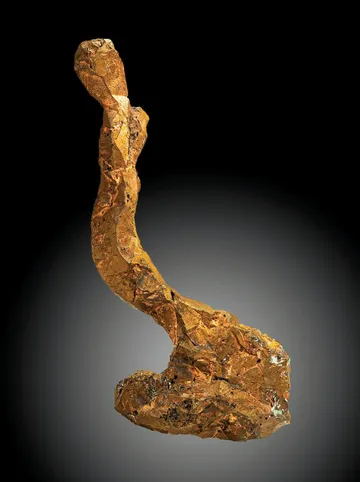
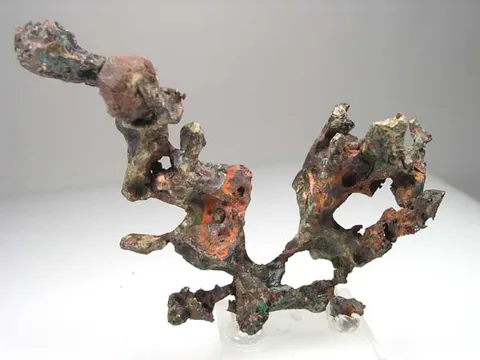
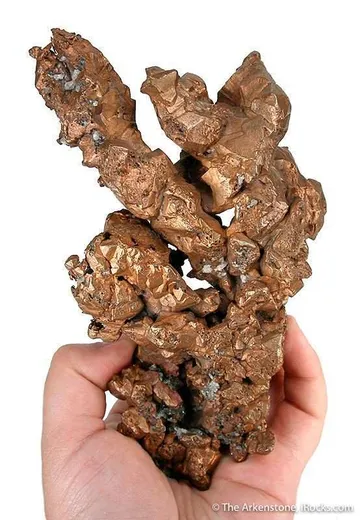
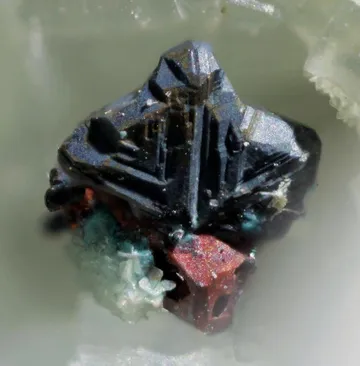
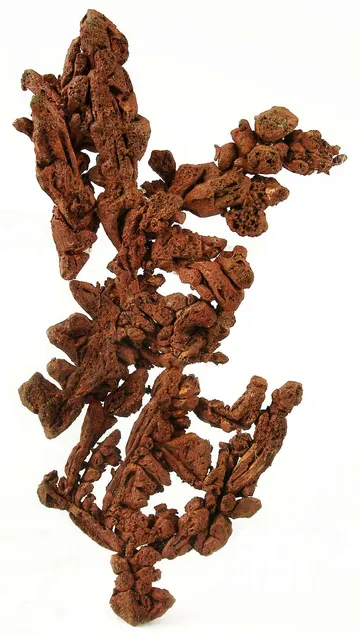
Collectors know Keweenaw County above all for native copper and native silver. The best pieces are not simply “copper ore”; they are sculpture: herringbone and arborescent copper groups, sharp dodecahedral and tetrahexahedral crystals, thin leaves, mossy plates, wires, hackly masses, copper enclosed in calcite, and rare half-breed silver-copper specimens where white metallic silver and red copper share the same specimen without becoming an alloy. The associated gangue minerals matter here. Keweenaw copper can be dressed with pale green prehnite, white or pink datolite, amber or colorless calcite, red-stained analcime, dark basalt, epidote-green seams, and old patinas of red cuprite and black tenorite that give some specimens their unmistakable antique look.
Historically, this is one of the key birthplaces of American hard-rock metal mining. Indigenous mining of Keweenaw copper began thousands of years before the industrial rush; in the nineteenth century Douglass Houghton’s geological reports, the opening of the federal mineral land agency at Copper Harbor, and the success of the Cliff Mine triggered one of North America’s earliest mineral booms. Mines such as Cliff, Central, Copper Falls, Phoenix, Delaware, Allouez, Ahmeek, Mohawk, Seneca, Iroquois, Clark, Ojibway, and Medora turned the peninsula into a proving ground for mining, milling, transportation, and underground engineering. Even when a mine failed financially, it could succeed spectacularly for collectors: the Keweenaw County fissure mines produced specimens that entered museums and cabinets around the world.
Regional View
Country View
The county’s mineral character changes as one moves from mine dumps to shoreline and island occurrences. Around Central, Cliff, Phoenix, and Copper Falls, the collector’s eye is trained to read fissure-vein matrix: dark altered basalt, prehnite, calcite, quartz, datolite, and open vugs where native copper grew freely. Around Copper Harbor, Agate Harbor, Horseshoe Harbor, Five Mile Point, Seven Mile Point, Eagle River, and Isle Royale, wave-worn pebbles and amygdules preserve the quieter side of the same volcanic story: agate, chalcedony, amethystine quartz, smoky quartz, prehnite pebbles, datolite, pumpellyite “greenstone,” and copper-bearing beach stones.
The great cabinet specimens from Keweenaw County have a different presence from the giant mass-copper slabs that made the district famous industrially. They are often small enough to hold, but they carry the full drama of the deposit: copper that grew as crystals rather than mere metal, silver that gleams from basalt like a secret, calcite with copper phantoms, datolite nodules with pink and green inclusions, and red-black patinas that show what a century of oxidation and handling can do to a native-metal specimen.
Search for specimens: View all specimens from Keweenaw County, USA
Keweenaw County occupies the northern end of the Keweenaw Peninsula and also includes Isle Royale in Lake Superior. Its collectible minerals come chiefly from the Lake Superior native copper district, where copper-bearing hydrothermal fluids moved through a thick pile of Midcontinent Rift basalt flows and interbedded sedimentary rocks. The important copper settings are amygdaloid lodes in brecciated, vesicular flow tops; conglomerate lodes in interflow sedimentary beds; and fissure veins cutting across both basalt and conglomerate. The Keweenaw County classics are especially tied to the fissure-vein mines, where steep veins could contain coarse copper, crystallized copper, native silver, calcite, quartz, prehnite, datolite, analcime, apophyllite-group minerals, chlorite, epidote, microcline-adularia, laumontite, natrolite, and later copper oxides and carbonates.
The great nineteenth-century mines were not all alike. Cliff, Central, Copper Falls, and Phoenix are the indispensable names in specimen literature for Keweenaw County fissure mining. Cliff, southwest of Eagle River at the base of the Greenstone flow, became the first large profitable copper mine of the district and made early collectors aware that Michigan native copper could form museum-quality crystals. Central, above the East Branch of the Eagle River, worked rich fissure ground near the greenstone bluff and remained important long after closure because its dumps continued to yield crystallized copper. Copper Falls, southwest of Eagle Harbor, took its name from copper exposed in a small waterfall on Owl Creek; despite producing a large amount of copper over decades, it was less successful financially than its operating life suggests, yet it is an excellent specimen locality for copper, silver, analcime, calcite, and datolite. Phoenix, near the base of the greenstone bluff near the former town of Phoenix, was a group of fissure mines and veins—including the Robbins or West, Phoenix, St. Clair, and Babbitt veins—and is one of the county’s great sources of copper and associated minerals.
Delaware is important both geologically and historically. It began with fissure-vein work and later focused on the Allouez Conglomerate, developing multiple shafts, winzes, and levels. The mine ultimately produced millions of pounds of copper but failed to reward its investors as hoped; today it survives as one of the best places to understand early underground mining in Keweenaw County, with tourist access to the upper workings rather than specimen collecting freedom throughout the site. Delaware is also a significant mineral locality for native copper, native silver, calcite, datolite, analcime, prehnite, and associated species.
Farther south in Allouez Township, the Ahmeek-Mohawk area belongs more to the later amygdaloid-lode story. Mohawk is famous among collectors not only for copper and silver but for arsenic-rich copper minerals and the material called mohawkite, a mixture dominated by algodonite, domeykite, and arsenian copper. The Mohawk Mine is also the type locality for jeankempite, a rare calcium arsenate hydrate described from the Mohawk No. 2 mine. Ahmeek specimens include copper, silver, calcite with copper-inclusion phantoms, datolite, and related Kearsarge lode assemblages.
The county’s shoreline and island localities broaden the collecting picture. Keweenaw Point beaches, Agate Harbor, Copper Harbor, Horseshoe Harbor, Five Mile Point, Seven Mile Point, Eagle River, the mouth of Silver Creek, Manitou Island, and Isle Royale have all furnished agate, chalcedony, amethystine quartz, smoky quartz, jasper, prehnite pebbles, datolite, pumpellyite-group “greenstone,” and occasional native copper. The north shore is especially productive after storms because Lake Superior continually sorts and exposes fresh pebbles. Some occurrences are in situ amygdules and veins; many collectible beach stones are glacially liberated and wave-worn.
Specimen pockets and notable finds give Keweenaw County its collector mythology. Copper Falls yielded superb copper crystals in the millimeter-to-centimeter range, including material from the Gribble vein and Petherick-related workings. Central produced fine copper crystals, hoppered cubic forms, dodecahedral groups, masses, and specimens associated with shot copper and vug minerals. Phoenix produced leaf copper, moss copper, arborescent groups, copper with analcime and apophyllite, and distinctive analcime specimens, including epitaxial overgrowths and amber pseudocubic calcite associations known from the West vein. Cliff produced superb single crystals, copper wires on prehnite, moss copper, arborescent copper, silver with copper and prehnite, datolite, calcite, and a variety of small but sophisticated crystallographic specimens. The Point Prospect, southeast of Copper Harbor, is famous for unusually large native copper crystals exposed during road work, including dodecahedral-looking crystals and groups that rank among the largest known for the species.
Collecting access is limited and must be treated seriously. Much of Keweenaw County’s mine ground is private, historically unstable, environmentally sensitive, or closed; old shafts, loose poor-rock piles, flooded workings, exposed metal, and hidden openings are real hazards. For casual legal mine-dump collecting, the widely cited accessible sites are Cliff Mine and Central Mine, with Central subject to local rules and gate conditions. Keweenaw Mineral Days and related organized events have provided permission-based access to prepared piles such as Seneca, Central, and Wolverine, with moved rock set aside for surface collecting. Isle Royale National Park is not a collecting locality for the public: specimens there are part of a protected national-park landscape. Beaches, parks, and roadcuts each have their own ownership and collecting rules; serious collectors should confirm land status before removing anything.
Copper from Keweenaw County is among the world standards for native copper as a cabinet mineral, especially from the fissure-vein mines Cliff, Central, Copper Falls, and Phoenix, where it occurs as sharp to distorted crystals, arborescent groups, herringbone aggregates, moss copper, leaves, wires, hackly masses, and occasional large masses in basaltic or conglomeratic matrix. Central is famed for dodecahedral groups, hoppered cubic crystals, and copper in vugs and shot-copper associations; Cliff is known for superb tetrahexahedral and twinned crystals, fine microcrystals, wire copper, and intimate prehnite associations; Copper Falls yielded crystals from a few millimeters to about 2.5 cm and historic mass copper, including a very large recorded mass; Phoenix produced leaf copper, moss copper with analcime, arborescent groups, and copper with apophyllite and calcite. Top pieces are judged by sculptural openness, sharp crystallization, old natural patina, undamaged terminations, solid provenance to one of the great mines or named veins, and strong contrast with prehnite, calcite, analcime, datolite, or dark basalt; ordinary pieces are massive, bruised, over-cleaned, or locality-vague.
Silver in Keweenaw County occurs in the same native-copper system but is far rarer as a fine specimen, appearing as bright white metallic masses, rounded blebs, crystallized groups, wires, plates, and copper-silver “half-breed” associations from mines and veins such as Cliff, Central, Phoenix, Delaware, Iroquois, Mohawk, and the more recently reported Silver Creek–area silver vein finds. It commonly accompanies native copper, calcite, prehnite, datolite, epidote, and quartz, and the contrast between white silver and warm copper is the entire appeal of many pieces; in the district, silver was often treated informally by miners and managers and was not always fully reflected in mine production accounts. Good Keweenaw County silver is natural-looking rather than melted or mill-made, with convincing matrix, undisturbed contacts to copper or gangue, and preferably crystallized surfaces or wires; the collector must be wary of smelter or stamp-mill “half-breed” lumps, artificially combined copper-silver pieces, and vague “Keweenaw” labels that cannot be narrowed to a mine.
Calcite is one of the essential gangue and display minerals of Keweenaw County’s native-copper district, occurring in veins, amygdules, vugs, and shoreline settings with native copper, silver, datolite, prehnite, epidote, chlorite, microcline, pumpellyite, and quartz. Allouez and Ahmeek are noted for calcite containing native copper inclusions or phantoms, in some cases giving a red or blood-red internal color; Five Mile Point produced a twinned calcite crystal with phantoms; Copper Falls produced museum-quality crystals, including black-included examples and calcite with early-noted copper inclusions; Phoenix is known for calcite with analcime, including amber pseudocubic crystals from the West vein; Cliff, Delaware, Iroquois, Medora, New York, Northwestern, Ojibway, Hays Point, and Silver Creek are all recorded county occurrences. The finest calcites here are not necessarily the largest, but those with clean form, copper inclusions, phantoms, contrasting basaltic matrix, or association with crystallized copper and analcime; etched, cleaved, iron-stained, and bruised calcites are common.
Datolite from Keweenaw County is a collector specialty because it appears both as porcelaneous nodules and as crystals, often colored or patterned by inclusions of copper, silver, and iron oxides. Copper Falls is a major county locality, with white, pink, and yellow nodules, complex gray-white to green crystals, Owl Creek pink breccia-cement material, and porcelaneous masses containing euhedral copper crystals; Delaware produced large pink, mauve, or red nodules with narrow white borders; Clark yielded white nodules and white to colorless glassy crystals; North Cliff furnished small well-formed crystals in prehnite-datolite rock with adularia; Central, Pennsylvania, and Keweenaw Point are also recorded. Fine datolite from the county should have strong color, polishable compact texture if a nodule, intact margins, visible copper or silver inclusions where present, or sharp glassy crystals with good matrix; dull chalky nodules, fractured pebbles, and pieces with ambiguous county labels are much less desirable.
Quartz in Keweenaw County is the quiet framework mineral behind many of the more glamorous native-metal specimens, present as an accessory in numerous amygdaloid and fissure lodes and as chalcedony, agate, smoky quartz, rock crystal, and amethyst in shoreline and island occurrences. Central formerly produced fine colorless crystals with prehnite; Mohawk and Seneca are recorded for fissure-vein quartz; Keweenaw Point beaches yielded amethyst and smoky quartz pebbles early enough to be recorded by Schoolcraft in 1824; Horseshoe Harbor produced amethyst groups; Seven Mile Point has agate in basalt and amethystine quartz lining basalt geodes; Isle Royale beaches have yielded rock crystal, carnelian, jasper, agate, and rare amethyst. The best quartz specimens from the county are those tied tightly to the copper district—crystals on prehnite, quartz with copper or silver, amethyst in recognizable Keweenaw basaltic context, or well-banded agate/chalcedony rather than loose, provenance-poor pebbles.
Prehnite is one of the signature green to yellow-green gangue minerals of Keweenaw County and is especially important because it carries, frames, and sometimes visually transforms native copper and silver specimens. Phoenix produced excellent prehnite from vein No. 5, with colors ranging from white and yellow through greens and rare pinkish-orange, and some material coated by quartz and calcite or forming pseudomorphs after calcite; Cliff and South Cliff yielded abundant pale green and brown aggregates with rare tiny measurable crystals; Central is noted for green botryoidal aggregates; Iroquois produced green botryoidal prehnite with copper and quartz; Clark has white-to-green comb-structure veinlets with disseminated copper scales; Copper Falls occurrences include Owl Creek amygdule fillings and associations with analcime, datolite, copper, and silver at the Silver Pit north of the Petherick vein. Fine pieces show fresh apple-green to pistachio-green color, botryoidal or crystalline texture, copper flecks or crystals, and undamaged association; beach-worn prehnite pebbles are attractive but less significant unless they show strong pattern, copper inclusions, or a known Isle Royale/Copper Harbor context.
Agate from Keweenaw County is a basalt-amygdule and shoreline mineral rather than a mine-room showpiece, but it is central to the county’s collecting culture. Agate and chalcedony are abundant near the top of the Kearsarge flow and occur as pebbles or in situ fillings at Keweenaw Point, Fort Wilkins–Copper Harbor beaches, Agate Harbor, Eagle River, the mouth of Silver Creek, Five Mile Point, Seven Mile Point, Black Creek, Lake Manganese, Manitou Island, and Isle Royale beaches. Horseshoe Harbor and Seven Mile Point are especially important for agate-amethyst associations, and one large banded agate from south of Horseshoe Harbor was reported at 7.85 kg. Collector-grade agates show fortification banding, sagenitic or mossy inclusions, strong red-brown, white, gray, or translucent chalcedony contrast, and—in the most sought-after modern market material—native copper inclusions or copper replacement textures; ordinary tumbled beach chalcedony without pattern or copper is common by comparison.
Analcime in Keweenaw County is a late zeolite-group mineral in the copper system, commonly forming colorless, white, orange, or reddish trapezohedra in veins and vugs with calcite, copper, quartz, apophyllite, adularia, natrolite, and prehnite. Copper Falls is one of the great county localities, with fine reddish crystals, granular bright-red material, pseudomorphs after feldspar, and trapezohedra to about 2.5 cm; the Petherick vein produced etched crystals, and analcime with copper inclusions was noted early. Phoenix produced famous analcime specimens, including crystals perched on copper, examples with copper and apophyllite, and a distinctive style of epitaxial analcime overgrowth that can help identify otherwise uncertain Phoenix pieces; the West vein is also known for analcime with amber pseudocubic calcite. Central, Northwestern, Cliff, Seneca, Mohawk No. 2, Clark, Five Mile Point, Allouez No. 1, and Point Prospect are all recorded occurrences, with Point Prospect material noted as fluorescing bright blue-white under ultraviolet light. Top specimens combine lustrous well-formed trapezohedra with copper, calcite, or apophyllite and solid mine attribution.
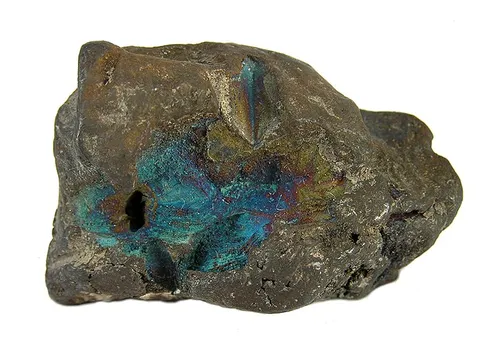
Cuprite from Keweenaw County is both a mineral species and a visual signature of old copper specimens, forming as red coatings, crusts, microscopic to small crystals, inclusions in calcite, and occasional pseudomorphous or replacement material after native copper. Allouez produced fine crystals and microcrystals in conglomerate interstices with copper, malachite, and chrysocolla, including chalcotrichite and inclusions that can impart carmine-red color to calcite; North Cliff yielded fine microcrystals in copper nodules; Cliff has cuprite with azurite as massive nodules cemented by copper and locally silver, plus vugs lined with excellent crystals; Central and Phoenix commonly show cuprite as a red patina on copper crystals, often with black tenorite; Mohawk has cuprite coatings on copper with malachite; Copper Harbor includes 1–2 mm crystals coating native copper in an underwater vein west of the Devils Wash Tub. The most desirable specimens keep their natural red patina or discrete crystals intact; harsh acid cleaning can erase much of the character that makes Keweenaw copper visually old and locality-specific.
Epidote is widespread in Keweenaw County’s altered basaltic rocks and native-copper lodes, occurring as replacement material, amygdule crystals, vein fillings, and green bands or masses with copper minerals. Recorded county localities include Mohawk, Seneca No. 1 and No. 2, Ojibway, Clark at Copper Harbor, Iroquois near Mohawk, Jacobsville Sandstone as a detrital accessory, general Keweenawan lava flows, drill core south of Eagle Harbor, and Isle Royale shoreline occurrences near Epidote Lake. Cliff is the standout county locality for collector epidote, with superb crystals reported to 25 mm in vesicles with calcite or pumpellyite. In hand specimens, epidote gives the county’s basalts and copper-bearing pieces their olive to pistachio green contrast; the most collectible examples show recognizable crystals, bright green color, and association with copper, calcite, prehnite, or quartz, while massive green alteration without crystal form is common and often misidentified by casual collectors as prehnite, pumpellyite, or “greenstone.”
Other documented minerals from Keweenaw County include algodonite, domeykite, chalcocite, bornite, chalcopyrite, ankerite, dolomite, gypsum, hematite, laumontite, natrolite, thomsonite-group minerals, pumpellyite-group minerals including chlorastrolite, microcline and adularia, apophyllite-group minerals, chrysocolla, malachite, tenorite, azurite, brochantite, langite, posnjakite, pyrolusite, rammelsbergite, annabergite, erythrite, guérinite, and kamiokite. Mohawkite is historically important but is best treated as a mixture rather than a valid single mineral species; it is typically associated with algodonite, domeykite, arsenian copper, and other arsenide/arsenate minerals from the Mohawk-Ahmeek area. The county’s most important type-locality mineral is jeankempite, Ca5(AsO4)2(AsO3OH)2(H2O)7, described from the Mohawk Mine in 2020 as a rare secondary arsenate associated with altered copper arsenides and other arsenate species.
Keweenaw County specimens are common enough in the market that a collector can be selective, but not all “Keweenaw” labels carry the same weight. A specimen labeled simply “Keweenaw Peninsula” may be perfectly legitimate, yet it is less informative than one tied to Cliff, Central, Copper Falls, Phoenix, Delaware, Mohawk, Ahmeek, Iroquois, or a named vein or level. Older labels are particularly valuable because many nineteenth-century and early twentieth-century copper and silver specimens lost mine attribution as they passed through dealers, museums, and private cabinets. The county-level label is often honest; it is also often the end of what can be proven.
The greatest authenticity problem is silver-copper material. Natural half-breed specimens do occur in the district, but the market also contains stamp-mill products, smelter or furnace material, and artificially married copper-and-silver pieces. Mill-made half-breeds tend to look battered, compact, smeared, or mechanically intermingled, without convincing natural contacts, vugs, crystal faces, or matrix relations. Natural pieces should show geologic context: silver in a vug, silver with copper and prehnite or calcite, silver attached to basalt or vein minerals, or coherent growth relations rather than a fused or crushed appearance.
Copper cleaning is another important issue. Many Keweenaw specimens were acid-cleaned, lacquered, oiled, waxed, or mechanically brushed. Bright salmon-pink copper can be attractive, but over-cleaning removes cuprite and tenorite patina, softens crystal edges, and can make an old specimen look suspiciously modern. Natural red cuprite and black tenorite coatings are part of the appeal of many Central, Phoenix, and other fissure-mine pieces; collectors should not assume that “shiny” means better. Conversely, some old specimens are dark with oxides, dirt, or mine coatings and need only gentle conservation.
Condition issues are predictable. Copper is soft and dents easily; arborescent branches, wires, leaves, and isolated crystals bend or break. Calcite cleaves and bruises, especially where copper inclusions tempt heavy handling. Datolite nodules fracture, and polished surfaces can hide internal cracks. Analcime, apophyllite, and zeolite-associated pieces can be chipped at crystal tips. Prehnite aggregates may be tough when massive but fragile when thinly botryoidal or associated with delicate copper wires. Heavy native-metal specimens should be supported from below rather than lifted by protruding crystals or matrix edges.
Fluorescence is not the main reason collectors seek Keweenaw County minerals, but there are notable exceptions. Some Point Prospect analcime has been reported to fluoresce bright blue-white under ultraviolet light, and calcite from some Michigan localities can fluoresce depending on composition; any fluorescent response should be treated as a bonus rather than a primary diagnostic test. Chemical testing with acids should be avoided on mixed copper-calcite-datolite-prehnite specimens unless one is willing to risk damaging carbonate or altering patina.
Market availability is broad at the low end and tight at the top. Massive native copper from Keweenaw County and the broader peninsula is readily available. Attractive crystallized copper is available but increasingly costly when well formed, damage-free, and mine-specific. Cliff, Central, Copper Falls, and Phoenix specimens with old labels, excellent crystallization, or famous associations command strong premiums. Native silver is much scarcer than copper, and convincing natural silver-copper specimens with matrix are always desirable. Datolite nodules, copper-in-agate, prehnite with copper, and analcime-copper combinations have their own specialized following and can outperform more common massive copper pieces of larger size.
The Keweenaw story begins long before company reports and stock certificates. Indigenous miners worked native copper on the peninsula thousands of years ago, digging shallow pits, breaking waste rock away from copper with heavy stones, and shaping the metal into tools, fishhooks, ornaments, and trade goods. On Isle Royale, early prospectors later found ancient pits as much as 9 meters across and 18 meters deep. Some rock-copper masses had reportedly been raised by cribwork, and one copper nugget from the Minong Mine site weighed 5,720 pounds after being found at a depth of 16.5 feet in a prehistoric pit. For collectors, that deep time matters: the same native metal prized in nineteenth-century cabinets had already been recognized, extracted, and moved across North America for millennia.
In 1840, Douglass Houghton collected a modest agate from Agate Harbor. It is not a spectacular specimen by modern aesthetic standards, but its label—“Agate Har. July 24 ’40”—makes it one of the most evocative objects in the Keweenaw mineral record. That field season fed into Houghton’s report on the geology of Michigan’s Upper Peninsula, a report that helped ignite the copper rush. A small banded stone from a Lake Superior shore thus became a witness to one of the first great mineral rushes in the United States.
The early mining boom was also a boom in exaggeration. The Keweenaw County fissure mines attracted promoters and speculators, and company reports could drift far from geology into salesmanship. A Mineralogical Record account preserves a wonderful exchange from an 1897 letter by Jacob Houghton concerning Captain Joseph Paul, a Cornishman connected to the small Garden City mine. When Houghton looked through old reports in Paul’s store near the Cliff Mine and remarked that they were interesting, Paul snapped back, “Pack of lies, pack of lies.” Houghton reminded him that he had written many of them himself. Paul’s answer was better still: “No difference, no difference, had to lie, had to lie, stockholders wouldn’t pay assessments.” It is difficult to imagine a more compact summary of frontier mining finance.
The Cliff Mine justified at least some of the excitement. Opened in 1845 near the basalt cliff southwest of Eagle River, it became the district’s first profitable large mine and returned more than $2.5 million in dividends on an initial investment of about $110,000. Its mineral specimens had nearly the same effect as its dividends. Fine copper, silver, and calcite from Cliff reached mineralogists who had never seen native copper in such quality. Surviving Cliff specimens are fewer than those from some later mines, but that scarcity amplifies their status: when a copper crystal, silver piece, or copper-on-prehnite specimen can be tied convincingly to Cliff, it carries both mineralogical and historical weight.
Central Mine had a different rhythm. In 1854, the newly organized Central Mining Company acquired ground where an ancient mining pit had already been found, and in the summer of 1855 a small crew under John Robinson opened the pit to 600 feet. They encountered copper-rich trap rock and several masses of nearly pure native copper. In its first year, Central produced 83,836 pounds of copper, hauled by wagon to Eagle Harbor and shipped “below,” the local word for the world down the Great Lakes. The mine earned more from its copper than it spent in that first year, a remarkable event for a Keweenaw mine, where years of underground development commonly preceded profit.
Central also carries one of the stark tragedies of Keweenaw mining. On Monday, April 22, 1872, thirteen men were riding the skip car down the No. 2 shaft when the rope failed. Many were Cornish miners, part of the “Cousin Jack” culture that shaped the district. A poem titled “Sad News From Central Mine” was published in Cornwall and listed the men and their Cornish home towns, a reminder that for many miners Central was not yet home but a foreign place where wages were earned in hope of return. By 1882 Central was still the only Keweenaw County mine paying a dividend, but the fissure copper was running out. In 1892 James P. Edwards called it “The Last of the Mohicans,” the last remaining fissure mine in the state. It closed in July 1898; with the pumps stopped, water rose into the workings, and the mine passed from production into memory, ruins, and rockhound legend.
Copper Falls was a study in persistence without lasting financial triumph. The mine opened in 1845 and operated almost continuously until at least 1901, producing more than 25 million pounds of copper but never becoming a true long-term success for investors. The name came from a small waterfall on Owl Creek where native copper was exposed, and early interest was heightened by hammerstones and other evidence of ancient mining in the area. The mine’s high elevation kept upper workings dry for many years, and that dryness helped later collectors reach ground that yielded copper, silver, analcime, calcite, and datolite. A specimen from the Gribble vein, collected in 1982 by Ross Lillie and Bob Barron on the 4th level, is part of the modern collecting lore of the mine.
Phoenix, opened as the Lake Superior Mine in 1844 and renamed in 1849, produced 16,632,536 pounds of copper and 25,000 ounces of silver before work ended in 1905. It was not a giant producer by district standards, but in specimen terms it became one of the great names. The Phoenix group worked multiple veins—Robbins or West, Phoenix, St. Clair, and Babbitt—and generated crystallized copper, silver, analcime, calcite, and apophyllite specimens that travelled far beyond Keweenaw County. Among the more memorable objects is a 17 cm copper chisel-chip fan, an artifact made by miners as a display of hammer-and-chisel skill and kept for years in the Calumet and Hecla Company offices. It is not a mineral-growth specimen, but it belongs unmistakably to the culture that produced them.
Not all discoveries were nineteenth-century. In 1971, Don Pearce of Calumet collected many hundreds of kilograms of well-crystallized copper from an underwater vein in Lake Superior near Eagle Harbor, locally known as Grand Marais or Gull Rock. The copper formed herringbone to arborescent groups enclosed in calcite. One specimen weighed about 45 kg and showed a face half a meter across covered with fine herringbone copper, with large blocky crystals on the reverse. Keweenaw collecting has always had this dual nature: the mines are old, but the lake, road cuts, dumps, and organized collecting events keep revealing new chapters.
The county’s largest public copper story is the Lake Copper mass now in the A. E. Seaman Mineral Museum’s Copper Pavilion. Discovered in 1991 by local divers Bob Barron and Don Kauppi and recovered in 2001 from Lake Superior bottomlands offshore between Eagle River and Eagle Harbor, it weighs 19 tons. The mass formed in a near-vertical tabular vein about a billion years ago, later fell to a horizontal position, and was smoothed on its upper surface by glacial abrasion. Its underside remained rough, protected against the lake bottom. It is a spectacular object partly because it bridges scales: the same native-copper mineralization admired in thumbnail crystals also produced metal slabs measured in tons.
The modern field experience is more controlled, but still vivid. At organized Keweenaw Mineral Days collecting events, old poor-rock piles may be legally prepared by moving fresh material for registered collectors. The practical advice from the organizers is blunt and accurate: for datolite or greenstone, “your eyes are the essential tool”; for copper and silver, a metal detector can be valuable, but it is not magic. Native copper is the common prize at prepared Seneca and Central events; silver is much less frequent; datolite, greenstone, and other hydrothermal minerals reward the patient eye. The old miner’s world has become a collector’s landscape, but permission, safety, and restraint now matter as much as luck.