






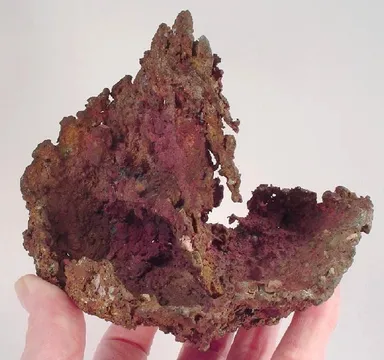
Calumet, Michigan - premier Keweenaw locality for native copper and copper-silver specimens, featuring hackly copper, golden patina, and a deep mining heritage.
Key facts
Calumet, in Michigan’s Keweenaw Peninsula, is one of the defining names in native copper collecting. The locality sits on the Houghton–Calumet part of the Keweenaw native copper district, a Mesoproterozoic Midcontinent Rift terrane where immense lava piles of the Portage Lake Volcanics were later cut by mineralizing fluids. At Calumet, the collector’s story centers on the Calumet & Hecla Conglomerate: a copper-bearing interflow conglomerate so rich, persistent, and minable that it became the backbone of the most famous copper company in the Lake Superior district.
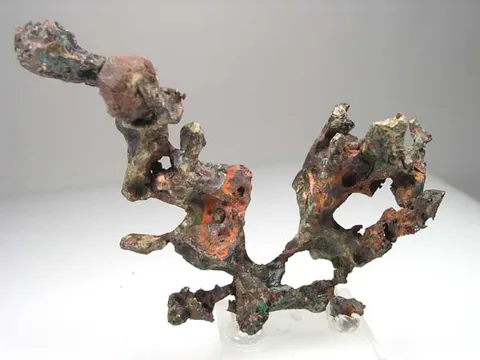
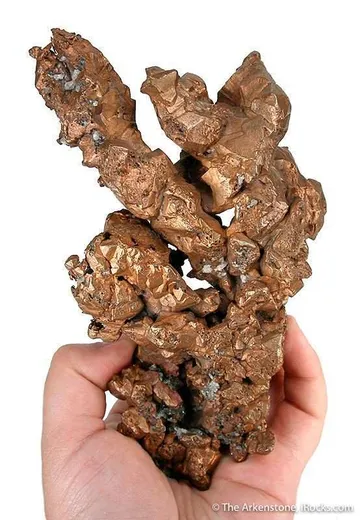
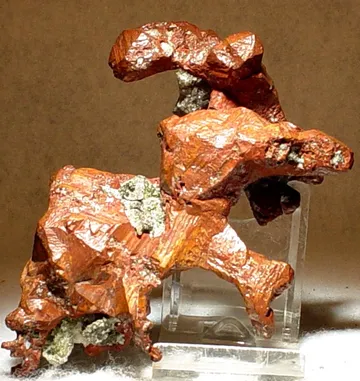
The best Calumet specimens are unmistakably Keweenawan but have their own character. Native copper occurs as heavy hackly masses, “shot” copper, copper-coated cobbles, boulder shells or “skulls,” copper replacing or molding minerals, and rarer sharp crystals with the warm orange-red metal showing through brown, black, or brick-red patina. Silver adds the second great collecting attraction: bright to tarnished native silver in crystal aggregates and “halfbreed” copper-silver pieces, some natural and some later products of crushing and milling. The matrix is equally diagnostic—basalt, felsitic conglomerate, epidote, prehnite, calcite, quartz, chlorite-group minerals, feldspar, and local secondary copper minerals that record the long life of this deposit after mining ceased.
Regional View
Country View
For collectors, Calumet is important not merely because copper was abundant, but because the specimens connect superb mineralogy with one of North America’s great mining landscapes. Mine Street in Calumet still follows the trend of the buried lode, and the surviving industrial buildings, parks, museums, and archives give unusual context to old specimens. A cabinet copper labeled “Calumet & Hecla” is not just a piece of native metal; it is part of the same mineralized sheet that drove the growth of Red Jacket and Calumet, financed deep shafts and vast stamp mills, and made the Keweenaw a world reference point for native copper.

Photo: Wikimedia Commons

Photo: Wikimedia Commons
Search for specimens: View all specimens from Calumet, USA
The Calumet collecting locality belongs to the Keweenaw Peninsula native copper district of Houghton County, Michigan. Its geology is the classic Lake Superior native copper setting: thick Mesoproterozoic basaltic lava flows of the Portage Lake Volcanics, interbedded with sedimentary layers and conglomerates, later mineralized by hydrothermal fluids moving through permeable flow tops, fractures, and porous interflow beds. In the Calumet section, the Michigan Tech Keweenaw Geoheritage account notes an extraordinary pile of 287 lava flows, with the copper-bearing conglomerates numbered for correlation. The famous No. 13 conglomerate was the great prize: the Calumet & Hecla Conglomerate, locally as much as about 25 feet thick and reported to contain up to 7 percent native copper in its richest parts.
The deposit is best thought of as a stratiform native-copper lode rather than the sulfide-dominated copper deposit familiar from porphyries or volcanogenic massive sulfides. Copper occurs as native metal in a basalt-and-conglomerate environment, accompanied by native silver and a gangue assemblage typical of low-grade hydrothermal alteration in the Keweenaw: calcite, quartz, epidote, chlorite, prehnite, pumpellyite, laumontite, feldspar, and related minerals. Hematite-stained rock, green alteration minerals, and locally chloritic or epidotized zones are part of the visual language of Calumet ore. Copper filled cavities, replaced rock and minerals, coated cobbles, lined fractures, and formed blebs, plates, masses, and rare crystals. Silver appears in pockets, vugs, and intergrowths with copper, with good old labels often distinguishing Calumet & Hecla, South Hecla, Calumet No. 1, Centennial, Osceola, and other nearby sublocalities.
The mining history is as important as the mineralogy. The Calumet mine opened in 1865 and the Hecla mine in 1866, after Edwin J. Hulbert recognized the value of the conglomerate lode in the Calumet area. The two operations, together with other interests, were consolidated in 1871 as the Calumet and Hecla Mining Company. Under Alexander Agassiz, the mines became the dominant power of the Keweenaw copper industry. By the 1870s Calumet & Hecla was responsible for a remarkable share of United States copper production, and at peak scale the company employed more than 4,000 people and operated day and night through most of the year. The lode was worked to great depth beneath the Calumet–Red Jacket area, leaving an enormous mined-out zone below the townscape.
Production figures underline why the name carries such weight on specimen labels. USGS tabulations for principal Keweenaw lodes attribute billions of pounds of copper to the Calumet and Hecla lode system; one widely cited table gives 3,721,535,287 pounds of copper production for Calumet and Hecla. Later historical summaries distinguish the main Calumet conglomerate workings from the broader C&H holdings, but either way the scale dwarfs most native copper occurrences worldwide. Economic decline, falling grade at depth, changing copper markets, labor conflict, reclamation of stamp sands, and eventual corporate consolidation all shaped the later years. The once-rich lower conglomerate workings were effectively abandoned in the 1930s, although the company and its successors continued other mining and reclamation activity in the district for decades. The old C&H era at Calumet ended in the late 1960s.
Collectors should understand that “Calumet” on a label may be used broadly or narrowly. Broadly, it can refer to the Calumet area of Houghton County and nearby Calumet Township localities. Narrowly, it may mean the Calumet & Hecla Mine, the Calumet Mine proper, South Hecla, Centennial, Osceola, or a specific numbered shaft. That distinction matters. C&H specimens are famous for copper boulder casings, copper-coated cobbles, “skull” copper around rhyolite pebbles, shot copper, feldspar pseudomorphs, and good crystal groups. Centennial, also in the Calumet area, is critical for rare secondary copper chlorides and as the type locality for anthonyite and calumetite. Osceola and the Kearsarge-lode mines are better known for certain wire, sheet, and silver habits. Old labels should be preserved, because a precise shaft or mine name can significantly change both scientific interest and market value.
Collecting access today is limited and must be treated seriously. Many old mine sites and rock piles in the Keweenaw are privately owned, hazardous, posted, or part of protected historic landscapes. The Calumet Unit of Keweenaw National Historical Park preserves and interprets parts of the former Calumet & Hecla landscape; national park sites are not casual collecting grounds. Modern legal collecting is best pursued through organized events, private-permission opportunities, local clubs, or public shoreline rock-picking where rules permit it. Keweenaw Mineral Days and similar organized events are valuable because organizers obtain legal permission and prepare mine-rock piles for surface collecting. Loose native copper is still found in the district, but specimen-quality Calumet & Hecla copper and silver with reliable old provenance are predominantly historical collection pieces.
Native copper is the signature mineral of Calumet, and the best pieces show why the locality became legendary: heavy, sculptural copper in basalt or conglomerate; copper-coated paleocobbles; “skull” forms molded around rhyolite cobbles; shot copper in vesicular rock; masses with hackly surfaces; replacements after feldspar and calcite; and rarer sharp crystal groups. Museum records and Michigan mineralogical summaries note many varieties from the Calumet & Hecla Mine, including boulder cases, boulder replacements, feldspar pseudomorphs, shot copper, and skulls, while Centennial in the same Calumet collecting area produced brick copper replacing sandstone, fine microcrystals, larger crystals, skulls, and leaf copper. Color ranges from fresh metallic orange-red where cleaned or broken to deep brown, black tenorite-coated, and reddish cuprite-patinated surfaces; the most desirable examples combine strong form, visible natural surfaces, minimal saw or hammer damage, and a trustworthy old label tying the specimen to Calumet & Hecla or a specific Calumet-area shaft rather than a vague “Michigan copper” attribution.
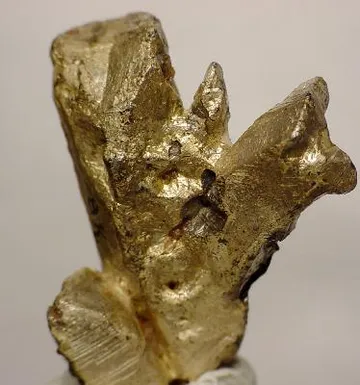
Native silver from Calumet is far rarer than copper but highly prized because it occurs in the same native-metal system and can form classic copper-silver “halfbreed” specimens. Published Michigan mineralogy records Calumet & Hecla silver as crystals and halfbreeds, including a Harvard Mineralogical Museum slab about 12.5 cm long, and records about 1 million ounces of silver production from Calumet & Hecla for 1916 to 1919. The silver may appear as bright to gray-white metallic patches, crystalline aggregates, or distorted crystals on or within copper, calcite, quartz, prehnite, and altered basaltic matrix; fine collector pieces are separated from ordinary material by visible silver crystal form, a natural junction between Ag and Cu rather than a mill-crushed texture, attractive contrast against copper or matrix, and precise old labels such as Calumet & Hecla, South Hecla, or Calumet No. 1.
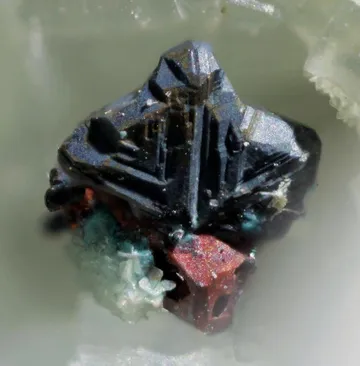
Other documented Calumet-area minerals include calcite, quartz, epidote, prehnite, pumpellyite, chlorite-group minerals, laumontite, feldspar, hematite, cuprite, tenorite, malachite, chalcocite, and chalcopyrite. The locality is especially important for rare secondary copper chlorides from the Centennial Mine near Calumet: anthonyite and calumetite were described by Sidney A. Williams in 1963 from material recovered at Centennial, occurring in pockets, fractures, and cavities in basalt with native copper, cuprite, paratacamite, epidote, quartz, tremolite, monazite, and other copper chlorides. Calumetite forms brilliant azure-blue to powder-blue spherules and sheaves of scaly crystals; anthonyite occurs as delicate lavender prisms and is notably unstable indoors, beginning to alter by dehydration within weeks. For micro-mineral collectors, those type-locality associations give the Calumet area a significance well beyond cabinet native copper.
The first question with any Calumet specimen is locality precision. A label reading “Calumet” is useful, but a label reading “Calumet & Hecla Mine,” “Calumet No. 1,” “South Hecla,” “Centennial Mine,” “Osceola,” or a numbered shaft is much better. The Keweenaw produced many native copper specimens with broadly similar appearances, and material from Central, Quincy, Kearsarge, Wolverine, Ahmeek, Cliff, Phoenix, Caledonia, and White Pine is often mixed in old collections under casual regional labels. Serious buyers should keep every scrap of provenance: old dealer cards, museum labels, estate notes, accession numbers, and even handwritten “C&H” tags.
Condition standards differ for copper and silver. Native copper is tough, but many Calumet pieces show saw cuts, hammer bruises, flattened points, old lacquer, abrasive cleaning, acid brightening, or modern polishing. Cleaned copper can be attractive, but overly bright, uniformly pink-orange surfaces often look unnatural on historic Keweenaw pieces and may hide repairs or recent preparation. Good natural patina—brown, black, red cuprite-rich, or selectively cleaned to reveal form—can be more desirable than mirror-bright metal. Copper crystals should be examined under magnification for bent edges, soldered or glued repairs, and artificial reattachment to matrix.
Silver presents a more specific Calumet problem: many nugget-like copper-silver “halfbreeds” in the marketplace are products of stamp milling, where crushing deformed and pressed copper and silver together. Published Michigan mineralogy notes this issue explicitly. Natural copper-silver intergrowths do exist and can be superb, but collectors should distinguish natural crystallized or in-situ Ag-Cu associations from rounded, mashed, nuggety mill products. Mill halfbreeds are legitimate historical objects if described honestly, but they are not equivalent to natural crystallized halfbreed specimens from a mine pocket.
Rare secondary copper chlorides from the Calumet area require caution. Calumetite is relatively more persistent, but anthonyite is known to dehydrate and alter after exposure to indoor conditions. Specimens of anthonyite, calumetite, atacamite-group minerals, paratacamite, and other blue-green copper chlorides should be kept dry, cool, and stable, away from repeated wetting or aggressive cleaning. Never acid-clean a specimen suspected to carry these minerals. Even vinegar, often used casually on Keweenaw copper, can destroy delicate secondary species and soften or remove calcite associations that help document the pocket environment.
Market availability is uneven. Massive Calumet-area copper remains obtainable, and small copper-in-matrix pieces appear regularly. Good Calumet & Hecla copper with strong sculptural form, crystals, skull texture, or old labels is much less common. Native silver from Calumet is scarce; fine crystallized silver or convincing natural halfbreed pieces with old provenance are premium specimens. Type-locality anthonyite and calumetite are specialist micro-minerals and should be purchased only from dealers or collections that preserve exact Centennial Mine provenance.
The Calumet story begins with one of those mining episodes that sounds almost too neat to be true: a lode of continental importance revealed by earlier miners. Edwin J. Hulbert, working in the Keweenaw in the late 1850s, recognized evidence of prehistoric mining in the Calumet area. The later Michigan Tech account of the C&H Conglomerate retells the scene as an ancient Indigenous storage pit filled with copper-rich boulders, lying directly above the great Calumet Conglomerate lode. However the details are parsed historically, the essential point is vivid: before Boston capital, deep shafts, stamp mills, and corporate reports, the place had already been tested by people who understood native copper at the surface.
Hulbert’s discovery did not immediately create an orderly empire. The Calumet mine opened in 1865 and Hecla in 1866, but early work was plagued by transportation problems, cave-ins, and mismanagement. Quincy A. Shaw and Boston investors backed the venture, and Alexander Agassiz—Swiss-born, Harvard-connected, son of Louis Agassiz, and already a man of science—was sent to inspect and then rescue the enterprise. Agassiz found a rich lode tied to a failing operation. He borrowed money to invest, reorganized infrastructure, and remade the mine around stamp mills, shafthouses, railroads, and disciplined management. Hecla paid its first dividend in December 1869, Calumet in August 1870, and the two were consolidated as Calumet and Hecla in May 1871.
Agassiz’s Calumet was not only a mine. It became a company landscape: offices, warehouses, smokestacks, shops, libraries, houses, rail lines, and schools, all arranged around the lode and the company’s needs. He scheduled scientific expeditions around semiannual visits to Calumet and used the mine itself as a place of experiment, studying underground geothermal temperature distribution and developing large-scale carbonic acid systems for fighting mine fires. The mineral collector looking at a copper skull or a cube-faced crystal from C&H is therefore holding a product of one of the strangest marriages in American mining history: a native-metal rift deposit managed by a marine biologist-industrialist whose interests ranged from deep mine workings to coral reefs.
One of the most memorable mineralogical field stories comes not from the 1870s but from the discovery of rare blue and lavender copper chlorides at Centennial. Robert H. Dean brought Sidney A. Williams a blue mineral specimen from the Centennial Mine near Calumet because it did not look like ordinary azurite. Williams, Dean, and others later recovered more material, not by leisurely underground collecting, but by hurriedly searching ore skips in the headframe just before the ore was dumped. The specimens apparently came from several areas between the 4,000- and 5,000-foot levels. That rushed salvage produced anthonyite and calumetite—two new mineral species from pockets, fractures, and basalt cavities, surrounded by copper, cuprite, paratacamite, quartz, epidote, and other minerals. It is a perfect Keweenaw collecting image: rare microcrystals riding upward in industrial ore, recognized only because a careful observer noticed the wrong shade of blue.
The human story at Calumet also has a dark, unavoidable chapter. During the bitter Copper Country strike, a Christmas Eve party for striking workers and their families was held at the Italian Hall in Calumet on December 24, 1913. A reported cry of “Fire!” caused a panic on the stairway. Seventy-three people died, 59 of them children. The circumstances remain debated, and the National Park Service emphasizes that the town may never know with certainty exactly what happened that night. Today the Italian Hall Memorial Park stands in downtown Calumet, its surviving arch and interpretive panels marking a place where mining history, labor conflict, memory, and grief converge.
_1_(16691610774).jpg)
_(16687779923).jpg)