A collector's guide to Centennial Mine, USA: its geology, mining history and notable minerals, illustrated with the 29 specimens documented from this locality on EarthWonders.
Key facts
Centennial Mine is one of the essential named localities of Michigan’s Copper Country: an underground native-copper mine at Centennial Heights, just north of Calumet in Houghton County, on the Keweenaw Peninsula. For collectors it sits at the intersection of three things that rarely coincide so neatly in one locality: classic Lake Superior native copper from amygdaloidal basalt, distinctive green-and-white nodular datolite from a tightly documented underground find, and a suite of blue to blue-green secondary copper chlorides that made the mine a type locality for anthonyite, calumetite, and centennialite.
The mine’s geology is pure Keweenaw: Mesoproterozoic flood basalts of the Portage Lake Volcanic Series, tilted northwest and mineralized by copper-bearing fluids that moved through porous amygdaloidal flow tops, brecciated “fragmental” lode rock, and fractures. Centennial’s commercial story wandered across several of the district’s great ore horizons. The earliest Schoolcraft work chased the northern continuation of the Calumet & Hecla conglomerate, later Centennial work tested the Osceola Amygdaloid, and the mine’s mature productive life was tied to the Kearsarge Amygdaloid, a copper-bearing flow top mined along strike from Centennial northward through the great Kearsarge, Wolverine, Ahmeek, Allouez, Mohawk, Gratiot, and Seneca ground.
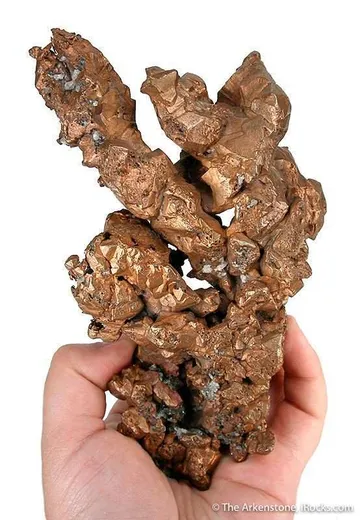
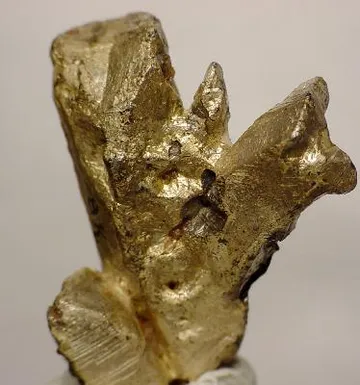
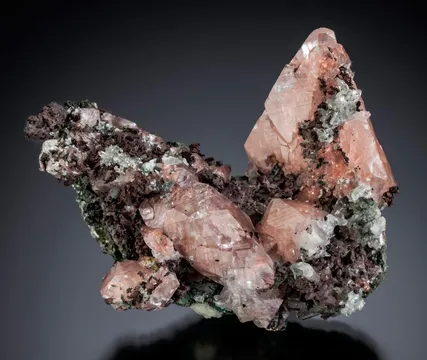
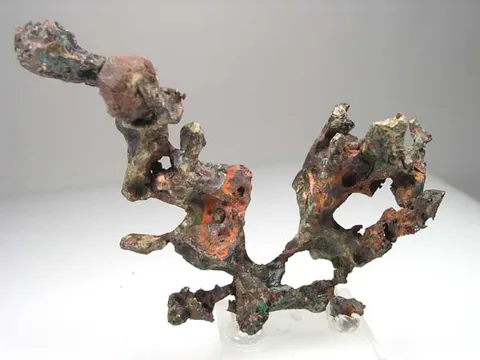
Specimen-wise, Centennial is best known for sculptural native copper, copper “skulls,” datolite nodules, silver, quartz, epidote, prehnite, and the rare secondary copper chlorides found as crusts and pocket coatings on basalt. The best copper pieces have the old Keweenaw virtues: three-dimensional architecture, ragged crystalline surfaces, antique reddish-brown patina, and enough basalt, quartz, epidote, or datolite association to fix them in the geological world rather than leaving them as anonymous metal. The best datolite is generally cut and polished, not because it needs improvement, but because Centennial’s prized material reveals itself inside: porcelain-white rims, green to blue-green zones from altered copper inclusions, and tight growth patterns that record the nodule’s botryoidal skin.
Regional View
Country View

Photo: Rob Lavinsky, iRocks.com, via Wikimedia Commons
A particularly useful way to understand Centennial is to think of it as both a mine and a collecting district in miniature. The numbered shafts matter. No. 2 is the name most often tied to good native copper and to the famous 1962 datolite recovery. Nos. 1 and 2 were long known to collectors for copper crystals, silver, datolite, quartz, and epidote, while Nos. 3 and 6 have been associated with copper “skulls” and occasional chlorastrolite-bearing material. The mine’s richest commercial ground and its most desirable specimens are not identical categories, but both reflect the same controls: open, permeable amygdaloid, copper deposition in cavities and replacement zones, and later oxidation or chloride-rich alteration in places where copper was exposed to reactive waters.

Search for specimens: View all specimens from Centennial Mine, USA
Centennial Mine is at Centennial Heights in Calumet Township, Houghton County, Michigan, near the north side of the old Calumet mining camp. Its coordinates are recorded near 47°15′30″ N, 88°25′43″ W. The mine was an underground copper operation developed by incline shafts, ultimately seven of them, following the copper-bearing beds down dip into the tilted Keweenawan volcanic pile.
The deposit type is the classic Lake Superior native-copper amygdaloid and conglomerate system. Centennial was not a sulfide mine in the ordinary sense; its ore metal was overwhelmingly native copper, deposited in vesicles, open seams, fractures, replacement patches, and porous breccia zones in basaltic lava flows and related clastic beds. The mine’s early and disappointing target was the Calumet & Hecla conglomerate, whose extraordinary richness immediately to the south at Calumet did not continue northward with equal value onto the Schoolcraft-Centennial ground. Later development turned to the Osceola Amygdaloid, and then to the Kearsarge Amygdaloid, where Centennial finally became part of one of the district’s important producing belts.
The Kearsarge lode at Centennial belongs to a flow horizon recognizable for its position above the Wolverine sandstone and for feldspar-porphyritic basalt near the flow top. In the main productive belt, the ore was chiefly in the lowest Kearsarge amygdaloid, while higher “west lodes” were locally copper-bearing but generally less important. At Centennial, a twelfth-level section recorded about 179 feet of Kearsarge trap and 6 feet of amygdaloid, with a total flow thickness near 185 feet; surface scaling gave about 170 feet. This places Centennial at the southern end of the main Kearsarge productive area, where the lode begins to thin and lose some of the thick, fragmental character that favored richer ore shoots farther along strike.
The internal character of the Kearsarge lode explains much of Centennial’s specimen style. The productive amygdaloid was not simply a uniform vesicular basalt. It included fragmental lode at the top, banded amygdaloid below or instead of it, and coarser “foot lode” toward the footwall. The fragmental lode was made of broken amygdaloid fragments, commonly from a fraction of an inch to several inches and rarely exceeding a foot, with the best-developed fragmental zones averaging perhaps 5 to 6 feet thick but locally reaching far greater widths. These broken, porous, oxidized flow-top rocks made excellent plumbing for mineralizing fluids; thin, tight, cellular or trappy amygdaloid was consistently poorer.
Alteration followed a sequence familiar to students of the Keweenaw. Early oxidation of the lode, probably connected with cooling of the lava rather than the later copper event, produced ferric-oxide-rich red rock, especially in fragmental portions. Later mineralization introduced or redistributed quartz, calcite, epidote, prehnite, pumpellyite, chlorite, feldspar, datolite, and native copper. Copper commonly bleached the red host rock around it, removing much of the hematitic color and leaving a light gray halo rich in quartz, epidote, pumpellyite, calcite, and feldspar. In the lower, less oxidized foot lode, copper was more likely to appear as amygdule filling and less as strong replacement masses.
Historically, the property began as the Schoolcraft Mining Company, organized in 1863 to test what was believed to be the northern extension of the great Calumet conglomerate. The venture failed. By 1873 the Schoolcraft company was bankrupt, a ruinous outcome made all the more painful by its proximity to the fabulously successful Calumet & Hecla ground immediately to the south. The property was reorganized in 1876 as the Centennial Mining Company. In late 1880, the new company began work on the Osceola Amygdaloid, starting two shafts about 660 feet apart and opening levels and drifts before the mine’s focus shifted again.
In 1896 the enterprise was reorganized as the Centennial Copper Company. Work on the old conglomerate and Osceola targets was abandoned in favor of the Kearsarge Amygdaloid, and two new incline shafts were driven on that lode. Kearsarge production at Centennial is recorded beginning in 1904, the same year the company acquired the Point Mills stamp-mill property formerly associated with the Arcadian. From then until the early 1930s, Centennial was a real, steady Copper Country producer rather than merely a speculative neighbor of Calumet & Hecla. In 1909, the mine’s fine-copper production was reported at 2,583,000 pounds valued at $343,000.
Calumet & Hecla took control in 1923 and operated the mine until closure in 1931 during the Depression era. No. 2 shaft was reopened in 1944 and worked until 1966, when the mine closed permanently. Before Calumet & Hecla control, Centennial had produced approximately 37 million pounds of refined copper. Its later production under C&H belongs to the final working chapter of the Calumet district, when only a few of the old mines remained active and much of the region’s industrial world was already passing into history.
For collectors today, Centennial is no longer a casual open-pile locality in the way older guidebooks sometimes imply. The Nos. 1 and 2 piles have been heavily reduced by county use and removal of rock, and very little remains compared with the piles remembered by earlier collectors. No. 6 is privately owned and access is restricted. Any collecting should be treated as permission-only, with particular care around old mine openings, unstable foundations, buried hazards, contaminated mine waste, and active or restricted municipal property. The specimens now circulating are mostly old finds, pieces recovered from the dumps during periods of better access, or material that came out while the mine was still operating.
The most famous specimen find at Centennial is the 1962 datolite recovery from the No. 2 Shaft. The material came chiefly from the 48 level south, in stopes along a zone roughly 4,800 to 6,900 feet south of the shaft. Miners recovered about 700 pounds of datolite nodules from brownish-gray mud pockets, washing the nodules out with a water hose. The largest reported nodule was 12 inches in diameter and weighed 22 pounds; many were 3 to 6 inches across, while most averaged 1 to 2 inches. That single find is why Centennial datolite has such a recognizable place among Keweenaw lapidary and specimen collectors: white nodules, often cut and polished, stained or zoned green to blue-green by oxidized copper inclusions.
Native copper from Centennial is valued less for giant mass-copper romance than for sculptural, collectible pieces from the Kearsarge and related workings, especially material attributed to the No. 2 Shaft and to the old Nos. 1–2 piles. Good specimens are arborescent, jagged, or “skull”-like masses with bright copper exposed on high points or an old reddish to bronzed patina over crystalline surfaces; the best pieces retain basalt, quartz, epidote, calcite, prehnite, datolite, or rare blue secondary copper-chloride associations that make the locality more than a generic Michigan copper label. Documented examples include cabinet-size, well-crystallized copper from the north side of Centennial No. 2 “under the lode,” and the broader mine is known for copper crystals, native silver, and copper “skulls” from particular shaft areas. Ordinary pieces are flattened fragments, battered stamp-rock copper, or cleaned scraps without form or association; superior Centennial copper has three-dimensional architecture, crisp metal surfaces, honest patina, and, ideally, a shaft-specific provenance.
Centennial datolite is one of the mine’s signature collector minerals, especially the No. 2 Shaft nodules recovered in 1962 from the 48 level south, where miners washed roughly 700 pounds of nodules from brownish-gray mud pockets in stopes 4,800 to 6,900 feet south of the shaft. The typical desirable piece is a cut and polished nodule or slice with a porcelain-white rim and a green to blue-green interior or banding produced by oxidized copper inclusions; recorded nodules ranged from mostly 1–2 inches, through a fair number of 3–6 inch pieces, up to a reported 12-inch, 22-pound example. Uncut nodules show a knobby botryoidal exterior, but their value is usually judged by the polish: strength and evenness of color, sharp white-to-green zoning, density of copper specks, freedom from fractures, and a credible Centennial No. 2 provenance. Some 49 level south datolite was also found, but it is reported to have contained much less copper and is usually less visually dramatic.
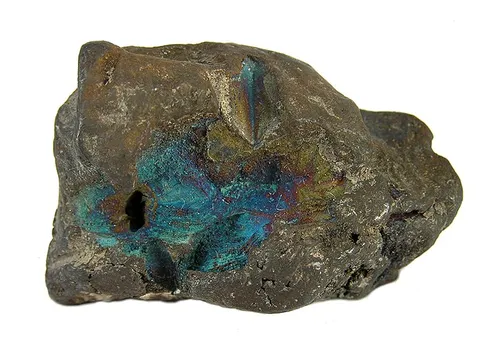
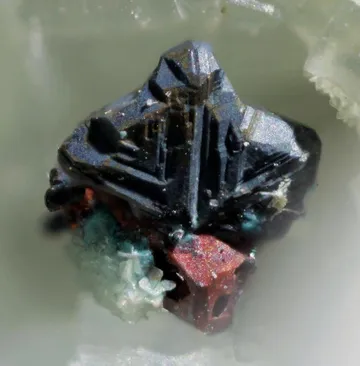
Centennial’s supporting mineral list is unusually interesting because it includes both common Keweenaw gangue and true rarities. Quartz, epidote, calcite, prehnite, pumpellyite-(Mg), chlorite-group minerals, laumontite, analcime, K-feldspar/adularia, and baryte occur with the copper-bearing basalt assemblage. Native silver is documented and is important when present with copper. Secondary copper minerals include cuprite, malachite, atacamite, paratacamite, chalcocite, chalconatronite, kinoite, buttgenbachite, hoganite, and the rare blue hydrous copper chlorides that made Centennial famous scientifically. Anthonyite, calumetite, and centennialite are all type-locality minerals here. Anthonyite occurs as tiny lavender to smoky-blue crystals and crusts, calumetite as brilliant azure to powder-blue scaly spherules and sheaves, and centennialite as pale to azure-blue chalky to botryoidal encrustations, commonly in intimate association with calumetite and atacamite-family minerals.
Centennial specimens reward careful provenance. “Centennial Mine” is a useful locality, but “Centennial No. 2 Shaft,” “Nos. 1 and 2 piles,” “No. 6,” or “48 level south” can be far more meaningful if supported by an old label, collection history, or credible chain of ownership. The mine worked several ore horizons over more than a century, so a shaft-specific label may say something real about geology, mineral association, and likely age of collection.
No widely documented cottage industry of deliberate Centennial fakes stands out, but the usual Michigan Copper Country problems apply. Native copper is easily cleaned, brightened, lacquered, artificially darkened, or given an “antique” patina; old lacquer can yellow or flake, and newly polished copper may look attractive but loses the surface information many advanced collectors prefer. Be wary of copper sold with only a romantic “Calumet” or “Keweenaw” tag but no mine provenance, especially if the form could have come from any of several famous copper mines. Conversely, genuine old Centennial pieces may look dark, dull, or rough because they have not been aggressively cleaned.
Datolite is often cut and polished, and for Centennial material that should not be considered a defect by itself. Polishing is the standard way the locality’s green-and-white internal structure is displayed. The concerns are different: look for repaired cracks, filled fractures, over-polished edges that obscure the original rind, mismatched halves, and labels that confuse Centennial material with visually similar greenish datolite from Isle Royale, Quincy, or other Keweenaw mines. Strongly colored Centennial No. 2 material with sharp blue-green copper-alteration banding, clean white borders, and a surviving knobby rind commands more attention than pale, fractured, or locality-ambiguous slices.
The rare copper chlorides require caution. Anthonyite, calumetite, and centennialite are collector-grade only under magnification in most cases, and visual identification is not enough for serious species claims. Anthonyite is particularly delicate: the original description noted dehydration and alteration after only a few weeks indoors. Calumetite proved more durable in the same early work, but all hydrous copper chlorides should be kept dry, cool, out of strong heat and direct sunlight, and away from repeated handling. Do not wash or acid-clean blue-green crusts on Centennial copper or basalt; what looks like dirt or verdigris may be the most scientifically important part of the specimen.
Condition standards vary by mineral. Copper can tolerate some contact marks if the sculptural form and patina are strong, but hammered, sawed, or tumbled edges lower collector interest. Datolite is judged like a lapidary specimen as much as a mineral specimen: polish quality, color, pattern, and crack-free surface are critical. Quartz-epidote pieces from Centennial are more conventional mineral specimens and should be judged for intact crystal faces, contrast, and freshness. Native silver, if present, should be protected from sulfide tarnish and excessive cleaning.
Availability is limited but not hopeless. Centennial copper and datolite appear regularly enough in older Michigan collections, online dealer inventories, and auction records that a patient collector can acquire representative pieces. Fine shaft-specific copper, richly colored No. 2 datolite from the 1962 recovery, and genuine type-locality rare-chloride specimens are much scarcer. Field collecting is now a poor strategy compared with buying well-documented old material: the best dump material was removed long ago, access has tightened, and the remaining exposures are far less productive than the locality’s reputation might suggest.
The first Centennial story is one of geological disappointment sharpened by geography. The property lay directly north of Calumet & Hecla, one of the great copper bonanzas of the world, and early promoters naturally hoped that the same Calumet conglomerate would carry its riches into the Schoolcraft ground. It did not. The Schoolcraft Mining Company organized in 1863, worked the conglomerate with zeal, and by 1873 was bankrupt. An 1883 account put the failure in brutal terms: the extension of the lode on the property proved “so utterly worthless” that the company was “entirely ruined.” That failure was not useless to the district; it helped define the limits of one of the world’s richest copper beds. But for investors and miners on the Centennial ground, it was an expensive lesson written in barren rock.
When the property was reborn as Centennial in 1876, hope shifted to other lodes. By late 1880, two shafts were started on the Osceola Amygdaloid, 660 feet apart. On the first level the shafts were connected, and No. 2 was advanced farther by drifting, winzes, and sinking. Four or five air drills were at work, making about 80 feet per month, while the old stamp mill was put back in order. The lode was described as bunchy; one crosscut showed it 24 feet wide. In that moment the mine was still more promise than production, with no stoping yet done and the work focused on opening ground, repairing buildings, and testing whether Centennial could finally become the mine its location had always promised.
The most vivid mineral-collector episode came much later, in 1962, deep in the No. 2 Shaft workings. On the 48 level south, miners entered stopes in a zone 4,800 to 6,900 feet south of the shaft and encountered brownish-gray “mud pockets” filled with datolite nodules. The recovery was not a romantic crystal-cave scene; it was practical underground mining. The miners used a water hose to wash the nodules out. In all they recovered about 700 pounds. Most were only 1 to 2 inches across, but many reached 3 to 6 inches, and the largest was a 12-inch nodule weighing 22 pounds. Once cut, these pieces showed why the find became famous: white datolite stained green to blue-green by oxidized copper inclusions, sometimes with a sharp internal line between rim and core. A little datolite was also found on the 49 level south, but it lacked much of the copper coloration that made the 48-level material so memorable.
The discovery of Centennial’s rare blue copper chlorides has a wonderfully unglamorous beginning. Robert H. Dean brought Sidney A. Williams a blue mineral specimen from Centennial that he believed was not azurite. It was “something unusual,” and he was right. Follow-up visits by Dean, Williams, and others revealed a small world of blue and green copper minerals that resisted quick identification. Because underground collecting was impossible at the time, the material was gathered by hurriedly searching through skips of ore in the headframe just before they were dumped. The new minerals apparently came from several areas between the 4000- and 5000-levels. From that hurried salvage work came the descriptions of anthonyite and calumetite, and decades later the reassessment that established centennialite as a new species tied to the same mine.
There is a nice irony in Centennial’s scientific afterlife. The mine that began as a failed attempt to continue the Calumet conglomerate became a type locality not because of its commercial ore grade but because of fragile blue crusts in basalt cavities and fractures. Anthonyite crystals were tiny, lavender prisms only fractions of a millimeter long; calumetite formed brilliant azure to powder-blue scaly spherules and sheaves. They were associated with native copper, cuprite, paratacamite, tremolite, quartz, epidote, monazite, and other minerals in the basalt. Williams concluded that these were not mere post-mining evaporites, but products of chlorine-bearing waters acting on copper, with cuprite as an intermediate stage. It is exactly the sort of mineralogical subtlety that makes an old copper mine more than an ore body.
Sidney A. Williams, “Anthonyite and Calumetite, Two New Minerals from the Michigan Copper District,” American Mineralogist, vol. 48, 1963, pp. 614–619. Original description of anthonyite and calumetite from Centennial Mine, including occurrence, chemistry, optical properties, associations, and the story of their discovery in ore skips. https://msaweb.org/msa/Collectors_Corner/arc/anthonyite.htm
W. A. Crichton and H. Müller, “Centennialite, CaCu3(OH)6Cl2·nH2O, n ≈ 0.7, a New Kapellasite-Like Species, and a Reassessment of Calumetite,” Mineralogical Magazine, vol. 81, no. 5, 2017, pp. 1105–1124. Establishes centennialite as a new mineral named for Centennial Mine and revisits the relationship between centennialite and calumetite. https://rruff.info/uploads/MM81_1105.pdf
Handbook of Mineralogy, “Centennialite, CaCu3(OH)6Cl2·nH2O, n ≈ 0.7.” Concise mineral data sheet with occurrence, association, type material, and analytical summary; lists type material at the Mineralogical Museum, University of Arizona, Tucson, and the Mineralogy Museum, School of Mines, Paris. https://www.handbookofmineralogy.org/pdfs/centennialite.pdf
George W. Robinson, update of E. W. Heinrich, Mineralogy of Michigan, A. E. Seaman Mineral Museum, Michigan Technological University, 2004. The Seaman Museum datolite sheet drawn from this work records the Centennial No. 2 Shaft datolite occurrence, the 1962 recovery, the 48 level south source, the 700-pound total, and the largest reported 22-pound nodule. https://museum.mtu.edu/pdfs/DATOLITE.pdf
B. S. Butler and W. S. Burbank, The Copper Deposits of Michigan, U.S. Geological Survey Professional Paper 144, 1929. Essential geologic treatment of the Michigan native-copper lodes, including the Kearsarge lode, its flow stratigraphy, alteration, ore controls, and the role of thick fragmental amygdaloid in richer ground. https://www.michigan.gov/-/media/Project/Websites/egle/Documents/Programs/GRMD/Catalog/09/GIMDL-USGSPP144H.PDF
History of the Upper Peninsula of Michigan, 1883, Houghton County section. Contemporary historical account of the Centennial Copper Mining Company, its Schoolcraft predecessor, the early Osceola Amygdaloid work, equipment, labor force, officers, and the economic disappointment of the Calumet conglomerate extension. https://www.houghton.migenweb.org/1883HistUpperPenin/pages256-264.html
Wikimedia Commons file record for a Centennial Mine datolite nodule, 6.7 x 4.5 x 1.8 cm, photographed by Rob Lavinsky and described as ex Frank Henderson and Seaman Museum collections; the record notes that Henderson donated his collection to the Seaman Museum in 1978. https://commons.wikimedia.org/wiki/File:Datolite-120401.jpg
Wikimedia Commons file record for a sculptural native copper specimen from the Centennial No. 2 Shaft, 11.75 x 7.75 x 4.3 cm, photographed by Rob Lavinsky, with an old label placing it on the north side of Centennial No. 2 “under the lode.” https://commons.wikimedia.org/wiki/File:Copper-20134.jpg
Mindat: Centennial Mine, Centennial Heights, Calumet Township, Houghton County, Michigan, USA — The core locality page, with coordinates, mineral list, type-locality status, history, production note, and collecting comments.
Mindat: No. 2 Shaft, Centennial Mine — Shaft-specific locality page for the most important Centennial specimen source, including copper, silver, datolite, and calumetite records.
Mindat: No. 6 Shaft, Centennial Mine — Useful long-form shaft history, including the Schoolcraft period, the multiple lodes tested, and the deep No. 3 shaft reference preserved in older literature.
Michigan Technological University Keweenaw Geoheritage: Centennial — Concise geosite note on Centennial No. 6 and the deep, dipping conglomerate workings near Calumet.
A. E. Seaman Mineral Museum: Datolite PDF — Best concise source for Centennial No. 2 datolite, including the 1962 recovery details and the size range of the nodules.
A. E. Seaman Mineral Museum: Calumetite PDF — Museum mineral sheet on calumetite, the rare blue type-locality copper chloride first described from Centennial.
Mineralogical Society of America: Anthonyite and Calumetite from Michigan — Online text of Sidney A. Williams’s original 1963 description of anthonyite and calumetite.
Handbook of Mineralogy: Centennialite PDF — Compact reference for centennialite chemistry, occurrence, association, and type material.
RRUFF: Crichton and Müller 2017 Centennialite paper — Full paper describing centennialite and reassessing calumetite.
USGS Professional Paper 144: The Copper Deposits of Michigan — Foundational geological reference for the Keweenaw native-copper district and the Kearsarge lode.
1883 History of the Upper Peninsula of Michigan: Houghton County — Period source for the early Centennial Copper Mining Company and its Schoolcraft predecessor.
MichiganRailroads.com: Centennial Mine, Centennial Heights, MI — Compact historical summary with operating dates, ownership sequence, shaft count, railroad connections, and production note.
Wikimedia Commons: Category Centennial Mine — Image category containing Centennial mineral photography and coordinate information.